BMW’s ‘Lifetime’ Transmission Fluid Is a Myth — ZF 8HP Service Guide (F30, G20)
Here is the honest answer to the BMW ZF 8HP transmission fluid change interval question: every 50,000–75,000 miles or 8 years — that is what ZF, the company that designed and built the gearbox, recommends. BMW’s official stance is a “lifetime fill” with no scheduled change. Both positions come from the same engineering reality: the fluid is fine for the life of the transmission as BMW defines it — which is not the same lifetime as the 150,000+ miles an enthusiast plans to keep the car.
This guide reconciles both claims using ZF’s actual published documents (not forum rumors), maps the interval to how you drive, breaks down what a real ZF 8HP service includes, and covers the differences between the F30’s 8HP45 and the G20’s 8HP50/51. It sits in our Maintenance & DIY hub, alongside the 3 Series maintenance schedule and the battery registration guide — the other procedure that requires telling your BMW’s computers what you just did.
The short answer
The BMW ZF 8HP transmission fluid change interval is 50,000–75,000 miles or 8 years, per ZF’s service guidance — a fluid and filter (pan) change using ZF LifeguardFluid 8 or an approved equivalent. BMW calls it a “lifetime fill” and lists no change in the maintenance schedule, but “lifetime” means BMW’s definition of normal operating conditions, not yours. If you drive hard, tow, sit in traffic in a hot climate, or plan to keep the car past 100,000 miles, service it at 50,000–60,000 miles. Neglect it and the shifts degrade — until the repair bill dwarfs what a service would have cost.
In this guide
- The “lifetime fill” myth: what BMW says vs what ZF says
- When to service: the interval decision table
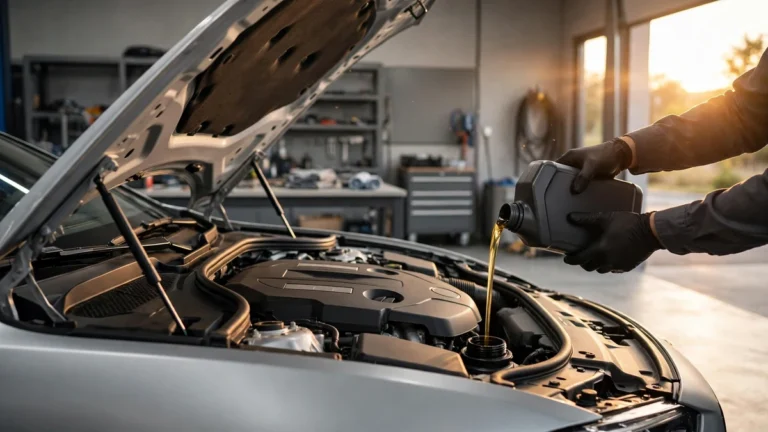
- What’s actually in a ZF 8HP service
- F30 8HP45 vs G20 8HP50/51: what changes
- The service procedure, step by step
- What it costs: DIY kit vs independent shop vs dealer
- Find your interval: driving-style picker
- Symptoms of neglected transmission fluid
- The verdict
- Frequently asked questions
The “lifetime fill” myth: what BMW says vs what ZF says
BMW’s position is the one your owner’s manual reflects. BMW’s service documentation describes the automatic transmission as factory-filled with long-term-rated fluid that “does not need to be changed except when necessary during repairs to the transmission” — wording from the maintenance and warranty booklet (2014 edition). There is no CBS reminder and no maintenance-booklet entry for a transmission fluid change on the F30 or G20: as far as BMW’s schedule is concerned, the service does not exist.
Now ZF’s position — and here is where the tension gets honest, because ZF’s own documents are more nuanced than the forums suggest. ZF’s official lubricant list (TE-ML 11, 2019 edition) says its 5-, 6-, 8- and 9-speed transmissions are filled maintenance-free for normal operating conditions — but carves out an explicit exception: under above-average conditions (frequent high-speed freeway driving, sporty driving, trailer operation), it recommends refreshing the oil every 100,000 km (~62,000 miles) or no later than 8 years. Separately, ZF’s oil-change-kit service information (03/2022) frames the change under demanding use at 80,000–120,000 km (50,000–75,000 miles) or 8 years, depending on driving style.
The popular shorthand — “ZF says 50–75k miles or 8 years” — is how FCP Euro’s definitive ZF 8-speed guide summarizes the kit-literature guidance, and it is the number the specialist world has standardized around. FCP Euro is blunt about the contradiction, noting that the automakers’ lifetime claims directly conflict with what ZF publishes — and attributing the motive to emissions and waste-reduction accounting rather than engineering.
Reconciling it honestly: there is no contradiction if you read carefully. ZF calls the fill maintenance-free under normal conditions — but defines “normal” the way a transmission engineer does. If you drive sportily, tow, run high-speed miles, or keep the car past 100,000 miles, you are in ZF’s “above-average conditions” category and should change the fluid. BMW’s “lifetime” assumes average use and a shorter ownership horizon. Trust the gearbox maker for the way you actually drive.
When to service: the interval decision table
The right interval is a function of heat and load — the two things that age ATF. Pick the row that matches how the car actually gets driven:
| How you drive | Recommended interval | Source / confidence |
|---|---|---|
| Easy highway commuter — steady cruising, mild climate | 75,000 miles or 8 years | ZF kit literature (80,000–120,000 km). High confidence — the manufacturer’s own window. |
| Mixed daily driving — commuting plus weekend back roads | 60,000–75,000 miles or 8 years | Midpoint of ZF’s stated range; matches specialist consensus. High confidence. |
| Sporty, tuned, towing, hot climate, heavy stop-and-go | 50,000–60,000 miles or 8 years | ZF TE-ML 11 severe-use guidance (100,000 km / 8 years); specialists tighten it for heat and tunes. High-medium confidence. |
| 8 years since last service, any driving style | Service now, regardless of miles | The time-based cap appears in both ZF documents. High confidence. |
| 100,000+ miles on the original fill | Specialist judgment first | No universal guidance — see the high-mileage callout below. Medium confidence. |
Two boundary rules hold across every row: time counts like miles — an 8-year-old garage queen at 40,000 miles still needs the service, because additive depletion does not care about the odometer. And the clock resets per service: after the first change, the next one is another 50,000–75,000 miles or 8 years, not “done forever.”
What’s actually in a ZF 8HP service
A proper 8HP service is not a “flush” — it is a drain, pan/filter replacement, and temperature-set refill. Here is what the job includes and why each part matters:
- New transmission oil pan with integrated filter. On the 8HP, the filter is bonded into the plastic pan — one part, replaced together. This is why the service costs more than a fluid swap, and why it matters: a fresh pan is a fresh filter.
- Fresh pan bolts. Kits include new bolts; ZF’s service information specifies tightening them crosswise from the center outward to the manufacturer’s torque values.
- ZF LifeguardFluid 8 (or approved equivalent). The fluid ZF engineered for the gearbox — roughly 6 liters total capacity per FCP Euro’s spec data, though a single drain removes only part of it (the torque converter and cooler retain the rest). Never substitute generic “multi-vehicle” ATF.
- A temperature-set fluid level check. The 8HP has no dipstick. The correct level is set with the engine running and the fluid inside ZF’s 30–50 °C window — underfilled is as dangerous as overfilled.
- (While you are in there) The mechatronic sleeve. FCP Euro’s guide flags the sealing sleeve where the wiring harness enters the transmission: if it fails, ATF reaches the electrical connections, causing dash warnings and shifting faults. It is inexpensive and only accessible with the pan off, so specialists replace it preventively.
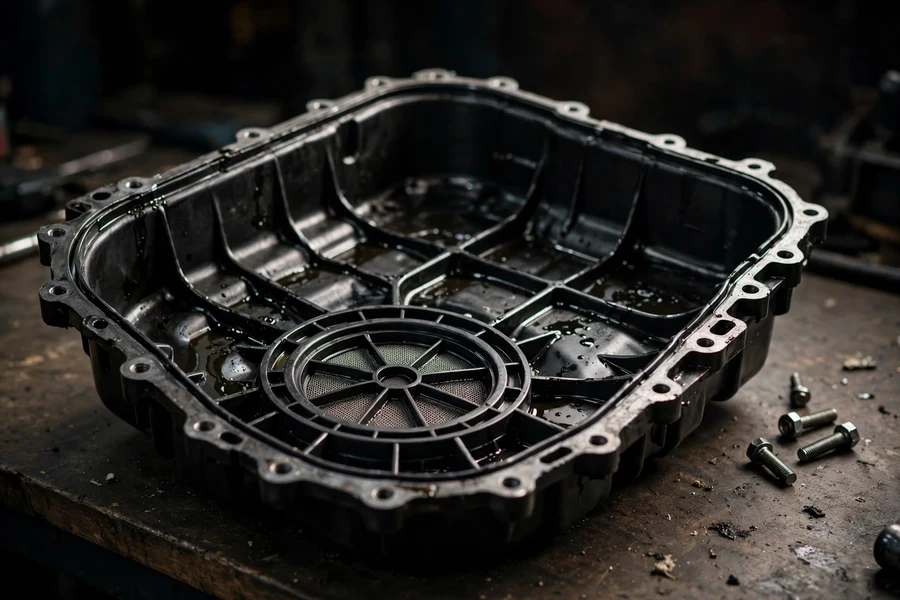
Do not flush a ZF 8HP. Pressure-flush machines and their detergents have no place in this gearbox — ZF’s procedure is a drain-and-fill with the correct fluid, nothing more. Owners who want a deeper exchange repeat the drain-and-fill at the next oil change rather than force-flushing.
F30 8HP45 vs G20 8HP50/51: what changes
The procedure is the same; the hardware generations differ. The F30 uses the first-generation 8HP (the 8HP45); the G20 moved to the second and third generations (8HP50 and 8HP51). Here is what that means when ordering parts:
The original 8HP — and the one most DIY guides were written for. The 8HP45 debuted in 2009, rated to 450 Nm (332 lb-ft); BMW’s internal designation is GA8HP45Z.
- Fluid: ZF LifeguardFluid 8 — same spec as every later generation.
- Pan/filter: plastic pan with integrated filter, same concept as later units, but generation-specific — order by VIN, not by assumption.
- Level setting: ZF’s 30–50 °C window with the engine running: cycle through P, R, D, then D1 and D2 held about 10 seconds each, per ZF’s oil-change-kit service information.
- BMW’s own procedure: BMW’s ISTA diagnostic calls this a “transmission control unit: oil adjustment” service function, performed with an initial fluid temperature of 30–40 °C rising to 40–50 °C — one more reason a BMW-capable scan tool belongs on the shopping list.
- Kit fitment: complete kits (pan/filter, fluid, bolts) are widely available — FCP Euro’s BMW 8HP service kit covers 8HP45 applications including the 228i, 320i, 328i and more.
The refined generations — same service, tighter electronics. The 8HP50 (2nd generation, 500 Nm / 369 lb-ft) and 8HP51 (3rd generation, also 500 Nm, with mild-hybrid variants) add wider ratio spreads and lower internal drag. FCP Euro’s spec data confirms both still take ZF LifeguardFluid 8.
- Fluid: ZF LifeguardFluid 8 — unchanged across all three generations.
- Pan/filter: same integrated pan/filter concept, but physically different from the 8HP45 unit — not interchangeable, so VIN-confirmed parts are essential.
- Level setting: same ZF 30–50 °C temperature-set procedure; BMW’s ISTA oil-adjustment service function applies here too.
- Adaptations: after a G20 service, a transmission adaptation reset (via ISTA or equivalent BMW-capable tool) lets the gearbox relearn shift pressures against the fresh fluid — shops performing G-chassis 8HP services list it as standard.
- Kit fitment: complete 8HP50/51 kits are available from the same suppliers — confirm 8HP50 vs 8HP51 by VIN before ordering.
The service procedure, step by step
This is an overview of ZF’s oil-change-kit service procedure (Service Information 03/2022) — enough to understand the job and audit a shop’s quote, not a substitute for the full document.
- Verify the variant and stage the parts. Confirm 8HP45 vs 8HP50/51 by VIN, and have the complete kit (pan/filter, fluid, bolts) plus a fluid transfer pump and a way to read transmission temperature.
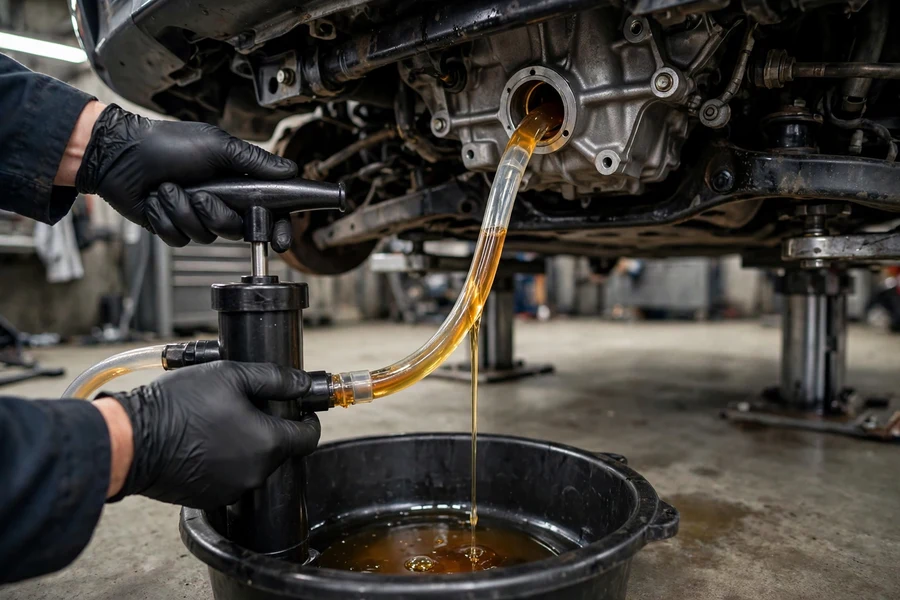
- Level the car and drain. The vehicle must be level — the fill is temperature-set, and a tilted car sets a wrong level. Remove the drain plug and drain the pan.
- Remove the old pan and filter. Unbolt the plastic pan (the filter is bonded inside it). Inspect the pan’s magnets: a smooth metallic paste is normal wear; chunks or large flakes warrant a specialist’s diagnosis before continuing.
- Install the new pan. Fit the new pan/filter with fresh bolts, tightened crosswise from the center outward to the manufacturer’s torque values. Replace the mechatronic sleeve while access is open if it shows seepage.
- Initial fill, engine off. Add ZF LifeguardFluid 8 through the fill hole until fluid runs out, then reinstall the plug.
- Start the engine and fill the torque converter. With the engine running, hold 2,000 rpm for about 30 seconds to fill the torque converter, then return to idle.
- Cycle the gears. Engine still running: select P, R, and D, then manually shift through D1 and D2, holding each about 10 seconds so every circuit fills.
- Set the level in the temperature window. With the fluid between 30 °C and 50 °C and the engine running, open the fill plug: add fluid until it runs out, then wait until only single drops fall before closing the plug. If the temperature passes 50 °C, let it cool and restart the check.
- Check for leaks and reset adaptations. Verify the pan and fittings are dry, then reset the transmission adaptations with a BMW-capable scan tool so shift pressures relearn against the new fluid.
The three ways this job goes wrong: an unlevel car, a fill outside the 30–50 °C window, and the wrong fluid — multi-vehicle ATF is not ZF LifeguardFluid 8. If a shop cannot describe the temperature-set fill, it is not the shop for this job.
What it costs: DIY kit vs independent shop vs dealer
Parts are fixed; labor is the variable. The kit costs the same whether you buy it yourself or a shop marks it up — what changes is who performs the temperature-set fill.
| Route | Typical cost | What it includes & confidence |
|---|---|---|
| DIY | ~$270–$320 | Complete kit (pan/filter, ~7L ZF fluid, bolts) — FCP Euro’s BMW 8HP kit is listed at $270.92. High confidence on parts cost; add a fluid pump and temperature-capable scan tool if you don’t own them. |
| Independent BMW specialist | ~$450–$750 | Parts plus 1–2 hours of labor. Owner reports include ~$600 at a California independent shop and a $599 flat-rate 8HP service advertised for G-chassis cars. Medium confidence — varies by market. |
| BMW dealer | ~$750–$1,100+ | Dealer parts pricing plus ~$200/hour labor. Owner reports include $740 for a gearbox oil change; one owner was quoted $1,100 for transmission plus differential fluids together. Medium confidence — some dealers decline the job, citing the lifetime-fill policy. |
A practical middle path: buy the kit yourself and bring it to an independent BMW specialist for labor — owners report shops doing the job for a few hundred dollars in labor when parts are supplied. Note the dealer’s awkward position: BMW’s official stance is lifetime fill, so some dealers perform the service on request while others decline it outright — which is exactly why independent BMW shops own this job.
Find your interval: driving-style picker
The tables above give the framework; this is the short version. Pick the driving style that matches you for the recommended service point:
Service at 75,000 miles or 8 years.
- You are the closest thing to ZF’s “normal operating conditions” — steady speeds, moderate temperatures, no tune.
- Use the upper end of ZF’s 80,000–120,000 km window; the 8-year time cap still applies at low miles.
- A second service at 150,000 miles keeps a long-keeper fresh.
Service at 60,000–75,000 miles or 8 years.
- Most owners live here: commuting with traffic, weekend back roads, the occasional mountain run.
- Split ZF’s range — 60,000 for traffic-heavy or hot-summer commutes, 75,000 for mostly open highway.
- Pair it with another major service (cooling refresh, spark plugs) to save a shop trip.
Service at 50,000–60,000 miles or 8 years.
- This is ZF’s TE-ML 11 “above-average conditions” category exactly: sporty driving, tunes, towing, high-speed runs, hot climates, heavy stop-and-go.
- A tuned car running extra torque belongs at the bottom of the range — heat is the fluid’s worst enemy.
- Track-day owners should watch fluid condition alongside the interval.
Symptoms of neglected transmission fluid
The 8HP’s signature trick is invisible shifts; if you can suddenly feel every gear change, something has degraded. Full list:
- Delayed engagement — a pause or clunk selecting Drive or Reverse from a stop.
- Harsh or hesitant shifts — the box you used to never notice is now impossible to ignore.
- Shift flares — the engine revs between gears, especially on light-throttle upshifts.
- Shuddering under load — vibration through the drivetrain during acceleration, often mistaken for an engine issue.
- Gear hunting — shuffling between gears at steady cruise where it used to hold one.
- Visible leaks — red or brown fluid under the car. Documented leak points: the oil cooler O-rings (fluid running down from above the pan) and the mechatronic sleeve (ATF at the wiring-harness connection, usually with dash warnings).
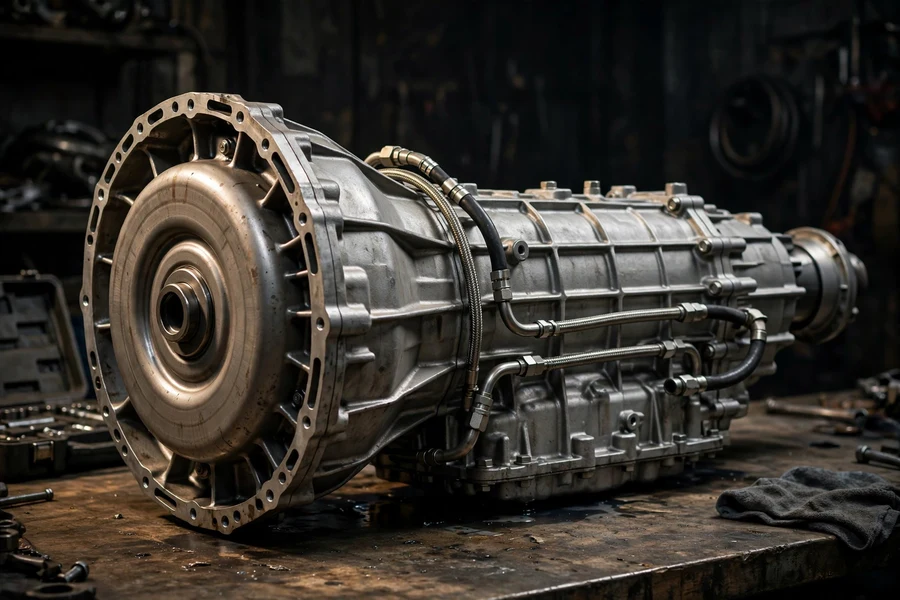
Symptoms already present? Diagnose before you service. A fluid change restores a gearbox that is merely dirty — it does not rebuild a damaged one. If shifts are severely harsh, gears slip, or warnings are active, get a specialist diagnosis first: it distinguishes “needs a service” from “needs a mechatronic or rebuild,” and fresh fluid in a failing gearbox can make it worse. High-mileage, never-serviced boxes with no symptoms are the debatable middle ground — most specialists still favor a gentle drain-and-fill with the correct fluid, never a flush, while watching closely for the first 500 miles.
The verdict
“Lifetime fill” is a marketing definition, not an engineering one. ZF — the company that built your gearbox — publishes a service window of 50,000–75,000 miles or 8 years and spells out exactly which driving conditions trigger the shorter end. If you drive gently and trade cars every four years, BMW’s stance costs you nothing. If you drive hard, tow, tune, or keep the car past 100,000 miles, a $270 parts kit (or $450–$750 at a specialist) is the cheapest insurance you can buy for a transmission that costs thousands to replace.
The job pairs naturally with a 100,000-mile refresh: fold it into the 3 Series maintenance schedule, and if you are already under the car with a scan tool, the battery registration guide covers the other BMW job that requires telling the car’s computers what you just did. For both chassis in full, see the complete 3 Series guide.
Frequently asked questions
The 50,000–75,000 mile / 8-year window and the 30–50 °C temperature-set fill come from ZF’s published documents (TE-ML 11, 2019 edition; 8HP oil-change-kit service information, 03/2022), summarized in FCP Euro’s ZF 8-speed guide. BMW’s “lifetime fill” position reflects its maintenance and warranty booklet, which prescribes no scheduled transmission fluid change. Kit pricing is from FCP Euro’s live product page; shop and dealer figures are owner-reported ranges and vary by market (medium confidence). Generation specs (8HP45 450 Nm; 8HP50/51 500 Nm; LifeguardFluid 8 throughout) are from FCP Euro’s spec data. No 2025–2026 class action specifically targeting the ZF 8HP “lifetime fluid” claim could be verified — the recently reported BMW lifetime-fluid suits concern front-differential fluid on X5/X6/X7 models — so none is cited. Last verified: September 2026.