How to Check BMW 3 Series Oil Level (No Dipstick)
Short answer: Checking the BMW 3 Series oil level is electronic-only — no E90, F30, or G20 has a physical dipstick. Warm the engine with at least 6 miles / 10 km of driving, park on level ground, and run the measurement from the dashboard: iDrive (Vehicle Info → Vehicle status → Engine oil level) or the BC stalk on non-iDrive E90s. Add oil only when the car asks for it, and never more than the indicated amount — the min-to-max span is about 1 quart.
In this guide
- Does any BMW 3 Series have a dipstick?
- The electronic dipstick: how it actually works
- Step-by-step: checking oil on E90, F30, and G20
- Conditions for an accurate measurement
- Which method does my 3 Series use?
- What each oil-level reading means
- How often to check the oil
- Adding oil: which oil and how much
- When to worry: stuck readings, dashes, and sensor faults
- Oil level check FAQ
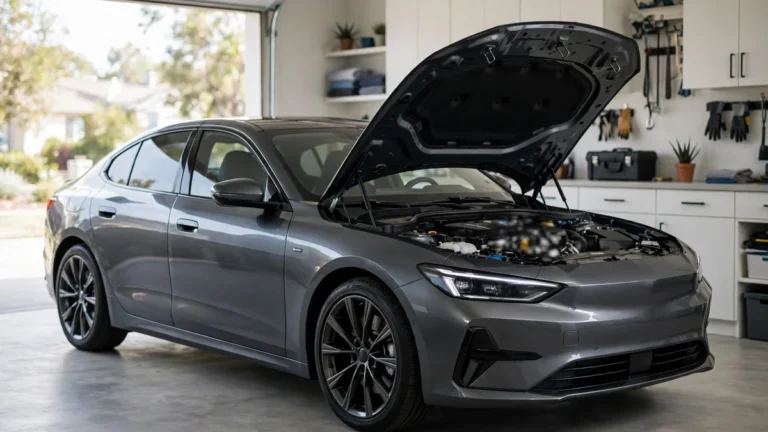
The first time a new BMW 3 Series owner pops the hood looking for the oil dipstick, the experience is the same every time: there is nothing to pull out. No yellow loop, no guide tube — just an empty spot where one used to be. Owners routinely spend ten minutes combing the engine bay before it dawns on them that the dipstick lives in the dashboard, not under the hood.
BMW removed the physical dipstick from the 3 Series with the E90 generation, replacing it with an oil condition and level sensor in the sump that reports to the dashboard. Done right, the electronic check is arguably more consistent than a dipstick — no smeared readings, no guessing at a tilted stick. Done wrong, it gives you “no measurement available” and a blank stare. This guide covers the exact menu path for every generation, the conditions the sensor needs, what each display message means, and how to top up correctly when the car asks for oil.
Does any BMW 3 Series have a dipstick?
Let’s settle this first, because it is the single most-searched question on the topic and the most confidently answered incorrectly. No BMW 3 Series from the E90 generation onward has a physical engine-oil dipstick. BMW’s own technical documentation for the N52 engine — the engine in the E90 325i, 328i, and 330i — states it plainly: there is no dipstick or guide tube, and oil level is measured by the oil condition sensor and displayed in the central information display. The last 3 Series sold with a dipstick was the E46 (with the M54 engine); every 3 Series built since the E9x cars arrived in 2005–2006 is electronic-check only.
If you’ve read otherwise — some Q&A pages describe an E90 328i dipstick procedure — that information is wrong, contradicting both BMW’s documentation and thousands of owner confirmations. Stop looking for the dipstick: it doesn’t exist. What follows is what to use instead.
| Generation | Engines | Dipstick? | Check method |
|---|---|---|---|
| E90 / E91 / E92 / E93 (2006–2013) | N52, N54, N55 | No | iDrive: Info sources → Service Info → Service requirements → Engine oil level · Non-iDrive: BC stalk in the turn-signal lever (hold ≥2 sec) |
| F30 / F31 (2012–2019) | N20, N26, N55, B48 | No | iDrive: Vehicle Info → Vehicle status → Engine oil level; detailed measurement via “Measure engine oil level” → “Start measurement” on equipped engines |
| G20 (2019+) | B48, B58 | No | iDrive 7: CAR → Vehicle status → Engine oil level; detailed measurement via “Engine oil measurement” → “Start measurement” |
The electronic dipstick: how it actually works
The component doing the job of the dipstick is the oil condition sensor (OZS), a sensor in the bottom of the oil pan that measures the oil level continuously while you drive and reports it to the engine control unit (DME). The DME then shows the result in the instrument cluster or the central information display. The sensor also tracks oil condition — temperature and dielectric properties — which feeds the condition-based service calculations behind your oil change interval.
Two characteristics of the system matter more than anything else. First, the display has slack: it reads full or “O.K.” anywhere within roughly the top quart of the scale, and only prompts you to add oil once the level has fallen about a quart below maximum. Don’t expect it to track small gradual drops the way a dipstick would. Second, the reading lags behind reality: after an oil change or top-up, the display can take up to about 30 minutes of driving to update. Resist the urge to keep adding oil because the display hasn’t moved — overfilling is a real hazard.
It’s worth being honest about what the system can’t do. A dipstick lets you see oil color and feel for grit; the electronic sensor tells you nothing about the oil’s condition in any way you can sense. That’s why the car tracks mileage and time for service intervals independently — don’t extend your change interval just because the level still reads O.K. Level is one number; the oil’s age is another.
Step-by-step: checking oil on E90, F30, and G20
Find your generation below and follow the path exactly. Every method assumes a fully warm engine — see the conditions section for why most failed measurements are a warmth problem.
E90 (2006–2013) — iDrive models
- Drive the car until the engine is fully warm — at least 6 miles / 10 km of uninterrupted driving is the BMW-manual threshold on this era of car.
- Park on level ground. The check works with the engine running, stopped or driving.
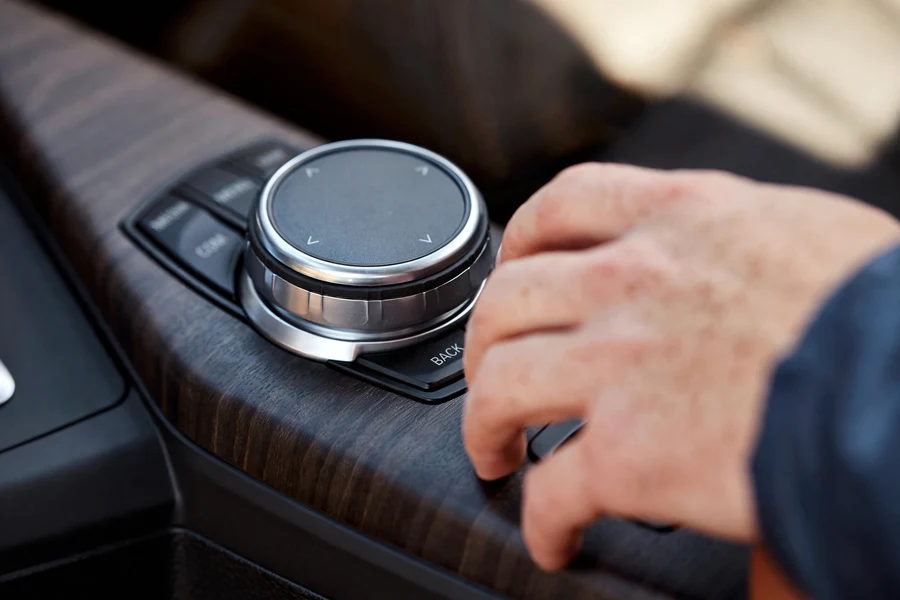
- Press the iDrive controller’s menu button, then navigate: Info sources → Service / Service Info → Service requirements → Engine oil level.
- The display shows one of four states: “Engine oil level O.K.” · “No measurement available: Updating…” (wait ~1 min at idle or ~5 min of driving) · “Oil level at the minimum! Refill with 1 quart.” · “Engine oil level too high.”
E90 (2006–2013) — cars without iDrive (BC stalk)
No iDrive doesn’t mean no oil check — the instrument cluster handles it through the turn-signal stalk.
- Warm the engine as above and idle on level ground.
- Press the BC button on the turn-signal lever repeatedly until the oil-level display appears in the instrument cluster.
- Press and hold the BC button for at least 2 seconds. A clock symbol appears while the measurement runs — about one minute.
- Possible displays: “Oil level OK” · “Oil level at minimum: add max 1 US quart / 1 liter” · “Oil level at maximum” · “Oil level too high” · “No value can be determined” — the engine isn’t warm enough yet; a cold engine can show dashes (“-.-“) instead of a reading.
F30 (2012–2019)
- Quick status check: the car monitors oil level electronically while you drive, so the fastest “check” is often just looking: “Vehicle Info” → “Vehicle status” → “Engine oil level.” Note that a current measured value needs roughly 30 minutes of driving to refresh; on shorter trips the display shows the last long trip’s value. If the level reaches minimum, a Check Control message appears on its own — the car will tell you.
- Detailed measurement (available on certain engines only): park on level ground with the engine at operating temperature and running. For manual cars, select neutral; for automatics, N or P — and don’t touch the accelerator.
- Navigate: “Vehicle Info” → “Vehicle status” → “Engine oil level” → “Measure engine oil level” → “Start measurement.”
- The measurement takes about one minute, and the result appears as a scale showing where the level sits between min and max.
G20 (2019+) — iDrive 7
- Ensure the engine is at operating temperature, with roughly 30 minutes of normal driving behind it for a current measured value. With frequent short trips, the display shows the last sufficiently long trip’s value — this is normal behavior, not a fault.
- Navigate: “CAR” → “Vehicle status” → “Engine oil level.”
- For a detailed measurement: “Engine oil level” → “Engine oil measurement” → “Start measurement.”
- BMW’s instruction for the G20 is explicit and worth repeating verbatim in spirit: only add oil when the message is displayed in the instrument cluster, and the quantity to be added is indicated in the message. Park and switch the engine off before adding oil.
Conditions for an accurate measurement
More electronic oil checks “fail” because of conditions than because of faults. The sensor would rather show “no measurement available” than give you a bad number. Before suspecting a problem, run through this checklist — every item is a BMW-manual requirement, not folklore:
- Engine at operating temperature. The single most common cause of failed measurements. E90-era cars need at least 6 miles / 10 km of uninterrupted driving; F30 and G20 cars need roughly 30 minutes of normal driving for a current value. A quick drive around the block is not enough.
- Level ground. The sensor measures the height of the oil surface in the sump — park on any meaningful slope and the reading is fiction.
- Engine running for the detailed/idle measurement.
- Transmission in N or P (F30 detailed measurement), accelerator untouched — revving sloshes the sump and confuses the sensor.
- Patience after topping up. The display will not move immediately; BMW allows up to ~30 minutes of driving, and under ~0.5 quart / 0.5 liter may not register at all. Never stack a second top-up onto the first.
If you’ve met all five conditions and still get “no measurement available,” something else is going on — see the when to worry section. But in practice, roughly nine times out of ten the answer is a short trip on a cold engine or a sloped driveway.
Which method does my 3 Series use?
Pick your generation, engine, and whether the car has iDrive — the picker returns the exact check method, the conditions it needs, and what to do when the display stays blank.
Find your oil-check method
Select your car below to get the exact read procedure for it.
Choose your generation above to get the exact steps for your car.
What each oil-level reading means
The electronic dipstick speaks in a small vocabulary of messages. The difference between “add 1 quart” and “too high” is the difference between a two-minute top-up and a shop visit:
| Display message | What it means | What to do |
|---|---|---|
| “Engine oil level O.K.” / “Oil level OK” | Level is within range — the display reads “full” anywhere within roughly the top quart of the scale. | Nothing. Recheck at your next scheduled check. |
| “Oil level at the minimum: add max 1 US quart / 1 liter” | Level has fallen about a quart below maximum — roughly the whole min-to-max span. | Add up to the indicated amount, never more. If it asks again soon, the car has a consumption or leak problem — see below. |
| “No measurement available: Updating engine oil level measurement…” | The sensor is still measuring: about a minute at idle, or roughly five minutes of driving. | Wait. If it persists after a full warm-up on level ground, work through the conditions checklist. |
| “No value can be determined” / dashes (“-.-“) | Usually a cold engine — the E90 BC-stalk method shows dashes when the oil isn’t up to temperature. | Drive longer until fully warm, then retry on level ground. Persistent dashes point to a failed sensor. |
| “Engine oil level too high” / “Oil level too high” | Overfilled. Too much oil can foam, foul the catalytic converter, and damage seals. | Don’t drive hard. Have the excess drained at a shop — BMW’s manuals are explicit that excess oil damages the engine. |
| Check Control “add engine oil” warning | Same as the minimum message; on newer cars the cluster states the exact quantity to add. | Per the F30 manual, add oil within 125 miles / 200 km — “otherwise, the engine may be damaged.” Add only the indicated quantity. |
How often to check the oil
BMW’s manuals give no mileage interval for checking oil — the F30 manual simply says to check regularly, suggesting “after refueling” as the habit. You stop for fuel every few hundred miles anyway, and a check takes ninety seconds on a warm engine.
Owner and specialist consensus goes a little further, and it’s worth following on these particular cars: check monthly or every 1,000 miles, whichever comes first — and tighten that habit on N20, N55, and B48 cars with known consumption, or on any 3 Series past 60,000 miles. These engines can consume oil at rates that surprise owners coming from Japanese cars, and the electronic display’s built-in slack means it won’t nag you about the first half-quart. Our oil consumption guide explains which engines are most affected and what “normal” consumption looks like.
Three moments always deserve a check regardless of schedule: before any long trip, after any “add oil” message (on your next long drive, to confirm the top-up registered and see whether the level is already falling again), and when evaluating a used 3 Series — checking the oil on a warm test drive tells you whether the seller kept up with it. Fold it into the broader 3 Series maintenance schedule, paired with the coolant-level check — the two fluids most likely to need attention between services.
Adding oil: which oil and how much
Topping up is the easy part — one rule governs everything: only add what the car asks for. When the message says “add 1 quart,” you add one quart. Not “a quart and a bit to be safe.” The electronic scale’s min-to-max span is about 1 US quart (1 liter), so the indicated quantity fills it to the top without overshooting.
- Park on level ground and switch the engine off.
- Open the oil filler cap (counterclockwise).
- Add no more than the quantity the message indicates — at most 1 US quart / 1 liter. Add at least 0.5 quart / 0.5 liter so the sensor registers it.
- Close the cap and drive. Give the sensor up to ~30 minutes to update — do not add more because the display hasn’t changed.
- Never exceed the maximum. “Oil level too high” means the excess has to be drained.
Which oil to use
BMW’s viscosity grades for these engines are SAE 0W-40, 0W-30, 5W-40, and 5W-30, meeting the BMW LL-01 specification (US) — LL-04 in Europe. Do not use oil additives: BMW’s manuals state plainly that additives may lead to engine damage. For viscosities, approved products, and change intervals, see our oil change interval and oil spec guide rather than repeating it all here.
Oil capacities (for reference at change time)
If you’re topping up after a DIY oil change and want to know how much the engine holds in total, these are the commonly cited fill capacities. Treat them as starting points and always confirm against your owner’s manual’s technical-data section before pouring — published figures vary, particularly on the B-series engines:
| Engine | Commonly cited capacity (with filter) | Note |
|---|---|---|
| N52 (E90) | 6.5 L / ~7 qt | Multiple owner sources and operating-manual references agree. |
| N54 / N55 (E90, F30) | 6.5 L | Quoted from BMW technical information by owners. |
| N20 (F30) | 5.0 L | DIY guides pour slightly under, then top up to full via iDrive — the recommended approach. |
| B48 (F30 LCI, G20) | 5.25 L | Commonly cited figure; one forum reply claims 6.5 L — unverified. Check your owner’s manual. |
| B58 (F30, G20) | 6.5 L | Widely reported by owners; still verify against the manual. |
When to worry: stuck readings, dashes, and sensor faults
Before you blame the sensor, re-run the conditions checklist: fully warm engine, level ground, engine running, no throttle input. If all four are genuinely met and the display still won’t give a credible reading, you’re in diagnosis territory.
The reading never updates after topping up
First, the innocent explanations. The display updates slowly: after a top-up, BMW allows up to about 30 minutes of driving before the new value registers, and an addition under roughly 0.5 quart / 0.5 liter may not register at all — the sensor’s slack swallows small top-ups. Add the indicated amount, drive normally, and re-evaluate after a proper trip. Stacking a second quart onto the first because the display hasn’t moved is exactly how overfills happen.
Persistent dashes or “no value can be determined”
If the display shows dashes or “no value can be determined” after a full warm-up on level ground, across multiple drives, the likely cause is the oil condition/level sensor itself. BMW’s service information documents this — SI B12 05 19 covers fault 1C4110, “oil level sensor: malfunction” — and BMW’s diagnostic software (ISTA) has a dedicated “Engine oil quantity check” service function for it. A dead sensor is a recognized, diagnosable failure with its own factory test routine, not a mystery.
The sensor is a wear item with age: specialists report failures becoming common as these cars pass the ten-year mark, and the symptom is exactly what you’d expect — readings that never update, greyed-out displays, or implausible values. If the reading is stuck, scan for 1C4110 with a BMW-capable tool — a basic OBD2 reader may not see manufacturer-specific faults, so this is where the right scan tool earns its keep.
The level keeps dropping between checks
A falling level is the sensor doing its job — the problem is whatever’s removing the oil. Some consumption is normal on high-mileage N20, N55, and B48 cars; our oil consumption guide draws the line between acceptable and excessive. If the drops are faster than consumption explains, suspect a leak — the oil filter housing gasket tops the suspect list on N52/N54/N55 cars (see our oil leaks guide). And if oil loss comes with coolant issues, the reliability-by-year breakdown shows which model years are most prone to the combination.
Oil level check FAQ
Where is the oil dipstick on a BMW 3 Series?
There isn’t one. No BMW 3 Series from the E90 generation onward (2006+) has a physical engine-oil dipstick. BMW’s own N52 engine documentation states there is no dipstick or guide tube — the oil condition sensor in the sump measures the level and displays it on the dashboard. The last 3 Series with a dipstick was the E46.
Why does my BMW say no engine oil measurement available?
The sensor needs a fully warm engine (at least 6 miles / 10 km of uninterrupted driving on E90-era cars, ~30 minutes of driving for a current F30/G20 reading), level ground, and the engine running for the detailed measurement. Meet all three and retry. If the message persists across multiple properly-warmed drives, the oil condition sensor may have failed — BMW documents this as fault 1C4110.
How much oil should I add when my BMW says oil level at minimum?
Add no more than the quantity the message indicates — at most 1 US quart / 1 liter, roughly the whole min-to-max span of the electronic scale. Add at least 0.5 quart / 0.5 liter so the sensor registers the top-up. Use BMW LL-01 spec oil (SAE 0W-40, 0W-30, 5W-40, or 5W-30), and never exceed the maximum — excess oil damages the engine.
Can I check the BMW oil level with the engine off or cold?
The detailed measurement needs the engine warm and running. F30 and G20 cars also show a passive status value while driving, but it only refreshes after ~30 minutes of normal driving — shorter trips show the last long trip’s value. A cold engine shows dashes or “no value can be determined” instead of a reading.
My BMW oil level hasn’t moved after adding oil — is the sensor broken?
Probably not — the display lags. BMW allows up to ~30 minutes of driving for a new measurement to register, and additions under ~0.5 quart / 0.5 liter may not register at all. Drive normally and recheck; don’t keep adding oil chasing the display or you’ll overfill. If the reading never updates across multiple long drives, the sensor may have failed with age (BMW fault 1C4110).
The electronic dipstick is one of those BMW changes that felt like a loss at first and turned out to be mostly fine once you learn the ritual: warm engine, level ground, engine running, the exact menu path for your generation. Build it into your routine alongside the maintenance schedule: check monthly or every 1,000 miles, verify on the next long drive after any top-up, and let the oil change interval guide handle the question of when the oil itself needs attention. And if this is your first deep dive into the car, the complete BMW 3 Series guide maps every other system the same way.