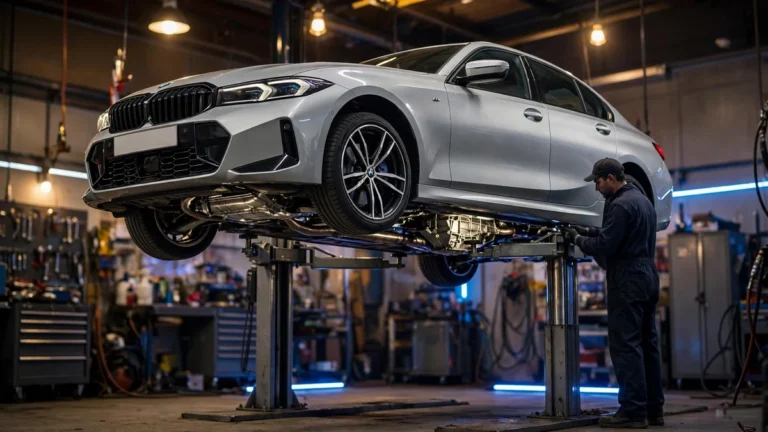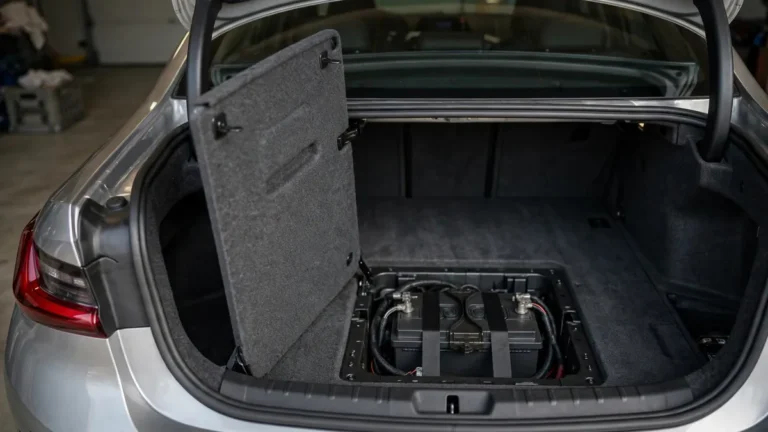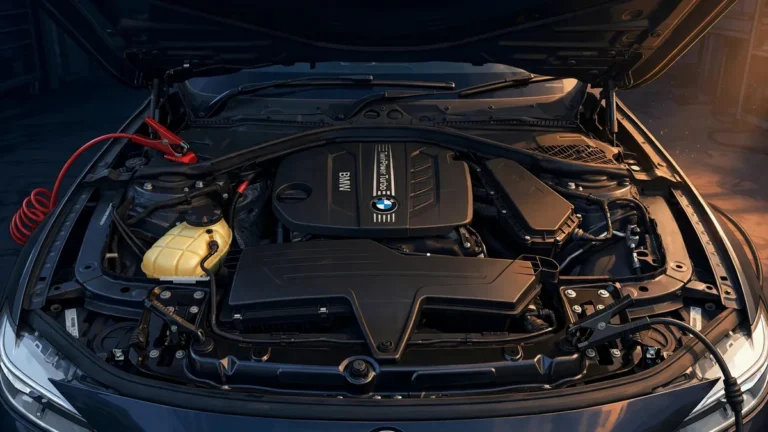
BMW 3 Series Coolant Type: Blue (G48) vs Green (HT-12)
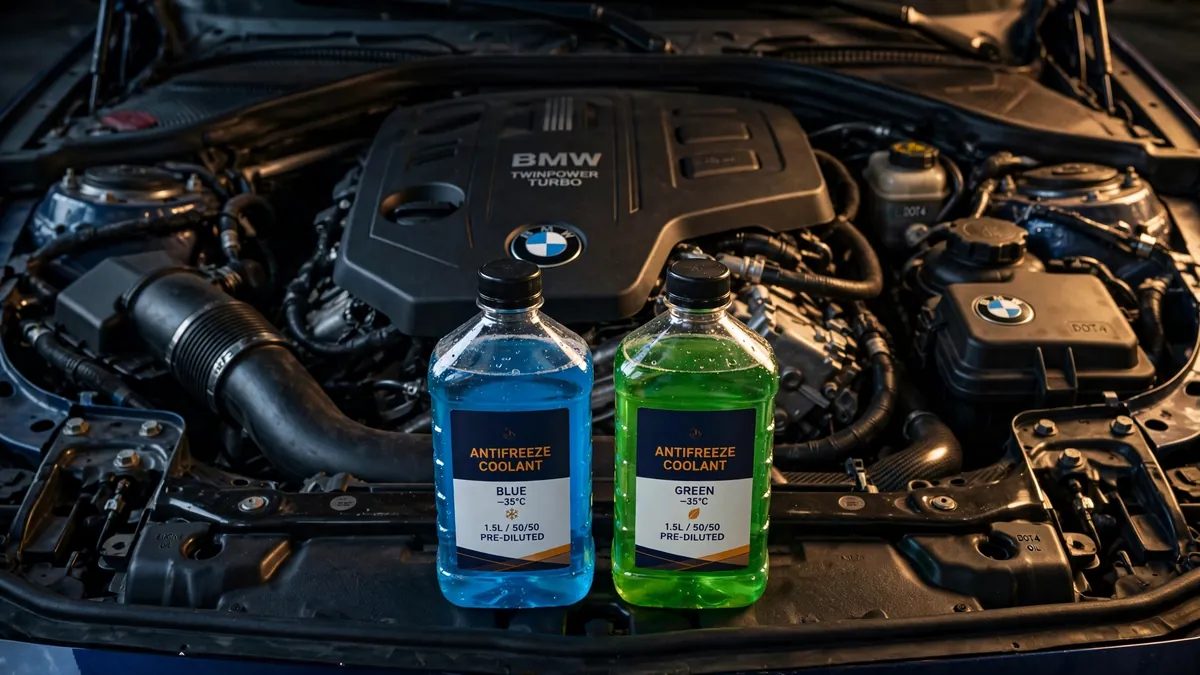
Put the wrong coolant in your BMW 3 Series and you won’t notice anything — at first. The damage shows up months later as degraded corrosion protection inside the cooling system. BMW changed its factory-fill coolant midway through the 3 Series’ life, so “blue” and “green” are both correct answers — for different cars. Getting it right takes about two minutes once you know your car’s production date.
This guide covers exactly which antifreeze your E90, F30, or G20 takes, the one-way mixing rule most sources get wrong, how much coolant each engine holds, how to top off and bleed the system by generation, and what to buy. Everything here sits in the Maintenance & DIY hub.
The short answer
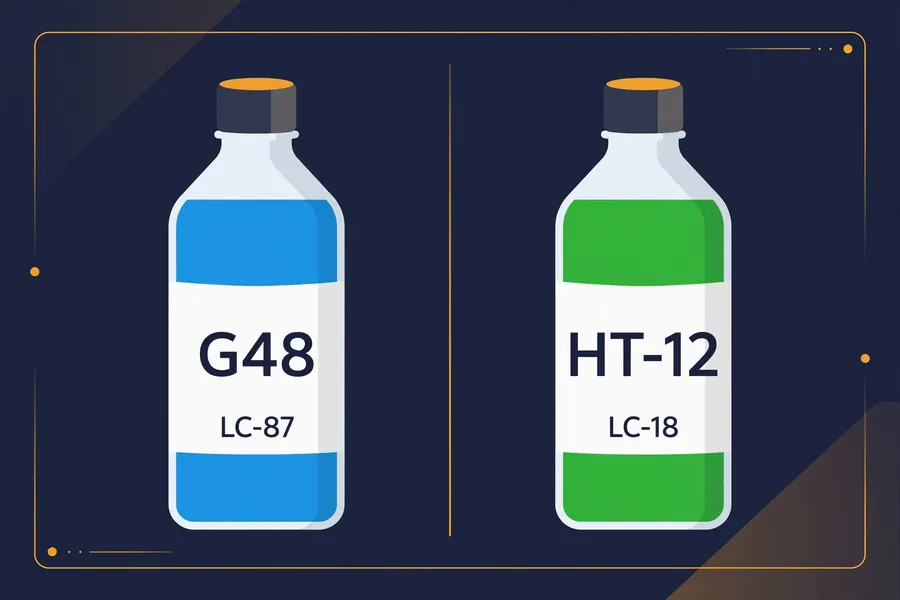
BMW 3 Series models built before mid-2018 use blue BMW antifreeze/coolant (G48, spec LC-87, part 82 14 1 467 704); models built from late 2018 onward — including the G20 — use green BMW HT-12 (spec LC-18, part 83 19 2 468 442). Match your factory fill using your production date and owner’s manual, not color alone.
The critical rule: HT-12 may top off a G48-filled system, but G48 must never go into a car factory-filled with HT-12. Details below.
In this guide
- Which coolant does my 3 Series take? (interactive)
- BMW G48 vs HT-12: what’s actually different
- Can you mix blue and green BMW coolant?
- How much coolant does a 3 Series hold?
- The two-reservoir surprise on turbo models
- How to top off coolant safely
- Bleeding the cooling system by generation
- How often should you change it?
- Troubleshooting: warnings, leaks, and brown coolant
- What to buy
- Frequently asked questions
Which coolant does my 3 Series take?
Select your generation. The changeover happened during 2018, so late F30s need a production-date check — the finder walks you through it.
Spec: BMW G48 (LC-87) — blue, no exceptions.
Part number: 82 14 1 467 704 (1-gallon concentrate).
Factory fill: every E90-generation 3 Series (325i, 328i, 330i, 335i, including E91/E92/E93) left the factory with blue G48. There is no ambiguity for this generation.
Cooling layout: single cooling circuit — one expansion tank, one system to check.
Confirm it: your owner’s manual lists the coolant spec, and what’s in the tank should be blue. If a previous owner put something else in, a drain and refill with G48 is the clean fix.
Spec: BMW G48 (LC-87) — blue — for builds through about mid-2018.
Transition warning: very late 2018 F30 builds may be factory-filled with green HT-12. Model year alone is not definitive for these cars.
How to check (3 steps):
- Read the production date on the sticker in the driver’s door jamb.
- Check the coolant spec in your owner’s manual.
- Look at what’s actually in the tank — and match the spec label/part number, not just the color.
Part numbers: G48 82 14 1 467 704 · HT-12 83 19 2 468 442.
Note: F30 LCI models with B-series engines (330i B48, 340i B58) have two cooling circuits — see the two-reservoir section below.
Spec: BMW HT-12 (LC-18) — green — from production start (early 2019 builds onward).
Part number: 83 19 2 468 442 (1-gallon concentrate).
Factory fill: every G20 3 Series was factory-filled with HT-12. Never use G48 in a G20 — the factory-fill rule below explains why.
Cooling layout: B48/B58 turbo engines run two independent circuits (high-temp engine + low-temp charge-air), each with its own reservoir. Check and top off both.
BMW G48 vs HT-12: what’s actually different
They’re both ethylene-glycol antifreeze, but the corrosion-inhibitor chemistry differs — that’s why the specs aren’t interchangeable by color:
| G48 (blue) | HT-12 (green) | |
|---|---|---|
| BMW spec | LC-87 | LC-18 |
| Chemistry | HOAT — silicated ethylene glycol | Si-OAT ethylene glycol |
| Color in the bottle | Blue / blue-green | Green (US); early EU Frostox HT-12 was magenta/rose |
| 1-gal concentrate part # | 82 14 1 467 704 | 83 19 2 468 442 |
| Factory fill | 3 Series built before ~mid-2018 | 3 Series built ~late 2018 onward; all G20 |
One more color warning: if the coolant in your tank is brown, rusty, or an unidentifiable murk, that’s not a third spec — it’s neglected or contaminated coolant. Drain, flush, and refill with the correct spec (see the troubleshooting section).
Can you mix blue and green BMW coolant?
This is where most of the internet contradicts itself. The accurate answer, per BMW as quoted by OEM parts suppliers, is a one-way rule — not a flat yes or no:
| Your car’s factory fill | Adding HT-12 | Adding G48 |
|---|---|---|
| G48 (blue) | ✅ OK — BMW permits HT-12 in G48-filled systems | ✅ OK — same spec |
| HT-12 (green) | ✅ OK — same spec | ❌ NEVER — G48 must not go into HT-12 factory-fill cars |
In practice: if you own a pre-2018 car (G48) and can only find HT-12 on the shelf, topping off with HT-12 is acceptable per BMW. If you own a 2019+ car (HT-12) and someone offers you blue G48 — decline. And if you simply don’t know what’s in the car, match the factory fill from your production date and owner’s manual rather than gambling on the matrix.
⚠️ The rule that matters: HT-12 may be used in a cooling system currently filled with G48, but G48 must never be used in a vehicle originally factory-filled with HT-12. When topping off, use the same spec as your factory fill wherever possible — the matrix above is for emergencies and shelf-availability, not routine practice.
How much coolant does a 3 Series hold?
Published capacities are surprisingly hard to pin down — BMW’s own documentation is the only fully authoritative source, and forums quote figures of varying quality. The table below gives the best available figures with confidence labels, so you know which numbers to trust:
| Engine | Total system capacity | Confidence & source note |
|---|---|---|
| E90 N52 (325i / 328i / 330i) | ~10 L | Medium — Bentley procedure (sourced from an E60 N52 document; treat as approximate for E90) |
| E90 N54 (335i) | 8.2 L (manual) 8.4 L (automatic) | Medium — ALLDATA via e90post |
| G20 B48 (330i) | 4.2 L low-temp circuit + 9.8 L high-temp circuit | Low — CarAraC; needs BMW TIS confirmation |
| G20 B58 (M340i) | 4.5 L low-temp circuit + 10.5 L high-temp circuit | Low — CarAraC; needs BMW TIS confirmation |
| F30 N20 / N26 (328i) | — | No citable figure found — verify via VIN parts catalog or ISTA |
A useful distinction: dry-fill capacity (a completely empty system, e.g. after engine work) is higher than what a drain-and-refill takes, because a simple drain leaves coolant trapped in the block, heater core, and hoses. Don’t buy fluid by the table alone — buy a gallon of concentrate, mix 50:50 as needed, and fill to the mark.
The two-reservoir surprise on turbo models
If you drive a B-series turbo 3 Series — F30 LCI 330i (B48), 340i (B58), or any G20 — your car has two independent cooling circuits, each with its own reservoir:
- High-temperature circuit — cools the engine itself (the familiar one).
- Low-temperature circuit — cools the charge air (turbo intercooler loop), running much cooler.
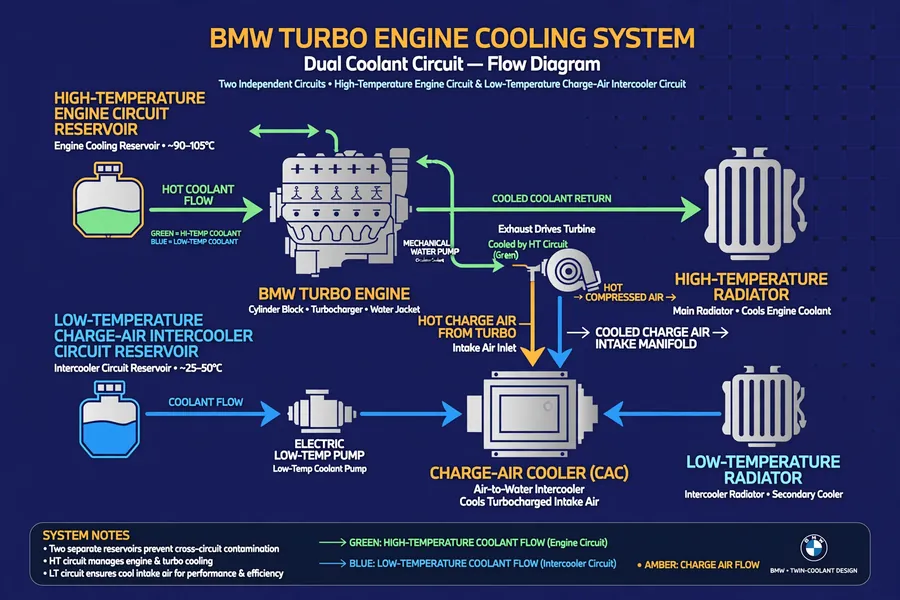
Why this matters: the two circuits must be topped off and bled separately. A full main reservoir tells you nothing about the low-temp circuit — check both caps, and don’t let one run low while the other looks fine. Almost no competitor guide explains this; now you know.
How to top off coolant safely
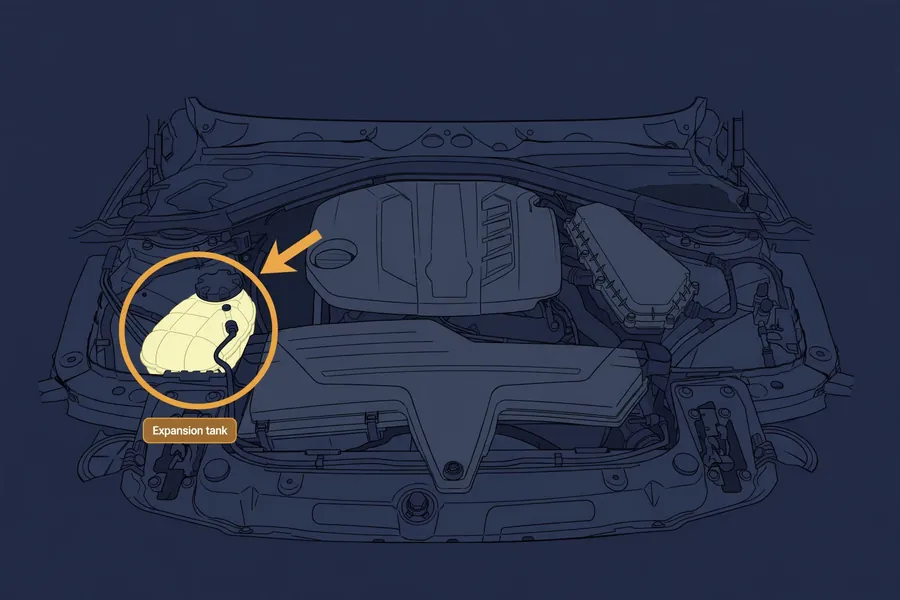
- Cold engine only. Never open the cooling system hot — it’s pressurized and the coolant can scald. Wait at least an hour after driving; the tank should feel cool to the touch.
- Find the expansion tank and read the level against the MIN/MAX marks on its side.
- Match your factory-fill spec (G48 or HT-12) using the finder above — not the color in the tank.
- Mix concentrate 50:50 with distilled or demineralized water. Use premix exactly as it comes — never dilute premix further, and never use tap water (minerals cause deposits).
- Fill to the MAX mark, not above it. Overfilling leaves no room for thermal expansion.
- Cap it securely and wipe any spills — coolant is toxic to pets and has a sweet smell that attracts them.
- On B-series turbo cars, repeat for the second reservoir.
Dilution calculator: 50:50 mix
Buying concentrate? Enter how many liters of 50:50 mix you need and get the exact split:
Bleeding the cooling system by generation
After any drain, refill, or major top-off, air trapped in the system causes repeat low-coolant warnings and poor heater performance. The bleed procedure depends on your generation — there is no single universal method:
E-series and F-series: electric water-pump self-bleed
- Ignition ON, engine OFF.
- Set the heater to maximum temperature and the blower to its lowest speed.
- Press the accelerator pedal fully to the floor and hold for about 10 seconds.
- The electric water pump now runs its bleed cycle — roughly 12 minutes. Do not open the expansion tank during the cycle.
- When the pump stops, check the level and top off to MAX with 50:50 mix.
G-series: vacuum fill (BMW technical procedure)
BMW’s technical documentation specifies vacuum filling for G-series cars — “watering-can” filling is explicitly not permitted, and an ISTA bleed routine runs after the refill. In practice this means a proper G20 coolant service needs a vacuum filler (or a shop that has one). Topping off a low reservoir is still a DIY job; a full drain-and-refill is best left to a BMW specialist with the right equipment.
Golden rule for every generation: if the low-coolant warning keeps coming back after you top off, you almost certainly have an airlock — re-bleed properly rather than pouring in more coolant.
How often should you change it?
Ask five sources, get five answers. Here’s who says what — presented as a comparison, because no single number is “the” answer:
| Who | Recommendation |
|---|---|
| BMW (technical documentation) | “Lifetime filling” — replace only after cooling-system repairs; never reuse drained coolant |
| BASF / Glysantin (inhibitor maker) | Every 3–4 years — corrosion inhibitors deplete over time |
| Generic retailers | Every 2 years / 30,000 miles |
| Aftermarket marketers | Up to 5 years / 150,000–250,000 km |
| Our practical advice | Check level and condition yearly; replace every 4–5 years as preventative practice |
Our take: BMW’s “lifetime” assumes ideal conditions, but corrosion inhibitors genuinely degrade — the company that makes them says 3–4 years. Inspecting the level and color yearly and replacing every 4–5 years (or sooner if it’s discolored) is cheap insurance against the cooling-system failures these cars are known for.
Troubleshooting: warnings, leaks, and brown coolant
- False low-coolant warning with a full tank. The usual suspect is the level sensor in the expansion tank — its contacts corrode and it reads low when it isn’t. Owners have fixed this by cleaning the sensor contacts; the sensor is integral to the tank, so if cleaning fails, a replacement tank comes with a new sensor.
- F30 expansion-tank cracks. The plastic tank degrades with heat cycles and cracks — a known leak point on the F30. Coolant residue around the tank seams or mounting points is the telltale.
- Warning returns right after topping off. That’s an airlock, not a leak. Re-bleed using the procedure for your generation above — ideally a vacuum fill — instead of pouring in more coolant.
- Brown or rusty coolant. That’s neglected or contaminated fluid, not a third coolant type. Drain, flush, and refill with the correct spec for your car.
- Coolant loss with no visible leak. Could be a slow weep from a hose, the water pump, or — worst case — internal consumption. This crosses from “which coolant” into diagnosis territory.
If your warning is about losing coolant rather than choosing it, our BMW 3 Series low-coolant warning guide walks through causes ranked by generation, the “can I keep driving?” decision, and what each fix costs. And if a CBS service reminder popped up alongside the warning, here’s how to reset the BMW service light once the work is done.
What to buy
Buy the spec, not the color. These are the genuine BMW part numbers — the surest way to get the right chemistry:
| Product | BMW part number | For |
|---|---|---|
| BMW Antifreeze/Coolant G48 1-gallon concentrate | 82 14 1 467 704 | Blue — 3 Series built before ~mid-2018 |
| BMW Antifreeze/Coolant G48 1-liter bottle | 82 14 2 209 769 | Same G48 spec, smaller bottle |
| BMW HT-12 Antifreeze/Coolant 1-gallon concentrate | 83 19 2 468 442 | Green — 3 Series built ~late 2018 onward, all G20 |
Aftermarket options (Valvoline/Zerex G-48 and HT-12, PEAK, Prestone) claim compatibility — the safe editorial line is: only use an aftermarket coolant that meets the exact BMW spec (LC-87 or LC-18) and matches your car’s factory-fill chemistry. When in doubt, the genuine bottle removes all doubt.
Frequently asked questions
Specs and part numbers cross-checked against BMW technical documentation, OEM parts suppliers, and owner-community sources. Where sources disagree — service intervals, transition dates, system capacities — this guide presents the disagreement honestly with confidence labels rather than picking one number. Last verified: September 2026.