How to Jump Start a BMW 3 Series: Use the Hood Terminals, Not the Trunk Battery
Your BMW 3 Series has a dead battery and there’s no battery under the hood — because on every modern 3 Series (E90, F30, G20), the battery lives in the trunk. This confuses almost every owner the first time it happens, and guessing wrong here is expensive: clamping jumper cables directly to the trunk battery can fry control modules and turn a free jump start into a four-figure repair bill.
This guide shows how to jump start BMW 3 Series cars the correct way: powering the car through the dedicated jump terminals under the hood. You’ll get the exact cable order from BMW’s own owner’s manual, the terminal locations for the E90, F30 and G20, jump-pack versus donor-car guidance, what to do after the car starts, and the mistakes that damage BMWs. Everything here sits in the Maintenance & DIY hub.
The short answer
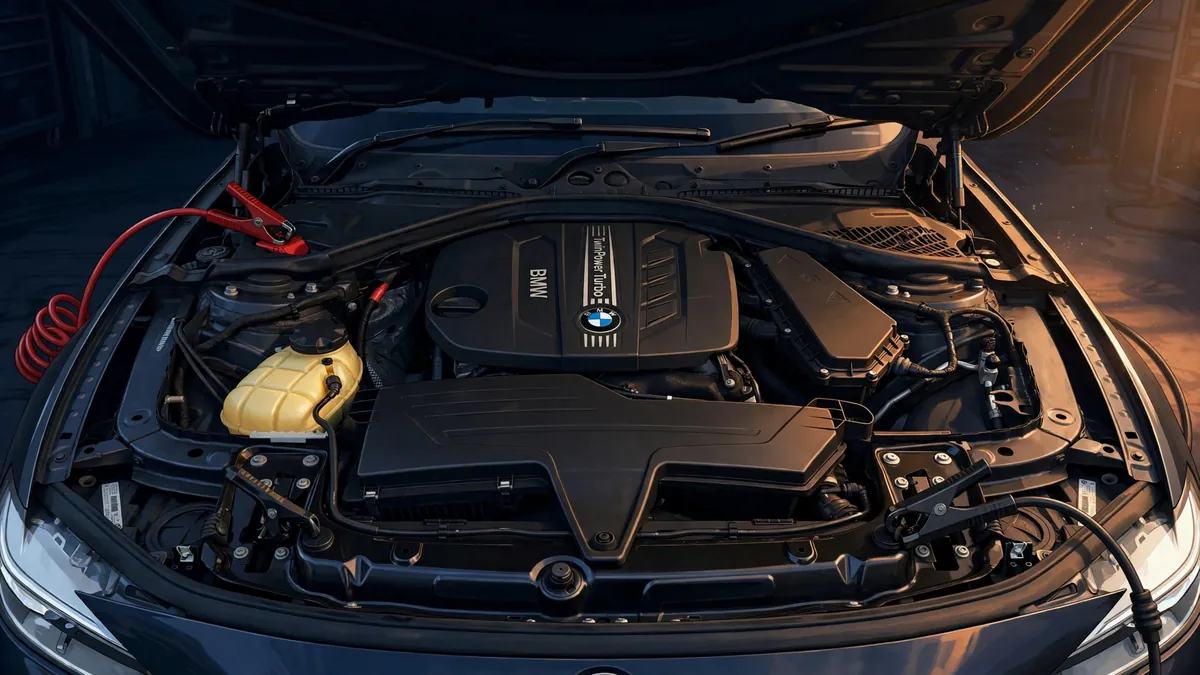
To jump start a BMW 3 Series, open the hood and use the under-hood terminals — never the trunk battery. Connect red to the + terminal under the red cover, the other red end to the donor’s + terminal, black to the donor’s − terminal, and the last black clamp to the BMW’s ground point. Start the donor, wait 2–3 minutes, then start the BMW.
In this guide
- Why the battery is in the trunk
- Find your jump terminals (interactive)
- Jump pack vs donor car
- Step-by-step with jumper cables
- Using a portable jump pack
- Disconnecting in reverse order
- What NEVER to do
- Locked out with a dead battery
- After the jump: the 30-minute rule
- It still won’t start?
- Frequently asked questions
Why your 3 Series battery lives in the trunk
Pop the hood of any E90, F30 or G20 and you’ll find no battery — it’s in the trunk, on the right side under the floor panel, beneath a plastic cover. BMW does this for two reasons: it pushes weight toward the rear for the near-50/50 balance BMW is famous for, and it keeps the battery away from engine-bay heat, which shortens battery life.
The trade-off is the Intelligent Battery Sensor (IBS): a module mounted on the battery’s negative terminal that monitors current flow so the car can manage charging precisely. Clamping jumper cables directly to the battery bypasses that sensor — which is exactly why BMW gives you dedicated jump terminals under the hood instead. Use them; they’re the engineered connection point, electrically closer to the starter and alternator.
Find your jump terminals
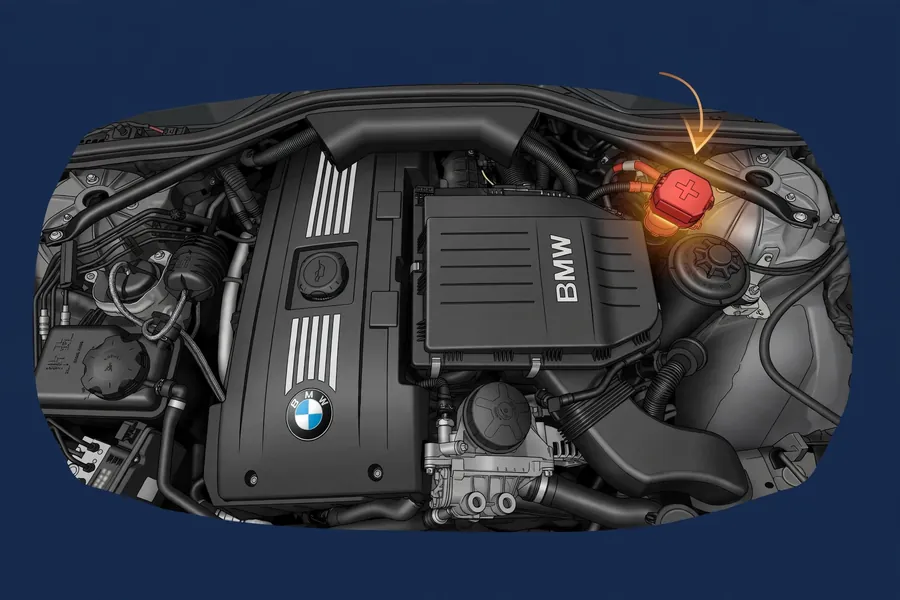
Pick your generation below. The honest news: BMW kept the same under-hood starting-aid layout across all three generations — positive terminal under a red “+” cover on the passenger side, ground post a few inches away near the strut tower. Learn it once and you’ll recognize it on any of them.
E90 (2006–2011)
- Pop the hood. On the passenger side of the engine bay, look for the red plastic cover marked “+”.
- Slide the red cover up to expose the positive jump terminal underneath.
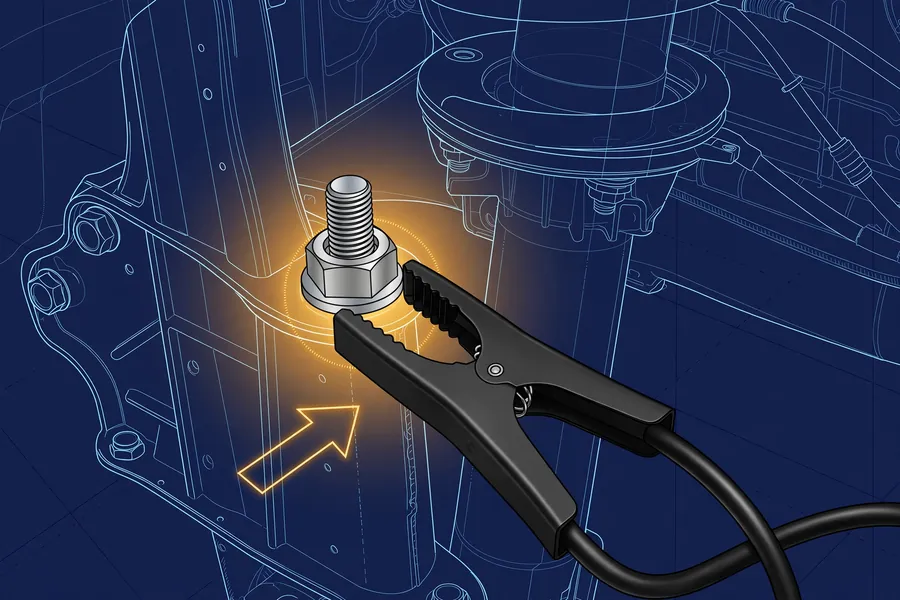
- A few inches away, near the strut tower, you’ll see the bare-metal ground post (a hex nut on a stud). That’s your negative point — not the trunk battery, not painted metal.
- This is the layout shown in the diagram above; the F30 and G20 kept it essentially unchanged.
F30 (2012–2018)
- Same as the E90: red “+” cover on the passenger side under the hood, ground post nearby.
- BMW’s own F31 (2014) owner’s manual describes the negative point this way: “The body ground or a special nut acts as the battery negative terminal.” That “special nut” is the bare-metal stud near the strut tower.
- If the red cover is stiff from age, wiggle it gently upward — don’t pry it with a screwdriver.
G20 (2019–present)
- Same layout carried over: red “+” cover on the passenger side, dedicated ground post nearby.
- On G20s with the B48/B58 engines the bay is more crowded with covers, but the red + cover and the ground stud are still in the same corner — look low and toward the fender.
- Mild-hybrid G20s add a 48-volt system, but jump starting still uses these same 12-volt terminals. 12 volts only — never a 24-volt source.
A note on the ground point: BMW’s manuals call it “the body ground or a special nut” — a dedicated bare-metal stud, usually near the strut tower. Use it rather than random engine metal. It’s the engineered return path, and clamping there keeps any spark well away from the battery itself.
What you’ll need: jump pack vs donor car
You have two ways to deliver the power. Both work; here’s how they compare so you can pick your situation:
| Portable jump pack | Donor car + jumper cables | |
|---|---|---|
| Cost | $50–$150 one-time purchase | Free if you own cables (~$20–$40) and can find a willing neighbor |
| Needs a second vehicle | No | Yes |
| Risk to electronics | Lowest — no second charging system in the loop | Low when done correctly under the hood; owner forums carry reports of fried modules from sloppy donor jumps |
| Speed | Fastest — clamp on and go | A few minutes of donor fast-idling first |
| Best for | Solo drivers, parking garages, the middle of nowhere | When help is already standing next to you |
One rule covers both options: 12 volts to 12 volts, always. Never jump from a 24-volt truck system — BMW electronics won’t survive it.
How to jump start BMW 3 Series with cables, step by step
This is BMW’s own owner’s-manual sequence, adapted for the 3 Series. Read it through once before you touch a clamp:
- Position the cars so the cables reach comfortably — but the two vehicles must not touch each other.
- Switch off the engine and every electrical consumer in both cars: lights, blower, heated seats, phone chargers, everything. Confirm the donor car has a 12-volt battery.
- Open your BMW’s hood and slide up the red plastic cover on the passenger-side jump terminal to expose the + post.
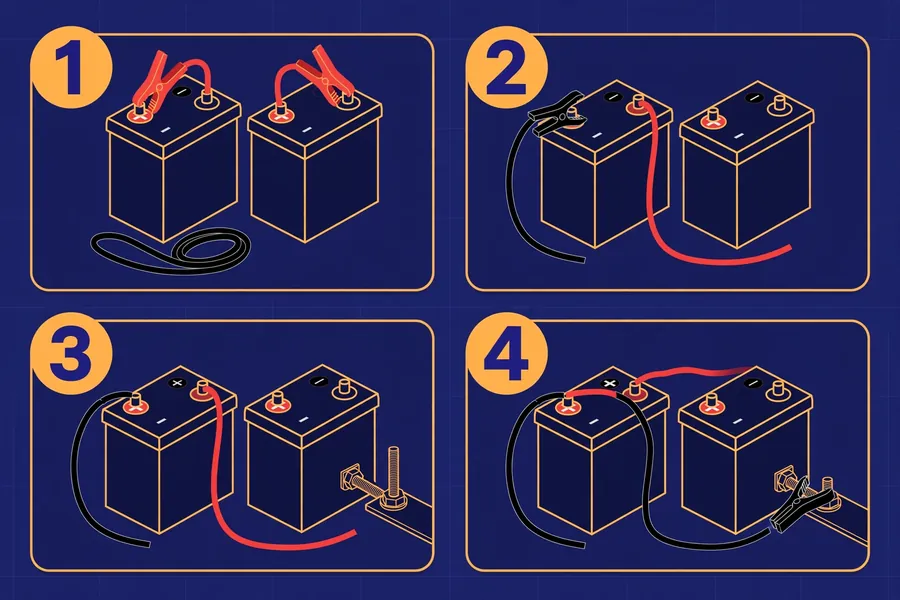
- Connect the red (+) clamp to your BMW’s under-hood + terminal.
- Connect the other red (+) clamp to the donor car’s + battery terminal.
- Connect the black (−) clamp to the donor car’s − battery terminal.
- Connect the other black (−) clamp to your BMW’s ground point — the bare-metal post near the strut tower. Not the trunk battery, not painted metal.
- Start the donor car and let it run at a fast idle for several minutes. (One outlier site advises keeping the donor switched off; BMW’s manual says fast-idle it — follow the manual.)
- Start your BMW. Once it’s running, let both cars run for several minutes before touching any cable.
- Disconnect in the exact reverse order — see the table below.
Memory aid: red to dead, red to donor, black to donor, black to ground. Removal is the mirror image.
| Step | Clamp | Attach to |
|---|---|---|
| 1 | Red (+) | Your BMW’s under-hood + terminal (under the red cover) |
| 2 | Red (+) | Donor car’s + battery terminal |
| 3 | Black (−) | Donor car’s − battery terminal |
| 4 | Black (−) | Your BMW’s ground point (bare-metal post near the strut tower) |
How to jump start BMW 3 Series with a portable jump pack
Same terminals, simpler process — and no second charging system in the loop, which is why many BMW owners prefer a pack after reading the forum horror stories:
- Check the jump pack is charged (most have a charge indicator).
- Red clamp to your BMW’s under-hood + terminal; black clamp to the ground point.
- Switch the jump pack on and wait about 30 seconds.
- Start the BMW.
- Switch the pack off, then remove black first, then red.
Disconnecting: the exact reverse order
Getting the car started is only half the job — pulling the cables off in the wrong order can arc across the terminals. Reverse everything, one clamp at a time:
| Step | Clamp | Remove from |
|---|---|---|
| 1 | Black (−) | Your BMW’s ground point |
| 2 | Black (−) | Donor car’s − battery terminal |
| 3 | Red (+) | Donor car’s + battery terminal |
| 4 | Red (+) | Your BMW’s + terminal — then slide the red cover back down |
What NEVER to do
- Never clamp to the trunk battery. The IBS sensor sits on its negative terminal, and bypassing it risks voltage spikes into sensitive modules. Owners have reported roughly $1,000 in junction-box repairs from this exact mistake. (One dissenting tech voice online argues it’s fine with the battery connected — but BMW’s manual and overwhelming owner experience say use the hood terminals.)
- Never reverse the polarity. Red to +, black to ground — no exceptions, no “just this once.”
- Never jump from a 24-volt system. Truck and commercial 24V electrics will destroy BMW’s 12V electronics.
- Never jump a frozen, cracked, swollen, or leaking battery. It can rupture or explode — replace it instead.
- Never let the two cars touch while the cables are connected.
- Never let the clamps touch each other while any clamp is attached to a terminal.
Locked out? Getting in with a dead battery
Dead battery, locked car, locked trunk — the battery you need is behind the panel you can’t open. Here’s the way back in:
- Pull the metal blade key out of the key fob (press the release button on the fob).
- Unlock the driver’s door manually with the blade — there’s a lock cylinder under a small cap on the handle.
- Pull the hood release lever twice — BMW uses a double-pull release — and open the hood.
- Connect your jump pack (or donor cables) to the under-hood terminals. This powers the car’s electronics.
- Press the trunk release — it works now. You can reach the battery for replacement or a full bench charge.
After the jump: the 30-minute rule
Starting the car is half the job. A jump start doesn’t fix a dying battery — it borrows enough power for one start. Do this next:
- Drive for 20–30 minutes, ideally on the highway — the alternator charges far more at cruising revs than at idle. Don’t just let it idle in the driveway and call it fixed.
- When you get home, put the battery on a trickle charger for about 24 hours — that’s what actually restores a deeply depleted battery. An alternator maintains charge; it doesn’t fully recover one.
- The next morning, check the resting voltage with the engine off: 12.6V or more means healthy; consistently under 12.4V means the battery is fading.
- If it dies again, the battery is done. Replace it — and make sure the new one is registered to the car. (Registration is only ever needed when the battery is replaced, never after a jump start.)
If the battery keeps dying with no obvious cause — lights left on, weeks parked — read our guide to the increased battery discharge warning: it ranks the real causes by likelihood and walks through diagnosis. And if a service reminder pops up once you’re mobile again, here’s how to reset the BMW service light.
It still won’t start? What that means
A jump doesn’t always work — and what happens when you turn the key tells you what’s actually wrong:
| What happens | Most likely cause | Next step |
|---|---|---|
| Rapid clicking, no crank | Poor clamp connection, or a battery too far gone to take a charge | Reseat all four clamps firmly, let the donor fast-idle 5 minutes, and try again |
| Single loud click, then nothing | Bad connection at the ground point, or a completely dead cell | Move the black clamp to a cleaner patch of bare metal and retry |
| Slow crank that fades out | Battery won’t hold a charge | It needs replacement, not another jump — and the new battery must be registered to the car |
| Cranks normally but won’t fire | Not a battery problem — fuel, spark, or immobilizer issue | Stop jump-starting; it needs proper diagnosis |
| Starts, then dies within seconds | Alternator isn’t charging | Keep it running only long enough to reach a shop — the charging system needs testing |
Frequently asked questions
Procedure cross-checked against BMW owner’s-manual documentation (including the F31 jump-start section), YouCanic, bimmer-tech, and owner-forum consensus. One dissenting forum voice on trunk-battery jumping is noted in the text; the consensus — including BMW’s manual — is presented as the rule. Last verified: September 2026.