BMW 3 Series Spark Plug Replacement Interval & Cost
Short answer
For the BMW 3 Series spark plug replacement interval, plan on 60,000 miles for most engines — the N55, N20, B46, B48, and B58 all land there. The naturally aspirated N52 (E90 2006 to early 2009) is the outlier at 100,000 miles, while the twin-turbo N54 should be done at roughly 45,000 miles. Any tuned turbo engine is a different animal entirely: refresh plugs around 20,000 miles and consider one-step-colder plugs to keep misfires away.
In this guide
- Why spark plug intervals vary by BMW engine
- Spark plug interval by engine: N52, N54, N55, N20, B46, B48, B58
- Symptoms of worn spark plugs (and the one that means stop driving)
- OEM plug cross-reference: NGK and BMW part numbers
- Cost comparison: dealer vs. independent shop vs. DIY
- What a DIY spark plug replacement involves
- Tuned 3 Series? Your interval is much shorter
- Spark plug FAQ
Find your engine’s interval
Pick your 3 Series engine. Tick the box if it has a tune — the recommendation changes significantly.
Select an engine to see its spark plug interval, correct plug type, and typical costs.
Why spark plug intervals vary by BMW engine
Search any BMW forum for the spark plug interval and you’ll find a spread from 25,000 to 100,000 miles — which is why so many owners end up confused. The spread isn’t because anyone is wrong. BMW has fitted the 3 Series with fundamentally different combustion systems over the years, and each one asks something different of its spark plugs.
The biggest split is naturally aspirated versus turbocharged. The N52 in the early E90 runs port injection and modest cylinder pressures, so its platinum-tipped plugs wear slowly and BMW’s published interval was 100,000 miles. Once you add a turbocharger and direct injection — the N54, N55, N20, and the later B-series engines — cylinder pressures and combustion temperatures climb sharply. The spark has to fire reliably in a much denser charge, which erodes electrodes faster and is harder on ignition coils. BMW shortened the interval on those engines to 60,000 miles (and 37,000–45,000 for the N54, depending on the era and plug spec), per independent BMW service documentation compiled by Ultimate Bimmer Service.
Electrode material matters too. Modern BMW plugs are laser platinum or laser iridium from the OE manufacturer — NGK in most cases — with wear-resistant center electrodes that last far longer than old copper-core plugs. That’s what lets the B58 and N20 credibly run 60,000 miles. But material only buys you so much: driving profile counts. A 3 Series that spends its life on short trips and stop-and-go commutes wears plugs faster than one running steady highway miles, because cold, rich running and repeated heat cycling are both hard on electrodes and coil insulation. One independent BMW specialist notes that on the B46, B48, and B58 they often recommend plugs a little before the 60,000-mile mark — roughly 45,000–60,000 — depending on use, history, and condition (Motronix).
BMW’s own Condition-Based Service (CBS) treats spark plugs as a mileage- and time-driven item that shows up in the iDrive service menu, so the car itself will tell you when the countdown ends. The CBS number is a good baseline, but it can’t feel a cold-start stumble or know that your N55 has an extra 80 lb-ft of torque from a stage 1 tune. Use the interval for your specific engine as the plan, and your ears — plus any misfire codes — as the override.
Spark plug interval by engine: N52, N54, N55, N20, B46, B48, B58
Here is the per-engine interval the forum threads never consolidate into one place. Figures reflect BMW’s published service data and widely observed dealer and specialist practice; the notes column flags the exceptions worth knowing about.
| Engine | 3 Series models | BMW interval | Notes |
|---|---|---|---|
| N52 (naturally aspirated I6) | 328i E90, 2006–2008 (built before 3/09) | 100,000 miles | Longest interval of any 3 Series engine; platinum plugs, no turbo heat |
| N52TU / N51 (I6) | 328i E90, 2009–2011 | 60,000 miles | Shortened with the updated engine; same plug family as earlier N52 |
| N54 (twin-turbo I6) | 335i E90, 2007–2010 | ~45,000 miles | BMW’s earlier published figure was 37,000 mi on copper-era plugs; with modern iridium replacements most shops land at ~45,000 |
| N55 (twin-scroll turbo I6) | 335i F30, 2011–2015 | 60,000 miles | Every fourth oil service or 60k, per BMW schedule |
| N20 (turbo 4-cyl) | 328i / 320i F30, 2012–2016 | 60,000 miles | Shares its plug with the N55; OE notes call for high-ignitability replacements |
| B46 / B48 (turbo 4-cyl) | 330i / 320i F30 LCI & G20, 2016+ | 60,000 miles | Specialists often suggest 45,000–60,000 by use and condition |
| B58 (turbo I6) | 340i F30 LCI, M340i G20, 2016+ | 60,000 miles | 60,000 mi or every 6th oil change per OE catalogue data |
| Any turbo engine, tuned | — | ~20,000 miles | Universal tuner consensus; see the tuned section below |
A few things this table quietly resolves. First, the often-quoted “30,000 miles” figure floating around BMW forums is generally a mix-up with copper-plug-era intervals or with tuned-car guidance — no stock 3 Series engine calls for 30,000-mile plugs. Second, the N52’s 100,000-mile number only applies to the early cars (built before March 2009); the later N52TU dropped to 60,000. Third, “every fourth oil service” is how BMW phrased the N20/N55/N52TU schedule in service literature, which works out to roughly 60,000 miles at BMW’s ~15,000-mile oil intervals (Ultimate Bimmer Service). If your own oil changes run shorter, ignore the oil-service phrasing and follow the mileage.
Symptoms of worn spark plugs (and the one that means stop driving)
Worn plugs rarely fail outright. They degrade, and the engine tells you about it in stages. Learning the sequence is what separates a cheap, planned plug swap from a tow and a damaged catalytic converter.
- Cold-start stumble that clears within a minute. The most common early sign. The engine shakes lightly on a cold start and smooths out as it warms. A weak plug or coil is a prime suspect, though injectors, mixture faults, or carbon buildup can produce the same behavior (Motronix).
- Hesitation or a flat spot under hard throttle. A marginal coil or plug tends to break down under load first — the coil fires fine at idle in the driveway, then misses at highway speeds when cylinder pressure peaks.
- Rough idle and vibration at stoplights. Classic worn-plug behavior, especially noticeable on the 4-cylinder N20 and B46/B48 where one missing cylinder is a quarter of the engine.
- Falling fuel economy with no change in driving. Misfires waste fuel before they ever trigger a warning. A small mpg drop alone isn’t diagnostic, but combined with a rough idle it’s a strong signal.
- Slower throttle response and lost power. The engine feels “flat” coming off corners or merging — particularly noticeable if you’re used to how the car pulls with fresh plugs.
- Steady check engine light with misfire codes. Codes like P0300 (random misfire) or P0301–P0306 (cylinder-specific) point at the ignition system. For the broader diagnostic path, see the check-engine-light causes guide rather than guessing — a misfire code can also be a coil, injector, or carbon issue.
- Flashing check engine light. This is the emergency signal: an active misfire severe enough to send raw fuel into the catalytic converter and destroy it. Ease off the throttle and stop driving — a $150 plug job left too long becomes a four-figure catalyst replacement.
One more thing to check when the plugs come out: oil pooling in the spark plug wells. That means the valve cover gasket is leaking into the wells, and new plugs alone won’t fix a misfire caused by oil-soaked coils. If you find oil, budget the gasket job alongside the plugs — it’s one of the more common discoveries on 100,000-mile N52s.
OEM plug cross-reference: NGK and BMW part numbers
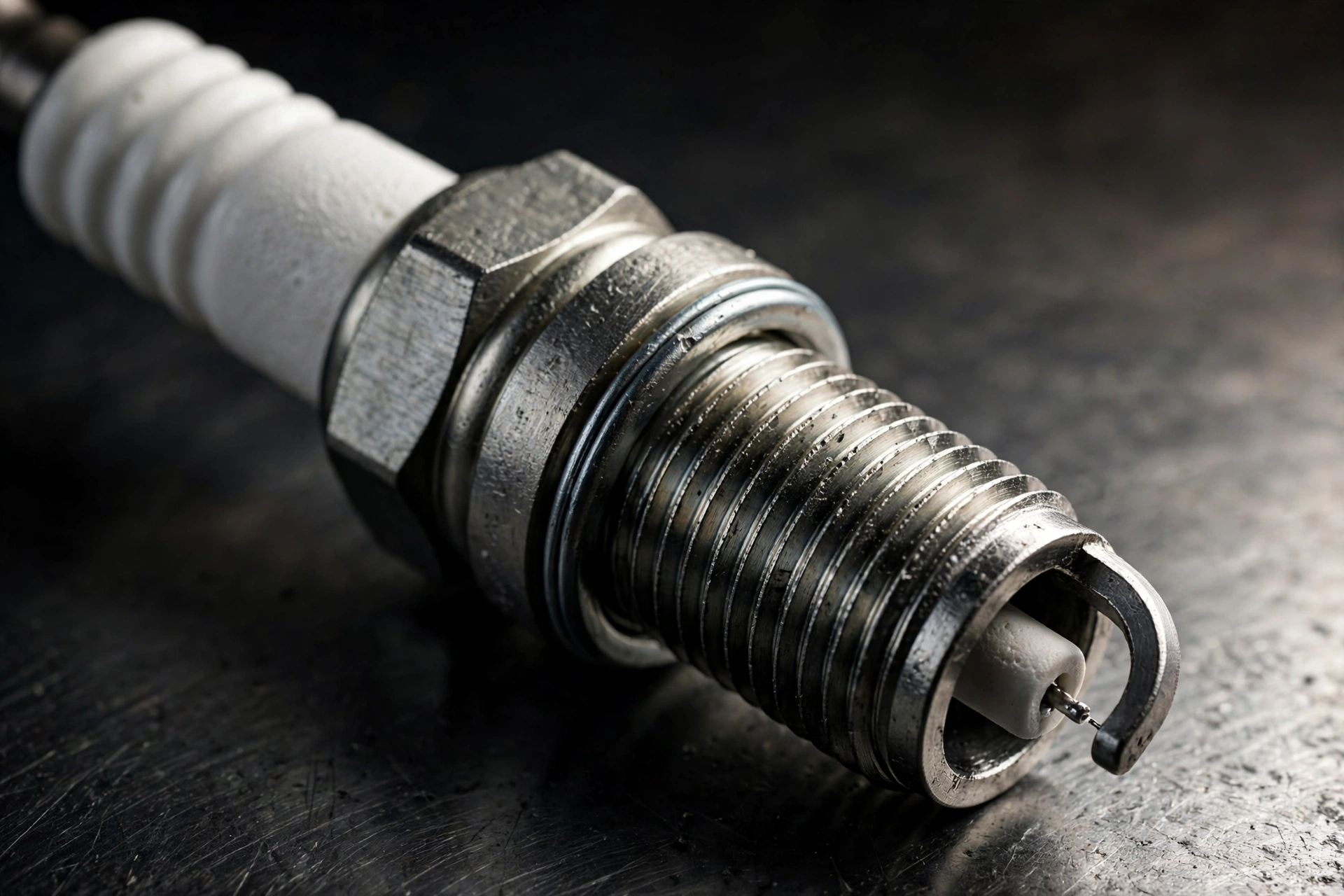
BMW doesn’t manufacture spark plugs — it buys them from NGK (and, in some production runs, Bosch or Champion) and sells them in a BMW box at a markup. Buying the identical plug from the OE manufacturer is the single cheapest legitimate move in this whole job, and it’s exactly what most specialists stock. Here is the current cross-reference for every 3 Series engine.
| Engine | NGK plug (stock no.) | Type | BMW OE counterpart | Qty |
|---|---|---|---|---|
| N52 / N52TU / N51 | NGK PLZFR6A-11S (5987) | Laser platinum, pre-gapped | BMW OE (several superseded numbers — verify by VIN) | 6 |
| N54 | NGK 97506 (SILZKBR8D8S) | Laser iridium | Supersedes BMW 12 12 0 037 581 / 12 12 0 039 664 / 12 12 0 037 582 | 6 |
| N55 / N20 | NGK 97506 (SILZKBR8D8S) | Laser iridium, 0.032″ gap per OE catalogue | BMW 12 12 0 037 582 (and supersessions) | 6 / 4 |
| B46 / B48 / B58 | NGK 94201 (SILZKGR8B8S) | Laser iridium, heat range 8, pre-gapped 0.030″ | BMW 12 12 0 041 666 | 4 / 6 |
How to read this table without getting burned: always confirm by VIN before ordering. BMW supersedes plug part numbers repeatedly — the N54/N55 line alone has cycled through 12120037581, 12120039664, and 12120037582 — and running changes happen mid-model-year. The NGK stock numbers are the stable reference: 97506 is the Laser Iridium SILZKBR8D8S, factory standard for the N20 and a listed replacement across the N54/N55 family (ML Performance), while 94201 is the SILZKGR8B8S Laser Iridium plug that is the actual OE manufacturer part for the B48 and B58, with a 60,000-mile OE service interval and a 0.030″ pre-gap confirmed in catalogue data (Newparts).
Two buying rules keep you out of trouble. First, use the same plug in all cylinders — never mix heat ranges or brands across a bank. Second, buy genuine NGK/Bosch from a reputable parts supplier. Counterfeit plugs are a documented problem in online marketplaces: look for proper branded packaging, correct laser etching on the metal shell, and a price that isn’t impossibly low. If a deal on “OEM BMW plugs” looks too good to be true, it is.
Cost comparison: dealer vs. independent shop vs. DIY
Spark plug replacement has one of the widest cost spreads in BMW maintenance — the same job can legitimately cost $100 or nearly $1,900 depending on who does it. The parts barely move; the labor does.
| Route | Parts | Labor | Typical total (4-cyl / 6-cyl) |
|---|---|---|---|
| BMW dealership | OEM plugs at dealer list pricing | Top-tier shop rate, often 2+ hours billed | $600–$1,855 |
| Independent BMW specialist | OEM/NGK plugs at trade pricing | 1–2 hours at independent rates | $250–$700 |
| DIY | NGK plugs online: ~$12–$22 each | Your Saturday morning | $50–$150 |
The top end of that dealer range is real: an owner-reported dealer quote of $1,855 for a 2021 M340i plug replacement — six iridium plugs, the same NGK 94201 that retails online for a fraction of that — shows how aggressively routine ignition work is marked up (News Usa Today). Independent BMW specialists typically land between $250 and $700 for the same job, and a DIY run of four to six NGK plugs from a reputable supplier lands in the $50–$150 range for parts.
What can move your number up from those baselines:
- Ignition coils. Coils are not a mileage item — specialists test them with the plugs out and replace by condition (Motronix). But on a high-mileage car, if one coil has failed, replacing the whole set while everything is already apart is the standard recommendation, and it adds meaningfully to the bill.
- A leaking valve cover gasket. Oil in the plug wells turns a plug job into a gasket job too. Common on N52s past 100,000 miles.
- Dealer “while you’re in there” add-ons. Get the estimate itemized and check each line against the maintenance schedule. Plugs, oil, and filters are the 60k core; everything else should be inspection-driven.
What a DIY spark plug replacement involves
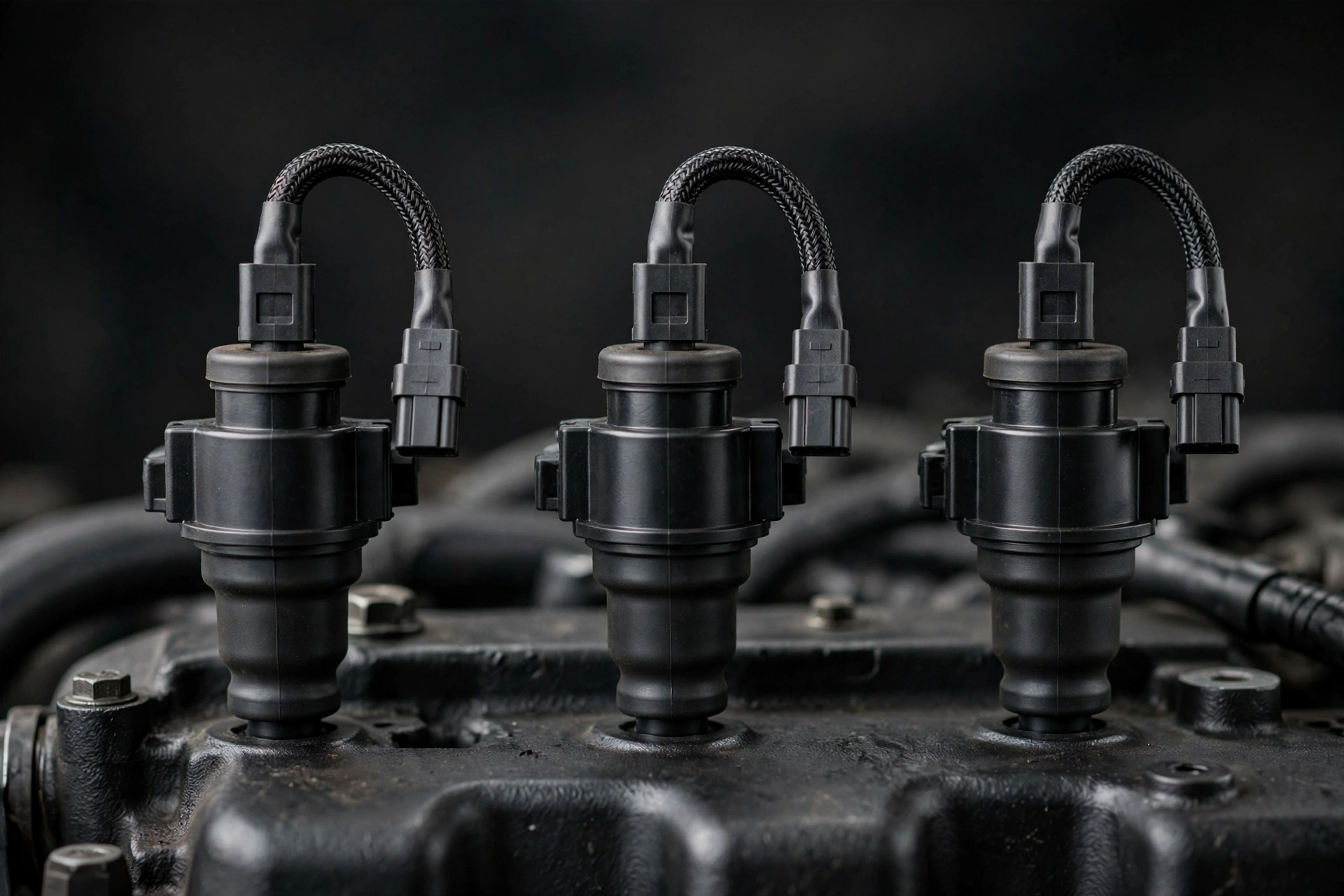
Of all BMW maintenance tasks, spark plugs are one of the friendliest for a careful first-timer: everything is accessible from the top of the engine, there’s one bolt per coil, and the whole job is typically under two hours. The risk isn’t complexity — it’s carelessness around torque and debris. Here’s the honest shape of the job.
What you’ll need. A ratchet with a long extension, a thin-wall 12-point spark plug socket (BMW plugs use a 14mm bi-hex, not a standard plug socket), a torque wrench, a gap gauge, and a can of compressed air. A magnetic pickup tool is cheap insurance against dropping a plug into the engine bay. The new plugs should be the correct OE plug for your engine from the cross-reference above, and they should come pre-gapped — verify the gap against the catalogue spec (0.032″ for the N20/N55 NGK 97506, 0.030″ for the B-series NGK 94201) rather than assuming.
The sequence. With the engine cold, remove the plastic engine cover to expose the coils. Unplug each coil’s electrical connector, remove its single mounting bolt, and pull the coil straight up — note which cylinder each came from. Before removing any plug, blow compressed air into the wells to clear grit that would otherwise fall into the cylinder when the plug comes out. Remove each old plug, then thread each new plug in by hand first to make sure it isn’t cross-threaded — this is the step that separates a successful job from an expensive one. Finish with a torque wrench to the plug manufacturer’s specified torque, reconnect the coils, refit the cover, and reset the spark plug service item in iDrive so the CBS countdown restarts.
Read the old plugs before they go in the bin. This is the part a dealer technician does that a rushed DIYer skips. Each plug’s color and wear pattern tells you how that cylinder has actually been running: a plug that’s noticeably darker or more worn than the others is pointing at a cylinder-specific issue (coil, injector, carbon) worth investigating before it becomes a misfire code. Specialists make a point of this — the old plugs are a free diagnostic snapshot (Motronix).
When not to DIY. If a plug won’t break loose with reasonable force, stop — a seized plug snapped off in an aluminum head is a professional extraction job. Likewise, if you find heavy oil in a plug well or damage to a coil boot, pause and assess the gasket situation rather than pushing through. And on tuned cars, don’t eyeball the gap: use a proper gapping tool and the tighter gap your tuner or plug supplier specifies, because an iridium electrode chips if you lever it carelessly.
Tuned 3 Series? Your interval is much shorter
This is the section that resolves the forum’s loudest disagreement. The stock 60,000-mile interval does not survive a tune — and the people who sell BMW plugs to tuned owners say so plainly: plug changes are suggested roughly every 20,000 miles on tuned vehicles, with fresh plugs or a re-gap required as power climbs (ML Performance; Nforcd).
The physics are straightforward. More boost means higher cylinder pressure, which means the ignition system has to build more voltage to jump the plug gap — and at a certain point the spark blows out before it can fire cleanly. The symptoms show up exactly where you’d expect: misfires under full boost, usually in the upper rev range, on an engine that idles perfectly. Tuners’ standard response is twofold: a colder heat range and a tighter gap.
For the N20, N54, N55, and S55 family, the go-to tuned plug is the NGK 97506 (SILZKBR8D8S) — the same plug that’s factory standard on the N20 — which runs one step colder than the stock N55 plug and two steps colder than the stock N54 plug, gapped down to around 0.020″ for higher-boost applications. For the B58, the stock NGK 94201 remains the right plug for mild street tunes, but tightened to roughly 0.022″; for Stage 1 and Stage 2 B58 builds, BMW offers a dedicated High Power Stage 1/2 plug worth asking your tuner about (ML Performance; Nforcd).
A word of balance: don’t go colder “just because.” A plug that’s too cold for the tune fouls at low load instead of resisting detonation at high load, and owners running mild tunes often do fine on stock heat range with a slightly tighter gap. Match the plug to the actual tune — and let your tuner’s guidance, not a forum signature, be the final word. Also worth knowing: a fresh set of correctly gapped plugs is the cheapest fix for tune-related misfires, and it’s where any competent tuner will tell you to start before blaming the map.
Spark plug FAQ
How often should I replace the spark plugs on my BMW 3 Series?
Every 60,000 miles for the N55, N20, B46, B48, and B58 engines. The early naturally aspirated N52 (built before March 2009) goes to 100,000 miles, the N54 twin-turbo should be done around 45,000 miles, and any tuned turbo engine needs fresh plugs roughly every 20,000 miles. Your iDrive service menu tracks spark plugs as a CBS item, but don’t let it overrule symptoms.
What happens if I drive too long on worn spark plugs?
Misfires get progressively worse — rough running, lost power, and poor fuel economy first. A persistent misfire dumps unburned fuel into the exhaust, which can overheat and destroy the catalytic converter. If the check engine light starts flashing, stop driving; a flashing light means active catalyst damage is happening.
Should I replace the ignition coils at the same time as the plugs?
Not automatically. Coils are a by-condition item, not a mileage item — good shops test them with the plugs out and replace only what fails. The exception is a high-mileage car where one coil has already failed: the rest of the set has aged alongside it, so replacing all coils while everything is apart is usually the economical call.
Can I use aftermarket spark plugs instead of BMW-branded ones?
Yes, provided they’re the correct OE-manufacturer plug. BMW buys these plugs from NGK, so an NGK 97506 or 94201 in NGK packaging is the same part as the one in the BMW box, at a lower price. What you should avoid is switching heat ranges, brands, or gap specs on your own — and counterfeit plugs from sketchy sellers.
Do worn spark plugs trigger a check engine light?
Yes — steady misfire codes (P0300 for random misfire, P0301–P0306 for specific cylinders) are the classic end stage of worn plugs. But misfire codes aren’t plug-specific; they can also mean a failed coil, injector issue, or carbon buildup. Scan the codes, then diagnose before buying parts.
Why does my tuned 3 Series need spark plugs so much more often?
Higher boost raises cylinder pressure, which erodes electrodes faster and can blow out the spark at high RPM. The tuner consensus is fresh plugs around every 20,000 miles, often with a one-step-colder plug and a tighter gap (around 0.020″–0.022″ depending on the engine). A fresh set of correctly gapped plugs is also the first thing to try when a tuned car develops misfires.
How long does a spark plug replacement take?
Plan on one to two hours of hands-on time for a first DIY attempt — it’s one of the more accessible BMW maintenance jobs since everything is on top of the engine. A shop typically bills one to two hours of labor, which is why independent-shop quotes vary more by hourly rate than by the work itself.
Spark plugs sit at the intersection of everything else on the maintenance calendar: they share the 60,000-mile milestone with the broader 3 Series maintenance schedule, they’re the cheapest fix to try when a misfire sends you down the check-engine-light causes guide, and they’re the kind of predictable, top-of-engine job that pairs naturally with other milestone services like the ZF 8HP transmission fluid service. If this article settled your interval, the next step is to check where your car sits relative to it — and if you’re already past the mark, read your old plugs when they come out. They’ll tell you more about your engine’s health than any odometer ever will. For the full picture of owning and maintaining these cars, start with the BMW 3 Series complete guide.