
Used BMW 3 Series Buying Guide: 9 Checks That Separate a Bargain From a Money Pit
A used BMW 3 Series can be the best value in the sport-sedan world — or the fastest way to turn “your dream car” into a repair invoice. The difference is rarely luck: it comes down to buying the right generation, inspecting it like a BMW specialist would, and paying a price the market supports. This used BMW 3 Series buying guide covers all three, with real 2026 price data, a generation-by-generation inspection playbook, and the walk-away red flags most buyers learn about too late.
Here is what you will find below: which years to target and which to avoid, a 12-step inspection checklist to run before paying a specialist, market price bands for every generation as of September 2026, and picks for three common buyer scenarios. It sits in our Buying Guides hub, alongside the 3 Series reliability record by model year and the complete 3 Series guide.
The short answer
This used BMW 3 Series buying guide comes down to three rules: buy 2014 or newer — 2016 and up is the sweet spot — never skip a $200–$300 specialist pre-purchase inspection, and pay what the 2026 market supports: roughly $10k–$16k for a solid F30 and $20k–$30k for an early G20. Walk away from 2006–2013 examples that cannot prove their maintenance history.
In this guide
- Which generation are you shopping: E90, F30 or G20?
- The 12-step pre-purchase inspection checklist
- What to pay: used 3 Series price bands (September 2026)
- Red flags: when to walk away
- Which 3 Series should you buy?
- Negotiation and paperwork tips
- The verdict
- Frequently asked questions
Which generation are you shopping?
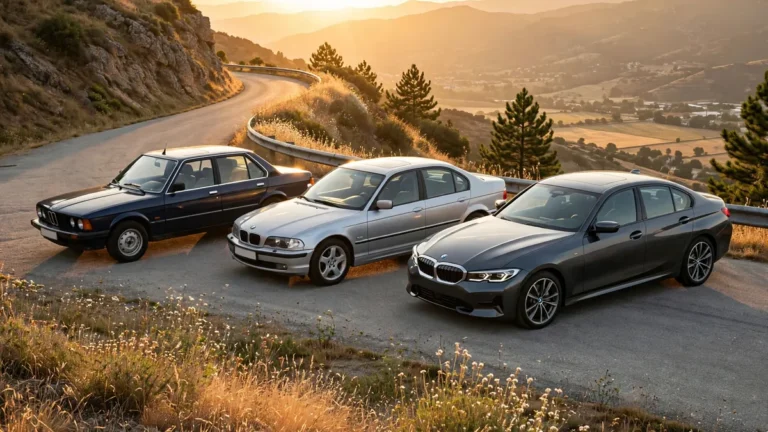
The single biggest factor in used 3 Series happiness is the generation — reliability, running costs and fair pricing all swing dramatically between them. Pick your generation below for what to inspect and which years to avoid.
The bargain basement — with the biggest repair bills. CarGurus calls the E90 BMW’s worst 3 Series generation: electrical gremlins, oil leaks and transmission issues are common. The 2010–2011 cars are marginally better, but still a step below the F30.
- Years to avoid: all of them as a default choice; specifically 2006 (airbag recall, blower-motor wiring faults) and 2007 (N54 high-pressure fuel pump failures, steering-lock faults).
- Engine choice: the 328i’s N52 is the safer E90; the 335i’s N54 is faster but adds HPFP, wastegate-rattle and injector-index-code risks — budget accordingly.
- Cooling system: original components rarely survive past 80,000–100,000 miles; ask what has been replaced and when.
- Electronics: test every window, lock, sensor and iDrive function — E90 electrical faults are legion and tedious to chase.
- Price reality: Edmunds appraises a 2010 328i at roughly $900–$2,700 depending on condition and sales channel, with trade-in values as low as a few hundred dollars. Most clean retail examples change hands between about $4,000 and $10,000.
The smart-money generation. The F30 fixed most of the E90’s sins and starts under $20,000, with the deepest parts market and most experienced independent specialists of any 3 Series.
- Years to avoid: 2012–2013 328i/320i — the N20 turbo four’s timing-chain guide failures make these the riskiest F30s. See our N20 vs N26 engine guide for what separates the early cars. Target 2014+, ideally the 2016+ facelift (LCI).
- Cold-start listen: on any N20/N26 car, a rattling or diesel-like clatter on cold start signals timing-chain guide wear — walk away unless replacement is documented.
- Cooling system: water pump, thermostat and expansion tank are the three pattern failures, typically surfacing at 60,000–100,000 miles. Proactive replacement beats a roadside failure.
- Oil leaks: valve-cover gasket and oil filter housing are the classic seep points; check coolant level and condition with the correct BMW coolant type.
- Transmission: the ZF 8-speed is proven, but BMW’s “lifetime fluid” claim is marketing — specialists recommend service every 50,000–93,000 miles.
- Best buys: 2016+ 330i (B48) and 340i (B58) are the consensus picks; the 335i’s N55 is solid if service records are complete.
The most reliable 3 Series generation in decades. Mature B48 four-cylinder and B58 six-cylinder engines pair modern tech with the fewest reported problems of any recent generation.
- Years to avoid: 2019 — the transitional first year carries the most reported bugs of the generation. Target 2020 and newer, where reliability ratings are strongest.
- Electronics first: cycle every iDrive function, driver-assistance feature and sensor; early-2019 cars are the ones most prone to software glitches.
- 330e plug-in hybrid: verify high-voltage battery health and charging behavior, and confirm hybrid-specific recalls are closed.
- Cooling system: B-series engines still use electric water pumps and plastic cooling components — keep the same 60,000–100,000-mile vigilance at higher mileages.
- Fuel economy: the payoff for buying newer — the 2021 330i is EPA-rated at 30 mpg combined, versus 26 for a 2012 328i.
- Best buys: 2021–2023 330i for the blend of reliability, tech and depreciation; M340i (B58) for the six-cylinder.
The 12-step pre-purchase inspection checklist
Run this list yourself on every candidate before you pay a specialist — it filters out most bad cars in under an hour, and whatever survives becomes the punch list for your $200–$300 professional PPI.
- Decode the VIN and pull a history report. Confirm the VIN on the dash, door jamb and paperwork all match, then check for accidents, title brands (salvage, flood, rebuilt) and mileage consistency.
- Check open recalls by VIN. Run the VIN through NHTSA’s recall lookup — the 2020 3 Series shows 12 recalls on its NHTSA record — and confirm every campaign is closed.
- Demand complete service records. Oil-change history, cooling-system work, brake fluid every two years, transmission service. Missing records at 80,000+ miles are a warning, not a discount.
- Cold-start the engine yourself. Ask the seller not to warm the car. Listen for timing-chain rattle (N20/N26), watch the exhaust for blue or white smoke, and note any rough idle.
- Scan every module, not just the engine. A BMW-capable scan tool reads codes a generic OBD-II reader cannot see. Stored codes the seller “just cleared” are a walk-away sign.
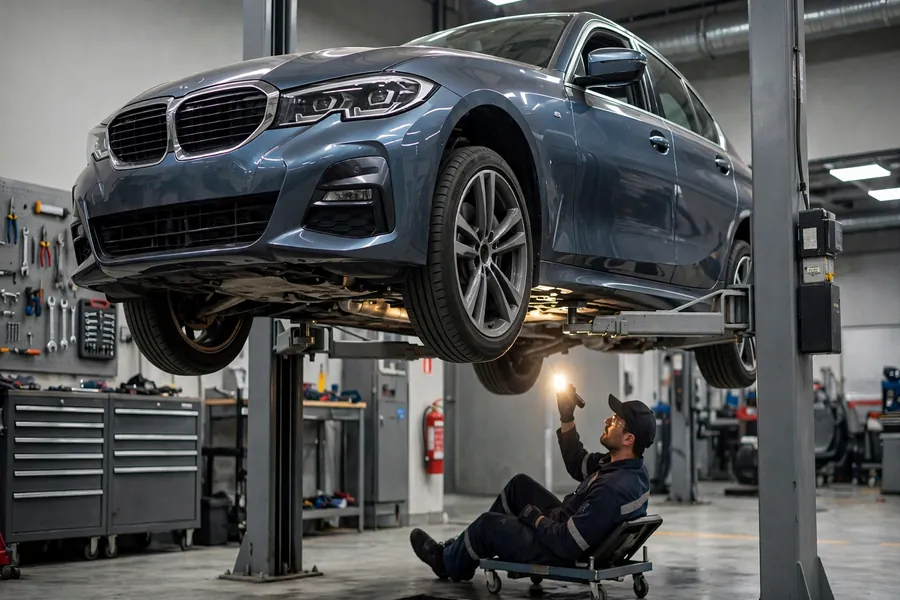
- Hunt for oil leaks. Valve-cover gasket, oil filter housing, oil pan — look underneath with a flashlight. Fresh undercoating can hide seepage.
- Pressure-test the cooling system’s story. Check the expansion tank for cracks and discoloration, confirm coolant level and color, and ask directly: has the water pump or thermostat been replaced? Our service-light reset guide explains what the CBS intervals mean.
- Judge the transmission. The ZF 8-speed should shift smoothly with no flare, slam or hesitation, hot or cold. Ask when the fluid was last serviced.
- Drive over bad pavement. Clunks or wandering over bumps point to control-arm bushings or sway-bar links — consumables on every 3 Series, and a negotiating lever if worn.
- Test every electronic function. iDrive, navigation, CarPlay, windows, sunroof, heated seats, parking sensors, and every warning light’s behavior at startup.
- Read the tires and brakes. Uneven wear signals alignment or suspension trouble; thin pads and scored rotors are a near-term $500+ bill. On xDrive cars, mismatched tire brands or sizes can damage the transfer case.
- Finish with a specialist PPI. A BMW independent shop puts the car on a lift, pressure-tests the cooling system and reads BMW-specific codes for $200–$300 — the cheapest insurance in this entire guide.
What to pay: used 3 Series price bands
Prices below are a September 2026 market snapshot built from CarGurus national-average listing data (last updated May 2026) cross-checked against Edmunds appraisal ranges. Condition, mileage, options and your local market move individual cars thousands of dollars either way.
| Generation | Model years | Fair price band (Sep 2026) | Basis & confidence |
|---|---|---|---|
| E90 | 2006–2011 | $4,000–$10,000 | Edmunds appraisal: 2010 328i trade-in $588–$6,993. Medium confidence — varies widely by body style and condition. |
| F30 (early) | 2012–2015 | $9,500–$12,000 | CarGurus national avg: $10,107–$10,819. High confidence. |
| F30 (LCI) | 2016–2018 | $11,500–$16,000 | CarGurus national avg: $11,965–$15,216. High confidence. |
| G20 (early) | 2019–2022 | $20,000–$30,000 | CarGurus national avg: $20,763–$29,612. High confidence. |
| G20 (late) | 2023–2024 | $34,000–$38,000 | CarGurus national avg: $35,643–$37,553. High confidence. |
Two pricing truths for negotiations. First, the spread within a model year is huge: Edmunds values a 2018 320i anywhere from about $6,300 to $27,400 across conditions and trims, so “what’s a 2018 worth?” is the wrong question — “what’s this 2018 worth?” is the right one. Second, mileage matters more than age on a BMW: a lower-mileage 2017 often beats a higher-mileage 2019 at the same price.
Budget the first year, not just the purchase. Specialists suggest $800–$2,000 per year for maintenance — up to $1,500–$2,500 past 60,000 miles. Add that to your purchase budget before you fall in love with a listing.
Red flags: when to walk away
Some findings are negotiating points. The ones below are not — each carries a repair bill or risk profile that no discount reliably fixes.
Walk away if you find any of these:
- No service records on a car with 80,000+ miles — you are buying someone else’s deferred maintenance.
- Timing-chain rattle on cold start (N20/N26, early F30) with no documented replacement.
- Any overheating history, coolant in the oil, or persistent white exhaust smoke.
- Mismatched tires on an xDrive model, or binding/shuddering on tight turns — transfer-case damage territory.
- Salvage, rebuilt or flood title; VIN plates that do not match the paperwork; signs of odometer rollback.
- A tuned N54/N55 with no supporting maintenance records.
- Multiple stored fault codes the seller “just cleared,” or a seller who refuses an independent PPI.
- Fresh undercoating or a steam-cleaned engine bay hiding active leaks.
Which 3 Series should you buy?
The “best” used 3 Series depends on your budget and tolerance for maintenance. Pick the scenario that matches you — and for the full generation head-to-head, see our E90 vs F30 comparison and F30 vs G20 comparison:
Buy: 2016–2018 330i (B48) — budget $12,000–$16,000.
- The LCI four-cylinder hits the sweet spot: modern enough for daily comfort, efficient (the related 2013 320i is EPA-rated at 28 mpg combined), and past the N20 timing-chain worry years.
- Prioritize full service history and fresh cooling-system components over low miles alone.
- Skip the 330e plug-in unless you can charge at home and have verified battery health.
Buy: 2016–2018 340i (B58) or 2020+ M340i — budget $16,000–$32,000.
- The B58 inline-six is the consensus enthusiast engine: strong, tunable, and more robust than the N54/N55 generations before it.
- Reject tuned cars with rough running, cooling issues or sloppy gearbox behavior — buy on service evidence, not dyno sheets.
- Manual-transmission F30s exist and are rare; expect to search nationally and pay a premium.
Buy: 2014–2015 328i/320i with full history — budget $9,500–$11,000.
- These are the cheapest F30s past the worst N20 timing-chain years, and the best value per dollar in the 3 Series market.
- Non-negotiable: documented oil changes, quiet cold start, no timing/VANOS codes, and a specialist PPI.
- Keep $1,500 in reserve for the first year — cooling and suspension consumables are a matter of “when,” not “if.”

Negotiation and paperwork tips
- Negotiate from the PPI report, not the asking price. Every documented fault — worn bushings, seeping gaskets, due-soon brakes — is a line item with a real repair cost. Present the report, not an opinion.
- Get the out-the-door number in writing. Doc fees and add-ons routinely add $500–$1,500 past the advertised price. Make the dealer itemize everything before you discuss trade-ins or financing.
- Private-party purchases need paperwork discipline: signed bill of sale, lien-free title, emissions compliance for your state, and insurance bound before you drive away.
- Do the CPO math. BMW Certified Pre-Owned costs more but bundles warranty coverage and a rigorous inspection — price it against a private-party car plus an independent warranty and PPI before dismissing it.
- Drive it cold, hot, and hard — then sleep on it. Highway at 60–70 mph, full-lock turns listening for xDrive binding, one firm stop from speed. Urgency is the seller’s best negotiating tool.
- Quote insurance before you buy. A 340i or M340i can cost dramatically more to insure than a 320i; get the real number while you still have leverage.
The verdict
If you remember nothing else from this used BMW 3 Series buying guide, remember this: buy the newest, best-documented car your budget allows, and never skip the specialist inspection. The 2016–2018 330i is the value champion, the 2020+ G20 is the lowest-risk buy, and anything from 2006–2013 demands proof — not promises. For the deeper breakdown, see our 3 Series reliability by year and the complete 3 Series guide.

Frequently asked questions
Price bands are national-average listing values from CarGurus market data (last updated May 2026), cross-checked against Edmunds appraisal ranges; local markets, mileage, condition and options move real prices. Reliability assessments synthesize NHTSA recall/complaint records, specialist inspection checklists and long-term owner consensus — not manufacturer claims. E90-era pricing carries medium confidence: it varies widely by body style and condition. Last verified: September 2026.