The Complete BMW 3 Series Wheel Fitment Guide
Short answer: BMW 3 Series wheel fitment comes down to five numbers: a 5×120 bolt pattern, a 72.56 mm center bore, an offset between roughly ET25 and ET47 depending on generation, a 7–9 inch width, and a tire whose overall diameter stays within 3% of stock. Every 3 Series from the E90 through the G20 shares the same bolt pattern and bore, so cross-generation swaps are possible — but offset, width, and brake clearance are where people get into trouble.
Wheel fitment is the one modification where getting it wrong costs real money. The wrong offset rubs the fender. The wrong bore vibrates at highway speed. The wrong tire diameter throws off your speedometer and can confuse your ABS and stability control. This guide covers every BMW 3 Series generation — E90 (2006–2013), F30 (2012–2019), and G20 (2019–present) — with the factory numbers, the physics, and a tire-size calculator so you can check any combination before you buy.
The Five Numbers That Define 3 Series Fitment
Every wheel has five measurements that decide whether it fits your car. Think of them as a combination lock: all five have to be right. Get four right and the wheel still doesn’t work.
- Bolt pattern (PCD): 5×120 — five lug bolts on a 120 mm circle. Identical across E90, F30, and G20.
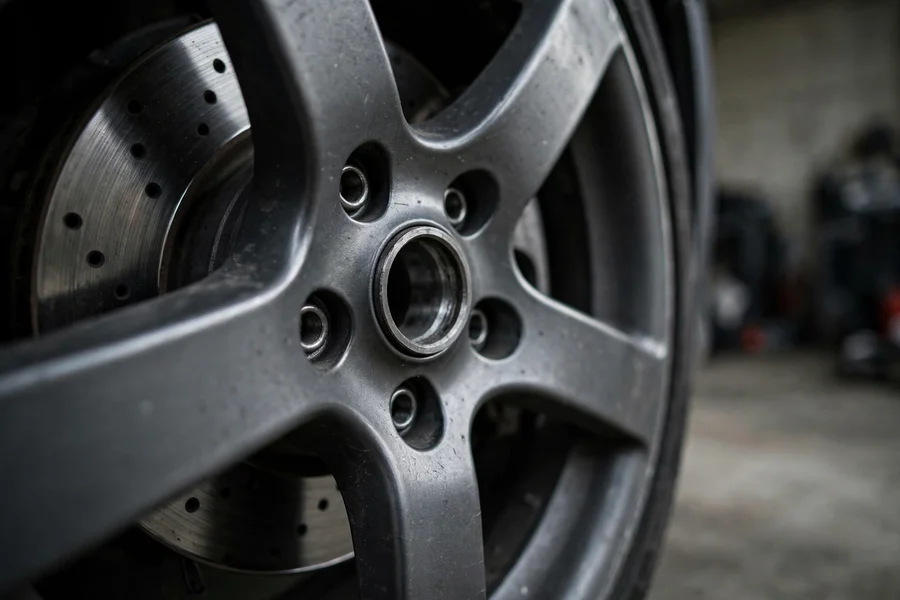
- Center bore: 72.56 mm. The hole in the middle of the wheel must match the hub, or you need a hub-centric ring.
- Offset (ET): the distance in millimeters between the wheel’s mounting face and its centerline. Factory 3 Series wheels run roughly ET25–ET47 depending on generation and width.
- Width: the rim width in inches, measured bead seat to bead seat. Factory range is 7–9 inches.
- Diameter: 16–20 inches factory, which decides the tire size you pair it with.
There’s a sixth item worth checking before you spend anything: the lug hardware. Every 3 Series here uses M12×1.5 lug bolts (not studs and nuts), torqued to 120 Nm (89 lb-ft) per the owner’s manual. Aftermarket wheels sometimes need shorter bolts, longer bolts for spacers, or conical-seat bolts instead of BMW’s ball-seat style — verify the seat shape before mounting.
Factory Wheel Specs by Generation
The good news: BMW kept the fundamentals constant. Every generation below is 5×120 with a 72.56 mm bore and M12×1.5 bolts. What changed are widths, diameters, and offsets — and the exact spec varies by trim, year, and option package, so treat the tables as typical ranges and confirm against your door placard and the markings stamped inside your current wheels.
E90 3 Series (2006–2013)
| Factory wheel | Offset | Typical tire |
|---|---|---|
| 7J×16 | ET31 | 205/55R16 |
| 7.5J×17 | ET34 | 225/45R17 |
| 8J×17 / 8J×18 | ET34 | 225/45R17 / 225/40R18 |
| 8J×19 | ET37 | 225/35R19 |
| Staggered: 8J×18 F / 8.5J×18 R | ET34 F / ET37 R | 225/40R18 F / 255/35R18 R |
| Staggered: 8J×19 F / 9J×19 R | ET37 F / ET39 R | 225/35R19 F / 255/30R19 R |
Base E90s (323i, early 328i) came on 16s; sport package cars got 17s or 18s. The classic E90 staggered setup — 8 inch front, 8.5 inch rear — was standard on sport-package 335i models and remains the most common E90 fitment you’ll find used.
F30 3 Series (2012–2019)
| Factory wheel | Offset | Typical tire |
|---|---|---|
| 7J×16 | ET31 | 205/60R16 (base 320i) |
| 7.5J×17 | ET37 | 225/50R17 |
| 8J×18 | ET34 | 225/45R18 |
| Staggered: 8J×18 F / 8.5J×18 R | ET34 F / ET47 R | 225/45R18 F / 255/40R18 R |
| Staggered: 8J×19 F / 8.5J×19 R | ET36 F / ET47 R | 225/40R19 F / 255/35R19 R |
| 20″ M Performance | ET36 F / ET47 R | 225/35R20 F / 255/30R20 R |
The F30’s rear staggered wheels run a notably high offset (ET47) — higher than the E90’s — because the F30 has a wider track and different suspension geometry. This matters if you’re shopping E90 wheels for an F30: they’ll bolt on, but the rear track changes.
G20 3 Series (2019–present)
| Factory wheel | Offset | Typical tire |
|---|---|---|
| 7.5J×17 | ET30 | 225/50R17 |
| 8J×18 | ET30 | 225/45R18 |
| Staggered: 8J×18 F / 8.5J×18 R | ET30 F / ET40 R | 225/45R18 F / 255/40R18 R |
| Staggered: 8J×19 F / 8.5J×19 R | ET27 F / ET40 R | 225/40R19 F / 255/35R19 R |
| 20″ M Performance (794M/795M) | ET27 F / ET40 R | 225/35R20 F / 255/30R20 R |
Note the trend: as generations get newer, factory offsets drop slightly at the front (ET27–ET30) for a more aggressive stance, while the staggered rears keep a higher offset to tuck the wider tire under the fender. One thing to know: the M3 (G80) switched to a 5×112 bolt pattern — this guide covers the regular 3 Series only, and M3 wheels do not bolt onto a 330i or M340i.
Offset Explained: Why ET Makes or Breaks the Fit
Offset (ET, from the German Einpresstiefe) is the most misunderstood wheel number and the one responsible for most bad purchases. It’s measured in millimeters from the wheel’s mounting face to its centerline. Positive offset — what every 3 Series uses — means the mounting face sits toward the outside of the wheel, tucking the wheel inward under the fender.
Here’s the practical version: lower offset pushes the wheel outward; higher offset pulls it inward. A 5 mm change is roughly the thickness of a smartphone screen edge-to-edge across the wheel face — small on paper, visible in person. The factory ranges above exist because BMW tuned each generation’s steering geometry around them.
- Too low (e.g., ET20 on an F30): the tire pokes past the fender, rubs the fender lip on bumps, and flings road grime down the car’s side. It also changes scrub radius, which can make steering feel vague or twitchy.
- Too high (e.g., ET50 on an E90): the wheel sinks inward and the inner sidewall or rim edge can contact the strut or suspension arm — usually discovered at full steering lock, which is the worst time to discover anything.
- Safe rule of thumb: stay within about 5 mm of your factory offset for the same wheel width. Going half an inch wider in wheel width? Offset roughly needs to rise by about 6–7 mm to keep the inner clearance unchanged, since the extra width splits evenly inboard and outboard.
When sellers list wheels as “fits BMW 3 Series,” they usually mean the bolt pattern matches. That is necessary and nowhere near sufficient — always ask for width and ET, and compare them to your factory numbers above.
Square vs Staggered: Which Setup Fits Your Driving
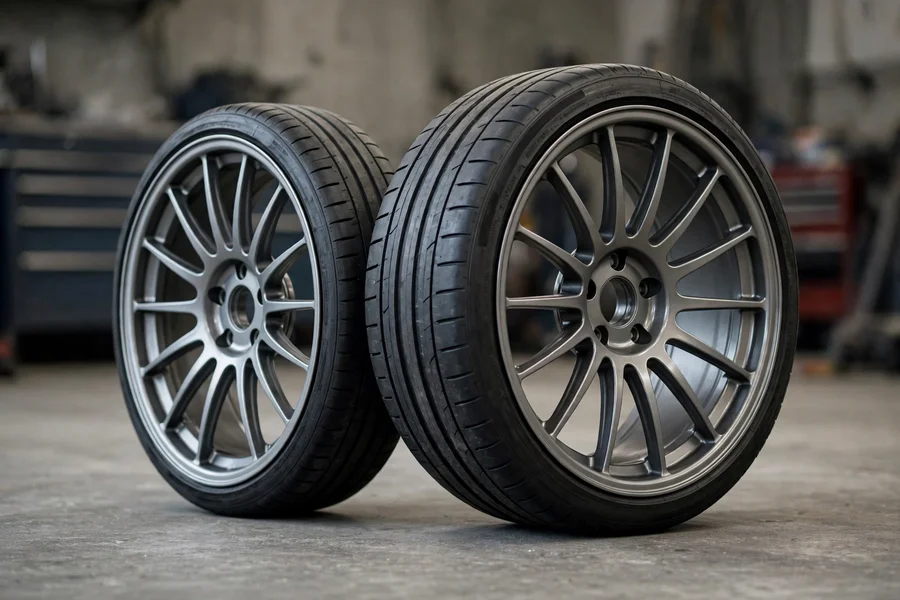
A square setup runs the same wheel width and tire size on all four corners. A staggered setup runs wider wheels and tires at the rear — the factory sport-package look on most 3 Series since the E90. Neither is universally better; they solve different problems.
Square setups: the practical choice
- Tire rotation is possible. You can rotate front-to-rear, which typically extends tire life noticeably — staggered setups can only be rotated side-to-side, and directional tires can’t even do that.
- Cheaper to run. One tire size to buy, often narrower rubber costs less, and a single spare or replacement covers every corner.
- Better in winter. Narrower tires cut through snow and slush more effectively. Most dedicated 3 Series winter wheel packages are square 17s or 18s for this reason.
- Neutral handling. Equal grip front and rear keeps the car’s balance closest to how BMW engineered it.
Staggered setups: the performance look
- More rear traction. A wider rear tire (typically 255 vs 225 front) puts more rubber down for acceleration — meaningful on a 335i or M340i.
- The factory sport look. Wider rear track fills the rear arches the way BMW’s designers intended on sport-package cars.
- The trade-offs: no front-to-rear rotation, faster and more expensive tire replacement, slightly more understeer at the limit, and on xDrive cars you must keep front and rear rolling diameters matched or you stress the transfer case.
The xDrive rule is non-negotiable: on all-wheel-drive 3 Series, all four tires must be the same overall diameter — and the same applies to tread depth. A worn pair mixed with a new pair creates a permanent diameter difference the transfer case reads as slip. If you run staggered on xDrive, replace all four tires together and check the calculated diameters with the calculator below: front and rear should be within about 1% of each other.
My honest take for most owners: run the factory staggered sizes if your car came with them and you like the look, but buy your winter set square. The tire savings alone pay for the compromise you never feel on a snowy commute.
Tire-Size Calculator: Check Any Combination Before You Buy
Pick your stock tire size and the size you’re considering. The calculator works out overall diameter, sidewall height, and circumference for both, then tells you the speedometer error and whether the new size stays inside the industry-standard 3% rule.
Your stock tire size
Candidate tire size
Reading a Tire Sidewall and Applying the 3% Rule
Take 225/45R17. The 225 is the tread width in millimeters. The 45 is the aspect ratio — the sidewall height as a percentage of the width, so 45% of 225 mm, about 101 mm. The R17 is the wheel diameter in inches. Overall diameter is simple arithmetic: wheel diameter plus twice the sidewall height. That’s the number everything else depends on.
The industry’s accepted guideline is the 3% rule: a replacement tire should be within 3% of the original overall diameter. This isn’t an arbitrary number. Your car measures speed by counting wheel rotations, so a taller tire makes the speedometer read slow (and the odometer under-record), while a shorter tire makes it read fast. At 3% tall, an indicated 60 mph is really about 62 mph — enough to matter for speeding tickets.
Speedometer error is only the visible symptom. ABS, traction control, and stability control all compare wheel speeds against expected values, and a diameter change beyond about 3% can make those systems intervene at the wrong moment or throw faults. On xDrive cars, mismatched diameters front-to-rear are worse — the transfer case interprets the constant speed difference as wheel slip. If you’re shopping for run-flat versus regular tires at the same time, settle the size question first, then the construction question.
Plus sizing done right
Plus sizing — moving to a larger wheel while keeping overall diameter constant — is exactly what the factory staggered packages do. The formula: for every inch of wheel diameter you add, drop the aspect ratio roughly 5 points and consider going 10 mm wider. The calculator above does the real math, but these factory-verified pairs show the pattern:
- 225/50R17 → 225/45R18 → 225/40R19: each step changes diameter by less than half a percent.
- 225/45R18 → 255/40R18: same diameter class, wider rear — the F30’s staggered formula.
- Minus sizing for winter (17″ wheels on a car that came with 19s) follows the same rule in reverse: smaller wheel, taller sidewall, narrower width, same overall diameter.
Hub-Centric Rings, Spacers, and Lug Bolts
BMW wheels are hub-centric: the 72.56 mm center bore fits snugly over a matching lip on the hub, and that lip — not the lug bolts — centers the wheel and carries the car’s weight in shear. This is the detail that separates a smooth aftermarket setup from a car that shudders at 65 mph.
- Aftermarket wheels with a larger bore (commonly 73.1 or 74.1 mm) are lug-centric on your BMW unless you fit hub-centric rings — cheap plastic or aluminum adapters that fill the gap between the wheel bore and the 72.56 mm hub. They cost very little and prevent vibration and uneven bolt loading. This is not optional.
- Spacers push the wheel outward, effectively lowering offset. A 10 mm spacer on an ET34 wheel behaves like ET24. Use only hub-centric spacers (with the 72.56 mm lip machined in), and fit longer lug bolts to match — the bolt must engage the same number of threads as stock. Spacers don’t fix a fundamentally wrong wheel; they’re a fine-tuning tool.
- Bolt seats matter. BMW uses ball-seat (radius-seat) lug bolts. Many aftermarket wheels are drilled for conical (tapered) seats. Running ball-seat bolts in conical-seat wheels — or vice versa — gives you a fraction of the intended contact area and a wheel that can work loose. Match the seat to the wheel, not the car.
TPMS: Don’t Forget the Sensors
Most E90s sold in the US use an indirect flat-tire monitor that works off wheel-speed data, while F30 and G20 models use direct valve-stem TPMS sensors. Either way, a wheel swap needs a reset afterward. If you’re moving to aftermarket wheels on an F30 or G20, you need a set of compatible direct sensors in the new wheels — running without them means a permanent warning light and no pressure monitoring. After mounting, follow the reset procedure in our 3 Series TPMS reset guide so the system relearns the new sensors.
Load Rating: The Number Nobody Checks
Every tire carries a load index — a number like 91, 94, or 98 molded into the sidewall that maps to a maximum weight per tire. Your replacement tires must meet or exceed the load index on your door placard. This is a hard safety floor, not a suggestion: an underrated tire overheats, wears the shoulders, and can fail under a loaded car on a hot highway.
The same applies to wheels. Aftermarket wheels carry a load rating too (usually stamped inside the barrel, sometimes listed in pounds or kilograms). A wheel rated for a 2,800 lb compact is not automatically safe on a 3,800 lb M340i. Match or exceed the factory wheel’s rating — when in doubt, buy wheels from manufacturers that publish per-wheel load ratings and JWL/VIA or TÜV certification. Speed rating follows the same logic: if your car came with V-rated or higher tires, don’t downgrade to H.
Brake Clearance: Measure Before You Buy
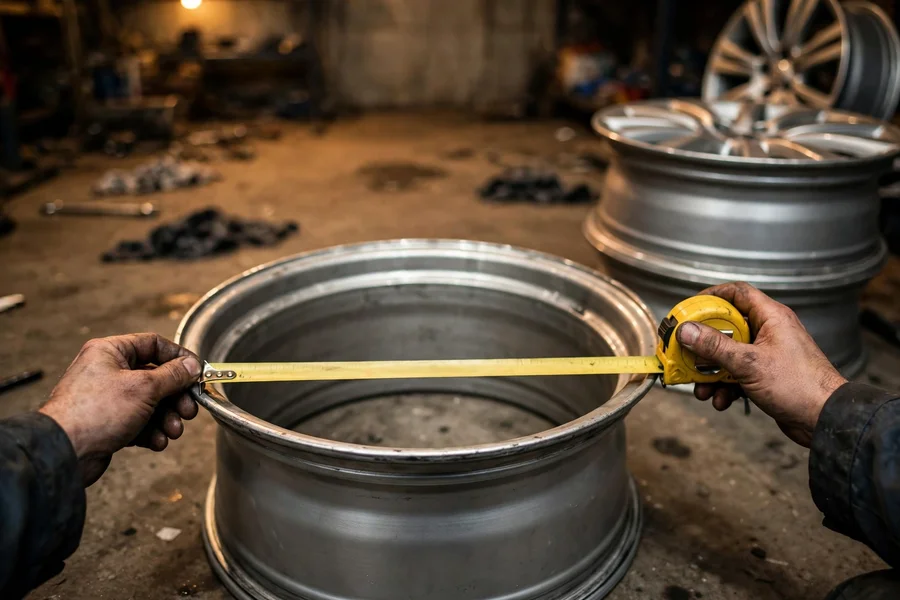
Diameter alone doesn’t guarantee a wheel fits — the spokes have to clear the brake caliper. M Sport and M Performance brake packages use larger calipers, and some 17″ wheels that clear a base 330i’s brakes won’t clear the M Sport fronts. The honest check is physical: with the wheel off, measure from the hub face to the outermost point of the caliper, and compare against the inside profile of the candidate wheel. When buying used OEM wheels from another 3 Series, match the brake package, not just the model. Our brake rotor replacement guide shows the caliper differences between standard and M Sport setups if you’re unsure what you have.
Test-Fitting and Mounting: Difficulty, Cost, and the Right Order
Swapping wheels is honest driveway work — moderate difficulty, about an hour for a full set with a jack and a torque wrench. But do the verification before you pay for mounting and balancing, because a shop will charge you whether the wheels fit or not.
The test-fit checklist
- Dry-mount one front and one rear wheel with no tire if possible, or with the tire but before balancing. Spin by hand and check caliper clearance at every point — you want at least 3 mm between caliper and spoke.
- Check inner clearance at full steering lock both directions. This is where too-high offset reveals itself.
- Check outer clearance by bouncing the suspension (or lowering the car off the jack onto the wheel) and looking for fender contact.
- Confirm the bore. The wheel should slide onto the hub lip with a snug fit and no wobble. If it drops on loosely, you need hub-centric rings.
- Seat the bolts by hand first in a star pattern, then torque to 120 Nm (89 lb-ft) with the car on the ground. Re-torque after 50–100 miles — this is the step people skip and regret.
Use proper 3 Series jack points — the reinforced pads behind the front wheels and ahead of the rears — and never work under a car supported only by a jack.
What it costs
OEM Wheel Notes: What to Look for Used
BMW’s own wheels are the safest used purchase: the bore, bolt seats, load rating, and offset range are all correct by design, and the style number stamped inside tells you exactly what you have. A few things to know when shopping:
- Style numbers are the real ID. “Style 400M” or “Style 791M” identifies the exact wheel — width, offset, and diameter are fixed per style. Ask the seller for the style number, not just “18-inch M Sport wheels.”
- M wheels are wider and staggered. Wheels from M Sport packages (the ones with the M badge on the spoke) are usually the staggered widths in the tables above. They’re also the most curbed, so inspect the lips closely.
- Check for cracks, not just curb rash. Cosmetic rash is negotiable; hairline cracks around the lug holes or inner barrel are a walk-away. Run-flat tires transmit more impact to the wheel, so used wheels that lived on run-flats deserve extra scrutiny.
- Replica wheels exist. If the price seems too good for genuine BMW wheels, check the stampings inside the barrel — genuine wheels carry BMW part numbers and manufacturer marks. Replicas may have the right dimensions but unknown load ratings.
The five-question safe-buy checklist. Before money changes hands, get written answers to these: (1) exact width and offset (e.g., “8.5J×19 ET40,” not “19-inch M wheels”); (2) center bore — 72.56 mm or the ring size you’ll need; (3) bolt seat type — ball or conical — and whether bolts are included; (4) load rating per wheel; (5) which brake package the wheels came off, if they’re used OEM. Any seller who can’t answer the first three is selling you a gamble, not a wheel set.
For the full picture of your car beyond its wheels, our complete 3 Series guide covers every generation’s specs, common problems, and buying advice in one place.
Frequently Asked Questions
Will F30 wheels fit my E90 (or G20 wheels fit my F30)?
Usually yes, because all three generations share the 5×120 bolt pattern and 72.56 mm bore. The catch is offset and width: F30 rear staggered wheels run ET47, which tucks noticeably further inward on an E90 than its factory ET34–ET37 wheels. They’ll bolt on and clear, but the stance changes. Always compare the specific width and ET against your factory numbers and test-fit before buying tires.
What offset range is safe for aftermarket 3 Series wheels?
As a starting point, stay within about 5 mm of your factory offset for the same width: roughly ET29–ET39 for an E90, ET30–ET47 for an F30 (match front and rear separately on staggered cars), and ET25–ET40 for a G20. Wider wheels need proportionally higher offset to keep inner clearance. Anything beyond a 10 mm deviation from stock deserves a test fit, not a guess.
Do I really need hub-centric rings for aftermarket wheels?
Yes, if the wheel’s center bore is larger than 72.56 mm. Without rings the wheel centers on the lug bolts instead of the hub, which causes vibration at highway speeds and puts bending loads on the bolts they weren’t designed for. Rings are inexpensive and take seconds to install — there’s no reason to skip them. Buy wheels with a 72.56 mm bore in the first place if you want to avoid the issue entirely.
Can I run a square setup on a car that came staggered from the factory?
Yes — it’s one of the most common and sensible changes owners make, especially for winter. Pick the front size for all four corners (e.g., 225/45R18 on 8J×18 ET34 for an F30), which keeps diameter, gearing, and handling balance factory-correct while enabling full tire rotation. The only thing you lose is the wider rear look and a small amount of rear traction.
Why does my steering wheel shake after installing new wheels?
The three usual suspects, in order: missing or wrong-size hub-centric rings, a wheel that wasn’t balanced properly, and lug bolts torqued unevenly or to the wrong spec. Less common causes include a bent wheel (check for runout on a balancer) and debris or corrosion on the hub face preventing the wheel from seating flat. Work through them in that order before assuming the wheels themselves are bad.