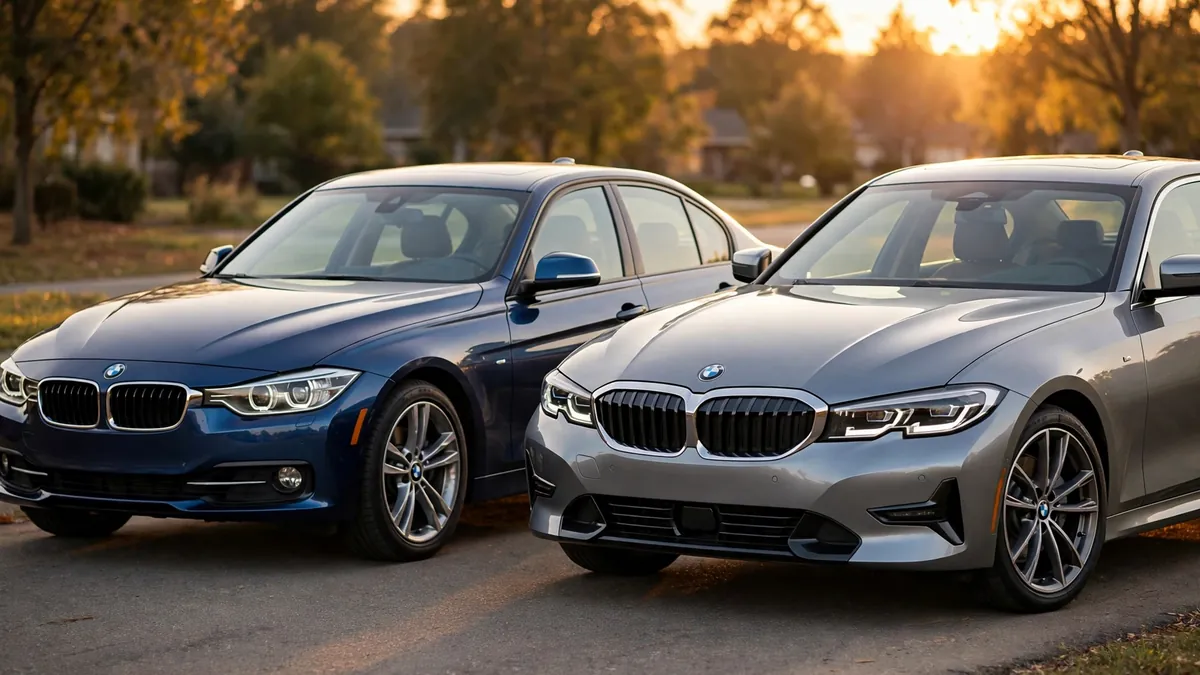
BMW F30 vs G20: Is the Newer 3 Series Worth the Premium?
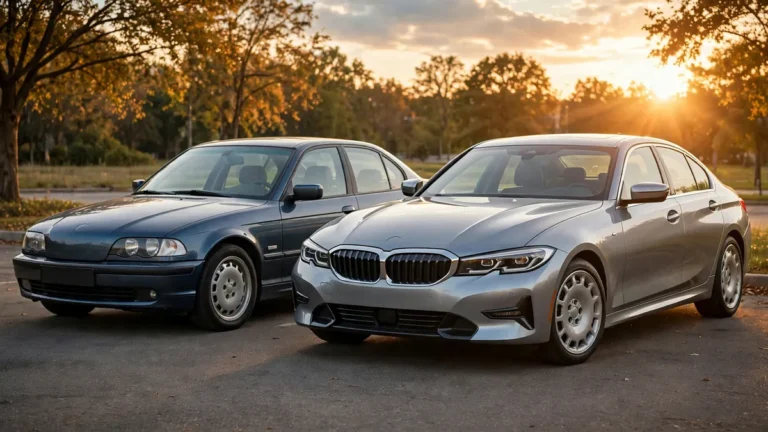
Shopping a used 3 Series usually ends at the same crossroads: the BMW F30 vs G20 decision. The F30 (2012–2018) is now the value play of the used market — thousands cheaper, with the same basic 3 Series formula. The G20 (2019–present) is the sharper, better-equipped, more efficient car — and it commands a real premium for it. The question isn’t which one is better. It’s whether the newer car is worth the extra money to you.
This guide compares the two generations head to head: specs, engines, reliability by engine code, real-world EPA fuel economy, 2026 used prices, and tech — then gives a verdict for three kinds of buyers. If you’re cross-shopping even older metal, our BMW E90 vs F30 comparison covers the previous step back, and the complete 3 Series guide puts every generation in context. More head-to-heads in the comparisons hub.
The short answer
BMW F30 vs G20 comes down to budget versus tech. The G20 (2019–) is the better car: 255-hp B48 power, 30 mpg combined, iDrive 7/8, and far stronger driver aids. The F30 (2012–2018) is the better deal: a late B48/B58 example costs roughly $8,000–$12,000 less and delivers most of the experience. Buy the G20 for tech and refinement; buy a late F30 for maximum value.
- F30 vs G20 specs at a glance
- What actually changed
- Reliability: which holds up better
- Used prices in 2026
- Running costs
- Which should you buy?
- The verdict: is the G20 worth the premium?
- Frequently asked questions
F30 vs G20 specs at a glance
The two generations overlap on the used market, so a like-for-like comparison matters. The table below uses the volume model — the 330i — as the baseline, with six-cylinder options noted separately. Every figure is sourced; notes on where figures vary follow the table.
| Spec | F30 (2012–2018, US) | G20 (2019–present; US MY 2020–) |
|---|---|---|
| 330i engine | 2.0L turbo B48 (2017–18) | 2.0L turbo B46/B48 |
| 330i power / torque | 248 hp / 258 lb-ft | 255 hp / 295 lb-ft |
| Six-cylinder option | 335i N55: 300 hp (2012–15) 340i B58: 320 hp (2016–18) | M340i B58: 382 hp (2020–24); 386 hp (2025+) |
| 0–60 mph (330i) | 5.5 s (Motor Trend instrumented test)* | ~5.0–5.4 s (published figures)* |
| EPA combined MPG (330i RWD) | 27 (24 city / 34 hwy) | 30 (26 city / 36 hwy) |
| Transmission | 8-speed automatic; 6-speed manual offered (RWD) | 8-speed automatic only |
| Wheelbase / length / width | 110.6″ / 182.0″ / 71.3″ | 112.2″ / 185.7″ / 71.9″ |
| Curb weight (330i) | ~3,537 lb (as tested) | 3,582 lb (RWD spec) |
| Cargo volume | ~17 cu ft | ~17 cu ft |
| Platform | Rear-drive F-chassis | CLAR architecture |
| iDrive | NBT (pre-LCI) → NBT Evo, iDrive 5/6 (2016+ LCI) | iDrive 6 → 7 (Live Cockpit Pro); BMW OS 8 on 2022+ LCI |
| Driver assistance | Optional Driver Assistance Package only | Standard lane-departure + collision warning w/ braking; Driving Assistant Professional optional |
A few notes on the table. The 5.5-second F30 330i figure is Motor Trend’s instrumented test of a 3,537-lb 2017 example; other outlets quote closer to 6 seconds for RWD cars, so treat 0–60 as a range. The G20’s published figures cluster around 5.0–5.4 seconds — meaningfully quicker, thanks to the torque jump from 258 to 295 lb-ft at just 1,550 rpm. Don’t overlook the economy delta either: 27 vs 30 mpg combined is an 11% improvement delivered with more power.
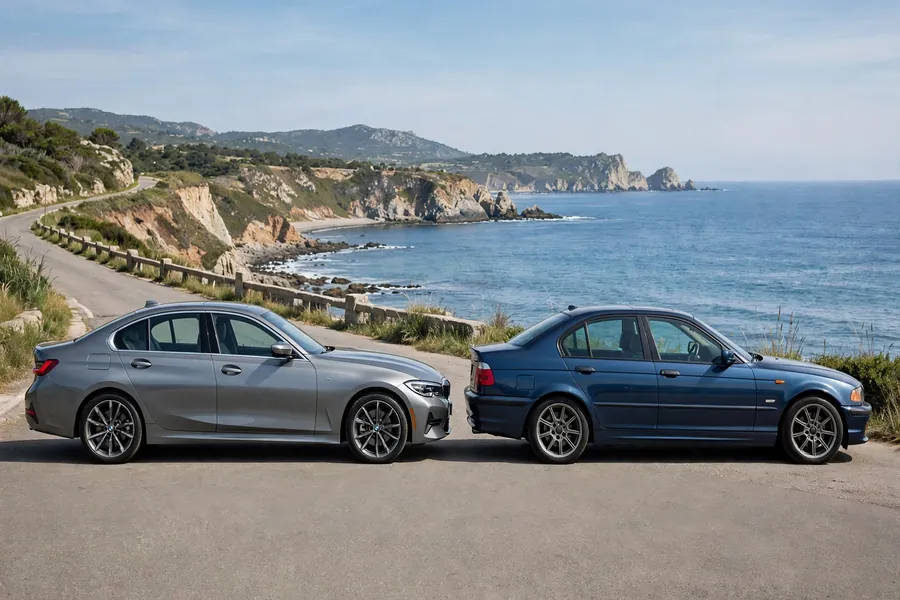
What actually changed between the F30 and G20
Generational changes are easy to wave at and hard to pin down. Here’s what genuinely changed under the skin — and what didn’t.
Platform and chassis
The G20 moved to BMW’s CLAR architecture, the modular rear-drive platform shared across the modern lineup, with a substantially stiffer body structure and retuned suspension geometry. In practice the G20 rides better and corners flatter, where the F30 often forced a choice. The G20 M340i also gets a proper mechanical limited-slip differential; the F30 340i made do with an open diff and brake-based torque trickery.
Engines: N20/N55 out, B48/B58 in
This is the most important change for used buyers. The F30 straddles two engine eras: early cars got the N20 four-cylinder (328i, 240 hp) and N55 six (335i, 300 hp), while 2016+ cars switched to the B48 (330i, 248 hp) and B58 (340i, 320 hp). The G20 launched with the B-family in place: the 330i’s B46/B48 makes 255 hp and 295 lb-ft, the M340i’s B58 makes 382 hp. Our N20 vs N26 deep-dive covers why the four-cylinder swap matters.
Interior and tech: the real generation gap
The F30’s cabin was dated even when new — small screens, limited connectivity, and an iDrive system (NBT, then NBT Evo with iDrive 5/6 from the 2016 facelift) that predates modern smartphone integration. The G20 was a reset: standard 8.8-inch display with iDrive 6, an available 10.25-inch screen with iDrive 7 and digital cluster, the “Hey BMW” assistant, over-the-air updates, and wireless Apple CarPlay. From mid-2020 every G20 got iDrive 7, and 2022+ LCI cars moved to BMW OS 8’s curved display. If you live in your car’s infotainment, this is where the premium pays off.
Driving character
Owners who’ve driven both describe the G20 as more refined yet more dynamic — the rare redesign that improved comfort and sharpness together. The F30’s electric steering was widely criticized as numb, and while the G20’s isn’t universally loved either, the stiffer chassis gives it more composure. One genuine F30 advantage for purists: it was the last 3 Series with a manual gearbox in the US. The G20 is automatic-only.
Bottom line on changes: the G20 is better in nearly every measurable way — power, efficiency, rigidity, tech, standard safety. The F30’s edges are price, a proven parts ecosystem, and the manual gearbox. Nothing about the F30 is bad; the G20 just moved the goalposts.
Reliability: F30 vs G20
Here’s the truth the spec table hides: engine code matters more than chassis code. A late F30 with a B48 is mechanically closer to a G20 than to an early N20 F30. Judge each car by the engine code, not the badge.
| Engine | Found in | Reliability notes |
|---|---|---|
| N20 / N26 2.0T (240 hp / 255 lb-ft) | F30 328i (2012–15) | Timing-chain wear is the documented concern. Demand service history showing chain replacement, or budget for it. |
| N55 3.0T (300 hp / 300 lb-ft) | F30 335i (2012–15) | Notably more problematic than the B-series per specialists: oil leaks, charge-pipe failures, pricier upkeep. |
| B48 2.0T (248 hp / 258 lb-ft) | F30 330i (2017–18) | Solid — no systemic timing-chain defect reported; revised tensioner and cooling fixed the N20’s weak points. |
| B58 3.0T (320 hp / 330 lb-ft) | F30 340i (2016–18) | Strong reputation; one of BMW’s best modern sixes. |
| B46 / B48 2.0T (255 hp / 295 lb-ft) | G20 330i (2019–) | Very reliable engine family. Watch early-car electronics and software, not the engine. |
| B58 3.0T (382 hp / 369 lb-ft) | G20 M340i (2020–24) | Excellent reputation — Toyota chose this engine for the A90 Supra. |
Generation-level patterns: the F30’s risk is concentrated in 2012–2015 N-series cars. A 2017–2018 F30 330i or 340i has essentially G20-grade powertrain reliability — which is why those late F30s hold value well. The G20’s weak spots are electronic rather than mechanical: early infotainment glitches and sensor issues. Independent generation rankings place late F30s and G20s together as the safest used 3 Series bets.
Whichever generation you target, run it through our used BMW 3 Series buying guide inspection checklist before money changes hands, and check the year-by-year breakdown in our BMW 3 Series reliability by year guide.
Non-negotiable on any F30: verify the engine code from the VIN, not the badge. A “328i” is always an N20/N26 car; a “330i” is always a B48. The production date and engine code — not the model year alone — determine the car’s risk profile.
Used prices in 2026: what the gap really looks like
Prices below are a September 2026 US market snapshot from published KBB values and marketplace listings — not a quote. Condition, mileage, and options move individual cars thousands in either direction, so treat these as bands.
- F30 (2012–2018): roughly $10,000–$20,000. KBB valued a base 2018 320i near $13,300 in 2026; a clean 2018 330i xDrive (42k mi) carried a typical listing value around $19,310 (May 2026 KBB data). Early high-mileage N20 cars sit at the bottom; late B48/B58 cars top the band.
- G20 (2019–present): roughly $16,000–$33,000. August 2026 market data: high-mileage 2020 330i near $16,000, 2021–2022 cars at $20,000–$22,300, 2023 330i trending around $30,900 — about 70% of original MSRP after three years.
- The gap: comparing like-for-like 330i examples, expect the G20 to cost about $8,000–$12,000 more than an equivalent F30 — the premium this article is interrogating.
Two forces favor the F30 buyer right now: heavy new-car leasing keeps depressing 3 Series residuals, and the F30 has the deepest used-parts market and most experienced independent-specialist network of any modern BMW. G20 buyers pay for remaining warranty coverage and modern tech.
Before you shop either generation, read the pricing and negotiation section of our used BMW 3 Series buying guide — it covers what to pay and which inspection items are worth paying a specialist to check.
Running costs: fuel, maintenance, and insurance
Purchase price is only the down payment on ownership. Here’s how the two generations compare once you’re driving.
- Fuel: the EPA rates the 2018 F30 330i at $2,850/year vs $2,550/year for the 2020 G20 330i (15,000 miles, premium fuel) — about $300 a year in the G20’s favor. Both require premium. (fueleconomy.gov: 2020 330i | fueleconomy.gov: 2018 330i)
- Maintenance: the F30 is older, so age-related items — suspension bushings, gaskets, cooling-system plastics — arrive sooner regardless of mileage. The G20’s parts are newer and pricier, but 2022+ cars may still carry factory warranty. The F30’s larger independent-specialist network is a genuine cost advantage.
- Insurance: all else equal, the more valuable G20 costs more to insure. Get quotes for both before you decide.
- Depreciation: the F30 has largely finished its steep depreciation curve. The G20 is still sliding — which is why waiting 12–18 months can buy you the newer car at an F30-adjacent price.

Which should you buy?
There is no single right answer to BMW F30 vs G20 — there’s a right answer for you. Pick the buyer profile that fits:
Buy a 2017–2018 F30 330i or 340i. You get the B48/B58 powertrain — essentially G20-grade mechanicals — for $8,000–$12,000 less than the equivalent G20.
- Target 2016+ LCI cars: NBT Evo iDrive, LED lighting, B-series engines.
- Verify engine code and full service history; the late F30’s fault profile is thoroughly understood.
- Avoid 2012–2015 N20/N26 cars unless timing-chain service is documented.
Buy a 2020+ G20 330i — ideally a 2022+ LCI. iDrive 7 or 8, wireless CarPlay, digital cluster, over-the-air updates, and standard collision warning with braking are things no F30 can match, retrofits included.
- 2020+ cars run iDrive 7; 2022+ LCI cars get BMW OS 8’s curved display.
- Look for Driving Assistance Professional if you want adaptive cruise with stop&go and lane-keeping.
- Budget $20,000–$31,000 depending on year and miles (2026 market).
Buy the G20 — M340i if the budget stretches. The CLAR chassis’ rigidity, better damping, and the M340i’s mechanical LSD and 382-hp B58 make it the driver’s choice by a clear margin.
- The M340i (382 hp) outguns the F30 340i (320 hp) everywhere that matters, and the B58’s reputation is excellent.
- Prefer a manual? Then flip the script: a 2016–2018 F30 340i 6-speed is the last manual 3 Series — a future classic.
The verdict: is the G20 worth the premium?
Yes — if you value what the premium buys. The G20 is better in nearly every measurable dimension: more power and torque, 11% better fuel economy, a stiffer chassis, a modern cabin, and standard active safety the F30 never offered.
But the F30 — specifically a 2017–2018 330i or 340i — is the smarter financial move for most buyers. Same B48/B58 engine family, same ZF 8-speed, and a car whose weaknesses are documented and cheaply fixable by any independent BMW shop — for roughly $8,000–$12,000 less.
The only F30 I’d steer you away from is an early N20/N26 car with unknown history: the timing-chain risk turns the bargain into a gamble. And the only G20 I’d question is a brand-new one at full sticker when 2–3-year-old examples trade at 70% of MSRP.
The one-line version: the G20 is worth the premium for tech lovers and driving enthusiasts; the late F30 is worth more than its discount for value hunters. There’s no bad choice here — only a wrong engine code. Verify it before you buy.
Frequently asked questions
Used-price bands reflect published KBB values and marketplace listings from May–August 2026 and will shift with the market. No reliability scores are invented; assessments are qualitative summaries of cited specialist sources. Last verified: September 2026.