BMW 3 Series vs Tesla Model 3 Costs Favor the Tesla
Short answer: Over five years and 75,000 miles, a Tesla Model 3 Standard costs roughly $12,000 less to own than a BMW 330i — about $39,500 vs $51,800 in our baseline model. The entire gap comes from three places: lower purchase depreciation in dollars, ~$6,800 less in energy, and ~$4,000 less in maintenance. Insurance slightly favors the BMW. But those defaults assume home charging at $0.17/kWh; if you rely on public fast chargers, the energy advantage shrinks dramatically. Run your own numbers in the calculator below before deciding.
- The price gap up front
- Tax credits, incentives and the fine print
- Fuel vs electricity: the energy math
- Interactive: 5-year ownership cost comparator
- Maintenance and repairs
- Battery longevity: the 10-year question
- Insurance and depreciation
- The used-EV alternative
- Which Model 3 trim changes the math
- Interactive: per-mile energy cost checker
- The intangibles: time, convenience, hassle
- The verdict
- FAQs
The price gap up front
Every ownership-cost comparison starts at the window sticker, and here the Tesla opens with a commanding lead. The 2026 BMW 330i starts at $48,000 before destination; the 2026 Tesla Model 3 Standard starts at $36,990. That is an $11,000 gap before either car turns a wheel — the single biggest line item in the entire comparison. (Tesla’s pricing moves more often than BMW’s, so verify the current figure before you buy; the Model 3 Performance tops the range at $54,990, which would change this math substantially.)
Two caveats before the Tesla’s lead hardens into gospel. First, transaction prices: BMW dealers routinely discount 330is several thousand dollars below MSRP, while Tesla sells at list price — a $4,000 dealer discount closes more than a third of the sticker gap. Second, equipment: the base Model 3 Standard is well equipped, but BMW’s option structure means a $48,000 330i and a $36,990 Model 3 are not identically specified cars. Our five-year model below uses MSRP for both and lets you adjust; if you can buy the BMW at a real discount, plug that number in.
Tax credits, incentives and the fine print
Before the calculator, a word on the money that does not show up on the window sticker. Federal EV tax credits, state rebates, utility incentives and HOV-lane access can shift this comparison by thousands of dollars — or by nothing at all, depending on where you live and what Congress has done lately. The federal clean-vehicle credit has changed eligibility rules multiple times in recent years, with income caps, MSRP caps and battery-sourcing requirements that phase models in and out. Do not assume any credit applies until you have checked the current rules for your tax situation; a $7,500 credit that you cannot actually claim is not a discount.
State and local incentives are where the real variability lives. Some states stack several thousand dollars in rebates on top of any federal credit; others offer nothing but HOV-lane stickers. Many utilities offer discounted overnight EV rates or rebates on home-charger installation — a $500 utility rebate on that $1,200 charger install is common and meaningfully improves the Tesla’s math. A few employers still offer EV purchase incentives or free workplace charging, which is effectively a salary bump denominated in kilowatt-hours. None of these apply to the BMW, so every dollar of incentive you qualify for lands directly on the Tesla’s side of the ledger.
The honest way to handle incentives: research them as a separate line item, confirm your eligibility in writing, and only then add them to the model. Our calculator deliberately excludes incentives because they vary so wildly — mentally subtract whatever you qualify for from the Tesla’s total. In the best case (generous state rebate plus utility perks), incentives can push the Tesla’s five-year advantage past $15,000. In the worst case (no credits, no rebates), the baseline $12,000 gap stands on its own. Either way, verify before you buy: incentive programs change with budgets and elections, and last year’s forum post is not a tax advisor.
Fuel vs electricity: the energy math
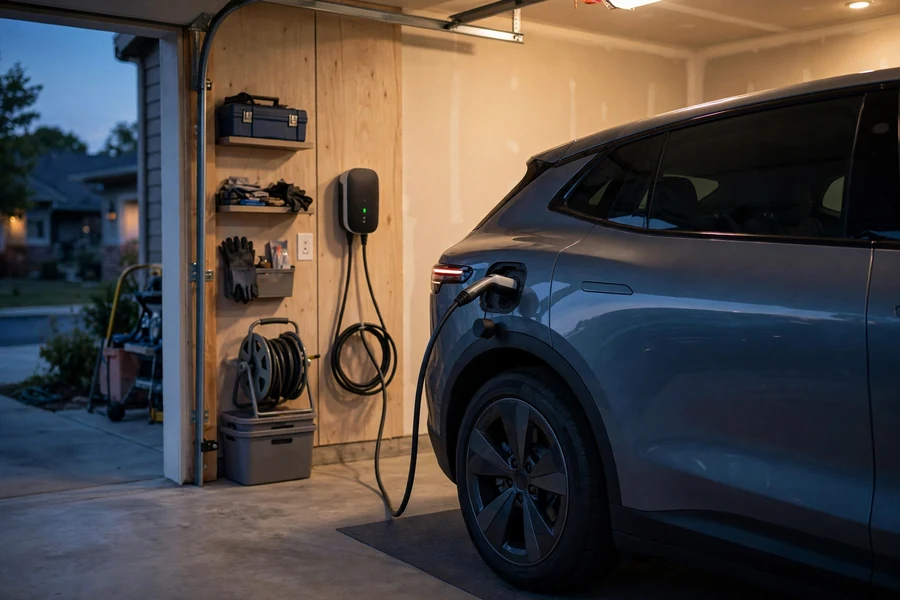
This is the Tesla’s home turf, and the math is not subtle. The 2024 BMW 330i is EPA-rated at 29 mpg combined and requires premium gasoline. At 15,000 miles a year and $4.00/gallon for premium, that is 517 gallons and $2,069 a year — $10,345 over five years. The Model 3 Standard uses roughly 0.25 kWh per mile from the battery; add 10% charging loss and you are buying about 0.275 kWh per mile from the wall. At the national average residential rate of roughly $0.17/kWh, 15,000 miles costs about $701 a year — $3,507 over five years. The Tesla’s energy bill is roughly one-third of the BMW’s.
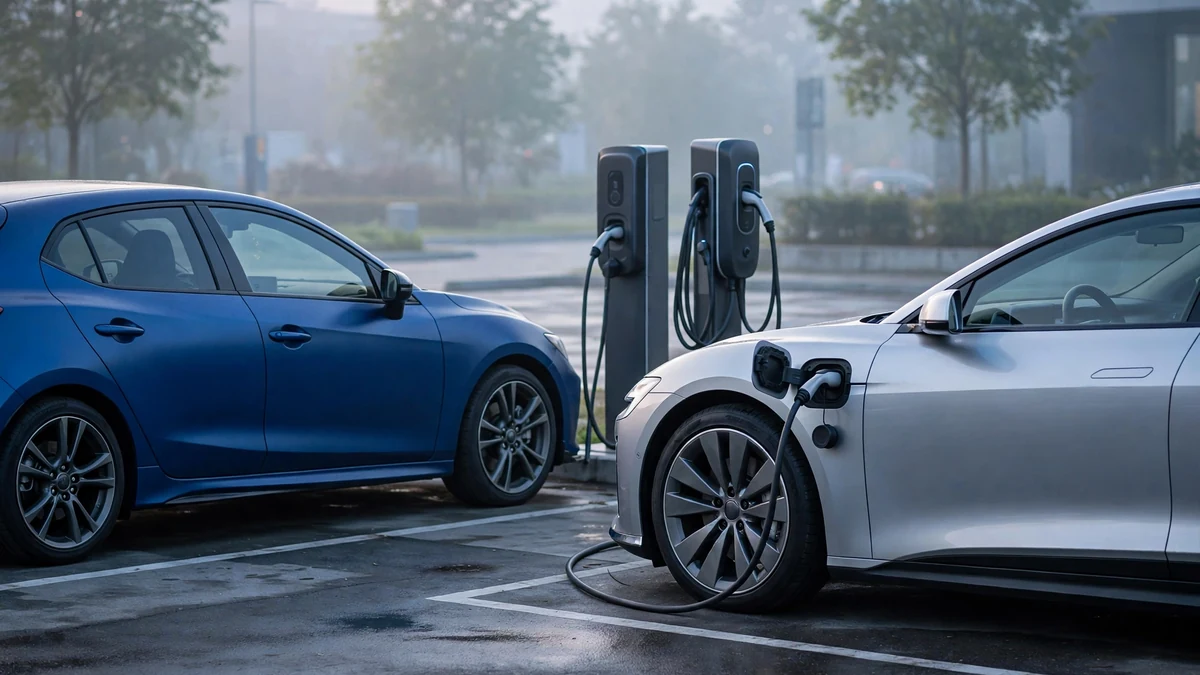
But residential rates are doing a lot of work in that calculation. At $0.32/kWh — common in California and the Northeast — the Tesla’s annual energy cost doubles to about $1,320, and the five-year gap narrows by over $3,000. Rely on public DC fast charging at $0.45–$0.55/kWh and the Tesla can actually cost more per mile than the BMW: 0.275 kWh/mi × $0.50 = $0.138/mile vs the BMW’s $4.00/29 = $0.138/mile. Dead even — before you count the value of your time spent charging. The honest rule: home charging makes the EV case; apartment living without a charger breaks it. Our calculator models this with an adjustable electricity price and an optional home-charger installation cost.
Interactive: 5-year ownership cost comparator
Four inputs, 72 scenarios, one honest answer. The model totals depreciation, energy, maintenance, insurance and charger installation over five years — every assumption is shown, and every default is labeled an estimate you should replace with your own quotes.
Assumptions (estimates — replace with your quotes): BMW 330i $48,000 MSRP, 29 mpg combined, premium fuel; Model 3 Standard $36,990, 0.275 kWh/mi from the wall; maintenance $1,600/yr BMW vs $800/yr Tesla; insurance $1,900/yr BMW vs $2,100/yr Tesla; 5-yr resale 50% BMW / 45% Tesla of MSRP. AAA 2024 category averages (10.89¢/mi medium-sedan maintenance) underpin the BMW figure.
Maintenance and repairs
The Tesla's maintenance advantage is structural, not marginal. No oil changes, no spark plugs, no transmission fluid, and regenerative braking that stretches brake-pad life to 100,000+ miles for gentle drivers. Tesla's published service schedule is essentially: rotate tires, replace the cabin air filter, check brake fluid every few years. Budget roughly $600–$800 a year — mostly tires, which EVs eat faster thanks to instant torque and heavy battery packs. A set of Model 3 tires every 30,000–40,000 miles at $800–$1,200 is the real recurring cost nobody puts in the brochure.
The BMW needs everything the Tesla skips. AAA's 2024 Your Driving Costs study pegs medium-sedan maintenance at 10.89¢/mile — about $1,630 a year at 15,000 miles — and the 330i lands right on that average: annual oil services, spark plugs every 60,000 miles, brake fluid every two years, and brake pads/rotors that cost $800–$1,200 per axle at a specialist. BMW Ultimate Care covers scheduled maintenance for 3 years / 36,000 miles, which erases the early bills, but years four and five are on you. Our 3 Series maintenance schedule lists every interval and typical cost.
The wildcard is out-of-warranty repairs. A failed Tesla battery pack or drive unit outside warranty is a five-figure event — rare, but catastrophic enough to mention, and one reason to consider Tesla's extended coverage. The BMW's risks are more granular: cooling-system components, the occasional sensor or actuator, and the B46 engine's general need for strict oil discipline. Neither car is a repair-cost disaster by German-luxury standards, but the Tesla's repair distribution has a fatter catastrophic tail. That tail is exactly what warranties are for.

Battery longevity: the 10-year question
Five-year cost models flatter the Tesla because five years is comfortably inside the battery warranty — but what happens in year eight, nine or ten is the question that keeps potential EV buyers up at night, and it deserves an honest answer. Tesla's battery warranty covers 8 years / 100,000–120,000 miles (depending on trim) against excessive degradation, typically guaranteeing at least 70% of original capacity. Real-world data from high-mileage Model 3s shows degradation of roughly 10–15% over 150,000–200,000 miles for cars that are mostly home-charged and rarely run to zero. That is far better than early-EV pessimists predicted, and it means most owners will never think about the battery at all.
The risk is not gradual degradation — it is the rare catastrophic failure outside warranty. A replacement battery pack runs well into five figures, a bill that would erase the Tesla's entire ownership-cost advantage in a single invoice. How rare? Rare enough that it does not show up meaningfully in reliability surveys, common enough that owner forums have threads about it. Your mitigation is the warranty itself: buy new or CPO with warranty remaining, and if you plan to keep the car past year eight, price Tesla's extended service coverage the way you would price any insurance policy against a low-probability, high-severity event.
The BMW's long-term risk profile is the mirror image: no single catastrophic bill, but a steady drumbeat of four-figure maintenance as the car ages. Cooling-system refreshes, suspension bushings, the occasional turbo or fuel-system component — our reliability-by-year data shows the pattern clearly. Over ten years the BMW's cumulative maintenance likely exceeds the Tesla's even accounting for battery risk, but the BMW's costs arrive as manageable installments while the Tesla's arrive (rarely) as a meteor strike. Which risk profile lets you sleep better is a personality question, not a math question.
Insurance and depreciation
Insurance is the one running-cost category where the BMW typically wins. Teslas are disproportionately expensive to insure: aluminum body construction, expensive sensor-laden parts, and a repair network that steers work toward Tesla-approved shops all push premiums up. Expect the Model 3 to cost $100–$300 a year more to insure than a 330i for the same driver — our model uses $2,100 vs $1,900 as planning estimates, but get real quotes, because your age, record and ZIP code swing this more than any other line item. Shop both cars before you buy; the difference occasionally surprises people into switching sides.
Depreciation is the heavyweight bout, and it is closer than the sticker gap suggests. Our model assumes the BMW retains 50% of MSRP after five years and the Tesla 45% — the Tesla loses a smaller percentage of a much smaller number, so its dollar depreciation ($20,300) still beats the BMW's ($24,000). But Tesla depreciation is volatile: the company's history of sudden price cuts has periodically cratered used values overnight, a risk BMW's steadier pricing does not carry. If Tesla cuts the Model 3's price again in year three, your resale estimate is fiction. The BMW's depreciation curve is boring, and boring is valuable when it is your money.
The used-EV alternative
Everything above assumes buying new, but the used market offers a third path that deserves its own paragraph: a two-to-three-year-old Model 3. Tesla's history of price cuts has been brutal for first owners and wonderful for second owners — used Model 3s routinely trade at 40–55% of their original MSRP with plenty of battery warranty remaining. A used Model 3 at $22,000–$26,000 with 30,000 miles rewrites the comparison so thoroughly that the BMW stops being a cost competitor at all; at that point you are choosing between a cheap EV and a nicer-driving BMW, and cost has exited the conversation.
Buying a used EV has its own checklist. Get a battery-health report — Tesla's service mode and several third-party tools can show degradation and charge-cycle history — and favor cars with documented home-charging histories over former fleet or rideshare vehicles that lived on fast chargers. Check remaining battery and drive-unit warranty by VIN, and remember that Tesla's used-vehicle warranty adds limited coverage on top. Tires, as always with EVs, are the hidden cost: inspect tread depth carefully, because a used Model 3 needing an immediate $1,000 set of tires is less of a bargain than it looked.
The mirror-image play — a used BMW 330i — is equally compelling and arguably the enthusiast's best move. A two-year-old CPO 330i at $35,000–$38,000 with warranty coverage attacks the Tesla's biggest advantage (depreciation dollars) directly while keeping the BMW's driving superiority. Our used 3 Series buying guide walks through the inspection process. If your heart wants the BMW but your spreadsheet wants the Tesla, a CPO 330i is the compromise that satisfies both — the only loser is the new-car smell.
Which Model 3 trim changes the math
Our model uses the Model 3 Standard at $36,990, but Tesla's lineup spans a wide range and each step up rewrites the comparison. The Long Range trim — typically around $44,000–$47,000 depending on current pricing — closes roughly half the sticker gap to the BMW while adding range that meaningfully improves the road-trip case. Its ownership math still beats the 330i comfortably, because the energy and maintenance advantages are identical and only the depreciation dollars grow. For most buyers, the Long Range is the rational sweet spot: the Standard's value with the road-trip usability the base car lacks.
The Performance trim at $54,990 is a different animal entirely — and the one that makes this comparison genuinely uncomfortable for BMW. It costs $7,000 more than the 330i up front, runs 0–60 in under 3 seconds, and still costs less to fuel and maintain than the BMW. Against a 330i it is overkill; against an M340i (which starts in the low $60,000s) it becomes the value-performance play of the segment. If outright pace matters to you, price a Model 3 Performance against an M340i rather than a 330i — the Tesla is thousands cheaper to buy and thousands cheaper to run, and the only thing it cannot do is sound like a B58.
On the BMW side, the trim walk runs the other direction. A well-optioned 330i xDrive with M Sport, Premium and driver-assistance packages can crest $55,000 — at which point you are paying M340i-adjacent money for 330i running costs, the worst of both worlds. Keep the 330i sensibly specified (M Sport and little else) to preserve its value proposition, or step up to the M340i if the budget allows. Either way, compare like with like: a loaded 330i against a base Model 3 is not the comparison either car's fans think it is.
Interactive: per-mile energy cost checker
Strip out everything but energy. Three inputs show you exactly what each mile costs in fuel or electricity — the number that decides whether the EV case works for your utility rates.
The intangibles: time, convenience, hassle
Spreadsheets miss the texture of ownership, and the texture favors whoever matches your life. Home charging is the Tesla's killer feature that no calculator captures: you spend zero minutes at gas stations, ever, and every morning starts with a "full tank." Road trips invert the advantage — charging stops add real time to long journeys, the Supercharger network is excellent but not gasoline-excellent, and winter range loss of 20–30% is a fact of battery chemistry. The BMW asks nothing of your infrastructure and gives you 400+ miles of range in five minutes at any of 100,000 gas stations.
Then there is the driving itself, which no cost model prices. The 330i is the better driver's car — rear-drive balance, communicative steering, an engine with character. The Model 3 is the better gadget — instant torque, one-pedal driving, software updates that add features overnight. Service experiences differ too: BMW's dealer network is vast and familiar; Tesla's service is app-based, occasionally brilliant and occasionally maddening, with parts delays that owner forums document in detail. If you have read this far, you probably already know which of those paragraphs made you lean forward.
Finally, consider the calendar. If you replace cars every three years, the Tesla's advantage is smaller than our five-year model shows — depreciation dominates short ownership and the BMW's steadier residuals help it. If you keep cars for ten years, the Tesla's advantage compounds — years six through ten are nearly free of maintenance on the EV while the BMW's bills grow. The five-year window is the fair middle ground, but your personal replacement cycle moves the answer. Short holders: the gap narrows. Long holders: the Tesla runs away with it.

The verdict
On pure cost, the Tesla Model 3 wins and it is not close — roughly $12,000 over five years in our baseline, driven by a lower purchase price, one-third the energy bill and half the maintenance. If your decision is financial and you can charge at home, the spreadsheet has spoken: buy the Tesla, bank the difference, and never think about it again. The result is robust across most realistic inputs — only expensive electricity or very low mileage meaningfully closes the gap.
But nobody cross-shops a BMW 3 Series and a Tesla Model 3 on cost alone, because they are not the same kind of object. The 330i is for the buyer who loves driving: the steering feel, the engine note, the sense that the car was tuned by people who enjoy back roads. The Model 3 is for the buyer who loves the future: the tech, the silence, the feeling of never visiting a gas station. Our used 3 Series buying guide can cut the BMW's purchase price dramatically — a two-year-old CPO 330i rewrites this entire comparison — while Tesla's fixed pricing offers no such escape hatch.
The honest answer: buy the Tesla if you want the cheaper, easier, more rational car. Buy the BMW if you want the one you will look back at in the parking lot. Both are defensible; only one of them makes your heart beat faster, and cost-per-mile has never measured that. If you are still torn, our 3 Series reliability breakdown and the calculators above have the rest of what you need — and whichever you choose, buy the very best-maintained example you can find.
FAQs
Is a Tesla Model 3 cheaper to own than a BMW 3 Series?
Yes, in most scenarios. Our five-year model puts the Model 3 Standard about $12,000 ahead of a BMW 330i at 15,000 miles/year with home charging — through lower depreciation dollars, one-third the energy cost and roughly half the maintenance. Expensive electricity or no home charger narrows the gap substantially.
How much does it cost to charge a Tesla Model 3 vs fueling a BMW 330i?
At $0.17/kWh home electricity, a Model 3 costs about $700/year in energy for 15,000 miles; the 330i costs about $2,070/year in premium fuel at $4.00/gal. But at $0.50/kWh public fast charging, the Tesla's per-mile cost roughly equals the BMW's — and winter range loss of 20–30% pushes real-world EV energy use higher in cold climates. Your utility rate, not the car, decides this one.
Do Teslas really need less maintenance than BMWs?
Yes — structurally. No oil changes, spark plugs or transmission services, and regenerative braking extends pad life enormously. Budget roughly $600–$800/year for the Tesla (mostly tires, which EVs wear faster due to instant torque and battery weight) vs about $1,600/year for the 330i at AAA's medium-sedan average, though the BMW includes 3 years/36,000 miles of scheduled maintenance. The Tesla's advantage is smallest in years 1–3 (when the BMW's maintenance is free) and largest from year 4 onward.
Is Tesla insurance more expensive than BMW insurance?
Usually, yes. Teslas typically cost $100–$300/year more to insure than a comparable 330i due to aluminum construction, expensive sensors and a constrained repair network. Get quotes for both cars before buying — your driver profile matters more than the badge.
Should I buy a used BMW 330i instead of a new Tesla Model 3?
It can flip the math. A two-year-old CPO 330i at a steep discount erases much of the Tesla's purchase-price advantage while keeping the BMW's driving appeal — and CPO warranty coverage de-risks the BMW's year-4-and-beyond maintenance. Run the calculator with the actual used price: depreciation is the biggest line item in this comparison, and buying used attacks it directly on either side.
Did the calculator change your mind? Tell us your real-world numbers in the comments — owner data beats estimates every time.