Coilovers Beat Lowering Springs for Serious Track Use
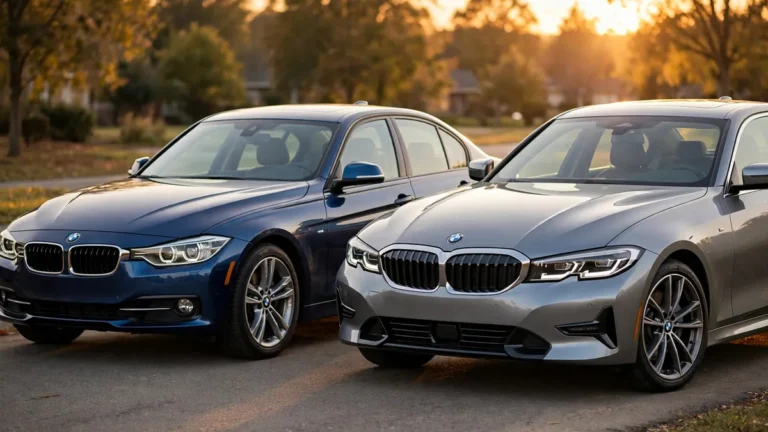
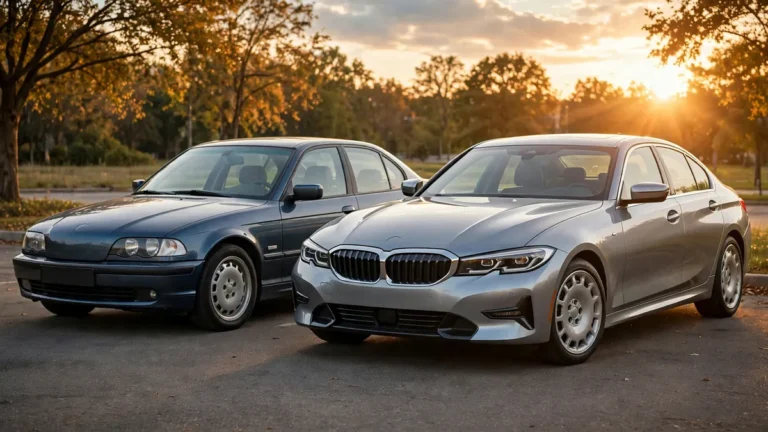
Park two identical BMW 3 Series side by side — one on lowering springs, one on coilovers — and most people can’t tell which is which until they drive them. Both close the wheel gap, both sharpen the turn-in, both make the car look like it should have from the factory. But under the sheet metal, they are completely different engineering answers to the same question, and choosing the wrong one is how owners end up with a daily driver that crashes over expansion joints or a track car whose ride height can never quite be dialed in.
This is the upgrade guide: springs versus coilovers as a deliberate modification, what each one actually changes, what each one costs all-in, and which one your use case justifies. Replacing worn-out dampers because the car bounces or clunks is a different job entirely — that is a repair decision, not an upgrade decision, and it is covered separately.
Short answer
The coilovers vs lowering springs decision comes down to adjustability. Lowering springs ($300–$400 for a quality set) drop a 3 Series roughly 1.0–1.6 inches and reuse your stock dampers — cheap, simple, and fine for a modest drop on a daily driver. Coilovers ($1,000–$3,500 for the kit) replace the spring and damper as a matched unit with adjustable ride height (typically 1.0–2.5 inches of lowering on published F30 specs) and, on pricier kits, adjustable damping. If you want a specific drop, track the car, or need damping control, coilovers are the honest answer. If you want a subtler stance on a daily driver for the least money, springs win — but never install them on worn dampers.
In this guide
- What you are actually choosing between
- Springs vs coilovers vs stock: the head-to-head table
- Real drop figures: what the brands actually publish
- The full cost picture: parts, install, alignment
- Interactive: coilover or springs? The decision tool
- Ride quality: what actually changes on the road
- E90 vs F30 vs G20: fitment notes that matter
- Interactive: total-cost estimator
- The damper trap: never lower on worn shocks
- DIY or shop? An honest difficulty rating
- Winter, practicality, and resale
- Frequently asked questions
What you are actually choosing between
A lowering-spring kit is exactly what it sounds like: four shorter, stiffer coil springs that bolt into the factory locations and reuse your car’s existing dampers (shocks and struts). The spring rate is fixed, the drop is fixed, and the damping is whatever your current dampers provide. A quality kit like H&R Sport or the Eibach Pro-Kit runs about $300–$400 for all four springs, installs in the same places the stock springs sat, and changes nothing else about the car. It is the smallest possible intervention that lowers a 3 Series.
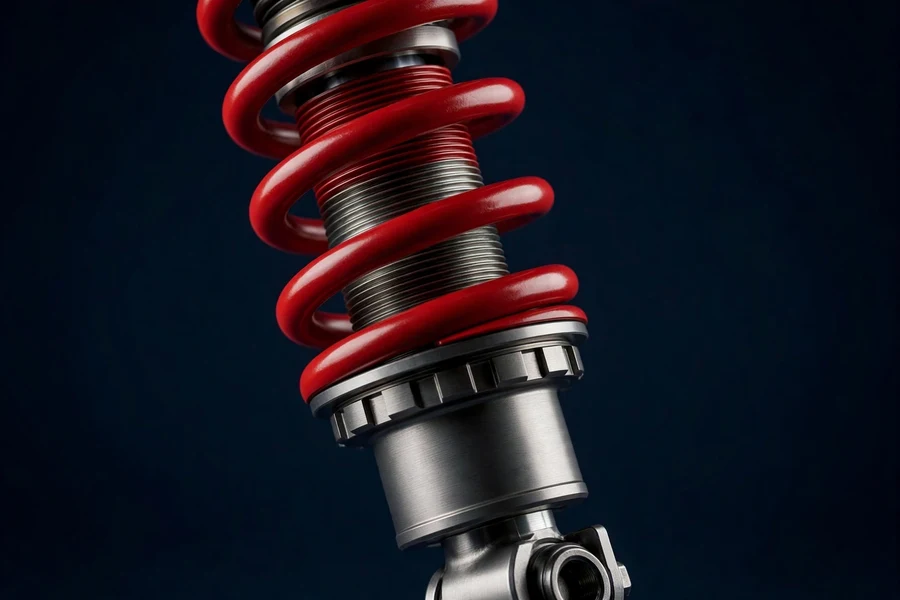
A coilover kit replaces the spring and the damper as a matched assembly — the coil spring literally wraps over the damper, hence “coil-over”. Because the damper body is threaded, ride height adjusts by moving the spring perch up or down, and on mid-range and premium kits the damping itself adjusts with knobs on top of the strut (rebound, and on three-way kits, low- and high-speed compression separately). You get a spring and damper engineered to work together at lowered ride height, plus the ability to change your mind about stance and damping later without buying new parts.
There is a meaningful middle ground worth naming: lowering springs paired with new performance dampers (Bilstein B8 and Koni Sport are the classic partners, both valved specifically for lowered springs). This combo costs more than springs alone and loses the height adjustability of coilovers, but it fixes the most common springs complaint — tired factory dampers trying to control stiffer springs — and for a pure street car it is arguably the best-riding option of the three.
Springs vs coilovers vs stock: the head-to-head table
Before the numbers, the honest summary. Nothing here replaces driving both setups, but this is where the trade-offs land for an E90, F30, or G20 used as a real car:
| Stock suspension | Lowering springs | Coilovers | |
|---|---|---|---|
| Typical total cost (parts + install + alignment) | $0 (baseline) | $800–$1,400 | $1,700–$4,500+ |
| Ride-height adjustability | None | None — fixed drop | Yes, typically 1–2.5 in of range |
| Damping adjustability | None (except adaptive cars) | None | On kits above ~$1,800 |
| Ride quality, daily driving | Best | Slightly firmer; can get crashy on worn dampers | Varies widely — good kits ride well, cheap kits punish |
| Handling gain | Baseline | Moderate: less roll, sharper turn-in | Largest: matched damping + alignment-friendly geometry |
| Install difficulty | — | Moderate DIY (spring compressor needed) | Moderate DIY; corner balancing is shop-only |
| Damper life | Normal | Can shorten life of old stock dampers | Fresh matched dampers included |
| Reversibility | — | Easy — keep your stock springs | Easy — keep the whole stock assembly |
The row most buyers underestimate is damping adjustability. A fixed spring kit commits you to one ride character forever. A damping-adjustable coilover lets you soften the car for a road trip and firm it up for a track day with a few clicks — which is exactly why coilovers beat lowering springs for serious track use, and why springs can be the smarter buy for everyone else.
Real drop figures: what the brands actually publish
Published lowering figures are measured from stock non-sport ride height, and cars that left the factory with the M Sport suspension already sit about 10 mm lower — so expect roughly 0.4 inches less drop on an M Sport car. Every figure below comes from the manufacturer’s own published specifications, not forum estimates.
| Kit | Generation | Front drop | Rear drop | Adjustable? |
|---|---|---|---|---|
| H&R Sport springs | E90 (50490) | 1.3 in | 1.2 in | No |
| H&R Race springs | E90 (50490-88) | 2.0 in | 1.5 in | No |
| H&R Sport springs | F30 (28878-2) | 1.5 in (1.3 in w/ sport susp.) | 1.0 in (0.7 in w/ sport susp.) | No |
| H&R Sport springs | G20 330i (28662-1/2) | 1.6 in (1.1–1.2 in w/ sport susp.) | 1.5 in (1.1–1.2 in w/ sport susp.) | No |
| Eibach Pro-Kit | F30 | ~1.0–1.2 in (25–30 mm) | ~1.0 in (25 mm) | No |
| KW V1 coilovers | F30 RWD | 1.6–2.5 in | 1.2–2.4 in | Height |
| KW V1 coilovers | F30 xDrive | 1.0–2.2 in | 1.2–2.4 in | Height |
| KW V1 coilovers | G20 330i xDrive | 1.0–1.8 in (25–45 mm) | 1.0–1.8 in (25–45 mm) | Height |
| KW V1 coilovers | G20 RWD | 1.6–2.4 in (40–60 mm) | 1.6–2.4 in (40–60 mm) | Height |
| Bilstein B14 coilovers | E90 / F30 / G20 | 1.2–2.0 in (30–50 mm) | 1.2–2.0 in (30–50 mm) | Height |
Two things jump out. First, a quality spring kit lands you at roughly 1.0–1.6 inches of drop — the same place as the middle of most coilovers’ range. Springs are not “less low”; they are less adjustable. Second, the coilover ranges are wide: KW’s published V1 range for a rear-drive F30 spans 1.6 to 2.5 inches up front, which means a coilover owner can run a conservative 1.25-inch drop in winter and a 2-inch stance in summer without buying anything new. That seasonal flexibility is a genuine coilover advantage that no spring kit can match. (Drop figures: H&R per the manufacturer’s published specifications; Eibach per Eibach’s published Pro-Kit data; KW V1 per KW’s published V1 specs; Bilstein B14 per Bilstein’s published B14 documentation.)
The full cost picture: parts, install, alignment
Parts prices are the easy part. The expensive part of lowering a BMW is labor and everything the labor touches: the alignment you must do afterward, the mounts and hardware that should be replaced while everything is apart, and on coilovers, the optional-but-worthwhile corner balance. The bands below are owner-reported US figures from 2025–2026; your zip code moves them, so treat them as planning ranges and get three local quotes.
| Item | Lowering springs | Budget coilovers | Premium coilovers |
|---|---|---|---|
| Parts (set of 4 corners) | $300–$400 (H&R MSRP $389; H&R G20 kit $399) | $1,000–$1,450 (Bilstein B14 advertised ~$1,099–$1,380; BC Racing BR ~$1,145 owner-reported) | $2,000–$3,500 (KW V1 advertised ~$2,094; KW V3 ~$2,900–$3,400 owner-reported) |
| Install, independent BMW shop | $400–$800 (owner-reported; one well-documented Euro-shop job was $800 including alignment) | $600–$1,000 | $600–$1,000 |
| Install, dealer | $700–$1,100 | $1,000–$1,600 | $1,000–$1,600 |
| Alignment (mandatory after) | $100–$160 (BMW specialists often $200–$260) | $100–$160 | $100–$160 |
| Corner balance (coilovers only, recommended) | — | $150–$300 extra | $150–$300 extra |
| Realistic all-in, independent shop | $800–$1,400 | $1,700–$2,900 | $2,800–$4,800 |
Notice what the table does to the “springs are half the price” narrative: springs plus a shop install plus alignment is roughly $800–$1,400, while a budget coilover setup all-in is $1,700–$2,900. The gap is real but smaller than the parts prices suggest, because labor and alignment cost the same either way. And springs carry a hidden second bill: if your dampers have more than ~80,000 miles on them, stiffer lowering springs will finish them off, and you will pay for the same labor twice when the shocks get replaced. That is the single most common way a “cheap” spring job becomes the expensive option — which is why pairing springs with fresh performance dampers in one job is often the smart-money street setup.
Interactive: coilover or springs? The decision tool
Answer five questions about your budget, your car, and how you drive — the tool walks a decision tree and tells you which path fits, with the reasoning spelled out. It is tuned for E90, F30, and G20 3 Series owners.
Coilover or springs? Decision tool
Ride quality: what actually changes on the road
Lowering changes three things about how a 3 Series rides, and only one of them is the spring rate. First, the spring itself gets stiffer — a lowering spring is typically 10–25% stiffer than stock, so small sharp inputs (expansion joints, pothole edges) come through harder. Second, and more important, you lose bump travel: the damper has less stroke before it hits the bump stop, so big compressions that the stock car absorbed now bottom out sooner and feel abrupt. This is why a spring kit on a car with 120,000-mile dampers rides terribly — it is not the spring’s fault, it is the exhausted damper running out of travel and control at the same time.
Third is the part owners notice months later: everything connected to the suspension now works at a different angle. Lowering a 3 Series more than about 1.5 inches pushes static camber more negative, which wears the inner edges of tires faster if the alignment is not corrected — and on some E90 setups there is not enough factory adjustment to fully correct a big drop, which is exactly why camber correction is strongly recommended with H&R’s 2.0-inch Race springs. Control arm bushings also live shorter lives at altered angles; our control arm bushing guide covers the shimmy that results when they fail.
Coilovers handle the travel problem better because the kit is engineered around the lowered height: shorter damper bodies, matched bump stops, and spring rates chosen for the reduced stroke. A good fixed coilover (KW V1, Bilstein B14) generally rides better than lowering springs on worn stock dampers, even though it is the “sportier” product — matched damping beats mismatched damping every time. Cheap coilovers invert this: stiff springs on crude dampers with poor low-speed control produce the pogo-stick ride that gives coilovers their bad reputation. And one BMW-specific wrinkle: if your car still wears run-flat tires, their stiff sidewalls stack with the firmer suspension — many owners report that ditching run-flats (see our run-flat vs regular tires comparison) improves ride more than any spring choice.
E90 vs F30 vs G20: fitment notes that matter
The three generations share the same basic layout — MacPherson struts up front, multi-link rear — but the details that bite buyers differ. Get these wrong and you order a kit that physically does not fit your car.
E90 (2006–2013). The oldest and cheapest chassis to lower, with the most mature aftermarket. Two notes: the rear suspension uses a separate spring and damper rather than a true coilover at the back, so E90 “coilover” kits ship with rear height adjusters plus dampers — normal, not a defect. And xDrive E90s need xDrive-specific front struts; a rear-drive kit will not bolt onto an xi. H&R’s Race spring (2.0 in front / 1.5 in rear) is the most aggressive fixed drop listed for this chassis, and vendor fitment notes recommend camber correction at the front axle with it. If your E90 still has its original dampers, they are done — budget for fresh dampers with the springs or go straight to coilovers.
F30 (2012–2019). The volume generation for this upgrade, and the best-documented. The key fork is EDC (Electronic Damper Control): cars ordered with adaptive dampers need either a coilover kit with EDC cancellation modules (KW ships these in the relevant V1 kits) or the system coded out — otherwise you get a dashboard warning and a car that defaults to a firm failsafe map. RWD and xDrive cars take different kits with different published lowering ranges (KW V1: 1.6–2.5 in front on RWD, 1.0–2.2 in on xDrive). Our xDrive vs RWD comparison covers the drivetrain differences that drive these fitment splits.
G20 (2019+). Newest, and the most electronically entangled. Cars with the Adaptive M suspension have electronically controlled dampers, so the same EDC-cancellation logic applies — and H&R’s G20 kit (28662-1/2) is explicitly designed to work with adaptive suspension, which is not true of every spring on the market. The G20’s published drops are also the largest of the three generations (up to 1.6 in front / 1.5 in rear on a non-sport car, per H&R), partly because the car sits taller from the factory. Because the newest G20s are still under factory warranty, this is the generation where a dealer-installed setup (or at minimum a conversation with your service advisor) matters most for warranty peace of mind.
Interactive: total-cost estimator
Pick your path, your installer, and whether alignment is included — the estimator builds the all-in band from the owner-reported ranges in this guide. Parts prices are advertised/typical US figures; labor is the 2025–2026 owner-reported range.
Lowering total-cost estimator
The damper trap: never lower on worn shocks
This is the mistake that produces most of the “lowering springs ride terribly” stories. Factory dampers are wear items: by 80,000–100,000 miles most are significantly degraded, even if the car does not obviously bounce. A stiffer lowering spring asks the damper to control more energy with less travel — exactly the conditions a worn damper fails at. The result is the worst of both worlds: harsher over sharp bumps and floatier over dips, because the damper can neither absorb the hit nor settle the rebound.
The fix is sequencing, not spending more on springs. If your dampers have real mileage on them, do one of three things: pair the springs with new performance dampers in the same job (one labor charge instead of two), go straight to coilovers (fresh matched dampers included), or replace the worn dampers first and lower later. If your 3 Series is bouncing after bumps, clunking over rough pavement, or leaking oil from a strut, that is a repair — worn dampers need replacement on their own terms, not as part of an upgrade. And keep the stock springs and struts you remove: they are your free ticket back to factory ride height if you ever sell the car to someone who wants it stock.
DIY or shop? An honest difficulty rating
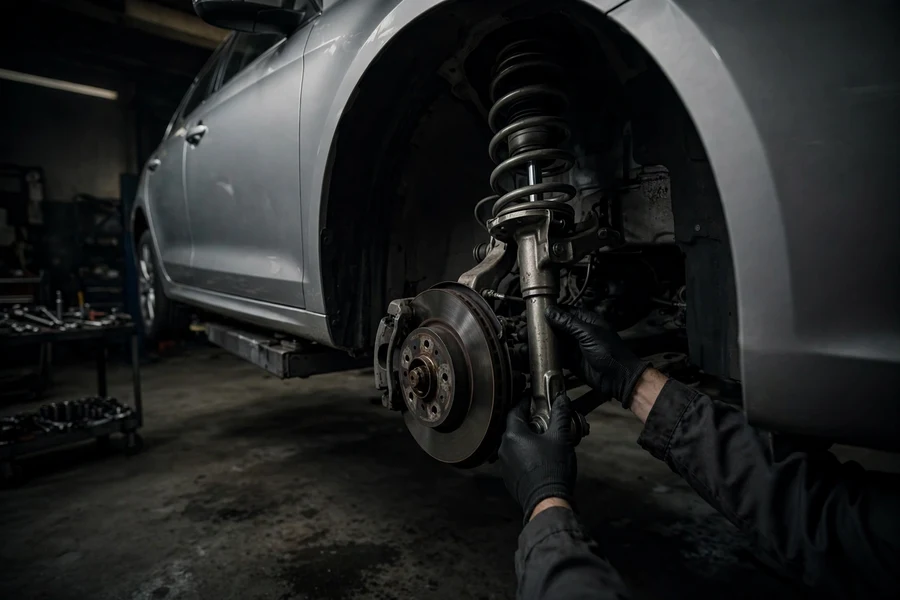
Difficulty: 5/10 for a competent home mechanic — with one genuinely dangerous step. Swapping strut assemblies is straightforward wrenching: the car goes up safely (see our guide to jacking up a 3 Series safely), wheels come off, and the strut unbolts from the knuckle and the tower. The danger is the front spring compressor: a compressed coil spring stores enough energy to kill you if a cheap compressor slips. Rent a proper wall-mounted or quality claw compressor, never the cheapest threaded-rod set, and if the spring looks sketchy at any point, stop and take the assembled strut to a shop for the swap — most will compress and swap springs for a small fee.
The rear is easier on all three generations (the spring and damper are separate, so no compressor needed back there). Plan a full weekend day for your first attempt, replace the strut mounts and bump stops while everything is apart (they are cheap and you are already paying the labor in your own time), and torque every fastener to BMW’s published specs — suspension bolts are not a place for guesswork. The alignment afterward is non-negotiable and shop-only. Coilovers add one more shop-only step if you want them done right: corner balancing, which sets the car’s weight distribution per corner after ride height is set.
Winter, practicality, and resale
A lowered 3 Series in a snow state is a lifestyle decision. Every inch of drop is an inch less clearance over the snow berm at the end of your driveway and the ice chunk in the intersection. Coilovers have the honest answer here: raise the car for winter, lower it for summer, thirty minutes a corner once you have done it once. Spring owners either live with it or budget for a winter wheel setup with a taller sidewall to claw back clearance. Either way, rinse the underbody regularly — salt on coilover threads seizes adjusters solid, which is why stainless-bodied kits (KW’s inox-line is the well-known example) exist.
On resale, suspension mods are neutral to slightly negative for most buyers: enthusiasts will pay for a quality setup with receipts, everyone else sees a car that was “messed with.” Keeping the complete stock suspension — labeled, in a corner of the garage — is the cheapest resale insurance in this hobby. It costs nothing to store and lets you return the car to stock in a day if the next buyer wants it that way. For the full picture of what these cars are worth and what to look for when buying one already modified, our complete 3 Series guide is the starting point.
Frequently asked questions
Are coilovers worth it over lowering springs for a daily driver?
Usually not, unless you specifically want height or damping adjustability. A quality spring kit (or springs plus fresh performance dampers) gives a daily driver 90% of the look and handling improvement for roughly half the all-in cost. Coilovers earn their premium when your drop target might change, you drive in winter and want to raise the car seasonally, or you track the car.
How much lower can I go before I need an alignment correction kit?
Every lowering job needs an alignment, full stop. Up to about 1.5 inches, the factory adjustment range on E90/F30/G20 cars can usually bring camber and toe back into spec. Past 2 inches — H&R Race spring territory on the E90 — you are likely to run out of factory camber adjustment up front and should budget for camber plates or adjustable arms, or the inner edges of your tires will pay for it.
Do I need an alignment after installing lowering springs or coilovers?
Yes — mandatory, not optional. Changing ride height changes camber and toe at every corner. Driving without an alignment after lowering will wear tires unevenly within a few thousand miles and the car will not track straight. Budget $110–$160 for the alignment (BMW specialists often charge $200–$260) and have it done after the suspension has settled for a week or after final ride-height adjustment on coilovers.
Can I install lowering springs on my stock shocks?
Physically yes, and the spring manufacturers design for it — but only if the dampers are healthy. On dampers with under ~60,000 miles, springs on stock shocks ride acceptably. Past ~80,000 miles, the worn dampers cannot control the stiffer springs and the ride falls apart. Either replace the dampers in the same job or choose coilovers, which include fresh matched dampers by design.
Will lowering my BMW void the warranty?
In the US, the Magnuson-Moss Warranty Act means a dealer must prove the modification caused the failure to deny a claim — lowering springs alone do not void your whole warranty. In practice, expect pushback on suspension, steering, and drivetrain claims on a lowered car, especially on a G20 still under factory coverage. Keep receipts, keep the stock parts, and for a newer car consider having the dealer do the install so there is no argument about workmanship.