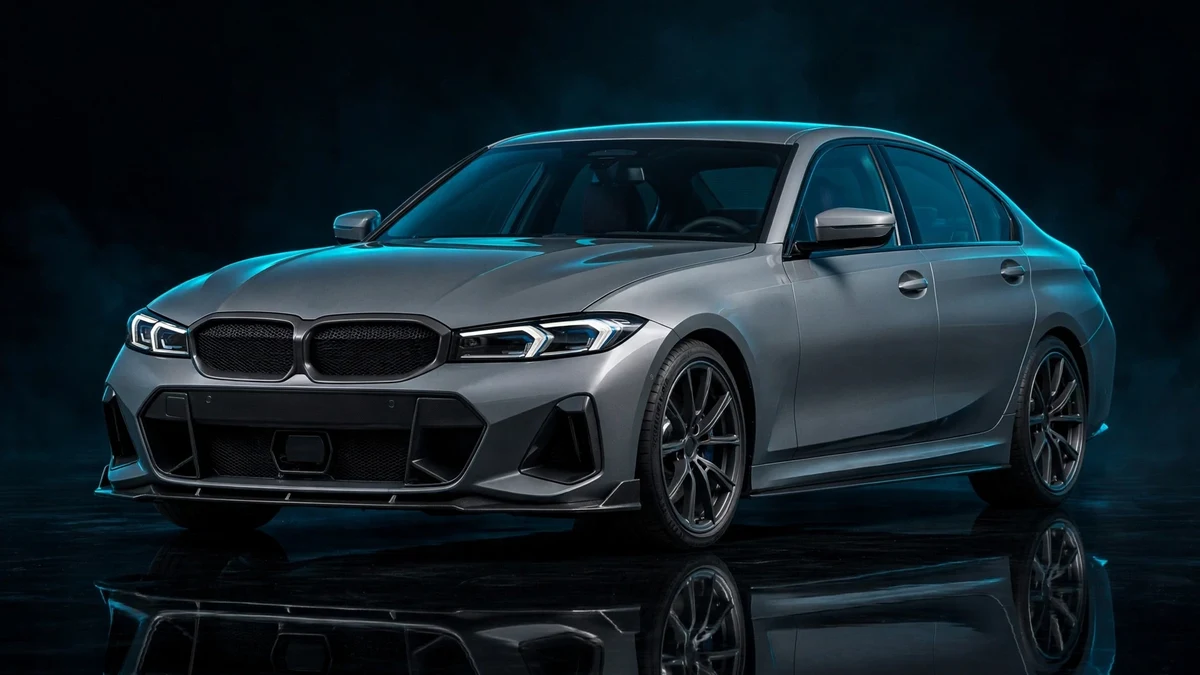
BMW M Sport Package Is More Than a Body Kit — Sometimes
Short answer: The bmw m sport package is a factory option bundle (option code 337) that gives a regular 3 Series the M look and sharper chassis manners — M aero bumpers, M sport suspension (15 mm lower on the E90, 10 mm on the F30 and G20), M wheels, M steering wheel, sport seats and dark interior trim. It never adds a single horsepower on any generation. E90 buyers paid $3,750 in the US when new; the F30 version ran about $3,000; the 2019 G20 package was $5,000. On a used car it is worth the premium if you care about looks, handling and resale — not if you only care about the engine, because the engine is identical to the base car’s.
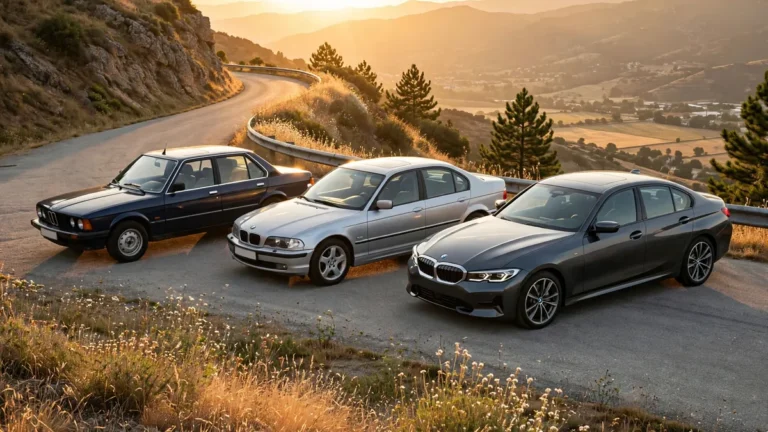
The bmw m sport package is the most misunderstood option in the 3 Series order book. Shoppers assume the little M badges mean more power, dealers advertise “M Sport” like it is a performance trim, and used-car listings slap the label on anything with dark wheels. None of that is quite right. M Sport is a factory option package — a bundle of styling, chassis and interior upgrades fitted on the production line — and its exact contents change with every generation. What it does on an E90 is not what it does on a G20, and knowing the difference is the difference between paying a fair premium and paying for badges.
This guide walks through what the package includes on the E90, F30 and G20, what it deliberately leaves out (engine, brakes, adaptive dampers — mostly), how it differs from M Performance models and the full M3, what it cost when new, and how to verify a used car really has it. If you are still choosing between the generations themselves, our E90 vs F30 comparison and F30 vs G20 comparison cover the bigger picture, and the used 3 Series buying guide is the place to start any purchase.
In this guide
- What the M Sport package is — and the one thing it never does
- E90 (2006–2011): what M Sport added
- F30 (2012–2018): the 10 mm suspension and the xDrive catch
- G20 (2019+): the $5,000 bundle and the brakes it skips
- M Sport vs M Performance vs the full M3
- What M Sport does not include
- Is it worth it? Prices then vs prices now
- Buying used: how to verify a real M Sport car
- Interactive: is M Sport worth it for you?
- Quiz: spot the real M Sport
- FAQ
What the M Sport package is — and the one thing it never does
Strip away the marketing and the M Sport package is simple: BMW takes a standard 3 Series and fits it, at the factory, with M-division-styled cosmetic and chassis hardware. On BMW’s order sheets it is option code 337 — the same code across the E90, F30 and G20 — which is why a VIN decode is the only reliable way to confirm a car has it (more on that below). In the US, the E90’s version was also sold under the package code ZMP.
The formula is consistent even as the details move: an M aerodynamic body kit, a lowered and stiffened sport suspension, larger M-design wheels, an M leather steering wheel, sport seats, darkened Shadowline exterior trim and a black headliner, plus small M emblems. Every generation gets its own version of that recipe — suspension drop, wheel sizes and trim are generation-specific, which is why blanket statements about “the” M Sport package mislead.
Now the one thing it never does: it never changes the engine. A 328i with M Sport makes exactly the same power as a 328i without it, and a 330i with M Sport is no closer to an M340i than a base car is. The package does not touch engine mapping, turbos, exhaust tuning (beyond cosmetic finishers) or gearing. If a listing implies an M Sport car is faster than the same model without it, the listing is wrong — or deliberately optimistic.
E90 (2006–2011): what M Sport added
The E90’s M Sport arrived with the 2009 facelift in the US, priced at $3,750 on the sedan and $3,250 on the coupe and convertible per BMW’s official 2009 pricing release. Here is the detail that matters for used buyers: mechanically it was barely above the existing Sport Package (ZSP). The M Sport suspension was the same sport setup already fitted to ZSP cars — roughly 15 mm lower than base, with firmer dampers and thicker anti-roll bars. The M Sport premium over ZSP bought appearance, not chassis hardware.
What the money did buy: 18-inch M double-spoke wheels (style 193M on most cars), the M aero kit with its deeper front air dam and sculpted side skirts, the M leather sport steering wheel, front sport seats, an anthracite headliner, high-gloss Shadowline window trim, M door-sill plates and aluminum interior trim. Le Mans Blue was the signature US launch color. The brakes were standard 3 Series hardware — no brake upgrade, and the blue M Sport calipers that later became famous did not exist yet.
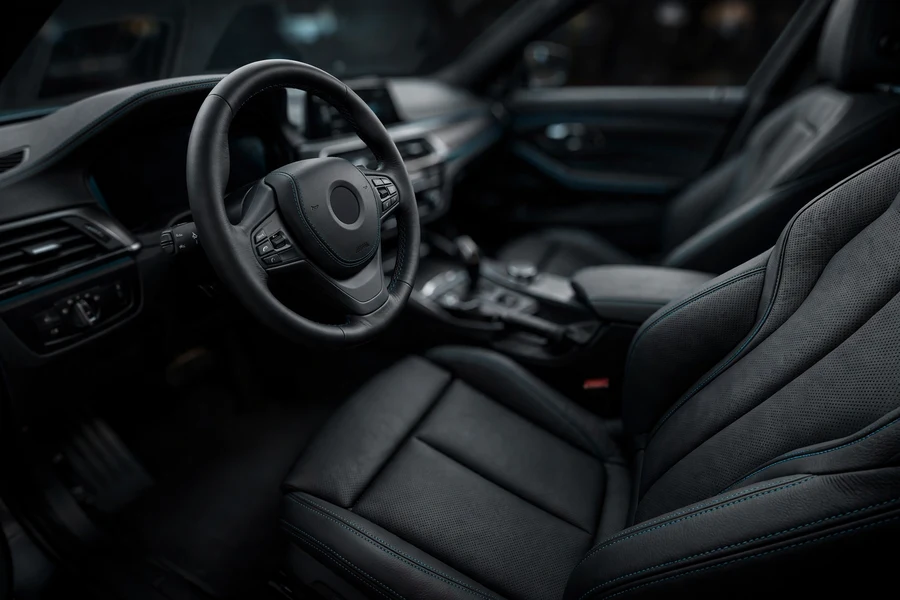
On the used market, the E90 M Sport’s value is almost entirely cosmetic: the bumpers and wheels transform the car’s stance, the sport seats are far better chairs than the flat base seats, and the package signals a car ordered by an enthusiast who likely ticked other options too. But don’t pay a premium expecting a handling revelation over a ZSP car — there isn’t one. See our E90 vs F30 breakdown if you’re cross-shopping, because the F30 changed the formula.
F30 (2012–2018): the 10 mm suspension and the xDrive catch
The F30 is where M Sport became the default enthusiast choice — and where its contents are best documented, because BMW published the full option-code breakdown. Package 337 bundled: the M aerodynamic kit (715), M sport suspension (704), M leather steering wheel (710), high-gloss Shadowline trim (760), anthracite headliner (775), sport seats (481), and 18-inch M wheels, with 19s optional. Interior trim was Aluminum Hexagon with a blue matte accent. It was a £3,000 option over the SE in the UK and about $3,000 in the US — a smaller premium than the E90’s, which is partly why such a large share of F30s carry it.
The suspension is the heart of the F30 package and the source of the most quoted figure: BMW’s own F30 media information states the M sport suspension lowers ride height by 10 mm (0.4 in), with stiffer springs and dampers and harder anti-roll bars. It is a passive setup — fixed-rate dampers, no electronics; the electronically controlled Adaptive M suspension was a separate option. Unlike the E90, this was a genuine step over the base car: the standard F30 rode softer and taller, and the 10 mm drop plus firmer tuning is noticeable from the driver’s seat.
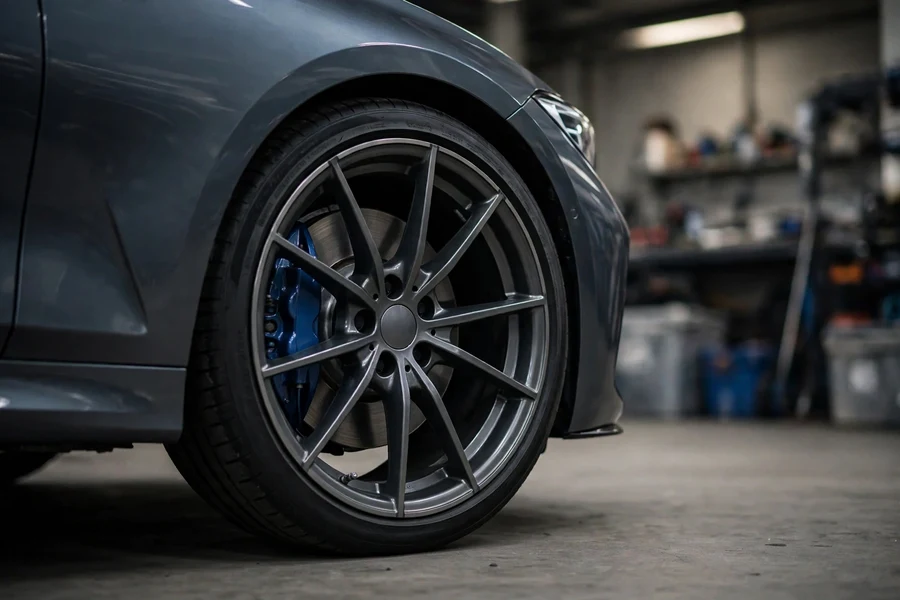
Two caveats trip up F30 shoppers. First, xDrive cars did not get the lowered suspension — BMW did not fit the 10 mm-drop setup to all-wheel-drive F30s, so an xDrive M Sport sits at standard xDrive ride height (itself 10 mm taller than a rear-drive base car). You still get the bumpers, wheels, steering wheel and interior, but the stance half of the package is missing: if the lowered stance matters, verify with your eyes, not the badge. Second, the blue M Sport brakes were not part of the package. The M Sport braking system (code 2NH) — blue fixed calipers with the M logo, larger discs (340 mm front / 345 mm rear on most models, 370 mm fronts on 335i variants) — was a separate factory option costing roughly $600 on a US window sticker (£570 in BMW’s UK equipment guide). Plenty of F30 M Sports wear plain grey sliding calipers; that is factory-correct.
The F30 also introduced the line structure that confuses people: base, then Sport, Luxury and Modern lines, then M Sport at the top. The Sport Line shared the same 10 mm sport suspension — so on a rear-drive car, M Sport’s dynamic advantage over a Sport Line was mostly wider wheels and tires, not the dampers. M Sport added the full M aero treatment, the M steering wheel and the interior upgrades. Between used F30s, that is the honest comparison to make, not M Sport versus base.
G20 (2019+): the $5,000 bundle and the brakes it skips
The G20’s M Sport package is the priciest of the three — $5,000 on the 2019 330i in the US, per BMW’s American package guide — but that needs context: BMW stuffed the bundle with non-sport equipment. The 2019 package included 19-inch M wheels, the M sport suspension (or Adaptive M), variable sport steering, the M steering wheel, the aero kit, Shadowline trim, a SensaTec dashboard, sport seats, LED headlights with cornering lights, Comfort Access, Active Driving Assistant and SiriusXM. Roughly half the price was convenience and lighting gear that BMW simply chose to bundle.
The chassis follows the F30 template with one meaningful evolution: the M sport suspension again drops ride height by 10 mm, but the G20’s version uses lift-related dampers — dampers whose firmness ramps up progressively with suspension travel — which BMW’s G20 technical press material presents as the fix for the old conflict between M Sport firmness and daily comfort. Variable sport steering, with its speed-sensitive ratio, is part of the M sport suspension rather than a standalone item, and Adaptive M suspension remained a separate option.
And the brakes: like the F30, the G20 M Sport package does not include the blue calipers. On the 2019 330i they came with the $2,450 Track Handling Package (which also added the M sport differential and adaptive dampers); on later cars they were a ~$650 standalone option. This is the most common G20 M Sport misconception — shoppers see the aero kit and assume the blue calipers come with it. Check behind the spokes: no blue, no M Sport brakes, whatever the bumper says.
Market structure changed with the G20 too. In the US it stayed an option package on the 330i (standard on the M340i — a different animal, see below). In the UK, BMW reorganized the range into Sport and M Sport trim levels, so nearly every British G20 is an M Sport by trim, not by option — which dilutes the used-market premium there. Portimao Blue, the launch signature color, was tied to M Sport cars and remains the easiest visual shorthand. Our F30 vs G20 comparison covers how the two generations drive back to back.
M Sport vs M Performance vs the full M3
Three different things share the letter M, and the industry — BMW included — does not try very hard to keep them distinct. Here is the clean separation:
| M Sport package | M Performance model | Full M (M3) | |
|---|---|---|---|
| What it is | Factory option bundle (code 337) | A model in the range — e.g. M340i | Separate M GmbH model |
| Engine change | Never — same as base | Yes — e.g. 382-hp B58 six | Yes — bespoke S58, 473+ hp |
| Suspension | Lowered, stiffened (passive) | M-tuned + adaptive standard | Full M chassis, wider track |
| Brakes | Usually standard (blue = extra) | M Sport brakes standard | M Compound brakes |
| Differential | Open (no LSD) | M Sport differential standard | Active M differential |
| Bodywork | M aero kit on standard body | M styling + wider details | Unique M body, flared arches |
| Price position | A few thousand over base | ~$10k+ over equivalent 330i | ~$30k+ over a 330i |
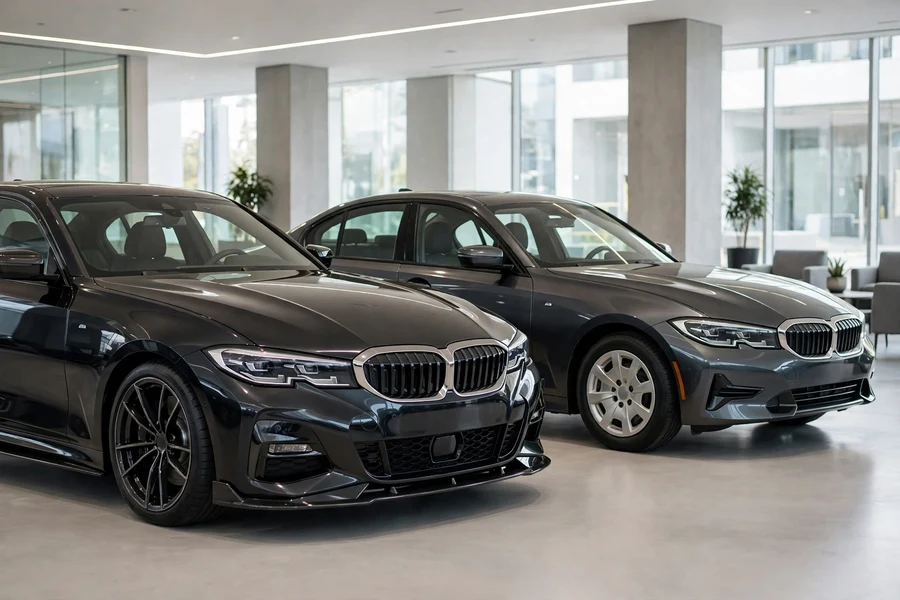
M Sport is the package this guide is about: looks and chassis manners on a standard engine. M Performance is BMW’s own label for the middle tier — the M340i is officially an “M Performance model” in BMW’s press material, a genuine step up in engine, brakes, differential and chassis tuning, but still built on the standard 3 Series architecture rather than re-engineered by M GmbH. (Separately, “M Performance Parts” are dealer accessories — splitters, exhaust tips, spoilers — that bolt onto any car and prove nothing about the factory build.) Full M — the M3 — is a different car underneath: bespoke engine, wider track, unique body panels, M-specific subframes. An M Sport 330i shares its engine, gearbox and fundamental chassis with the base 330i.
The practical takeaway: M Sport changes how the car looks and rides; M Performance (M340i) changes how fast it is; M3 changes everything. Price and running costs step up accordingly — our 330i vs M340i comparison quantifies the middle jump, including the used-price gap and B58 running costs.
What M Sport does not include
Worth stating as a checklist, because every item here is something buyers routinely assume comes with the package:
- No engine or power change. Not on the E90, not on the F30, not on the G20. Same turbo, same map, same 0–60 time as the identical model without the package.
- No limited-slip differential. M Sport cars keep the standard open differential. The M Sport differential is reserved for M Performance models and above (and was a standalone option on some cars).
- Usually no brake upgrade. The blue M Sport calipers (2NH) were a separate option on the F30 (~$600 US) and the G20 (Track Handling package, later ~$650 standalone). An M Sport without blue calipers is normal, not decontented.
- No adaptive suspension. The M sport suspension is passive on all three generations. Adaptive M suspension was always a separate option or part of a different package.
- No M3 parts. Despite the badges, no M Sport package has ever included M3 suspension components, M3 brakes, or M3 body panels. The aero kit is M-styled, not M-sourced.
- On the F30 xDrive, not even the lowered suspension. The all-wheel-drive cars kept standard ride height — the single biggest “gotcha” in the used market.
Is it worth it? Prices then vs prices now
When new, the value depended heavily on generation. The E90’s $3,750 was steep for what was largely a cosmetic upgrade over the cheaper Sport Package. The F30’s ~$3,000 was the sweet spot: genuine suspension improvement, full aero treatment and sport seats for less than the E90 asked. The G20’s $5,000 looks alarming until you subtract the bundled convenience equipment many buyers would have ordered anyway — the sport-specific content underneath cost roughly what the F30’s did.
On the used market, the math flips in the package’s favor. First, depreciation compresses the original premium: a $3,000 option on a $45,000 car becomes a few hundred dollars once the car is worth $15,000 — owner-reported auction results consistently show M Sport cars drawing stronger bidding, though the gap varies too much by market to quote as a rule. Second, you cannot retrofit the package properly: bumpers, suspension, seats, steering wheel and trim bought separately, painted and fitted would cost multiples of the used-market premium. Buying it baked into a used car is the cheapest way to get it, by far.
The honest verdict splits by buyer. Worth it if you care about looks (the M aero kit genuinely transforms all three generations), want the firmer factory suspension without going aftermarket, value the sport seats on long drives, or care about resale — M Sport cars sell faster to a wider audience. Skip it if your priority is the engine (zero horsepower gained), if you want a soft commuter (the lowered suspension and bigger wheels ride firmer, and replacement run-flats cost more — see our run-flat vs regular tire guide), or if you’re shopping F30 xDrive and the stance was the point. Never stretch past maintenance money for it: a base car with fresh suspension, brakes and fluids — per our maintenance schedule — always beats a neglected M Sport.
Buying used: how to verify a real M Sport car
M Sport is one of the most faked designations in used listings, because the visual parts are easy to retrofit and the badges are cheap. Here’s how to check what you’re actually buying:
- Decode the VIN. The only definitive answer is option code 337 (M Sports package) on the build sheet, visible through any BMW VIN decoder. Supporting codes: 704 (M sport suspension), 710 (M steering wheel), 715 (aerodynamic kit). If 337 is absent, the car did not leave the factory as an M Sport — no matter what the bumpers look like.
- Read the bumpers. The M aero front bumper has large, angular side intakes and a deeper splitter line; the rear has a diffuser-style insert. Base bumpers are visibly plainer. But bumpers are the most commonly retrofitted part, so this is a supporting clue, not proof.
- Check the steering wheel and seats. The M leather steering wheel is thicker with a distinct rim profile; sport seats have pronounced side bolsters and (on the F30/G20) an extending thigh support. Base seats are flat by comparison.
- Look at the headliner and trim. Factory M Sport cars have a black/anthracite headliner and dark Shadowline window trim. A light-grey headliner with M bumpers means a retrofit.
- Measure the stance (F30/G20). A rear-drive M Sport should sit visibly lower with a tighter wheel gap than a base car. If it doesn’t — and the VIN shows 337 — suspect worn or replaced suspension, or an xDrive car (F30) that never had the drop.
- Don’t trust blue calipers alone. Blue M Sport brakes were a separate option; their presence proves 2NH, not 337. Conversely, grey calipers don’t disprove M Sport.
A properly retrofitted car isn’t necessarily a bad buy — quality OEM bumper conversions are common and honest — but it should be priced as a base car with nice bumpers, not as a factory M Sport. And run the usual checks regardless of trim: our used buying guide and the reliability record by model year matter far more than any option code. The full complete 3 Series guide ties the generations together if you’re still deciding which one to hunt.
Interactive: is M Sport worth it for you?
Twenty-four buyer profiles, one honest verdict each. Pick your generation, your priority and your budget — the tool weighs the real package contents (including the F30 xDrive catch and the no-horsepower rule) and tells you whether the premium makes sense for you.
Is the M Sport package worth it for you?
Quiz: spot the real M Sport
Five true-or-false questions built from the traps in this guide. Answer them all to get your score — and your M Sport detective rating.
1. A 2013 328i xDrive with the M Sport package sits 10 mm lower than a base 328i.
2. The M Sport package adds horsepower on every generation.
3. Blue brake calipers on an F30 prove it has the M Sport package.
4. The M340i is an M Performance model — a step below the full M3.
5. Option code 337 on the build sheet confirms a factory M Sport car.
FAQ
Does the M Sport package add horsepower?
No — never, on any generation. The packages change styling, suspension, wheels, steering wheel, seats and trim, but the engine, turbo, mapping and gearing are identical to the same model without it. A 330i with M Sport is exactly as fast as a 330i without it. If you want more power, you need a different model (like the M340i), not the package.
How can I tell if a used BMW really has the M Sport package?
Decode the VIN and look for option code 337 (M Sports package), supported by 704 (M sport suspension), 710 (M steering wheel) and 715 (aerodynamic kit). Visual clues — M bumpers, M wheels, sport seats, black headliner — are supporting evidence only, because bumpers and badges are commonly retrofitted. A light-grey headliner with M bumpers is the classic sign of a conversion.
Is the M Sport suspension lower than the standard suspension?
On rear-wheel-drive cars, yes: the E90’s sport/M Sport suspension sits about 15 mm lower than base, and the F30’s and G20’s M sport suspension (code 704) is 10 mm lower with stiffer springs, firmer dampers and harder anti-roll bars. The exception is the F30 xDrive, which never received the lowered suspension and sits at standard xDrive height despite wearing the M Sport badge.
Are the blue M Sport brakes part of the package?
No. The blue-painted M Sport brakes (option code 2NH) were a separate factory option on the F30 (about $600 in the US) and on the G20 (via the Track Handling Package, later a ~$650 standalone option). Most M Sport cars left the factory with standard grey calipers, which is factory-correct. Blue calipers prove the brake option, not the package.
Should I pay extra for M Sport on a used 3 Series?
Usually yes, if the premium is small. Depreciation compresses the original $3,000–$5,000 option price into a few hundred dollars, and you cannot retrofit the package properly for anywhere near that. It pays off in looks, handling (rear-drive cars) and resale. Skip it only if your priority is the engine — it adds zero power — or if you want the softest ride. Never stretch past maintenance money for it: a well-serviced base car beats a neglected M Sport.