9 Warning Signs of BMW Expansion Tank Failure
Short answer
BMW expansion tank failure means the translucent plastic coolant reservoir has cracked — usually at a seam or hose neck after years of heat cycles and pressure. The giveaways: a sweet coolant smell after parking, a low-coolant warning that keeps returning, visible cracks or yellowing on the tank, and crusty residue or a puddle underneath. A new tank runs $80–$180 DIY, $350–$600 fitted, and the system must be bled afterward or trapped air will overheat the engine.
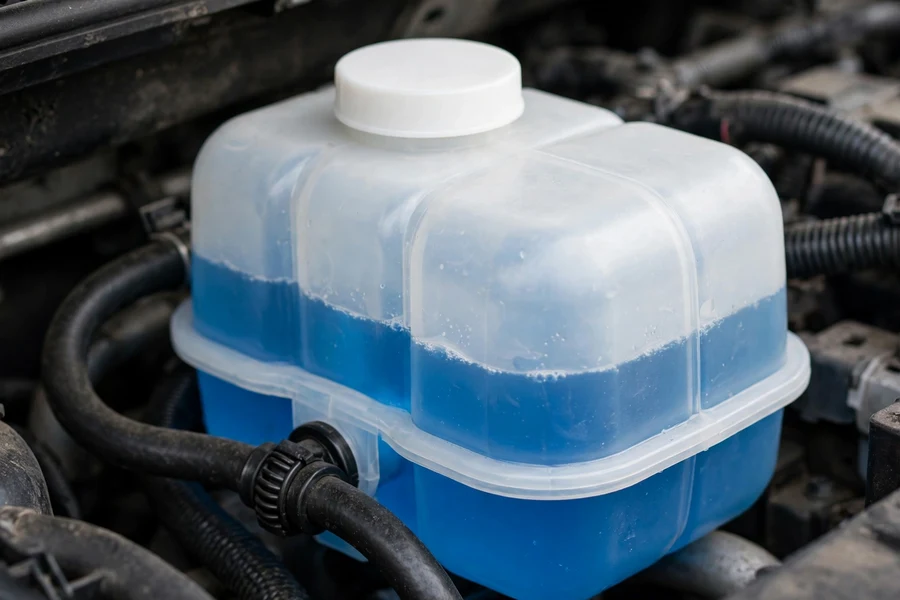
The expansion tank is the one cooling-system part you can see — a translucent white bottle on the driver’s side of the engine bay — and on aging 3 Series cars it is a leading source of slow coolant leaks. It rarely fails all at once: a hairline at the seam, a weep that evaporates on the hot tank wall, a level dropping a little each week until the low-coolant warning lights up the dash.
This guide explains what the tank does and why it cracks, the nine symptoms ranked by urgency, a no-tools inspection you can do in five minutes, a symptom checker that scores your answers, the full DIY replacement with honest difficulty and cost bands, and the correct coolant spec to refill with. Because the tank sits on the pressurized side of the system, every replacement must be followed by a proper bleed — the full procedure lives in our dedicated coolant bleeding guide rather than being repeated here.
In this guide
- What the expansion tank actually does
- Why BMW expansion tanks crack
- 9 symptoms of a failing expansion tank
- Is your tank failing? Symptom checker
- How to inspect your expansion tank in 5 minutes
- Is it the tank, or something else?
- Replacement DIY: difficulty, tools, and steps
- Cost bands: DIY vs independent shop vs dealer
- Prevention and realistic lifespan
- FAQ
What the expansion tank actually does
Despite the name, the expansion tank is not an overflow bottle — it is part of the pressurized circuit. It sits high so air collects there, absorbs coolant expansion as the engine heats, feeds coolant back as it cools, and carries the filler cap. The DME’s level sensor lives inside it, which is why tank trouble so often announces itself as a low-coolant warning.
The cap is the system’s pressure regulator: pressure raises the coolant’s boiling point, letting the engine run well above 100°C without the coolant flashing to steam. Most non-M E90 cars use a 1.4-bar cap; the E90 M3 and many later models use 2.0 bar — check the rating stamped on your cap, since the wrong cap either vents early or stresses old plastic further.
The translucent plastic doubles as the sight glass: level marks and a small float show the cold level, and the DME reads the sensor to trigger the dashboard warning. During the electric-pump bleed the tank acts as the air separator — watch bubbles rise through it — which is why a cracked tank can never hold a proper bleed.
Why BMW expansion tanks crack
The tank is a glass-filled plastic composite, molded in two halves welded at a seam with the hose necks molded in. Every drive is a stress cycle: cold to operating temperature, pressure climbing to the cap’s limit, then back down. Over six to ten years that is thousands of cycles; the plastic loses plasticizers, yellows, and goes brittle — and cracks start where stress concentrates: the seam and the hose necks.
Heat is the accelerant, so the pattern is worst on turbo cars: E90 335i owners report seam failures at roughly 90,000–120,000 miles — six to ten years old — sometimes as a sudden pop and a steam cloud at idle. Naturally aspirated E90s are less failure-prone; one well-known specialist notes the 325/330 tank is not crack-prone the way the E46’s was. The E46 earned the reputation, turbo E90s inherited a milder version, and every plastic tank ages out eventually.
The small plastic bleeder screw in the tank neck is the other known weak point — it cracks or snaps with age, though a spare costs only a few dollars. The level-sensor float can also snap off inside, producing a phantom low-coolant warning on a full tank.
Color is the earliest signal: white and translucent is healthy; amber or brown yellowing means end of life is approaching. Plan the replacement on your schedule rather than the tank’s.
| Generation | Factory coolant | Cap pressure | Common crack points | Notes |
|---|---|---|---|---|
| E90 (2006–2013) | BMW blue (G48-type) | 1.4 bar on most cars; 2.0 bar on the M3 | Seams, hose necks, bleeder screw | Turbo 335i tanks sit beside hot turbos — seam failures documented from around 90k miles |
| F30 (2012–2019) | BMW blue (G48-type) | Check the rating stamped on your cap | Seams, hose necks | Same plastic aging as the E90 |
| G20 (2019+) | BMW HT-12 green | Check the rating stamped on your cap | Too young for a clear pattern | Never mix green HT-12 with blue coolant |
9 symptoms of a failing expansion tank
Tank failure is usually slow-motion, and the symptoms arrive in a predictable order — smell first, then the warning light, then visible evidence. Recognize three or more of the following and the tank is the prime suspect.
- A sweet, sharp coolant smell after parking. Hot coolant weeping from a hairline crack evaporates on the tank wall or the tray below, and the vapor drifts up through the bay. Smell it every time after a drive and something is leaking under heat and pressure.
- A low-coolant warning that keeps coming back. A warning that returns every few weeks is a leak. The level sensor lives in the tank, so the tank is the first place to look — our low-coolant warning guide covers the full decision tree.
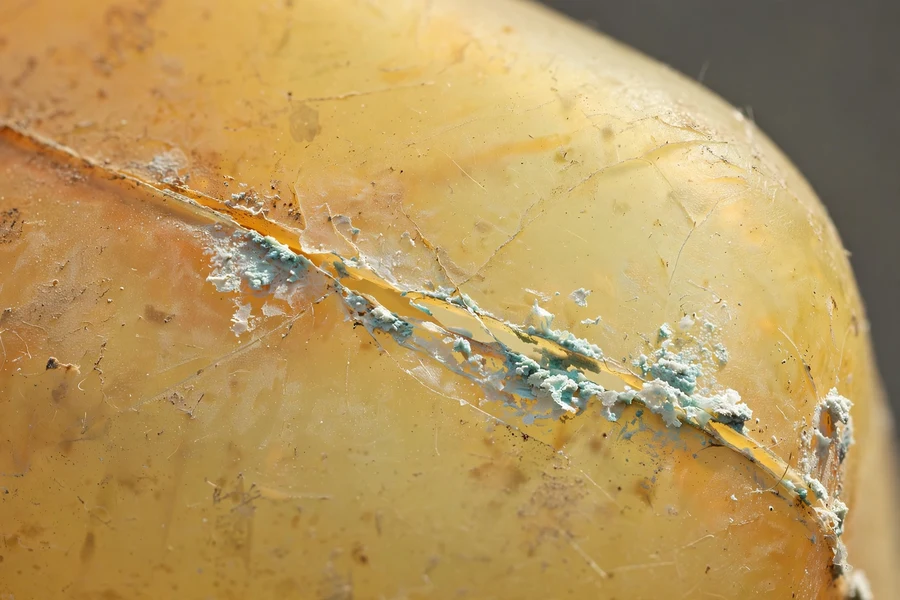
- Visible cracks, especially along the seam. The weld seam around the tank’s middle and the bases of the hose necks are where cracks start. Hairlines hide on white plastic — look at an angle with a flashlight, especially the engine-facing side, which takes the most heat.
- Yellowing and brittleness. White-to-amber discoloration means the plastic’s service life is nearly over. If a thumbnail pressed into an inconspicuous edge leaves a mark or flakes, the tank is brittle — a crack is a matter of when, not if.
- Crusty residue around the tank or on the tray below. Residue on the seam, around a hose neck, or on the undertray beneath the tank is a leak’s calling card even when the crack itself is invisible.
- A puddle under the car. BMW coolant is blue (green on G20 cars) and slightly slippery. A puddle under the driver’s side of the bay points at the tank or its hoses; further forward points at the radiator.
- Hissing from the engine bay after shutoff. Pressure venting through a crack hisses as the system stays hot after the engine stops. Steam with the hiss means coolant is flashing to vapor — the leak is active, and the car should not be driven until it is fixed.
- The level drops with no puddle at all. A fine crack high on the tank can weep only at full pressure and temperature, every drop evaporating before it reaches the ground. Weeks of top-ups with a dry driveway is this failure’s signature.
- A temperature warning after being driven on too long. This is the end of the chain: enough coolant lost and the engine overheats. If you are here, read our overheating causes guide before driving another mile.
| What you notice | What it means | Urgency |
|---|---|---|
| Sweet coolant smell after parking | Coolant weeping under heat, evaporating on hot surfaces | Inspect this week — a leak is active |
| Low-coolant warning returns after top-up | The system is losing coolant; the tank is suspect number one | Top up and inspect before the next long drive |
| Visible crack in the tank | The tank has failed — a diagnosis, not a symptom | Replace now; drive only to reach a repair |
| Yellowed, brittle plastic | Tank near end of life; may not leak yet | Plan replacement within the next few months |
| Crusty residue on or under the tank | Dried coolant from a weeping crack or hose neck | Inspect this week; the leak will only grow |
| Puddle of blue/green fluid | An active leak — tank, hose, or radiator | Do not drive until the source is found |
| Hissing or steam from the bay | Coolant escaping under pressure | Shut the engine off and let it cool fully |
Is your tank failing? Symptom checker
Answer five questions and the checker scores your symptoms, gives a verdict, and points you at the right next step.
Expansion Tank Symptom Checker
Answer what you can — the verdict updates as you go.
Answer the questions above to get your verdict and next steps.
Safety note: hissing, steam, or a temperature warning means the car stays parked until the leak is fixed.
How to inspect your expansion tank in 5 minutes
You need no tools — just a cold engine and a flashlight. Never open the cooling system hot: the tank is pressurized, and a hot cap can vent scalding coolant. Do this first thing in the morning, or at least an hour after driving.
- Find the tank. On E90 and F30 cars it sits on the driver’s side of the bay, a translucent white bottle against the inner fender with a black cap. The G20 layout is similar; if unsure, follow the large coolant hoses.
- Judge the plastic’s color. White and translucent is healthy; amber or brown yellowing means the plastic has aged — plan a replacement. Dark brown or opaque means it is living on borrowed time.
- Walk the seam. Run eyes, then a fingertip, along the weld seam around the tank’s middle and the base of every hose neck — feeling for hairline cracks, raised edges, and dampness. Check the engine-facing side with the flashlight; heat attacks that face first.
- Check the bleeder screw. E90 and F30 tanks have a small plastic bleeder screw in the tank neck — look for cracks in the head and white crust around its base. It is a known failure point and costs a few dollars.
- Inspect the cap and its seal. Remove the cap and check the rubber seal: supple is good; flattened, cracked, or crumbling vents pressure early and mimics a tank leak. Note the pressure rating stamped on the cap.
- Read the level. The cold level should sit at the marked line. A full tank with a phantom warning points at a snapped sensor float; a dropping level with no puddle points at a weeping crack.
- Look underneath. Shine the flashlight on the undertray directly below the tank for dried coolant crust or fresh wet spots. Residue there with a clean-looking tank above usually means a crack on the hidden engine-facing side.
| Inspection item | Pass | Fail — replace or repair |
|---|---|---|
| Plastic color | White / translucent | Amber-brown, opaque, or flaking when scratched |
| Weld seam | Smooth, dry, no raised edges | Hairline crack, dampness, or crust on the seam |
| Hose necks | Solid, dry bases | Cracked base, residue, or a flexing neck |
| Bleeder screw | Intact head, dry base | Cracked or snapped head; crust at the base |
| Cap seal | Supple rubber | Flattened, cracked, or crumbling seal |
| Level vs. warning | Level matches the warning state | Full tank but warning on, or level keeps dropping |
| Undertray below tank | Clean and dry | Crust or wet coolant |
One fail anywhere in that table means the tank — or the cap or screw — is done: plastic does not heal and a crack never gets smaller. If the inspection is inconclusive but the level keeps dropping, a cooling-system pressure test at an independent BMW shop finds the leak in minutes.
Is it the tank, or something else?
A dropping level with a sweet smell has several possible authors, and the tank is only the most common on an aging car. Run your symptoms through the lineup before ordering parts.
| Suspect | Typical symptoms | Distinguishing clue |
|---|---|---|
| Expansion tank | Smell after parking, level drops slowly, warning returns | Crack, yellowing, or crust on the tank; residue on the tray below |
| Pressure cap | Same slow loss; sometimes coolant pushed out at the cap | Worn seal; residue around the cap; holds fine with a new cap |
| Bleeder screw | Slow weep, often mistaken for a tank crack | Leak localized to the screw; head cracked |
| Radiator hose / quick-disconnect | Puddle further forward, sometimes only when hot | Wetness at a hose joint, not on the tank |
| Electric water pump | Overheating with a full reservoir; fan roaring | Level holds — a circulation failure, not a leak; see our water pump failure guide |
| Radiator | Puddle at the front, sometimes after a minor impact | Wetness on the radiator’s plastic end tanks, ahead of the engine |
| Level sensor float | Warning light with a full tank | Level correct by eye; float snapped off inside the tank |
The water pump row traps owners: a dead pump overheats the car while the tank sits full, and topping up does nothing — level holds but temperature climbs means it is not a tank problem. Past 90,000 miles on original components, the tank, pump, thermostat, and hoses are aging together; many owners refresh them as one job.
Replacement DIY: difficulty, tools, and steps
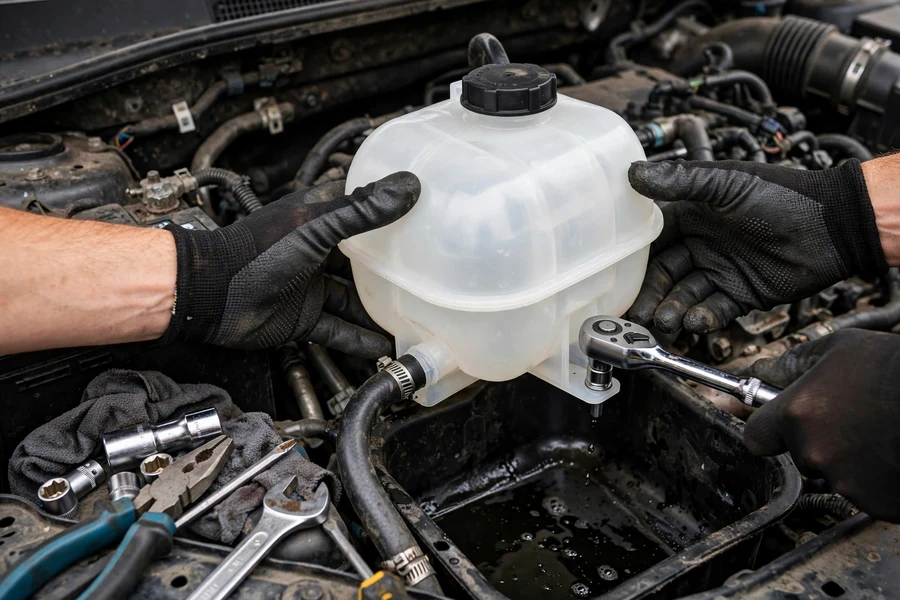
Honest difficulty: 3 out of 10 — the easiest cooling-system job. A few screws, two or three hoses, one electrical connector; budget one to two hours. The non-negotiable: bleed the system afterward (linked, not repeated, below).
| What you need | Notes |
|---|---|
| New expansion tank | Match to chassis/engine; cap and sensor often separate |
| New pressure cap (if worn) | Match the pressure rating stamped on your old cap |
| Spare bleeder screw | A few dollars; the old plastic one often snaps on removal |
| Correct BMW coolant | E90/F30: BMW blue (G48-type). G20 2019+: BMW HT-12 green. Never mix the two |
| Distilled water | For the 50/50 mix — never tap water |
| Drain pan, funnel, rags | Coolant is toxic to pets — catch every drop |
| Basic hand tools | Screwdrivers, pliers, socket set |
| Gloves and safety glasses | Coolant irritates skin; work on a cold engine only |
Get the coolant spec right before you buy: E90 and F30 cars take BMW blue, G20 cars from 2019 onward were factory-filled with green HT-12. Mixing them compromises the corrosion package the system was designed around. If unsure, match the color in the tank and read our coolant type guide first.
- Step 1 — Cold engine, drain the system. With the engine fully cold, open the radiator drain plug over the pan. If the plug is seized, disconnect the lower radiator hose instead — expect a faster gush. You need the tank and its hoses empty, not every last drop.
- Step 2 — Clear access. Remove whatever blocks the tank — sometimes the engine cover or part of the airbox. Photograph the hose routing first; it is cheap insurance.
- Step 3 — Disconnect the hoses. Squeeze the quick-disconnect tabs and pull straight off — never twist a brittle neck. Keep the pan underneath, and replace any hose or connector that crumbles.
- Step 4 — Unplug the level sensor. Press the release tab on the sensor connector at the tank’s base and pull it straight off; check the pins for green corrosion.
- Step 5 — Remove the mounting screws and lift the tank out. Two or three screws hold the tank to its bracket. Lift it straight up and out, tipping any remaining coolant into the pan.
- Step 6 — Fit the new tank. Seat the new tank, refit the screws snug — plastic threads strip easily, so firm hand-tight is enough (check your owner’s manual rather than guessing a torque figure). Reconnect hoses until each fitting clicks, refit the sensor connector, and install the cap.
- Step 7 — Refill with the correct coolant. Mix BMW-spec coolant 50/50 with distilled water and fill slowly to the maximum mark — a fast pour traps air and makes the bleed harder.
- Step 8 — Bleed the system. Mandatory, not optional. Opening the system introduces air, and trapped air causes hot spots, a lukewarm heater, and pump cavitation. Follow our full BMW 3 Series coolant bleeding procedure for your generation’s self-bleed sequence, then recheck the cold level for the next few drives.
Two honest caveats. First, 15-year-old plastic clips do not always survive disassembly — if a tab snaps, that part was already at end of life; budget a few dollars of contingency. Second, if the tank failed because something else was overheating the system (a dead water pump, for instance), the new tank will not fix the underlying problem.
Cost bands: DIY vs independent shop vs dealer
A tank is one of the cheaper cooling-system repairs — simple part, short labor. Typical US ranges for 2026 are below; regional pricing moves these numbers.
| Route | Typical total | What drives the price |
|---|---|---|
| DIY | $110–$220 | Tank $80–$180 (owners report ~$125–$178 at dealers), plus BMW coolant concentrate ($25–$35) and distilled water |
| Independent BMW shop | $350–$600 | One to two hours labor plus parts and coolant |
| Dealer | $500–$950 | Highest parts markup and labor rate; sometimes bundled with a full cooling-system inspection |
Do not economize on the coolant spec or the bleed: the wrong coolant or a skipped bleed can cost a water pump or a head gasket. If a shop quotes the job, ask whether the price includes the correct BMW-spec coolant, a new bleeder screw, and the full bleed — not just a top-up.
Prevention and realistic lifespan
BMW publishes no replacement interval — what exists is owner and specialist consensus: on E90 cars, plan on the tank in the 90,000–140,000-mile window (six to ten-plus years), earlier on turbo cars. The pragmatic move is proactive replacement alongside the water pump and thermostat at 60,000–80,000 miles, when the system is already drained.
Between replacements the maintenance is free: glance at the tank’s color and the undertray below it at every oil service, never open the cap hot, and top up only with the correct coolant mixed 50/50 with distilled water. You can check for open manufacturer campaigns via the NHTSA recall lookup. A $150 tank on your schedule beats a $150 tank on the highway shoulder — usually with a tow bill attached.
BMW expansion tank failure FAQ
How long does a BMW expansion tank last?
None published. Owner reports cluster around 90,000–140,000 miles — six to ten-plus years — with turbo cars trending earlier. Inspect from the five-year mark; consider replacing with the water pump and thermostat at 60,000–80,000 miles, when the system is already drained.
Can I drive with a cracked expansion tank?
Only as far as the repair. A slow weep might get you to a nearby shop after topping up — but a crack never shrinks, pressure makes it grow, and enough coolant loss overheats the engine. If the temperature warning appears, pull over and shut the engine off.
Can I repair a cracked expansion tank with epoxy?
No — not as a real repair. The tank cycles between ambient and full system pressure at over 100°C, and no epoxy bonds reliably to aged, heat-cycled plastic under those conditions. A new tank costs $80–$180 — the epoxy experiment is false economy against a tow bill.
Does a new expansion tank include the cap and level sensor?
Usually not — the three are most often sold separately. Match the old cap’s stamped pressure rating, check whether the sensor transfers, and order a new bleeder screw; the old one often snaps on removal.
Do I really need to bleed the cooling system after replacing the tank?
Yes — mandatory, not optional. Opening the system introduces air, and trapped air causes hot spots, a lukewarm heater, and pump cavitation. Follow our full BMW 3 Series coolant bleeding procedure for your generation’s self-bleed sequence, then recheck the cold level for the next few drives.
The expansion tank is a humble part with an outsized say in whether your 3 Series gets you home. Catch it yellowing and it is a $150 Saturday job; catch it in a steam cloud and it is a tow truck. Put it on the same schedule as the water pump, keep the correct coolant in the system, and never skip the bleed. Our complete 3 Series guide puts the cooling system alongside every other wear item worth watching.