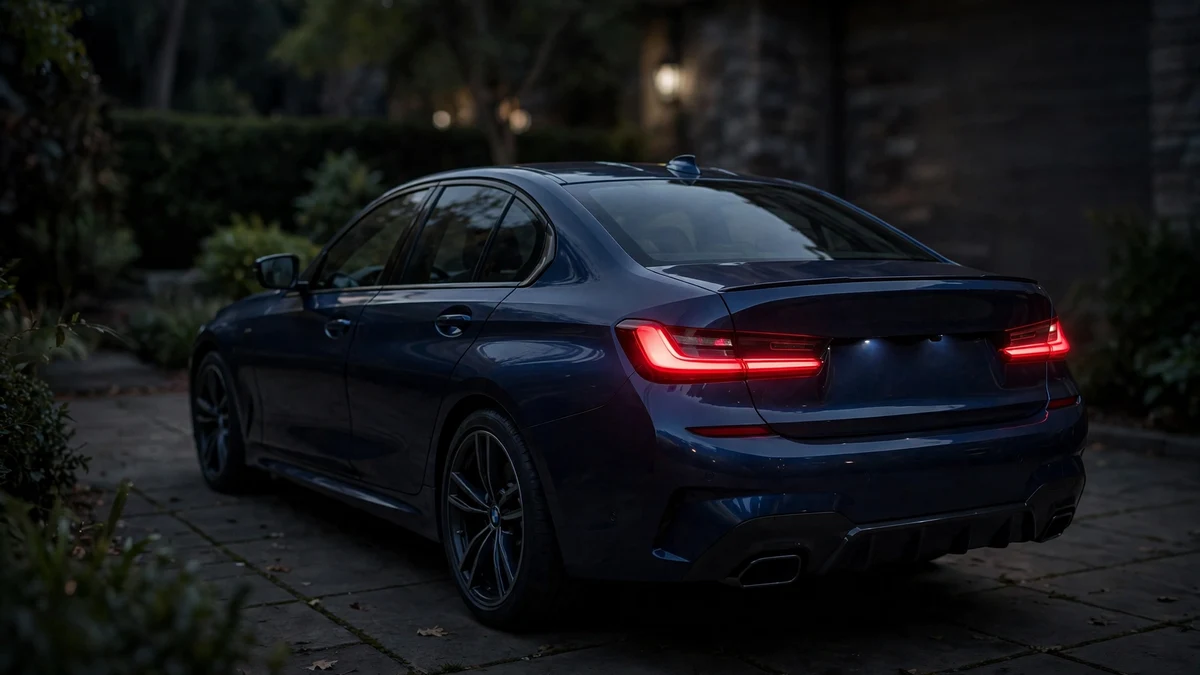
How to Replace Your BMW 3 Series Taillight Bulb
Short answer
BMW taillight replacement on a 3 Series is a bulb swap on most generations and a full assembly swap on the newest one. The E46 (1999–2006), pre-LCI E90 (2006–2008) and F30 (2012–2019) use serviceable bulbs — commonly P21W for brake lights, dual-filament 1157/P21-5W for the E46’s tail/brake, and H21W for the F30’s inner trunk-lid lamps. The E90 LCI (2009–2011) and all E92/E93 run LED tail/brake strips, and the G20 (2019+) is full-LED with no user-replaceable bulb at all. A bulb costs roughly $5–$20 and takes 10–30 minutes; a dealer charges around $100–$150 for the same job; a complete assembly runs about $150–$300 aftermarket or $400–$900+ OEM, G20 LED at the top. All figures are approximate — this guide shows exactly which fix your car needs.
In this guide
- Figure out which rear light actually failed
- Bulb types by generation
- Bulb swap or full assembly: which fix you need
- Find your exact fix in 10 seconds
- DIY: E46 and E90/E91 bulb replacement
- DIY: F30 outer and inner lamps
- G20: full-LED rear means assembly replacement
- What it costs: DIY, independent shop, dealer
- LED vs halogen: retrofit notes and the law
- Troubleshooting: when the warning won’t clear
- FAQ
Figure out which rear light actually failed
Check Control usually knows first: a text message or bulb-out pictogram naming the side and function (“rear left brake light malfunction”). E46 and early E90 cars show a simple amber lamp icon; F30 and G20 spell it out in the cluster or iDrive. Write down exactly what it says — a 3 Series cluster packs up to five functions into one housing, and they fail independently.
Once you have the message, confirm it with a 60-second walk-around before buying anything:
- Parking lights on, engine off. Compare both clusters. A dim or dark tail section on one side is the parking/tail filament (or LED segment).
- Press the brake. Have someone hold the pedal and compare brake brightness side to side. A brake section that stays dark, or glows no brighter than the tail light, is the culprit.
- Hazards on. A turn signal flashing roughly twice as fast (hyperflash) means that side’s bulb is out.
- Reverse. Ignition on, foot on the brake, shift to R and check the white reverse sections.
- Look at the lens. Condensation, a cracked lens, or a loose housing mean an assembly problem — no bulb swap will fix it.
One more check: on twin-filament bulbs (the E46’s 1157/P21-5W), one filament can die while the other works — if the tail light works but the brake doesn’t on the same section, the bulb is still the prime suspect, not the fuse or the switch. If the whole cluster is dark, check the fuse first; the fuse box diagram guide shows which fuse feeds rear lighting on each generation.
Bulb types by generation
This is the table most people land here for. Fitment varies by model year, body style and lighting package, so treat it as the standard map and verify against your owner’s manual or — more reliably — the bulb you pull out. The codes are European trade designations; US equivalents are in parentheses where they differ.
| Generation | Years | Tail / parking | Brake | Rear turn | Reverse | License plate |
|---|---|---|---|---|---|---|
| E46 sedan (pre-facelift) | 1999–2001 | R5W | P21/4W twin filament | P21W (1156) | P21W (1156) | C5W |
| E46 sedan (facelift) | 2002–2006 | 1157 (P21/5W dual filament) | 1157 (P21/5W dual filament) | P21W (1156) | P21W (1156) | C5W |
| E46 coupe/convertible | 1999–2003 | 1157 (P21/5W dual filament) | P21/4W twin filament (LED on 2004+ facelift) | P21W (1156) | P21W (1156) | C5W |
| E90/E91 pre-LCI | 2006–2008 | P21W | P21W | PY21W (amber) | W16W / P21W* | W5W |
| E90/E91 LCI | 2009–2011 | LED (sealed) | LED (sealed) | PY21W (amber)* | W16W / P21W* | W5W |
| E92/E93 coupe/convertible | 2007–2013 | LED (sealed) | LED (sealed) | PY21W (amber)* | W16W / P21W* | W5W |
| F30/F31/F34 | 2012–2019 | LED bar on most trims* | P21W (outer); H21W (inner trunk-lid lamp) | PY21W (amber)* | W16W* | W5W |
| G20/G21 | 2019+ | Full LED (sealed) | Full LED (sealed) | Full LED (sealed) | Full LED (sealed) | LED (sealed) |
Three patterns worth internalizing. First, BMW’s bulb-check system watches circuit resistance, so a twin-filament bulb where a single-filament belongs (or the reverse) can trigger a persistent warning even though the light appears to work. Second, LEDs creep in at every facelift: the E46’s 2002 facelift added LED brake-light strips, the E90 LCI went LED for tail and brake, and the F30 accelerates the trend. Third, on the E90 and F30 the reverse light often lives in the inner lamp on the trunk lid rather than the outer fender lamp.
Bulb swap or full assembly: which fix you need
Not every dark taillight wants a bulb. Use this decision matrix before you spend money — buying a bulb for an LED-sealed unit is the most common dead end in this job.
| Symptom | Most likely cause | Fix | Typical cost band* |
|---|---|---|---|
| One filament dark, housing intact (bulb generations) | Burned-out filament | Replace the bulb | $5–$20 DIY; $40–$80 indie shop; $100–$150 dealer |
| Bulb blows again within days or weeks | Voltage issue, poor contact, or wrong wattage | Clean/inspect socket and connector; check battery voltage | $0–$20 DIY; see battery guide for voltage gremlins |
| Intermittent light, works when tapped | Loose bulb, oxidized contacts, or melted ground pin (documented on E46) | Reseat or replace bulb; replace connector if heat-damaged | $5–$25 DIY; $80–$200 shop |
| Entire cluster dark on one side | Blown fuse, broken trunk-lid wiring, or failed ground | Check fuse first, then inspect harness at the trunk hinge | $0–$15 DIY |
| LED strip partially or fully out (LCI E90, E92/E93, F30, G20) | Failed LED driver or sealed unit | Replace the full assembly (no bulb to change) | $150–$300 aftermarket; $400–$900+ OEM |
| Cracked or fogged lens, water inside | Seal failure | Replace the assembly; resealing is a short-term patch at best | Same assembly bands as above |
| Hyperflashing turn signal | Failed turn bulb (or LED retrofit without resistor) | Replace turn bulb; add resistor or code out check for LED retrofits | $5–$20 DIY; $40–$80 shop |
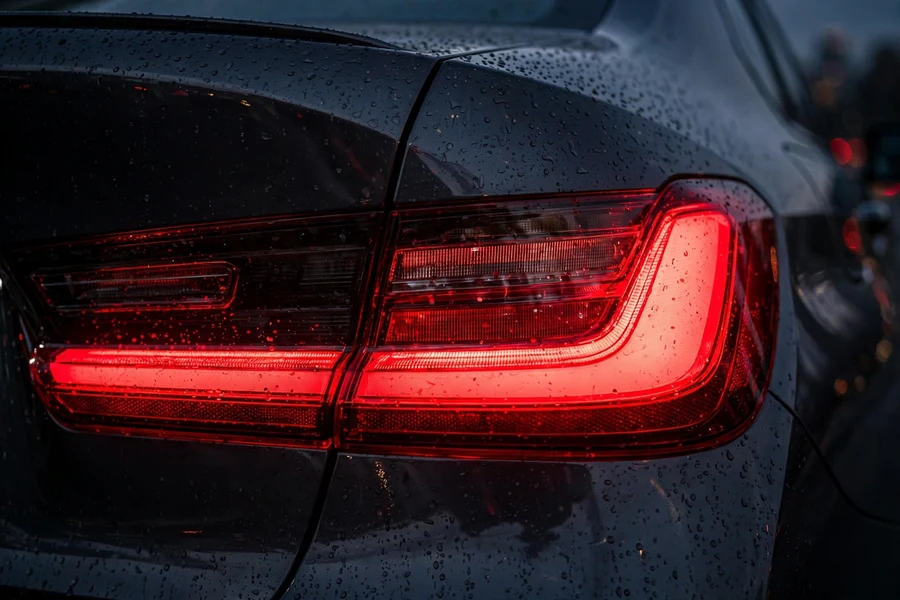
The LED rows deserve emphasis: on the E90 LCI, E92/E93, most F30 tail positions and the entire G20 rear, there is no user-replaceable bulb — the LEDs are soldered into the housing with their driver electronics. If one segment is dead while its neighbor glows, the housing is done. The one exception: the turn signal stayed a conventional PY21W bulb on some LED-tail trims, so verify before pricing an assembly.
Find your exact fix in 10 seconds
Taillight fix finder
Pick your generation and the light that’s out. You’ll get the part type, the repair path, and the realistic cost band.
DIY: E46 and E90/E91 bulb replacement
These are the easiest bulb jobs BMW ever made. Plan on 5–10 minutes per side for the E46 (the carrier unclips by hand) and 15–20 for the E90/E91. Turn the lights off first — a lit filament burns instantly — and never touch the new bulb’s glass with bare fingers; skin oils shorten filament life.
E46 (1999–2006)
- Open the trunk and find the carpet flap or plastic cover directly behind the taillight cluster. Fold it aside to expose the back of the housing.
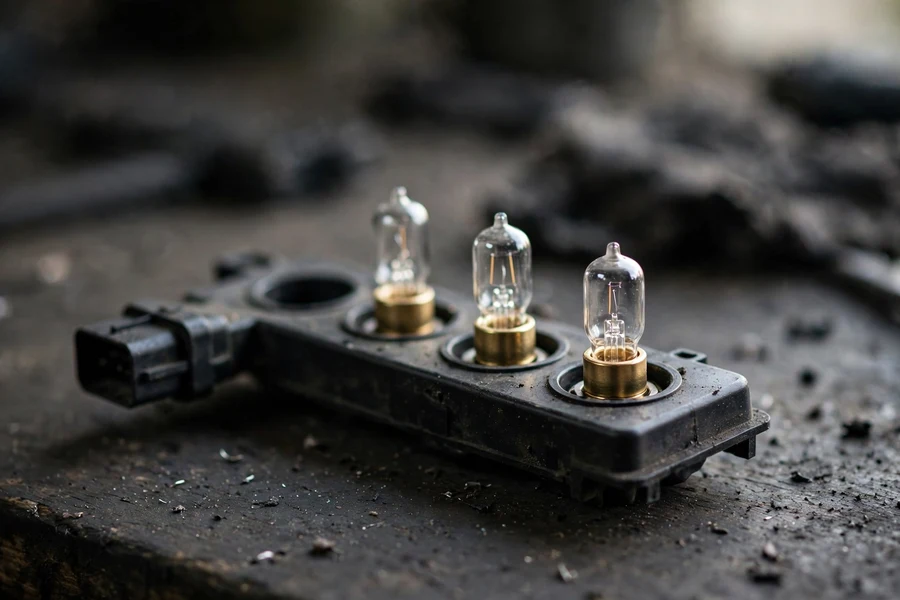
- Locate the bulb carrier — the black plate carrying all the rear bulbs — squeeze its retaining tabs and pull it straight back off the housing.
- Identify the failed bulb — a broken filament or blackened glass confirms it — then twist a quarter turn and pull it from the carrier.
- Push the new bulb in and twist to lock, using a rag or gloves so your fingers never touch the glass.
- Press the carrier back onto the housing until the tabs click, then test every function — parking, brake, turn, reverse — before refitting the trunk cover.
Two E46 cautions: the facelift LED brake strip is a separate sealed element — if the bar is out but the bulbs are fine, the housing or its feed is the problem, not a bulb. And the rear lamp connector is a documented weak spot whose ground pin can melt on high-mileage cars, producing intermittent-out symptoms that mimic a bad bulb. If a new bulb only works when you wiggle the carrier, inspect the connector for browning and replace it rather than buying more bulbs.
E90/E91 pre-LCI (2006–2008)
- Open the trunk and remove the small trim cover on the side wall directly behind the taillight. On the sedan it’s a clipped flap; on the touring, a slightly larger panel.
- Remove the retaining nut(s) holding the outer lamp assembly (typically 8–10 mm) and disconnect the electrical connector.
- Pull the assembly straight rearward out of the body. It sits on locating pins, so a firm straight pull works better than prying sideways.
- Twist the bulb holder for the failed function counterclockwise and pull it out. The brake and tail bulbs on these cars are both P21W single-filament bulbs.
- Fit the new bulb with a rag, reassemble in reverse order, and test all functions before refitting the trim cover.
The inner trunk-lid lamps are the fiddly ones: pop the trunk-lid trim rivets or screws, peel the liner aside, and remove the single nut holding the lamp — support it so it doesn’t drop onto the bumper. The rest is the same twist-and-swap routine.
DIY: F30 outer and inner lamps
The F30 dropped the service flaps, so bulb access means removing the lamp assembly — or part of the trunk-lid trim for the inner lamps. Still a driveway job: 20–30 minutes outer, 30–45 inner. You’ll want 8 and 10 mm sockets, a plastic trim tool, and a clean rag for handling bulbs. Work with the lights off and the trunk fully open.
F30 outer lamp (fender side)
- Lift the trunk lid and locate the cover panel on the side wall over the lamp. Loosen its screw and remove the cover to expose the back of the assembly.
- Loosen the two retaining nuts and unplug the wiring connector from the bulb holder.
- Detach the lamp assembly from the body by pulling it straight rearward. Set it lens-down on a soft cloth so the lens doesn’t pick up scratches.
- Separate the bulb holder from the assembly by releasing its four retainer clips. The holder lifts away as one plate, exactly like the carrier shown in the photo above.
- Pull the failed bulb — brake is the P21W, turn is the amber PY21W on most trims — and push the new one home without touching the glass.
- Reassemble in reverse order — snug the two nuts by feel (they thread into plastic) — reconnect, and test all functions before refitting the cover.
F30 inner lamp (trunk lid)
- With the trunk lid open, remove the trunk-lid trim panel (roughly eight fasteners — keep them in a cup so none migrate into the lid cavity).
- Release the retainers holding the inner bulb holder and lift it out. This is where the H21W brake bulb lives on many F30s, alongside the reverse lamp.
- Swap the failed bulb, reseat the holder until every retainer clicks, and test before the trim goes back on.
Two F30 notes: the outer turn signal is the amber PY21W with offset pins — not a clear P21W — and forcing a clear bulb into the amber socket is how sockets break. And if you find a melted or browned rear-lamp connector (the E46’s known failure pattern), replace the connector instead of the bulb; a fresh bulb on a cooked connector buys a few weeks of intermittent operation and another dashboard warning.
G20: full-LED rear means assembly replacement
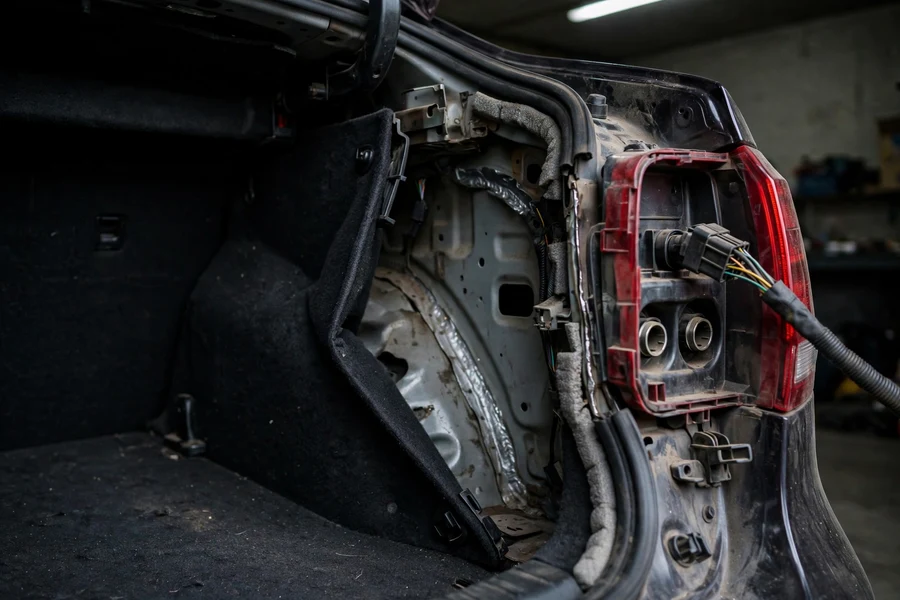
On the G20 (2019+) every rear function — tail, brake, turn, reverse — is a sealed LED array with no serviceable bulb. A dead segment means the complete lamp assembly for that side, inner or outer as the failure dictates. The job is straightforward: trim access from inside the trunk or trunk lid, a few nuts, one electrical connector, and the assembly pulls free. Budget 45–60 minutes per side (3/5 difficulty) — not hard, just expensive enough that rushing the trim clips is a bad idea.
Price is the real story: aftermarket G20 assemblies typically list around $200–$300 per unit, OEM BMW units commonly $500–$900+ per side depending on inner vs outer — before labor. Shops bill an hour or less for the swap; a dealer adds its usual premium. If the car is still under factory or CPO warranty, run a dead LED segment through the dealer first.
One G20 nuance: the bulb-check system can occasionally flag a healthy rear lamp after a software update or low-voltage episode. If the warning clears after an iDrive reboot and a short drive — and every rear light visibly works — log it and move on. If it returns, or a segment is visibly dark, price the assembly: there is no bulb, and no resistor or coding trick revives a dead LED driver.
What it costs: DIY, independent shop, dealer
A taillight bulb job is one of the cheapest repairs this car will ever need — and one of the most marked up at the dealer counter. Bands below are approximate US figures for a single side; labor rates vary by metro area.
| Repair | DIY | Independent shop | BMW dealer | DIY time |
|---|---|---|---|---|
| Bulb swap (E46 / E90 / F30 bulb positions) | $5–$20 | $40–$80 | $100–$150 | 5–30 min |
| Connector replacement (melted pin, E46/F30) | $5–$25 | $80–$200 | $150–$350 | 30–60 min |
| Aftermarket assembly, one side (E90/F30) | $150–$300 | $230–$450 fitted | $450–$750 fitted | 30–60 min |
| OEM assembly, one side (E90/F30) | $350–$600 | $450–$750 fitted | $650–$1,000 fitted | 30–60 min |
| G20 LED assembly, one side | $200–$900 (part) | $350–$1,050 fitted | $700–$1,400+ fitted | 45–60 min |
Two takeaways: the dealer premium on a bulb swap is the steepest ratio here — a minimum labor charge plus a marked-up bulb for a ten-minute job, making this the textbook first DIY. And on the G20 the economics flip: the gap between a quality aftermarket assembly and the OEM part can fund the whole independent-shop install. Buy the assembly for your exact side, body style and lighting package — left and right differ, and LED vs non-LED housings are not interchangeable.
Keep receipts for any lighting repair — if a shop’s bulb fix fails within days, that paper trail gets you the connector or ground repair under their rework policy instead of a second bill. For the bigger ownership picture, the maintenance schedule and cost guide keeps running totals honest.
LED vs halogen: retrofit notes and the law
Filament bulbs on the E46 and early E90, LED strips at each facelift, a fully sealed LED rear on the G20: BMW’s own trajectory is the technology story. LEDs hit full brightness roughly 200 ms faster — several car lengths of earlier warning at highway speed — and outlast filaments by an order of magnitude. It does not follow that a $15 drop-in LED bulb is an upgrade for the socketed cars.
Three things go wrong with LED retrofit bulbs. First, the bulb-check system monitors resistance: an LED draws far less current, so the car throws the very bulb-out warning you wanted to avoid — or hyperflashes the turn signals. The usual fixes are load resistors or coding out bulb monitoring for that circuit. Second, photometrics: a cheap LED in a reflector designed for a filament is often dimmer where it counts and glaring where it shouldn’t. Third, the law: FMVSS 108 restricts rear lighting to red and amber (white only for the reverse lamp), and a retrofit that changes brightness or color can fall outside compliant lighting (NHTSA’s FMVSS 108 interpretation on rear lamp color). A fix-it ticket costs more than the “upgrade.”
The safe path is the one BMW took: replace the whole housing with a proper LED assembly designed for the car, not a bulb masquerading as one. Look for DOT/SAE markings on the lens — their absence is a red flag — and expect to pay real money for correct brightness and beam pattern.
Troubleshooting: when the warning won’t clear
Most taillight jobs end with the warning gone on the first start. When they don’t, the culprit is almost always one of five things, in this order:
1. Wrong bulb, right socket
P21W and twin-filament P21/4W share a base family, and 1157s come in wattage variants. A plausible-looking wrong bulb lights up fine yet still throws a fault, because the bulb-check system compares resistance against the expected filament. Pull it back out, compare the markings and pin layout against the old bulb, and match wattage exactly.
2. Oxidized or spread contacts
Thermal cycling loosens the holder’s spring contacts and grows a film of oxide on them. A pencil eraser or contact cleaner on both the bulb base and the holder contacts fixes a surprising number of “new bulb, same warning” cases. If the contacts are visibly spread or the plastic is heat-discolored, replace the holder or the connector rather than the bulb.
3. The melted ground pin (E46, and check F30)
The ground pin in the E46’s rear lamp connector can overheat and melt its plastic surround, making intermittent contact that reads as a bulb failure: the light works when you wiggle the carrier, dies over bumps. The fix is a new connector on the car side of the harness — not another bulb, and usually not a new assembly. Inspect browned connectors the same way on E90 and F30 cars; the failure is less common there but the check costs nothing.
4. Broken wiring at the trunk hinge
Wires feeding the trunk-lid lamps flex at the hinge with every opening; after a decade-plus, conductors crack inside the insulation at the bend. If an inner lamp or the whole trunk-lid cluster is dead while the fender lamps work, peel back the rubber boot at the hinge and look for broken wires. Solder-and-heat-shrink — or a replacement harness section — is the permanent fix, and it also cures phantom warnings that come and go with trunk movement.
5. Moisture inside the housing
Light mist inside the lens on a humid morning is normal condensation and clears with driving. Standing water, persistent droplets, or corroded contacts means the housing seal has failed — the lamp will keep killing bulbs until the assembly is replaced. While the housing is off, check the foam gasket between lamp and body; on the older generations it’s a cheap separate part.
One last consideration: BMWs are voltage-sensitive, and a weak battery produces phantom warnings — lighting faults among them — that vanish once proper voltage is restored. If the taillight warning arrived alongside slow cranking or other random faults, read the battery replacement and registration guide before chasing the lamp itself. The E90 vs F30 and F30 vs G20 comparisons fill in the generational engineering context.
Frequently asked questions
Can you replace just the bulb on a BMW 3 Series, or do you need the whole taillight?
E46, pre-LCI E90/E91 and the F30’s bulb positions (brake, turn, reverse on most trims) take a simple bulb swap — 5–30 minutes from inside the trunk. E90 LCI sedan/touring, all E92/E93, and the entire G20 rear use sealed LED arrays for tail and brake: no serviceable bulb, so a dead segment means a full assembly. The turn signal stayed a conventional bulb on some LED-tail trims, so check that before pricing an assembly.
What bulb does my BMW 3 Series taillight take?
Common fitments: E46 tail/brake — dual-filament 1157 (P21/5W), pre-facelift sedans R5W or P21/4W; E90 pre-LCI brake/tail — P21W; F30 brake — P21W outer, H21W inner trunk-lid lamp. Rear turn is generally amber PY21W; license plate W5W or C5W. The definitive answer is the bulb you pull out — match markings and wattage exactly, since the bulb-check system faults on resistance mismatches.
How much does BMW charge to replace a taillight bulb?
Roughly $100–$150 at a BMW dealer for a bulb swap, $40–$80 at an independent shop, $5–$20 DIY (approximate US bands). The dealer premium is mostly minimum labor plus a marked-up bulb — hence the classic first DIY. A full assembly is a different scale: $150–$300 aftermarket or $400–$900+ OEM per side, G20 LED at the top end.
Why does my taillight warning stay on after replacing the bulb?
In order: wrong bulb variant or wattage mismatch, oxidized or spread holder contacts, a melted ground pin in the lamp connector (the E46 classic), and broken wiring where the harness flexes at the trunk hinge — especially for trunk-lid lamps. If the warning arrived with slow cranking or other electrical oddities, suspect a weak battery first.
Are LED replacement bulbs legal, and will they trigger warnings?
Drop-in LEDs frequently trigger bulb-out warnings or hyperflash from their lower current draw; resistors or coding mask it but don’t fix the photometric mismatch. FMVSS 108 restricts rear lighting to red and amber (white only for reverse), and retrofits that alter brightness or color can fall outside compliant lighting. A DOT/SAE-marked LED assembly is the defensible route; the headlight bulb guide covers the front-car version of the same question.