When BMW Walnut Blasting Pays Off (and When It Doesn’t)
Cold-start misfires that vanish once the engine warms up. A rough idle that no spark plug change seems to fix. Power that feels slightly duller than it used to, and fuel economy that keeps sliding. If you own a BMW with a direct-injected engine — the N54, N55, or N20 — this pattern is familiar to thousands of owners, and it has one common culprit: carbon deposits choking the intake valves. BMW walnut blasting is the cleaning method BMW specialists standardized on: crushed walnut shells blasted at the closed valves, stripping the carbon crust without damaging the metal underneath.
This guide explains why direct injection causes intake-valve carbon buildup in the first place, the symptoms that genuinely point to carbon, the mileage windows where independent BMW specialists recommend the first cleaning, what the process actually involves, what it costs at a shop versus doing it yourself, and the honest before-and-after expectations — plus what to rule out first, because not every misfire is carbon.
The short answer
BMW walnut blasting is a media-blasting cleaning of the carbon deposits baked onto the intake valves of BMW’s direct-injected engines — chiefly the N54, N55, N20, and N26. Because direct injection sprays fuel straight into the cylinder, the intake valves never get washed by detergent fuel the way they did on older port-injected engines, so oil vapor from the crankcase ventilation system bakes onto them over tens of thousands of miles. There is no BMW factory interval for this service; the specialist consensus is to inspect or clean at roughly 60,000–80,000 miles on N54 engines and 70,000–100,000 miles on N55 and N20 engines, repeating as needed when symptoms return. Expect $400–$800 at an independent shop, or $150–$350 in parts and media for a DIY setup. It restores lost smoothness and power when carbon is the cause — and does nothing for misfires caused by coils, injectors, or a failing high-pressure fuel pump.
In this guide
- Why direct injection coats the intake valves in carbon
- Which BMW engines are affected (and which aren’t)
- Symptoms that point to carbon buildup
- Do you need a carbon cleaning? — the quiz
- The walnut blasting process, step by step
- Walnut blasting cost: DIY vs shop
- Honest before-and-after expectations
- Prevention: what actually slows it down
- When it’s not carbon: rule these out first
- FAQ
Why direct injection coats the intake valves in carbon
To understand walnut blasting, you have to understand why the problem exists at all — because on the BMW engines that came before these, it essentially didn’t. The difference is where the fuel goes. On an older port-injected engine like the N52, injectors spray fuel into the intake port, just upstream of the intake valves. Every intake stroke bathes the back of each valve in detergent-laden gasoline, which washes away the oily film before it can harden into deposits. The valves effectively self-clean on every drive.
Direct injection moved the injectors into the combustion chamber. That was a deliberate trade-off: spraying fuel directly into the cylinder enables precise metering, cooler charge temperatures, and the stratified-charge and turbocharged operation that gave the N54, N55, and N20 their blend of power and economy. But it removed the washing step. The intake valves now see only air — and whatever else rides along with it.
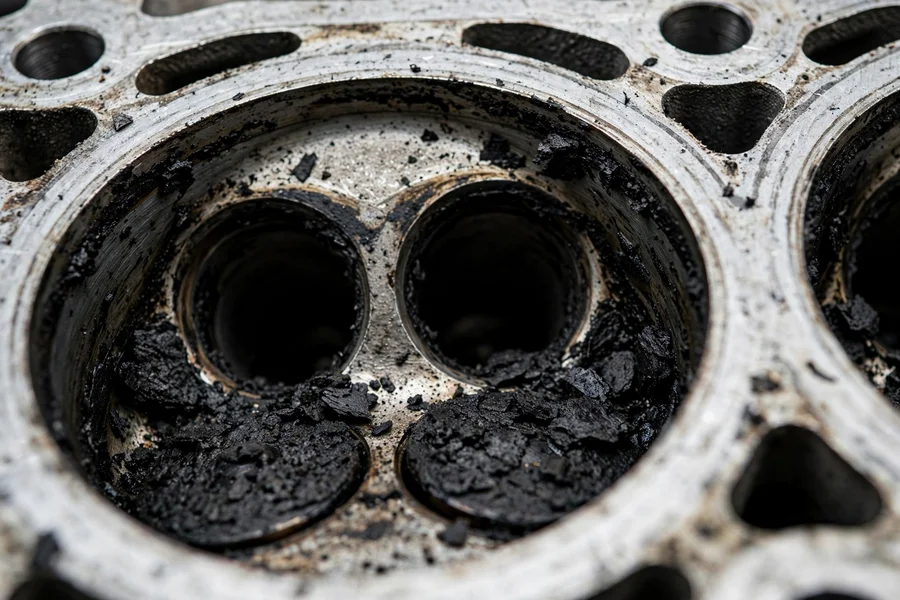
What rides along is oil vapor. Every engine has blow-by: combustion gases that slip past the piston rings and pressurize the crankcase. The positive crankcase ventilation (PCV) system routes those gases back into the intake to be burned, which is good for emissions — but the gases carry atomized oil mist. On a port-injected engine, that mist lands on valves that get washed by fuel. On a direct-injected engine, it lands on hot, dry valves and stays. Heat cycles bake each layer into a hard, black, crusty shell. Turbos make it worse: higher cylinder pressures create more blow-by, so turbocharged direct-injected engines like the N54/N55/N20 accumulate deposits faster than a naturally aspirated direct-injected engine would.
| Factor | Port injection (e.g., N52) | Direct injection (N54 / N55 / N20) |
|---|---|---|
| Where fuel sprays | Intake port, upstream of valves | Directly into the cylinder |
| Valve washing | Yes — fuel washes valves every cycle | No — valves see only air and oil mist |
| Oil mist from PCV | Burns off; washed away | Bakes onto hot valves, layer by layer |
| Carbon buildup rate | Negligible on the valves | Progressive over tens of thousands of miles |
| Cleaning needed | Rarely, if ever | Walnut blasting at specialist-recommended mileages |
The important consequence: deposits are a design characteristic of these engines, not a defect in yours. A low-mileage garage queen driven gently on short trips can carbon up faster than a high-mileage commuter that regularly sees full operating temperature — gentle, cool running bakes softer deposits rather than burning the lightest fractions off. That is why mileage guidance is always a range, never a fixed number.
Which BMW engines are affected (and which aren’t)
Carbon buildup on the intake valves is a direct-injection phenomenon, so it follows the direct-injected engines. On the 3 Series, that means the N54 twin-turbo inline-six (2007–2010 335i), the N55 single-turbo inline-six (2011–2015 335i), and the N20 single-turbo four-cylinder (2012–2016 320i and 328i), plus the N26, the SULEV-rated sibling of the N20. The earlier N52 naturally aspirated six, used in the 2006–2013 325i/328i/330i, is port-injected and effectively immune — one genuine maintenance advantage of the older engine.
BMW publishes no official carbon-cleaning interval for any of these engines. The mileage figures below are the consensus ranges recommended by independent BMW specialists — the mileages at which shops report regularly finding buildup worth cleaning — not a factory schedule. Individual cars vary with driving style, oil change habits, and climate.
| Engine | 3 Series models | Specialist-consensus first cleaning* | Typical repeat cleaning* |
|---|---|---|---|
| N54 twin-turbo six | 2007–2010 335i (E90) | 60,000–80,000 miles | Every 50,000–70,000 miles after |
| N55 single-turbo six | 2011–2015 335i (F30) | 70,000–100,000 miles | Every 60,000–80,000 miles after |
| N20 / N26 turbo four | 2012–2016 320i, 328i (F30) | 70,000–100,000 miles | Every 60,000–80,000 miles after |
| N52 port-injected six | 2006–2013 325i, 328i, 330i (E90) | Not needed | Not needed |
The N54 generally needs the earliest attention: it was BMW’s first mass-production turbocharged direct-injection engine, its PCV and crankcase ventilation design were less refined than what followed, and it runs higher boost. The N55 and N20, with revised ventilation and engine management, accumulate deposits more slowly — but they accumulate them all the same. If you’re shopping for one of these cars, a borescope look at the valves through the intake is one of the most informative checks on a high-mileage 3 Series: heavy buildup at 90,000 miles is a negotiating point and a scheduled maintenance item, not a deal-breaker.
Symptoms that point to carbon buildup
Carbon buildup strangles the engine gradually, and its signature is a gradual decline rather than a sudden failure. The classic pattern: the car runs slightly rough for the first minute on a cold start — sometimes setting misfire codes like 29CD through 29D2 on the N54 — then smooths out and drives acceptably once warm. Owners often report that the car simply doesn’t feel as eager as it used to, that throttle response is lazier, or that fuel economy has slipped a mile or two per gallon over a year or two.
What’s happening mechanically: the deposits roughen and narrow the intake ports, disturbing the airflow into each cylinder. Air distribution between cylinders becomes uneven — some cylinders get a clean charge, some get a disrupted one — which is why idle suffers most and why cold starts (when the engine is least forgiving) show it first. In severe cases, deposits grow thick enough to interfere with valve seating, which can cause persistent misfires and a check engine light that doesn’t clear.
| Symptom | How carbon causes it | Other common causes to check |
|---|---|---|
| Rough cold start, smooths out warm | Uneven airflow across cylinders is worst before the engine adapts | Worn spark plugs, aging coils, leaky injectors |
| Cold-start misfire codes | Restricted ports lean out individual cylinders at startup | Coils, injectors, high-pressure fuel pump |
| Gradual power loss | Narrowed ports reduce volumetric efficiency | Boost leaks, worn turbo, restricted exhaust |
| Lazy throttle response | Turbulent, disrupted intake airflow | VANOS timing faults, vacuum leaks |
| Declining fuel economy | Engine works harder for the same output | Tires, alignment, thermostat, driving pattern |
| Persistent misfires at all temperatures | Deposits interfering with valve seating (severe) | Coils, injectors, HPFP, compression issues |
Two things in that table deserve emphasis. First, carbon is the slow failure — coils and injectors fail suddenly, one cylinder at a time. If your car ran fine Tuesday and misfires Wednesday, that’s a part, not buildup. Second, misfire codes on an N54 at 85,000 miles with no service history are genuinely ambiguous: they could be carbon, coils, or injectors. That’s why the standard specialist workflow is a scan, then the cheap-and-fast parts checks (plugs, coils), then a borescope look at the valves before committing to a blasting appointment.
Do you need a carbon cleaning? — the quiz
Mileage plus symptoms tells you most of the story. Answer three questions for a recommendation based on the specialist-consensus ranges in this guide — a triage aid, not a diagnosis. A borescope look at the valves through the intake is the only way to confirm buildup before you book.
Carbon cleaning triage
Three questions — engine, mileage, and your main symptom.
Triage aid, not a diagnosis. Sudden-onset misfires point to a failed part (coil, injector, pump) rather than buildup — see the differential table above.
The walnut blasting process, step by step
Walnut blasting earned its status because it solves the access problem elegantly: the deposits are inside the intake ports, behind the valves, where no chemical soak or intake spray can reliably reach them without risking the turbo and catalytic converters downstream. The mechanical approach is direct, controlled, and — done properly — safe for the engine.
1. Remove the intake manifold. The ports and valve backs are only accessible with the manifold off. On an N54 or N55 that means disconnecting the charge pipe, vacuum lines, throttle body, and fuel-line brackets; on an N20 it’s a similar job with tighter packaging. This is most of the labor. New intake manifold gaskets go on at reassembly — they’re inexpensive and reusing the old ones risks vacuum leaks.
2. Close the valves for the cylinder being cleaned. This is the critical safety step. The engine is rotated (by hand, on the crank bolt) until the intake valves of one cylinder are fully closed, so the port becomes a sealed cup. Blasting with an open valve lets media fall into the cylinder — the one mistake that turns a cleaning into an engine problem.
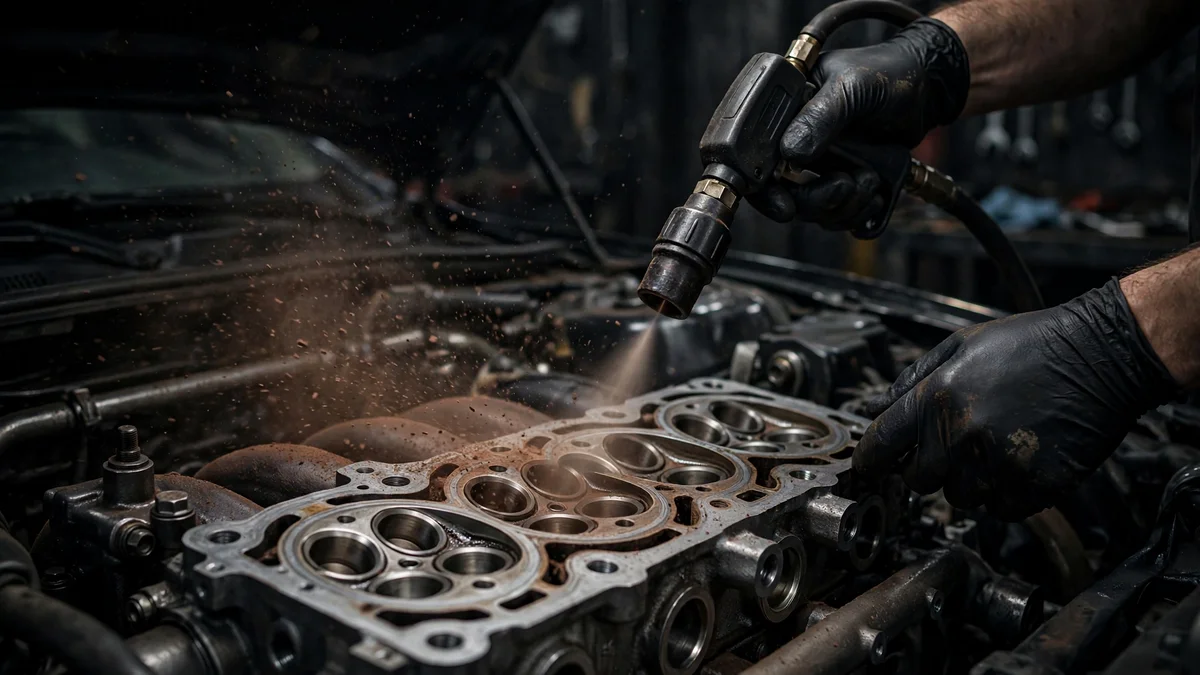
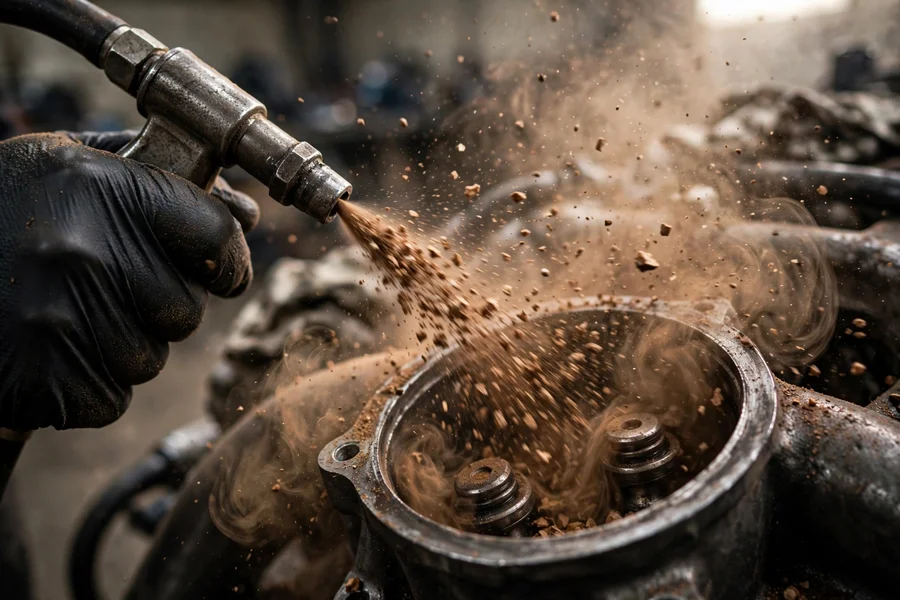
3. Blast the port with walnut-shell media. A blaster gun fires crushed walnut shells at the deposits while a shop vacuum simultaneously extracts the spent media and loosened carbon through a sealed adapter. Walnut shells are the media of choice for a reason: they’re harder than carbon but softer than the steel valves and aluminum ports, so they strip the crust without cutting the metal. Typical shop time per port is a few minutes; a full six-cylinder head takes a few hours.
4. Rotate the crank and repeat. Each cylinder is brought to closed-valve position in turn and blasted the same way. A borescope check between cylinders confirms the work.
5. Reassemble and clear adaptations. The manifold goes back on with new gaskets, everything is reconnected, codes are cleared, and the engine management relearns with clean airflow. Most shops road-test and re-scan to confirm no vacuum leaks or leftover codes.
Walnut blasting cost: DIY vs shop
This is an honest advanced-DIY job, not a beginner one. The blasting itself is simple; the risk is all in the preparation — confirming each cylinder’s valves are truly closed before blasting, keeping media out of open ports, and getting the intake manifold sealed correctly on reassembly. Shops that do this weekly have the jigs, adapters, and borescope routine dialed in, which is why most owners choose the shop route even though the equipment is affordable.
| Route | Typical cost | Time | Difficulty / notes |
|---|---|---|---|
| DIY (own equipment) | $150–$350 in blaster kit, media, gaskets | 5–8 hours first time | Advanced — intake removal, valve-timing discipline, media control |
| Independent BMW shop | $400–$800 | 3–5 hours | The standard choice — ask to see borescope before/after photos |
| Dealership | $700–$1,200+ | Half day | Highest price; some dealers subcontract to specialists anyway |
A word on the cheaper alternatives you’ll see advertised: intake “carbon clean” sprays and fuel-system additives cannot replicate this. Fuel additives never touch the valves on a direct-injected engine — that’s the entire premise of the problem — and aerosol intake sprays applied through the manifold can’t generate the mechanical action needed to remove baked-on crust, while carrying some risk to the turbo and catalysts. If a shop offers a $99 “carbon service” with no manifold removal, that’s a chemical treatment, not walnut blasting. The related high-pressure fuel pump symptoms and ignition coil failure symptoms guides cover the parts most often confused with carbon buildup.
Honest before-and-after expectations
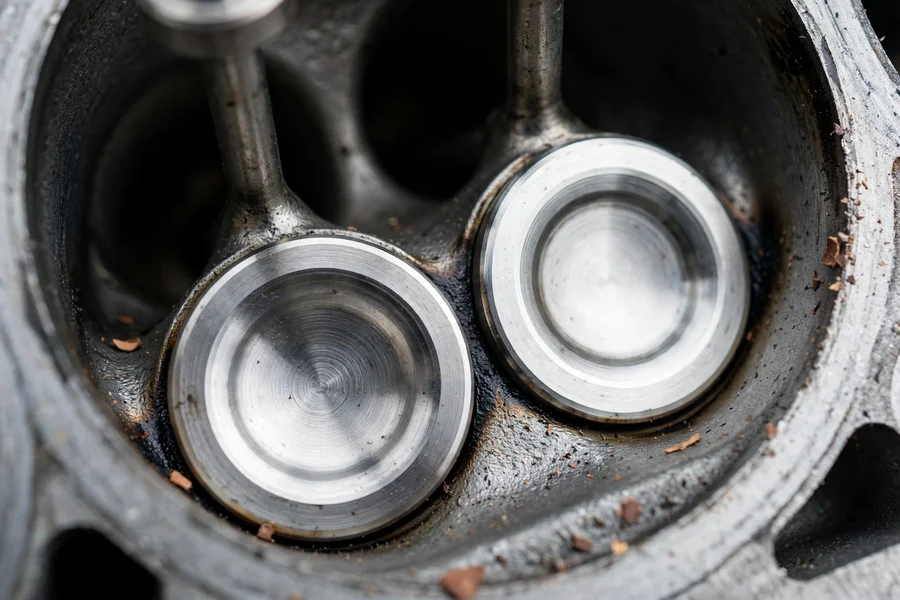
Set expectations by what carbon actually takes away, because blasting gives exactly that back — no more. Owners most consistently report a smoother cold start, a steadier idle, and snappier throttle response in the first week after the service. Fuel economy often improves by 1–2 mpg on cars that had lost it, though that’s owner-reported rather than laboratory-tested, and it won’t show on a car whose economy never dropped. What you will not get is more power than the car had new: walnut blasting restores factory airflow, it doesn’t add airflow. Anyone selling it as a performance upgrade is selling.
The other honest caveat: the clock restarts immediately. Nothing about the blasting changes the PCV system or the injection layout, so deposits begin re-accumulating on the first drive home. That’s why the consensus figures are repeat intervals, not one-time cures — this is a maintenance item like brake fluid, just on a much longer cycle. And critically, blasting fixes nothing if carbon wasn’t the problem: misfires from dead coils, leaking injectors, or a failing HPFP will be exactly as bad afterward, minus the money spent.
Typical carbon severity by mileage (specialist consensus)
Illustrative chart visualizing the consensus ranges in Table 2 — not measured data. Driving style and maintenance shift individual cars within and beyond these bands.
Prevention: what actually slows it down
You can’t prevent carbon buildup on these engines, but you can slow it. The deposits come from oil vapor, so everything that reduces oil in the intake charge helps. Change the oil on time with the correct BMW Longlife specification — degraded oil vaporizes more readily — and favor drives that reach full operating temperature: short, cold trips are the worst case for deposit formation, while regular highway running keeps the PCV system and crankcase at their cleanest.
Oil catch cans are the one aftermarket addition with a real mechanism behind it. A catch can plumbed into the PCV line condenses oil mist before it reaches the intake, and owners who empty them find measurable oil collected between changes. Brands like BMS and VRSF sell application-specific kits for the N54 and N55. They’re a reduction, not a cure — some vapor always gets through — and they need periodic emptying to work at all. What doesn’t help: premium fuel or fuel-system cleaners. Top-tier gasoline is excellent for the injectors and combustion chamber, but on a direct-injected engine the fuel never touches the intake valves, so no additive can wash them.
The most useful preventive habit is also the cheapest: have the valves scoped whenever the intake area is already accessible — during a spark plug change or a charge-pipe replacement, for example. Catching moderate buildup early means the next cleaning is routine instead of urgent. Ask the shop to save borescope photos of the valves before and after the work — reputable specialists do this as standard practice, and it documents the result you paid for.
When it’s not carbon: rule these out first
Walnut blasting is a four-figure-or-near-it commitment at a dealer, so confirm the diagnosis before booking. The failures most often mistaken for carbon are the sudden ones: a dead ignition coil (one cylinder drops out overnight), a leaking injector, or a failing high-pressure fuel pump — all covered in the site’s diagnostic guides. VANOS timing faults can also mimic the lazy throttle response of restricted ports; the VANOS and Valvetronic problems guide decodes those codes. The working rule: carbon is gradual and affects all cylinders roughly together; a fault that arrived suddenly, or one cylinder misfiring far worse than the others, is a part, not buildup. Start with a scan and the cheap checks — the complete 3 Series guide walks through the diagnostic order for these engines.
FAQ
How often do BMW intake valves need walnut blasting?
BMW publishes no official interval. The independent-specialist consensus is a first cleaning at roughly 60,000–80,000 miles for the N54 and 70,000–100,000 miles for the N55 and N20/N26, with repeat cleanings every 50,000–80,000 miles after that depending on symptoms. A borescope inspection of the valves is the way to confirm whether your car needs it now or can wait.
How much does walnut blasting cost?
Expect $400–$800 at an independent BMW shop and $700–$1,200 or more at a dealership. A DIY setup — blaster kit, walnut-shell media, and intake manifold gaskets — runs $150–$350 if you already own a compressor and hand tools. Be wary of $99 “carbon clean” offers with no manifold removal: those are chemical treatments, not walnut blasting.
Can walnut blasting damage the engine?
Done correctly, no. Walnut shells are softer than the steel valves and aluminum ports, so they strip carbon without cutting metal, and the process is performed with each cylinder’s valves fully closed so no media can enter the combustion chamber. The genuine risk is procedural: blasting with a valve open lets media fall into the cylinder. That’s why valve position is verified before every port — and why this is an advanced DIY job.
Will walnut blasting fix my misfires?
Only if carbon is causing them. The pattern that fits is gradual: cold-start misfires that fade as the engine warms, worsening over months, on a high-mileage car with no recent plug or coil service. Sudden misfires — fine Tuesday, misfiring Wednesday — point to a failed coil, injector, or fuel pump instead, and blasting won’t touch those.
Is walnut blasting worth it on a stock daily driver?
If the car is in the consensus mileage window and shows the symptoms, yes — owners typically report a noticeably smoother cold start and restored throttle response, which is the factory drivability you’ve been gradually losing. Treat it as scheduled maintenance rather than a performance modification: it returns the engine to stock airflow, it doesn’t add power beyond stock, and the deposits will slowly return afterward.