BMW Starter Motor Failure? Decode the Click-No-Crank
Short answer
BMW starter motor failure usually announces itself as a single loud click with no cranking — but that click is also the signature of a weak battery or a corroded cable, so never condemn the starter until you have ruled those out. Rapid clicking means low voltage at the solenoid; complete silence with a healthy battery points at the key or CAS authorization; cranking that will not fire is not a starter problem at all. Two multimeter tests below separate the suspects — worth doing, because on N52 and N20 engines the starter hides under the intake manifold, turning a ~$200 part into an $800-and-up installed job.
In this guide
- The four click-no-crank signatures
- What the starter actually does (and who tells it to)
- Starter vs battery vs CAS vs IBS vs ground strap
- Two voltage-drop tests that settle it
- Click-no-crank diagnosis tree (interactive)
- Replacement guide: difficulty by engine
- What starter replacement costs
- The “tap the starter” trick
- Frequently asked questions
This is the starter-specific deep dive. If your 3 Series does anything other than crank, the companion guide BMW 3 Series won’t start: the complete no-start diagnosis covers the full picture — fuel, spark, immobilizer, and charging-system failures — and you should start there if you have not isolated the symptom to the cranking circuit. Everything below assumes the engine does not turn over, or turns over and will not catch. If it turns over, your starter works and this article is not your problem.
The four click-no-crank signatures
Every click-no-crank complaint falls into one of four buckets, and the bucket determines the diagnosis. Listen for thirty seconds before touching a tool — the sound (or silence) is free evidence, and misreading it is how owners buy a starter they did not need.
| What you hear | What it usually means | First move |
|---|---|---|
| Single loud click, then nothing | Solenoid pulled in but no cranking: starter, battery, or cable/ground resistance | Load-test the battery, then voltage-drop test |
| Rapid clicking (machine-gun) | Solenoid chattering: voltage collapsing under load | Clean terminals, charge and load-test the battery |
| Complete silence | No start command sent: key, CAS, brake/clutch, or Park/Neutral input | Try the spare key; check fob battery and dash warnings |
| Cranks normally, will not fire | Starter is doing its job — look at fuel, spark, or immobilizer instead | See the won’t-start guide |
Single loud click
This is the classic dying-starter sound — and also the classic sound of a battery that collapses the moment the starter asks for several hundred amps. The start signal reaches the solenoid, the plunger slams forward with an audible clack and bridges the copper contacts feeding full battery current to the motor. Then nothing turns. Three possibilities — burned solenoid contacts, a battery that cannot sustain the draw, or resistance in the cable or ground path — identical from the driver’s seat, separable only by the voltage-drop tests below. Watch the dash lights: barely a flicker points at the starter or cable path; a hard dim points at the battery.
Rapid clicking
That fast rattle — the solenoid engaging and dropping out ten times a second — is almost never a bad starter. The solenoid pulled in, the motor drew its huge inrush current, the marginal voltage sagged below the hold-in threshold, and the cycle repeated. A weak or discharged battery is the cause in the large majority of cases; the rest are dirty, loose, or corroded terminals and grounds. Twist the battery terminals by hand — they should not move — and look for white or green crust. A jump start that brings the car to life confirms the battery or its connections; a free load test then decides whether the battery is dead or merely discharged.
Complete silence
No click at all means the solenoid never fired — the car refused to send the start command. The CAS module (E90/F30; the BDC module on G20) must recognize your key, see the brake pedal pressed (clutch on manuals), confirm Park or Neutral, and satisfy the immobilizer before energizing the starter relay. Silence with a healthy battery is an authorization problem: a dead fob battery, a forgotten fob, a failed brake-light switch, or a CAS fault — code A0B4 is the telltale. Try your spare key first; it costs nothing.
Cranks but will not fire
If the engine turns over at a healthy speed and never catches, your starter, battery, cables, and CAS are all doing their jobs. Do not spend another dollar on the cranking circuit — the problem is downstream (fuel, spark, a sensor, or the immobilizer). That territory belongs to the won’t-start guide.
What the starter actually does (and who tells it to)
Understanding the chain of command makes the diagnosis logical instead of guesswork. Pressing start begins a short chain, and each link fails differently.
First, the key verification: the fob’s chip is read by the CAS module. A weak fob battery or a desynchronized key stops everything here — complete silence, often with a key warning. The key fob troubleshooting guide covers this branch, including the emergency detection spot on the steering column that can coax a dying fob into one last start.
Second, CAS authorization: with a valid key, the CAS checks brake-pedal input, transmission position (Park/Neutral, or clutch on manuals), and the immobilizer handshake with the engine computer. Satisfied, it switches the starter relay, sending a small 12-volt signal down the trigger wire to the solenoid. A failed brake-light switch or a CAS internal fault kills the command silently. The BMW-specific code is A0B4, visible only on a BMW-capable scan tool — a generic parts-store reader cannot reach the CAS, so a clean generic scan proves nothing here.
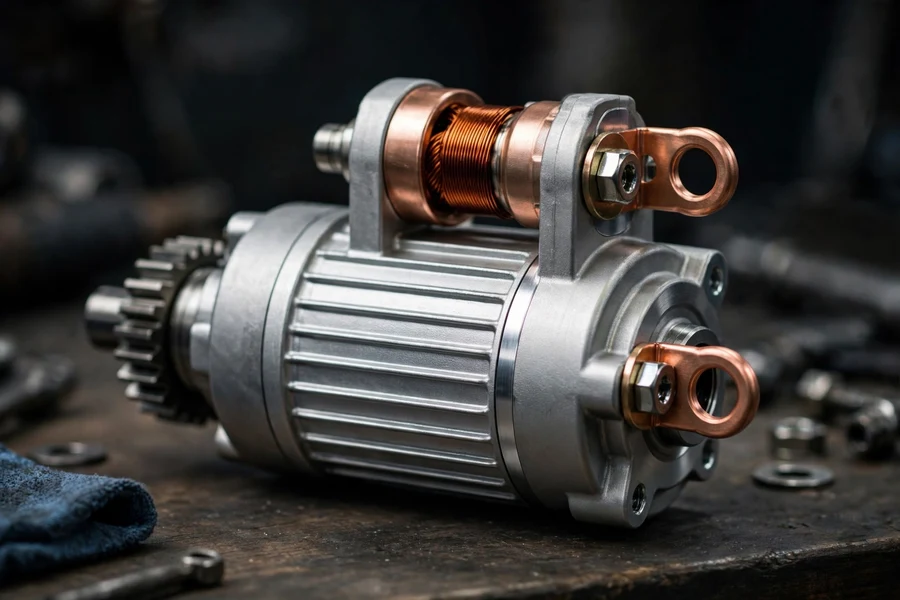
Third, the solenoid: that small signal energizes a coil that shoves the pinion gear into the flywheel’s ring gear and slams shut a pair of heavy copper contacts feeding the battery’s fat positive cable to the motor windings. The click is this plunger hitting home. Solenoid contacts burn and pit over tens of thousands of starts; a starter with burned contacts clicks perfectly while passing zero current to the motor — the most common internal starter failure on high-mileage BMWs.
Fourth, the motor and its current path: the motor needs a few hundred amps for the second or two of cranking — battery positive → thick cable → motor windings → starter housing → engine block → ground strap → chassis → battery negative. Any resistance in that loop — a corroded terminal, a green ground strap, a chafed cable — behaves exactly like a weak battery under load.
Starter vs battery vs CAS vs IBS vs ground strap
Five suspects, one symptom. Work down the table before buying anything: most click-no-crank cases resolve at step one or two, and the starter is the priciest suspect.
| Suspect | Typical sound | Supporting evidence | What confirms it |
|---|---|---|---|
| Battery | Rapid clicking, or single click with lights dimming hard | Short trips, old battery, jump start helps | Load test fails; voltage collapses under cranking |
| Terminals & cables | Rapid clicking or single click; intermittent | White/green crust on terminals, loose clamps, recent work near the battery | Cleaning fixes it; voltage-drop test shows resistance |
| Ground strap | Single click; everything else looks healthy | Older E90/F30, visible corrosion or fraying | Voltage drop on the ground side; cleaning/replacing fixes it |
| Starter / solenoid | Single loud click, bright lights, good battery | High mileage (typically 100k+), intermittent at first, hot-restart failure | Clean voltage-drop readings everywhere, still just clicks |
| CAS / key | Complete silence | Key warning on dash, spare key works, no authorization | A0B4 code on BMW scan; fob/key tests |
| IBS sensor | Usually silence after a sleep cycle, or repeated discharge | “Battery discharge” messages, car fine after a drive then dead again | Rarely the cause of click-no-crank — investigate battery drain first |
The battery is guilty until proven innocent
Shop policy, not a figure of speech: a battery can read a healthy 12.4 volts at rest and still be incapable of delivering the few hundred amps a starter demands. Resting voltage alone is nearly useless; what matters is voltage under load. If the battery is four or five years old, your driving is mostly short trips, or a jump start brings the car back, the battery is suspect number one — a free load test at any parts store confirms it. If a fresh battery keeps dying, see the alternator failure symptoms guide. BMW caveat: a replacement battery must be registered to the car’s power management, or you will be back here in a year.
Ground strap: the E90/F30 specialty
The engine ground strap — the braided cable tying the engine block to the chassis — is a known corrosion point on higher-mileage E90s and F30s. Because the starter grounds through its housing into the block and out through this strap, a rotted strap produces the perfect single-click-with-bright-lights signature of a bad starter. Inspect it before condemning the motor: tug its visible runs — a strap shedding green powder or strands is done. The sting: a twenty-dollar fix masquerading as an eight-hundred-dollar one.
CAS: the silent gatekeeper
On the E90 and F30 the CAS module owns the start command; on the G20 the body domain controller holds the same role. Withheld authorization — unrecognized key, failed brake-pedal input, transmission position disagreement, or an internal CAS fault — gives total silence. The dash usually tells on it with a key or transmission warning. Cheap tests first: try the spare key, replace the fob battery, confirm the brake lights come on with the pedal (no brake signal, no crank). Beyond that, a BMW-capable scan for codes like A0B4 is professional-diagnostic territory.
IBS: usually a red herring here
The Intelligent Battery Sensor on the negative terminal lets the car manage charging. When it misbehaves, the classic symptom is parasitic drain — “battery discharge” warnings, fine after a drive but dead the next morning. That is a discharge problem, not a click-no-crank problem. With a freshly charged, load-tested battery that still only clicks, move on to the cables and the starter instead.
Two voltage-drop tests that settle it
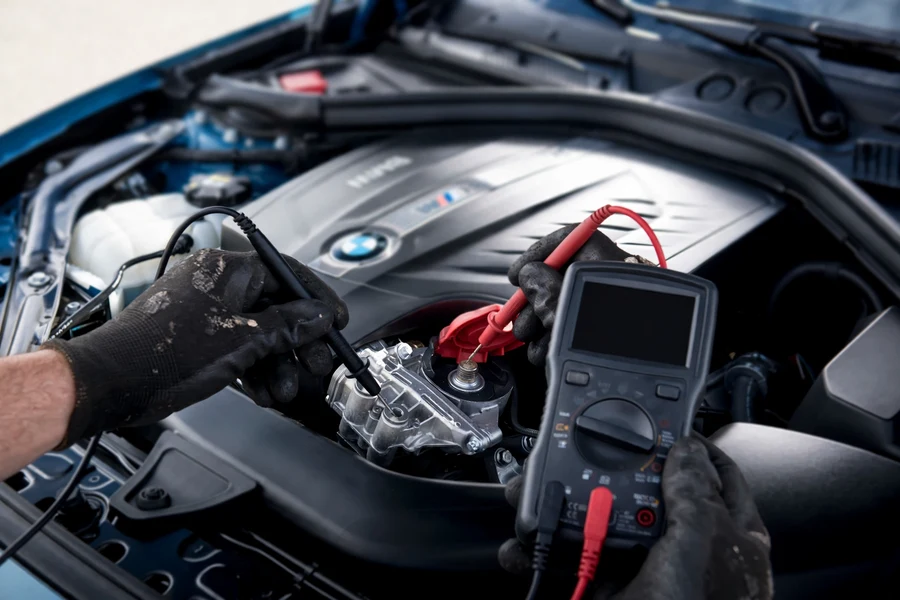
A voltage-drop test measures the voltage wasted in the cables while the starter tries to crank — resistance invisible at rest shows up under load. You need a basic digital multimeter, a helper to hold the start button, and ten minutes, all at the under-hood jump points and the battery: no disassembly.
Test 0: the 30-second battery sanity check
Before the drop tests, establish the baseline. Meter on DC volts, across the battery terminals with everything off: 12.6+ is fully charged, ~12.4 is three-quarters, near 12.0 or below is discharged. Then have your helper attempt a start: a healthy battery dips but stays above roughly 9.6 volts. If it plunges toward 8 volts, the battery cannot carry the starter’s load — charge it fully and load-test it. If it holds voltage but the engine still only clicks, the battery is cleared and the drop tests will find the real culprit.
Test 1: positive-side drop (battery to starter)
Red lead on the battery’s positive post — not the clamp — black lead on the starter’s main positive lug (the under-hood jump terminal is on the same heavy cable and works as the probe point). Have your helper crank. Rule of thumb: more than about half a volt of drop under cranking load means resistance is stealing the starter’s current — work backward from the starter, cleaning and tightening each connection until the drop falls. Clean positive side but still a single click: the fault is on the ground side or inside the starter.
Test 2: ground-side drop (starter housing to battery)
Now red lead on the starter’s metal housing (any clean bolt) and black lead on the battery’s negative post, then crank again. This reads the voltage lost through the block, ground strap, and chassis return path. Same rule of thumb: more than about half a volt condemns the ground path — on an E90 or F30 the braided engine ground strap is the first thing to inspect. Unbolt it, wire-brush both ends and mounting points to bare metal, and retest. A crumbling, green strap gets replaced, not cleaned.
The verdict logic is the same sequence a shop follows: excessive drop on either side means fix the connection and retest. Clean drops on both sides, a battery that holds voltage under load, and a solenoid that still just clicks: the starter itself is bad. Only then talk about replacement.
| Measurement | Reading | Verdict |
|---|---|---|
| Resting battery voltage | 12.6 V or more: fully charged; near 12.0 V or below: discharged | Charge fully, then load-test |
| Voltage during crank attempt | Stays above ~9.6 V | Battery is carrying the load — suspect cables or starter |
| Voltage during crank attempt | Collapses toward 8 V or less | Battery cannot deliver starter current — replace after a load test |
| Positive-side drop while cranking | Well under ~0.5 V | Positive path clean |
| Positive-side drop while cranking | Above ~0.5 V | Resistance in cable or connections — clean and tighten each joint |
| Ground-side drop while cranking | Well under ~0.5 V | Ground path clean |
| Ground-side drop while cranking | Above ~0.5 V | Bad ground — inspect the engine ground strap first |
Click-no-crank diagnosis tree
Answer the three questions and the tree hands you the verdict — the same decision path described above, telling you which tests to run.
Click-no-crank diagnosis tree
Pick what happens when you press start — every branch ends in a verdict.
Answer all three questions to get your verdict.
Replacement guide: difficulty by engine
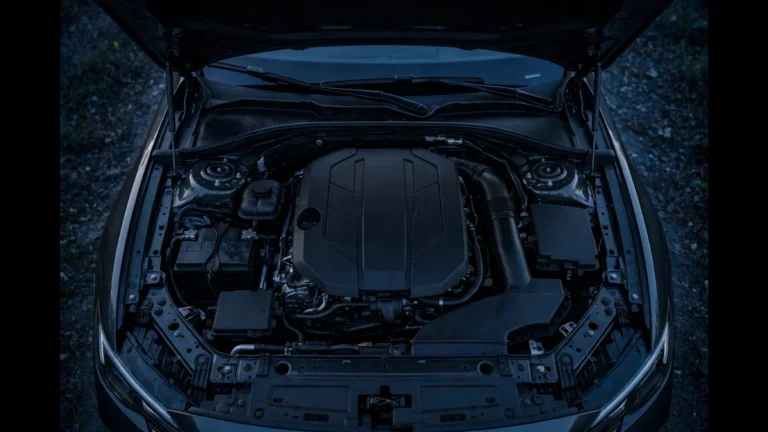
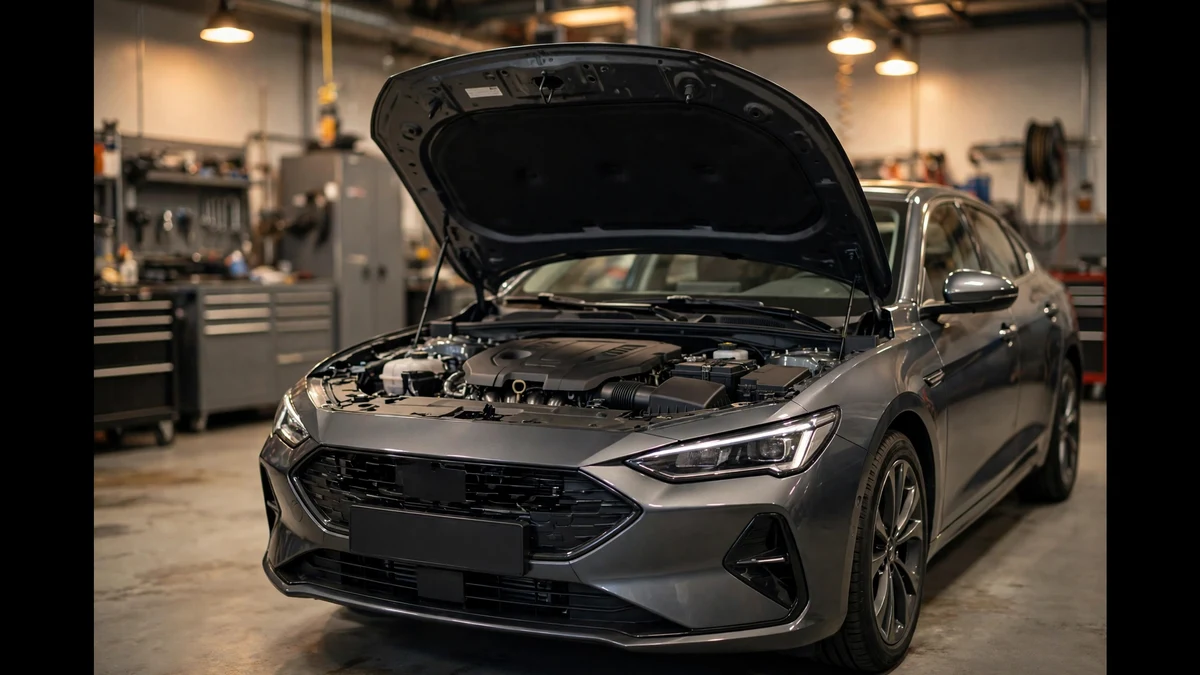
The honest truth about this job: the part is ordinary, the labor is not. On BMW’s six-cylinder and early four-cylinder engines the starter sits directly under the intake manifold on the driver’s side, buried where you cannot see or reach it without major disassembly. That packaging decision is why the job costs what it costs.
E90 (2006–2011): N52, N54, N55 — the manifold has to come off
On every E90 six-cylinder the starter lives beneath the intake manifold on the driver’s side, with no shortcut: the manifold must be unbolted and lifted clear (or pivoted far out of the way) to reach the starter bolts, trigger-wire plug, and main positive lug. Book labor is about four and a half to five hours; a first-timer should budget a full weekend day, ideally on a lift. The work is methodical — label every vacuum line and connector, remove the cabin-filter housing and engine cover, unbolt the manifold. Disconnect the battery negative terminal first: the starter’s main lug is permanently hot. Plan on new intake-manifold gaskets — heat-cycled old ones trade a starter job for a vacuum-leak hunt. Difficulty: advanced DIY, because everything you remove must be labeled and correctly reinstalled. For model-year and engine coverage across all three generations, the complete BMW 3 Series guide is the reference.
F30 (2012–2018): N20/N26 and N55 — same story, slightly tighter
The turbo four (N20/N26) and the F30’s N55 six keep the starter in the same location: under the intake manifold on the driver’s side. The procedure mirrors the E90 — manifold off, gaskets replaced, battery disconnected first — with turbo heat shielding making the N20 slightly tighter. Labor books in the same four-to-five-hour range. One F30-specific note: with the manifold off you are inches from the charge pipe and brittle plastic cooling fittings, so do this job with the car stone cold and do not rush it. Difficulty: advanced DIY, same as the E90.
B46/B48/B58 (F30 LCI 330i/340i and all G20) — the easy ones
BMW’s modular B-series engines moved the starter to the rear of the engine at the transmission bell housing, reachable from underneath without touching the intake manifold. From a lift or solid jack stands, it is a two-to-three-hour job: undertray off, heat shield aside, unplug the trigger wire, unbolt the main lug and mounting bolts, and maneuver the unit out. It is still tight, and the cable stays hot until the battery is disconnected — but it is a fundamentally different job from the manifold route. Difficulty: intermediate DIY, an afternoon for a competent home mechanic.

What to buy, and what not to skimp
A remanufactured starter from a reputable rebuilder is the value choice and what most independents install; a new OEM unit costs roughly double and suits long-term keepers. Avoid no-name bargain starters — a failure in eighteen months costs you the whole manifold-removal labor again. Buy the intake-manifold gaskets as a set for N52/N20/N55 cars, plus dielectric grease for the connections. No coding or registration is required after a starter swap. Reconnect the battery, clear stored codes, and the first start should be immediate.
What starter replacement costs
Because the labor splits so sharply by engine family, the price depends more on what you drive than where you live. A quality remanufactured starter runs roughly $150–$250, a new OEM unit roughly $300–$450; everything else is access labor. The bands below are installed totals in US dollars.
| Engine / generation | DIY (parts + gaskets) | Independent shop | Dealer |
|---|---|---|---|
| N52/N54/N55 (E90) — manifold route | $200–$400 | $600–$900 | $900–$1,300 |
| N20/N26/N55 (F30) — manifold route | $200–$400 | $650–$950 | $950–$1,350 |
| B46/B48/B58 (F30 LCI, G20) — from below | $180–$350 | $450–$750 | $750–$1,100 |
Installed cost ranges, parts + labor
Same bands as the table above. The manifold route is the expensive one — not the part.
Bars show the independent-to-dealer span; DIY is parts and gaskets only, roughly $180–$400.
Two things move a quote within its band. A shop that voltage-drop-tests before quoting is the shop you want; one that quotes a starter over the phone is guessing with your money. Second, “while you’re in there” finds on manifold-route jobs — a brittle hose or weeping gasket — add parts but save a second labor charge later. Ask the shop to photograph anything they find before approving it.
The “tap the starter” trick
You have probably heard it: whack the starter with a hammer while someone holds the start button, and a dead car springs to life. It is real, it sometimes works, and it is wildly misunderstood. The trick only helps one failure — worn brushes or a sticky solenoid plunger — where a sharp jolt reseats the contact for one start. On a BMW with the starter buried under the intake manifold, you cannot reach it to tap it.
When it is appropriate: as a one-time emergency measure to get a car with a known, diagnosed failing starter to a shop — for example, B-series cars where the starter is reachable from below. Use a rubber mallet or wooden hammer handle, tap firmly rather than swinging, and aim at the starter body, not the electrical lugs. When it is not appropriate: as a diagnosis (failure to start after tapping proves nothing — you may not have reached it); as a daily ritual (each successful tap is the brushes wearing further, and the day it quits will be the least convenient one); and near the permanently-hot main lug with a metal hammer, where a slip bridges battery positive to ground through your tool. If it works once, drive straight to the repair — it bought you a single start, not a fix.
Frequently asked questions
How do I know if it is the starter or the battery?
Rapid clicking is almost always the battery or its terminals. A single loud click with bright headlights points at the starter — but only after you prove the battery holds voltage under cranking load and the voltage-drop tests show clean cables. Diagnose the cheap suspects first; the starter is the most expensive one.
Can I drive with a failing starter?
Only in the narrow sense that a car whose starter works intermittently drives perfectly once started. The risk is the next start: intermittent click-no-crank becomes permanent without warning, usually far from home. Schedule the replacement promptly rather than collecting successful starts — the tap trick buys you one start, not reliability.
Why is BMW starter replacement so expensive?
The part is not the problem — a quality remanufactured starter is roughly $150–$250. The cost is access labor: on N52, N54, N55, N20, and N26 engines the starter sits under the intake manifold, booking around four and a half to five hours. The B-series engines (B46/B48/B58) moved it to the bell housing, reachable from below, roughly halving the labor.
Does a BMW starter need coding or programming after replacement?
No. Unlike a battery replacement, which must be registered to the car’s power management, a starter swap needs no coding or registration. Reconnect the battery, clear stored codes, and the car starts normally. If someone quotes a programming fee for a starter job, question it.
My BMW is completely silent when I press start — is that the starter?
Almost certainly not. Silence means the starter never received the command: an unrecognized key, missing brake-pedal input, the transmission not in Park/Neutral, or a CAS fault such as code A0B4. Work the authorization chain in the key fob guide and the diagnosis tree above before spending anything on the cranking circuit.