BMW 3 Series Low Coolant Warning: Causes & Fixes
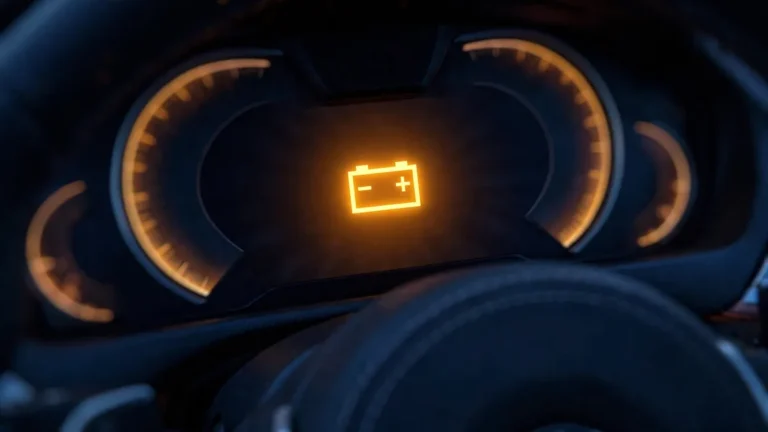
A low-coolant warning is one of the few BMW messages you should never ignore — but it doesn’t always mean the same thing. A yellow “low coolant” message with a steady temperature gauge is a top-up-and-investigate situation; a red overheating warning means the engine is already in danger and every extra mile risks serious damage. Knowing which one you’re looking at — and what to do in the next ten minutes — is the whole game.
This guide walks you through exactly that: the immediate roadside sequence, whether you can keep driving, the most common leak points on each 3 Series generation (E90, F30, G20), how to find your leak in five steps, and what each fix actually costs. It lives in our Troubleshooting hub — and if a CBS vehicle-check reminder pops up along the way, our service-light reset guide covers that separately.
The short answer
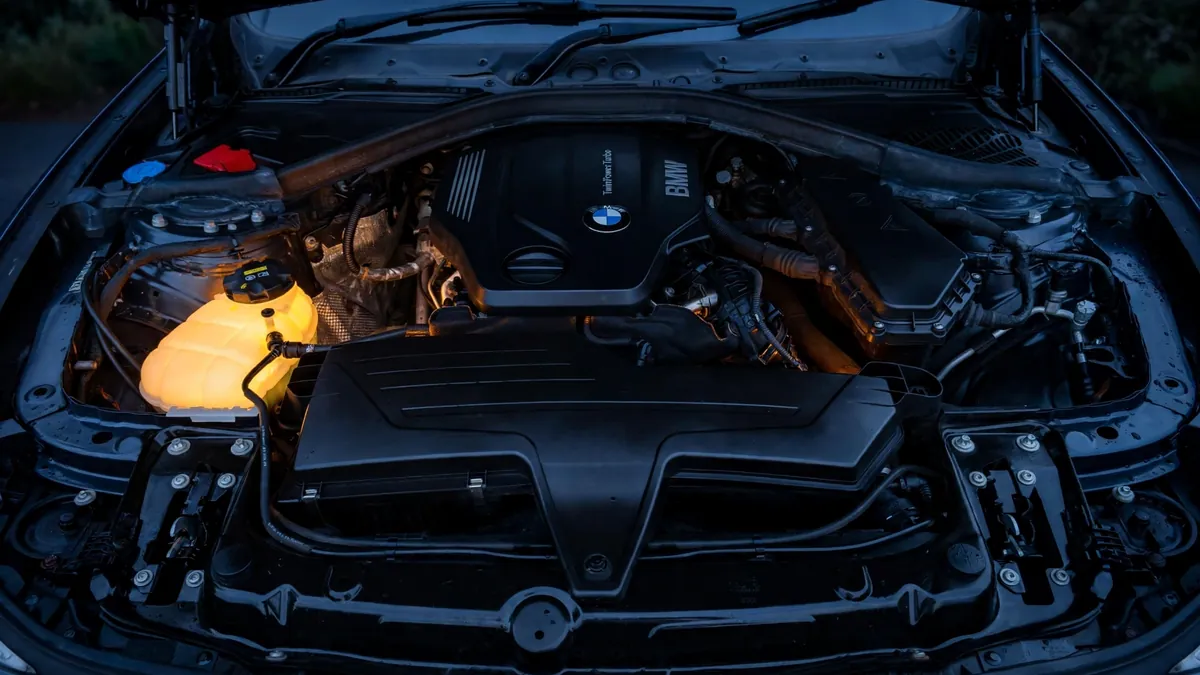
Pull over safely and read the exact message. If the warning is red or the temperature gauge is climbing, switch the engine off immediately — do not drive. If it’s yellow and the temperature is stable, let the engine cool completely, check the expansion-tank level only when cold, and top up with BMW-approved coolant. Never open the cap on a hot engine.
In this guide
- Can I keep driving? (interactive)
- Yellow vs red: which warning do you have?
- What to do right now: the 10-minute sequence
- Find your leak by generation (interactive)
- The 8 most common leak points, ranked
- False alarm: tank full, warning on
- Diagnose it yourself in 5 steps
- What each fix costs
- Bleeding the system after a top-up or repair
- Which coolant to use
- What happens if you ignore it
- Frequently asked questions
Can I keep driving?
Pick the situation that matches yours. This is guidance, not a guarantee — when in doubt, stop and get the car recovered:
Verdict: stop now, engine OFF. Do not drive — not even “the last mile home.”
A red temperature warning means the engine is already beyond safe limits. Switch off, hazards on, and let it cool fully (at least 30 minutes) before you even open the hood. Driving on risks a warped cylinder head or blown head gasket — damage that happens in minutes and costs thousands.
- Once cold, look for steam, puddles, or burst hoses — but do not open the expansion-tank cap until the engine is fully cold.
- Call for recovery rather than driving. If you must move the car a very short distance to safety, keep it brief, keep revs low, and stop the moment the gauge moves.
Verdict: you can usually drive gently a short distance — then top up and investigate.
A yellow “low coolant” message with a steady temperature gauge means the level has dropped but the engine isn’t overheating yet. No hard acceleration, no high revs, eyes on the temperature gauge the whole way.
- At your stop: let the engine cool completely, check the expansion-tank level (cold only), and top up with BMW-approved coolant to between MIN and MAX.
- If the warning comes back after topping up, you have an active leak — work through “Find your leak” below instead of just refilling again.
Verdict: topping off isn’t fixing it — something is leaking (or the sensor is lying).
Coolant doesn’t evaporate in a healthy sealed system. If the level keeps dropping, the coolant is escaping somewhere — the usual suspects are a cracked expansion tank, a seeping water pump, or a tired hose. If the tank is genuinely full and the warning still appears, suspect the level sensor (see “False alarm” below).
- Don’t just keep refilling: find the leak with the 5-step diagnosis below, and check the “what each fix costs” table before you call a shop.
Yellow vs red: which warning do you have?
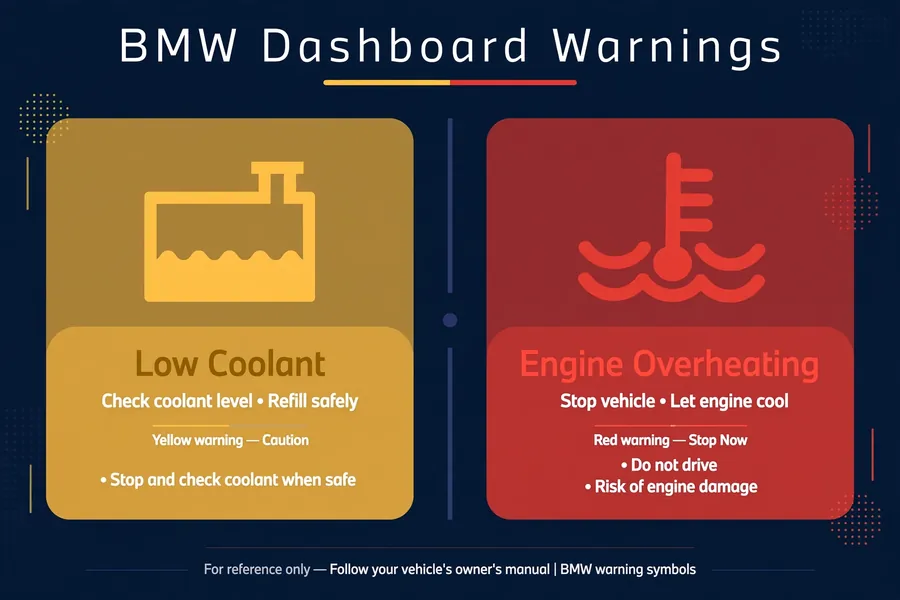
BMW uses color to tell you how scared to be. Match your warning to the right row:
| Warning | What it means | What to do |
|---|---|---|
| Yellow: “Coolant level low” / “top up coolant” | Coolant level has dropped below the sensor threshold; engine temperature still normal. | Top up at the earliest opportunity; find the leak. |
| Yellow: thermometer symbol | Coolant temperature above normal, but not yet critical. | Reduce load immediately; watch the gauge; stop if it keeps rising. |
| Red: thermometer / “engine overheating” | Engine already beyond safe temperature limits. | Engine OFF now. Do not drive. Let it cool fully, then recover. |
What to do right now: the 10-minute sequence
Do this in order, whether you’re on the shoulder or in your driveway:
- Pull over somewhere safe, hazards on. Photograph the exact warning message — the wording (yellow vs red) matters for diagnosis later.
- Red warning or climbing gauge? Engine OFF, now. Don’t open the hood immediately if there’s steam — stand clear and wait.
- Yellow + stable temperature? You may drive gently to the nearest safe stopping place — no hard acceleration, gauge watched constantly.
- Wait until the engine is fully cold (at least 30 minutes) before touching the expansion-tank cap. Never open it hot — the system is pressurized and the coolant can scald.
- Check the level cold. It should sit between MIN and MAX on the expansion tank. Top up with BMW-approved coolant (distilled water is acceptable in an emergency — see below).
- Look for the leak. Puddles under the engine, crusty white/pink residue on hoses and the tank, a sweet smell — all point to the source.
- Decide: level was very low, or drops again quickly → don’t drive, arrange recovery. Level stable after top-up → drive gently to a shop, rechecking at every stop.
Find your leak by generation
Coolant failures follow patterns — and the patterns differ by generation. Pick yours to see the usual suspects in likelihood order:
E90 (N52 / N54 / N55) — check in this order:
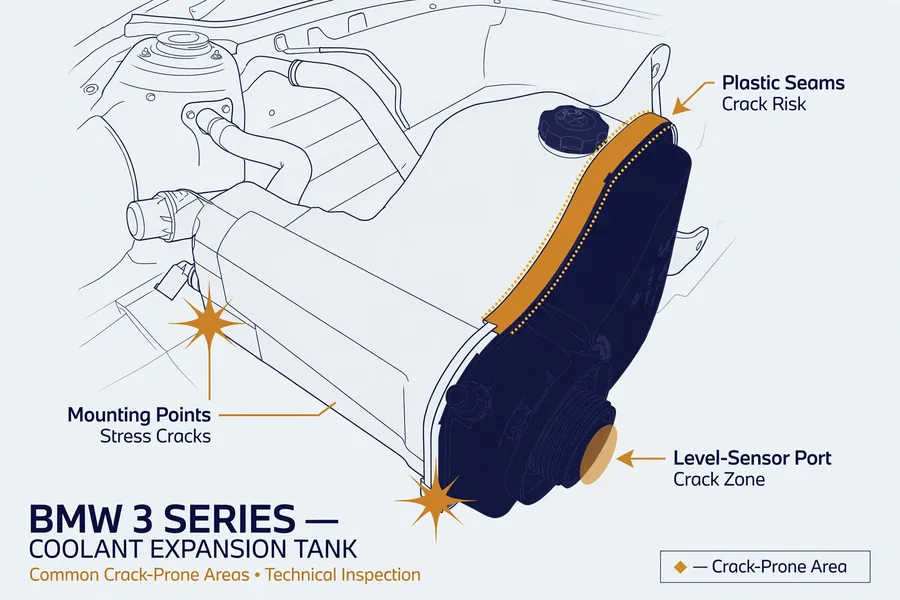
- Expansion tank cracks. The plastic tank goes brittle with heat cycles; inspect the seams, mounting points, and around the level-sensor port for crusty residue or dampness.
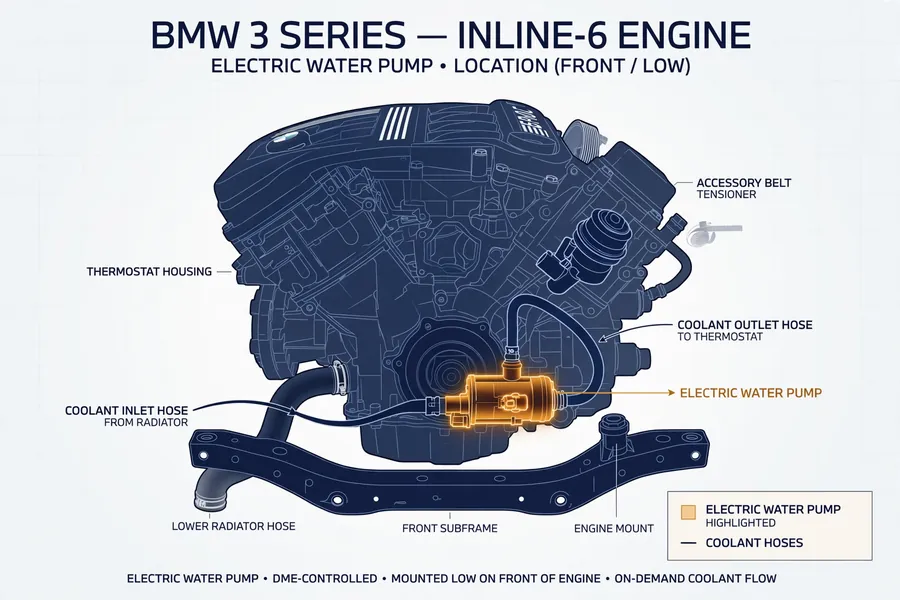
- Electric water pump + thermostat (N52 especially). Typical life is roughly 60,000–100,000 miles, and it tends to fail suddenly with little warning. Telltale: the radiator fan stuck on maximum. Fault codes 2E81 / 2E82 / 2E85 point here.
- Thermostat housing cracks. The plastic housing is a known weep point — replace it with the pump to avoid paying the labor twice.
- Radiator hoses, clamps, and radiator end tanks. Age-related; look for wet clamps and seepage at the plastic end tanks.
- Level sensor false positives. Warning on with a full tank? The float in the expansion tank sticks or the sensor contacts corrode — see “False alarm” below.
F30 (N20 / N26 / N55) — the expansion-tank generation. Check in this order:
- Expansion tank cracks — the pattern failure. The factory F3X tank is plastic and cracks after enough heat cycles; it’s the first place to look on any F30 losing coolant. Aluminum upgrade tanks exist for a permanent fix.
- Electric water pump. On the N20/N26 the failure is usually electronic — almost no warning before it quits. Same 60,000–100,000-mile window; same fan-on-max telltale; same 2E81 / 2E82 / 2E85 codes.
- Thermostat. Do it with the pump — the labor overlaps almost completely.
- The N20 “mickey mouse” coolant flange. A notorious plastic flange on the front of the N20 that cracks and seeps; a ~$20 aluminum replacement is the standard fix, ideally during a pump job.
- Coolant pipe under the intake manifold. A hidden plastic pipe — when it cracks, the leak is large and hard to spot from above.
- Oil filter housing gasket (N20/N26) — with nuance. This is primarily an oil leak (typically 6+ years / 60,000+ miles); it only becomes a coolant issue in bad cases where oil and coolant mix. Don’t chase it as your first coolant-loss suspect.
- Level sensor false positives. Same story as the E90 — full tank, warning on, stuck float or corroded contacts.
G20 (B48 / B58) — fewer documented pattern failures so far (these are newer cars), but the same inspection logic applies:
- Expansion tank and hoses. Still plastic, still heat-cycled — inspect the tank seams and hose connections first.
- Electric water pump. Still an electric, DME-controlled pump and still a wear item as miles accumulate; sudden failure with the fan on max remains the classic symptom.
- Thermostat and housing. Same replace-with-the-pump logic.
- Level sensor. A stuck float triggers the same false warnings on any generation.
Note: B-series turbo cars run two coolant circuits (high-temp engine circuit + low-temp charge-air circuit) with separate reservoirs — check both levels, and top up / bleed each circuit separately.
The 8 most common leak points, ranked
Across all three generations, these are the failures behind the vast majority of 3 Series coolant warnings — most likely first:
| Cause | Where to look | Telltale signs | Typical mileage / age |
|---|---|---|---|
| 1. Expansion tank cracks | Seams, mounting points, level-sensor port on the tank | Crusty white/pink residue; slow, steady loss | 6+ years / heat cycles |
| 2. Electric water pump | Low on the front of the engine | Radiator fan stuck on max; sudden overheat; codes 2E81/2E82/2E85 | 60,000–100,000 mi |
| 3. Thermostat | Beside the water pump | Temperature swings; slow warm-up — usually found with the pump | With the pump |
| 4. N20 coolant flange (“mickey mouse”) | Front of N20/N26 engine | Seep at the plastic flange | 60,000+ mi |
| 5. Coolant pipe under intake manifold | Hidden beneath the intake | Rapid loss that’s hard to see from above | Age-related |
| 6. Hoses, clamps, radiator end tanks | Along hose runs; sides of the radiator | Drips, wet clamps, sweet coolant smell | Age-related |
| 7. Oil filter housing gasket (N20/N26) | Oil filter housing | Primarily an oil leak — only a coolant suspect if oil and coolant are mixing | 6+ yrs / 60,000+ mi |
| 8. Head gasket (worst case) | Between head and block | White exhaust smoke, milky oil, bubbles in the tank | Rare — usually after overheating |
False alarm: tank full, warning on
Before you chase a leak that isn’t there: if the expansion tank is genuinely full and the warning still appears, the prime suspect is the coolant level sensor — a float inside the tank that sticks, or sensor contacts that corrode. Owners have fixed it by cleaning the contacts; the lasting fix is a new expansion tank (the sensor comes with it).
A second false-positive cause: airlocks after a refill. If the warning returns right after you topped up, the system may not have been bled properly — re-bleed it (see below) rather than assuming a new leak.
Diagnose it yourself in 5 steps
Work through these in order — each step narrows it down before you spend money:
- Cold level check. Engine fully cold. Note the exact level against MIN/MAX — this is your baseline.
- Top up and monitor the loss rate. Fill to MAX with the correct coolant, drive normally, and recheck after every trip. A fast drop means an active leak; a slow drop over days means a seep (tank seam, flange, hose).
- UV dye. Add UV-reactive dye to the coolant, drive, then inspect with a UV flashlight in the dark — even tiny seeps glow. This is how shops find leaks you can’t see in daylight.
- Pressure test. A shop pressurizes the cold system and watches for pressure drop and visible seepage — it finds leaks that only open under pressure. Ask your shop for the price; there’s no reliable published figure, but most independents charge a modest diagnostic fee.
- Scan for codes. An OBD scan is the decider for pump failures: 2E81 / 2E82 / 2E85 point at the electric water pump circuit. Stored codes also reveal thermostat and sensor faults.
What each fix costs
Real-world bands from parts suppliers and shop data. Prices vary by region — treat these as planning figures, not quotes:
| Repair | DIY parts | Independent shop | Notes |
|---|---|---|---|
| Expansion tank | ~$50–210 (tank + cap) | ~$150–300 | Aluminum upgrade tanks cost more but end the repeat failures |
| Water pump + thermostat | ~$362 in parts | ~$600–1,200 | Always replace the thermostat with the pump — the labor overlaps |
| Thermostat alone | ~$120 part | ~$250–625 | Rarely done alone; usually bundled with the pump |
| N20 coolant flange | ~$20 (aluminum upgrade) | Usually bundled with a pump job | Cheap part, awkward access — do it while you’re in there |
| Oil filter housing gasket (N20) | ~$10–300 in parts | $500+ | Oil-leak-first repair; pricey labor for a cheap gasket |
| Head gasket | — | Up to ~$3,400 | Worst case; get a proper diagnosis before assuming this |
| Pressure test (diagnostic) | — | Ask your shop | No reliable published price; most indies charge a small diagnostic fee |
Bleeding the system after a top-up or repair
Air trapped in the cooling system causes repeat low-coolant warnings and poor heater performance. The correct bleed procedure depends on your generation — don’t use one procedure for all three:
- E90: uses a bleed screw. Fill slowly with the bleed screw open until coolant runs out bubble-free, then close it. Top up to MAX, run the engine with the heater on, recheck cold.
- F30 (electric water pump self-bleed): ignition ON, engine OFF — heater to maximum temperature, blower to lowest, low-beam headlights and hazards on, then press the accelerator fully for about 10 seconds. The electric pump runs the bleed cycle for roughly 8–12 minutes (don’t open the tank during it). A strong battery or charger is recommended; top off to MAX afterward. No scanner needed.
- G20 / B-series: BMW specifies vacuum filling — this is a shop job with the proper equipment, not a driveway procedure.
Which coolant to use
Short version: older 3 Series take blue BMW coolant (G48); newer ones take green BMW HT-12. Match your car’s factory fill — never mix colors — and mix concentrate 50:50 with distilled water. Our full BMW 3 Series coolant type guide covers the G48 vs HT-12 split, part numbers, and what to do if you’re unsure what’s in the car.
What happens if you ignore it
Low coolant leads to overheating, and overheating kills aluminum BMW engines fast: a warped cylinder head or blown head gasket turns a ~$150 expansion tank into a ~$3,400 repair. A yellow warning you keep topping off without fixing the leak is just a slow-motion version of the same story. Fix the cause, don’t feed the symptom.
Frequently asked questions
Causes ranked from owner-forum consensus, parts-supplier technical notes (FCP Euro, Turner Motorsport, BimmerWorld), and independent shop guides; cost figures are typical US bands and vary by region and shop. Last verified: September 2026. Your temperature gauge and a cold level check are the final authority on your car.