BMW Sunroof Stuck? Motor Fixes & Initialization Steps
Short answer: BMW sunroof motor replacement is only the right fix when the motor itself is dead — total silence or a faint click with zero glass movement after you rule out the fuse. Clicking, grinding, partway travel, or glass that reverses on its own almost always means jammed tracks, broken guides, or lost travel limits, and those are fixed with cleaning or the free button-hold sunroof initialization (press and hold the switch in the tilt direction for about 15 seconds until the roof cycles fully open and closed). Expect $400–$800+ at a shop for a motor replacement (owner-reported range), versus $100–$300 for the part alone if you DIY — the motor sits behind the overhead console and is one of the easier BMW repairs.
Dead motor or mechanical trouble? How to tell
Most sunroof failures look like a dead motor but aren’t. The motor is a small, fairly reliable unit; the plastic guides, drive cables, and travel-limit memory around it fail far more often. Before you price a motor, run the sound test below — what you hear when you press the switch is the single best clue to what’s actually wrong.
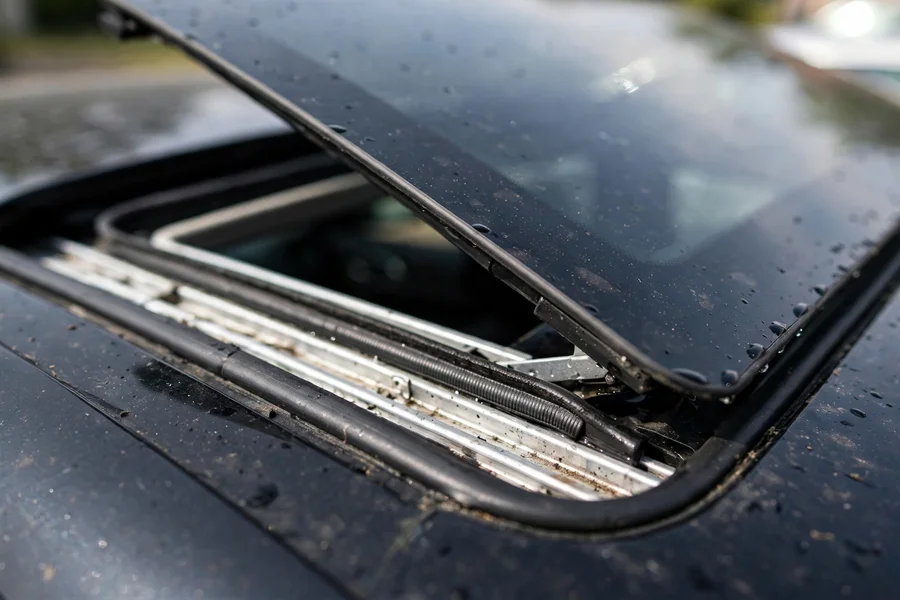
If the glass does absolutely nothing and the headliner is silent, think electrical: fuse, switch, wiring, or the motor itself. If you hear clicking or ticking, the motor is alive but its pinion gear is skipping teeth on the drive cable — something is jammed. A motor that whirs while the glass sits still has usually stripped its drive gear or cable. And glass that moves partway and then reverses is the anti-trap system doing its job against a binding track, which is a cleaning issue, not a motor issue.
| Symptom | Most likely cause | What to do first |
|---|---|---|
| Total silence when you press the switch | Blown fuse, failed switch, dead motor, or no power | Check the fuse, then try the initialization; test for a faint click from the headliner |
| Clicking or ticking, glass doesn’t move | Motor pinion skipping on a jammed drive cable or broken track guides | Stop cycling it — clean and lubricate the tracks, then reassess |
| Motor whirs but glass stays put | Stripped drive gear or cable; motor can’t engage the mechanism | Try the manual emergency crank; if the crank works, the drive is stripped |
| Moves partway, then stalls or reverses | Binding tracks tripping the anti-trap, or a motor stalling under load | Clean and lubricate the tracks, then run the initialization |
| Slow or labored in every direction | Dry, dirty tracks — or a motor wearing out | Clean and lubricate first; if still slow, plan a motor replacement |
| Works, but glass isn’t flush or one-touch is gone | Travel limits lost after a battery disconnect or motor removal | Run the initialization procedure — this is the classic fix |
One rule saves a lot of money: never keep hammering the switch when you hear clicking. That machine-gun ticking is the motor’s gear grinding against the drive cable, and every extra cycle wears flat spots into both. Owners who stop immediately and clean the tracks often get away with a $15 maintenance job; owners who keep trying can turn it into a motor-plus-cable replacement.
The other common misdiagnosis is blaming the motor after any battery work. Disconnecting or replacing the battery wipes the sunroof’s stored travel limits, so the roof may tilt only, lose one-touch operation, or sit slightly off-level. That isn’t a failed part — it’s the control unit asking to be re-standardized. The initialization procedure below fixes it in about a minute, and the same button-hold logic applies to the power windows, which is why a window regulator that loses one-touch responds to the same trick.
Three 60-second checks that rule out the motor
Before you spend anything, do these in order. First, pull the sunroof fuse and look at it — our fuse box diagram shows exactly which fuse feeds the roof on your generation. A fuse is a $5 part and the most common “dead motor” that isn’t one. Second, check resting battery voltage; anything under about 12.4 volts means the battery is weak enough to produce exactly these symptoms, and BMW’s own documentation calls for adequate voltage during any sunroof work. Third, hold the switch for a full 20 seconds with the cabin quiet and listen at the headliner: a faint click means the switch and wiring are delivering signal and the motor is the suspect; absolute silence with a good fuse means the fault is upstream of the motor, in the switch or its wiring. Those three checks take five minutes and correctly sort a large share of “dead sunroof” complaints into the cheap column.
It also helps to understand why the motor is rarely the culprit. The motor itself is a simple, sealed DC unit with very little to go wrong — the wear items are all around it: plastic guides that go brittle with age and heat, drive cables that develop flat spots, and travel-limit memory that evaporates every time the battery is disconnected. When a shop quotes you a motor, they’re often quoting the part that’s easiest to replace, not the part that failed. Diagnose by sound first, and you’ll buy parts once instead of twice.
The sunroof initialization (reset) procedure
Initialization — BMW’s term is “standardisation” — re-teaches the sunroof drive where its end positions are. Per BMW’s technical documentation, the drive stores the positions of its internal position transmitters during this procedure, and it’s required after any power interruption, after the motor is removed or replaced, after repairs to the mechanism, and whenever one-touch or comfort operation is lost.
The good news: the procedure is the same button-hold logic on every modern 3 Series. The switch style changed over the years, but the control unit’s standardization routine did not.
| Generation | Model years | Initialization notes |
|---|---|---|
| E90 / E91 / E92 / E93 | 2006–2011 | Same button-hold procedure. Ignition on, engine off works; the onboard toolkit of many E90s includes the manual crank tool. |
| F30 / F31 / F34 | 2012–2018 | Same button-hold procedure. Start with the engine off but ignition on (press Start without your foot on the brake). |
| G20 / G21 | 2019+ | Same button-hold procedure, including for the larger panoramic roof — the cycle simply takes a little longer to complete. |
Step-by-step: how to initialize your BMW sunroof
- Switch the ignition on, engine off. The sunroof needs to be operable — on push-button cars, press Start without touching the brake pedal.
- Press and hold the sunroof switch in the tilt (vent) direction. Push the switch upward/forward into the tilt position and keep it held. BMW’s documentation specifies holding for at least 15 seconds once the lift end position is reached.
- Keep holding through the full cycle. The glass will close (if it isn’t already), then open fully and close fully on its own. The whole process takes about 60 seconds. Do not release the switch mid-cycle — if you do, the procedure must be repeated from the start.
- Release only when the cycle finishes. On panoramic roofs the roller sunblind then runs its own open-close cycle; wait for that to finish too.
- Function-check. Test one-touch open, one-touch close, tilt, and comfort closing. If all work, initialization succeeded.
Two cautions from BMW’s documentation: there is no anti-trap protection during initialization, so keep hands and objects clear, and the car needs adequate voltage — a weak battery can interrupt the procedure, so charge the battery first if it’s marginal. Weak batteries cause all kinds of electrical gremlins on these cars, which is why a sunroof that “forgot” its limits after a battery discharge warning or a battery that keeps dying should get the battery sorted before you blame the roof.
Three initialization mistakes that waste your time
First, releasing the switch early. The routine must run to completion — about 60 seconds, glass fully open and fully closed. Let go halfway and nothing is stored; you have to start over from the beginning. Second, trying it on a weak battery. Voltage sag mid-procedure aborts the standardization, which is exactly why BMW’s documentation insists on adequate voltage — put a charger on the car if the battery is marginal. Third, trying to initialize a physically jammed roof. If the glass can’t travel because of broken guides or debris, the routine can never complete its open-close cycle. Clear the mechanical problem first, then standardize. Initialization is a software fix; it cannot overcome hardware.
When initialization fixes it — and when it won’t
Initialization fixes lost limits: one-touch gone, glass not sitting flush, tilt-only operation after battery work, or the roof stopping a few millimeters short. It does not fix hardware. If the glass doesn’t move at all during the procedure — you hear the relay click but the drive wheel never turns — the motor is almost certainly dead. If the procedure starts but the roof jams, clicks, or reverses, you have a mechanical problem (broken guides, stripped cable, debris) that no amount of re-standardizing will cure.
Interactive: diagnose your sunroof fault
Answer a few questions about what your sunroof does (or doesn’t do) and get a likely diagnosis, the first thing to try, and the cost band you’re looking at. It covers electrical, motor, mechanical, and maintenance causes.
BMW Sunroof Fault Diagnostician
Cost bands are owner/community-reported ranges for E90, F30, and G20 3 Series.
Interactive: estimate your repair cost
Pick your generation and the repair you need, set a realistic local labor rate, and get an estimated parts-plus-labor range. Ranges are owner/community-reported — genuine BMW parts run higher than the aftermarket figures shown.
BMW Sunroof Repair Cost Estimator
Owner/community-reported ranges. Genuine BMW parts cost more than the figures below.
Replacing the sunroof motor: difficulty, procedure, and costs
Difficulty: 3 out of 10. Time: 30–60 minutes. Tools: trim tool, Torx driver set, 4mm Allen key (for the manual crank if the roof is stuck open). The sunroof motor lives directly behind the overhead console at the front of the headliner — you don’t remove the headliner, drop the cassette, or touch the glass. Owners consistently report it as one of the more approachable BMW repairs, which is why the DIY parts cost ($100–$300) is so much lower than the shop bill.
Motor replacement procedure
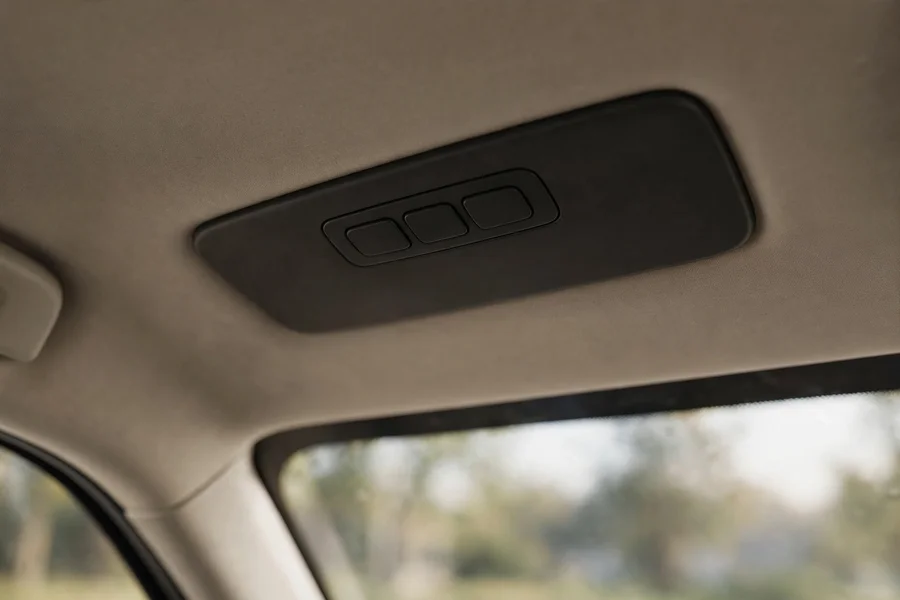
- Get the glass closed. If the roof is stuck open, close it first with the manual emergency crank (the tool lives in the onboard toolkit on many cars; otherwise a 4mm Allen key fits). Remove the front overhead light cover to reach the drive.
- Ignition off. You don’t want the motor energized while you’re unplugging it.
- Remove the overhead console trim. It unclips with a trim tool — work gently, since the clips are the only fragile part of this job.
- Unplug the motor connector. Squeeze the release tab and pull straight out.
- Remove the motor’s mounting bolts (three bolts on most 3 Series fitments) and lower the motor out of the drive.
- Fit the new motor in the same position and torque the bolts snugly — this is a small drive unit, not a structural fastener, so firm hand-tight plus a quarter turn is the right feel. Don’t guess at a spec; there is no published owner-service torque value worth quoting here.
- Reconnect, then initialize. A new motor has no stored travel limits, so run the button-hold initialization procedure immediately after fitting it.
- Function-check one-touch open, close, tilt, and the anti-trap before refitting the trim.
If you’re on the fence about doing it yourself, the honest dividing line is trim work: if you’ve removed interior trim without breaking clips before, this job is easy. If the thought of prying at your headliner makes you nervous, pay the shop — the labor portion is small. And if your 3 Series is still under any kind of warranty or service plan, let the dealer handle it; sunroof mechanisms are exactly the kind of job where DIY evidence complicates a later claim.
Confirm the motor is dead before you buy one
The definitive test takes ten minutes and costs nothing. Unbolt the motor (the three bolts behind the overhead console) and let it hang by its connector, then run the initialization command while watching the motor’s drive wheel. If you hear the relay click but the drive wheel never turns, the motor is dead — order the replacement with confidence. If the wheel does turn, the motor is fine and your problem is a jammed mechanism; bolt the motor back in and inspect the tracks, guides, and cables instead. Owners who skip this test sometimes discover — $300 later — that the new motor clicks exactly like the old one, because the cable was the problem all along.
On parts: aftermarket new motors ($100–$300, owner-reported) are the common DIY choice; genuine BMW units run roughly $300–$600 depending on fitment; used motors from breakers are cheapest but carry the same age-related wear as the one you’re replacing. Whatever you buy, confirm fitment for your chassis (E90, F30, or G20) and run the initialization the moment it’s fitted — a new motor with no stored travel limits will misbehave until it’s standardized.
Sunroof repair cost comparison
All figures below are owner/community-reported ranges for the 3 Series (E90, F30, G20). Genuine BMW parts run higher than the aftermarket part prices shown; dealer labor rates push shop totals to the top of each band.
The spread between the bottom and top of each shop band is mostly dealer versus independent. A dealer’s labor rate and genuine-part pricing push a motor replacement toward the $800+ end; a good BMW independent typically lands mid-band with an aftermarket or OEM-supplier motor. For the cassette job the gap is even wider, which makes a second quote worthwhile — but beware the too-cheap quote that skips the initialization step or reuses a worn drive cable. Ask any shop quoting a motor whether the price includes re-standardizing the new unit; if they look blank, find another shop.
| Repair | DIY (parts only) | Shop (parts + labor) |
|---|---|---|
| Initialization / reset | $0 | $0–$100 (diagnostic fee if charged) |
| Track cleaning & lubrication | $5–$15 | $75–$150 |
| Fuse replacement | Under $5 | $50–$75 (as part of a diagnostic visit) |
| Sunroof switch replacement | $50–$150 | $200–$400 |
| Sunroof motor replacement | $100–$300 | $400–$800+ |
| Full sunroof cassette / mechanism | Not recommended DIY | $1,000–$2,500+ |
Shop repair cost ranges (parts + labor)
Scale $0–$2,500. Owner/community-reported ranges.
Bars show each repair’s reported shop-cost band on a common $0–$2,500 scale. The motor itself is a mid-range repair; the cassette is the budget-killer.
The chart tells the real story: the motor is a mid-priced repair, and everything cheaper than it (reset, cleaning, fuse) should be ruled out first. The financial cliff is the full cassette — which is why the cardinal rule of 3 Series sunroofs is to stop pressing the switch the moment you hear clicking. A $15 cleaning today beats a $2,500 cassette tomorrow.

Sunroof problems and water leaks: what’s actually connected
A failing sunroof motor does not cause water leaks — but the two problems travel together often enough that owners confuse them. Water gets past every sunroof by design: the glass seal slows it down, and four drain tubes (front pair running down the A-pillars, rear pair down the C-pillars) carry it away. Leaks happen when those drains clog with leaves and debris, or when a cracked seal or a glass panel that no longer sits flush lets in more water than the drains can handle.
That’s the one real intersection with this article: a sunroof that stopped closing flush because its travel limits were lost — or a glass panel sitting crooked from worn guides — admits extra water and can overwhelm even clear drains. Fix the closing problem (initialization first, mechanical repair second) and the “leak” often disappears with it. But if the roof closes properly and water still appears at the headliner edges or A-pillars, the motor is innocent — the drains are the suspect. Drain cleaning is a separate job with its own procedure, covered in our dedicated sunroof drain guide; this article stays on the motor and initialization side of the fence.
Rubber seals age too: the perimeter seal around the glass shrinks and hardens over a decade of sun, admitting a slow trickle that the drains handle until they partially clog — which is why leaks often arrive as two small problems combining rather than one big failure. If your 3 Series is over ten years old and the drains have never been serviced, cleaning them is cheap insurance regardless of how the motor is behaving.
One more leak-adjacent check for used-car shoppers: cycle the sunroof through tilt, open, and close during any test drive, and look at the headliner around the opening for water staining. A roof that works smoothly and seats flush is one less expensive surprise — our used 3 Series buying guide has the full inspection checklist. And since dry tracks are the root of most sunroof grief, folding a track wipe-down into your regular maintenance schedule costs almost nothing and prevents the failures this article is about.
Frequently asked questions
How do you reset a BMW sunroof?
Switch the ignition on with the engine off, then press and hold the sunroof switch in the tilt (vent) direction. Keep holding — after about 15 seconds the standardization routine starts, the glass closes, then runs fully open and fully closed on its own. Don’t release the switch until the cycle finishes (roughly 60 seconds); releasing early means starting over. Then check one-touch open, close, and tilt. The procedure is the same on the E90, F30, and G20.
How much does it cost to replace a BMW sunroof motor?
Owner-reported ranges: $400–$800+ at a shop (parts plus labor), or $100–$300 for the motor alone if you do it yourself — the unit sits behind the overhead console and the swap takes 30–60 minutes. Genuine BMW motors run higher, roughly $300–$600 depending on fitment. Always rule out the free fixes first: the button-hold initialization, a blown fuse, and dirty tracks.
How do I know if my sunroof motor is bad or the tracks are just jammed?
Listen. Total silence (or a faint click with zero movement) after checking the fuse points to a dead motor. Clicking or ticking with no glass movement means the motor is alive but its gear is skipping on a jammed drive — that’s tracks, guides, or a stripped cable, not a dead motor. Glass that moves partway and reverses is the anti-trap reacting to binding tracks. Clean and lubricate the tracks first; if the symptoms survive a cleaning and an initialization, then suspect the motor.
Can I close my BMW sunroof manually if it’s stuck open?
Yes. Remove the front overhead light cover to access the sunroof drive, then turn the emergency crank with the Allen key from the onboard toolkit (many E90s include it; otherwise a 4mm Allen key fits). Crank it closed gently — if it won’t turn, don’t force it, since forcing a jammed mechanism breaks guides and cables. Once closed, diagnose the underlying fault before using the roof again.
Will a sunroof motor problem cause water leaks?
Not directly — the motor doesn’t seal anything. But a sunroof that won’t close flush (lost travel limits, worn guides) lets in more water than the drain tubes can carry away, which looks exactly like a leak. Fix the closing problem first with initialization or mechanical repair. If the roof closes properly and water still appears at the headliner or A-pillars, the drains are clogged — that’s a separate cleaning job covered in our dedicated sunroof drain guide.
Most BMW sunroof problems end one of two ways: a free initialization or a $15 track cleaning. The motor is the suspect of last resort, not the first — diagnose by sound, fix the cheap causes in order, and you’ll rarely need to buy the part this article is named for. And when the motor truly is dead, it’s a 30-minute job behind the overhead console, not a dashboard-out nightmare — the rare BMW repair where the DIY savings are both large and honestly earned.