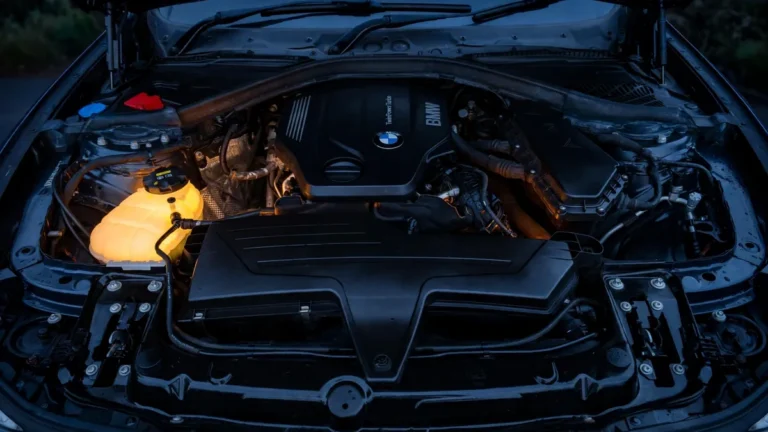
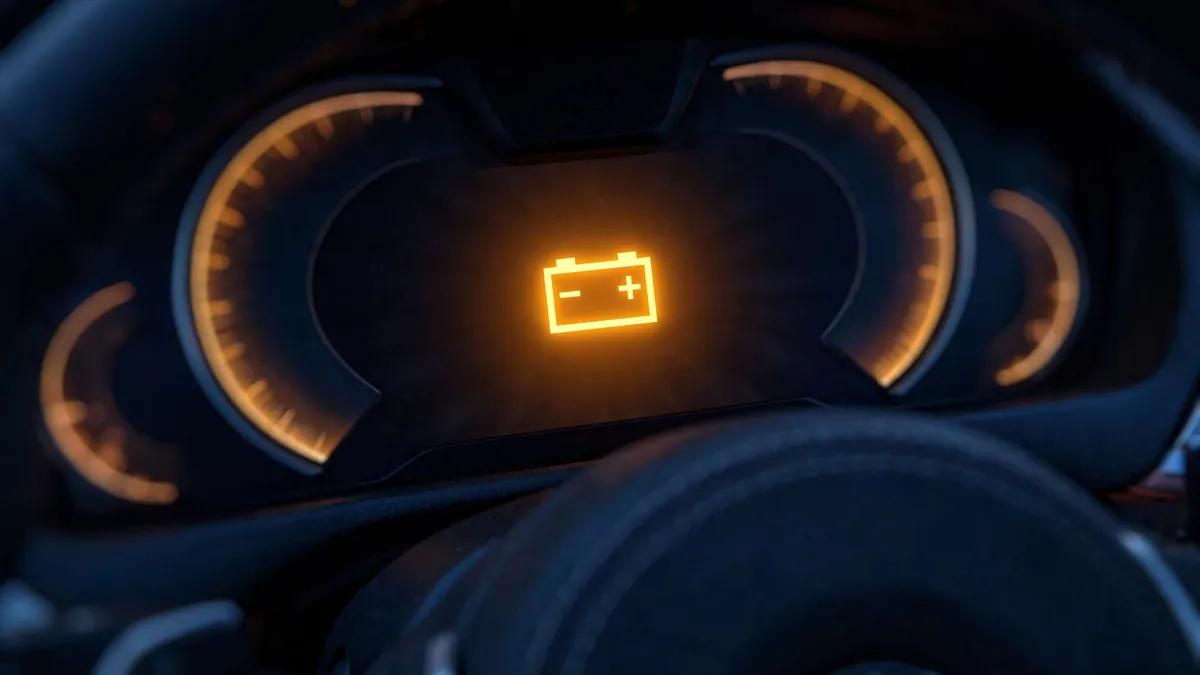
BMW Increased Battery Discharge Warning: Causes & Fixes
That “Increased Battery Discharge” warning on your BMW’s dashboard isn’t telling you the battery is dead — it’s telling you the car’s computer has noticed the battery draining faster than it should, and has started switching things off to protect your ability to start the engine. It’s one of the most Googled BMW warnings, and also one of the most misunderstood.
This guide is built differently from the thin explainers ranking today: the causes are ranked by how likely they actually are, so you check the right thing first. You’ll get a five-minute triage checklist, an interactive symptom finder, real voltage and current specs, BMW’s own service-bulletin fault codes, and honest cost ranges for every fix. Part of the Troubleshooting hub.
The short answer
Your BMW’s computer has detected the battery draining faster than the alternator can recharge it. As protection, the car shuts off non-essential electronics — windows, mirrors, seats, sunroof — to preserve enough charge to start the engine. The most common causes are an aging battery, short-trip driving, or a parasitic drain from a faulty module.
There is no button to clear this warning — it switches itself off once the underlying problem is fixed, usually after 5–30 minutes of driving.
In this guide
- Quick checks first (5-minute triage)
- What the warning actually means
- Causes ranked by likelihood
- Symptom finder: what’s most likely in your case (interactive)
- How to diagnose it yourself, step by step
- Battery voltage reference
- Fault codes from BMW’s service bulletin
- What each fix costs
- Warning still on with a new battery?
- Preventing it from coming back
- Frequently asked questions
Quick checks first: the 5-minute triage
Before touching a multimeter, run through these five checks. They solve a surprising share of discharge warnings — tick them off as you go:
If the warning survives the triage, keep reading — the ranked cause list below tells you exactly what to suspect next.
What “increased battery discharge” actually means
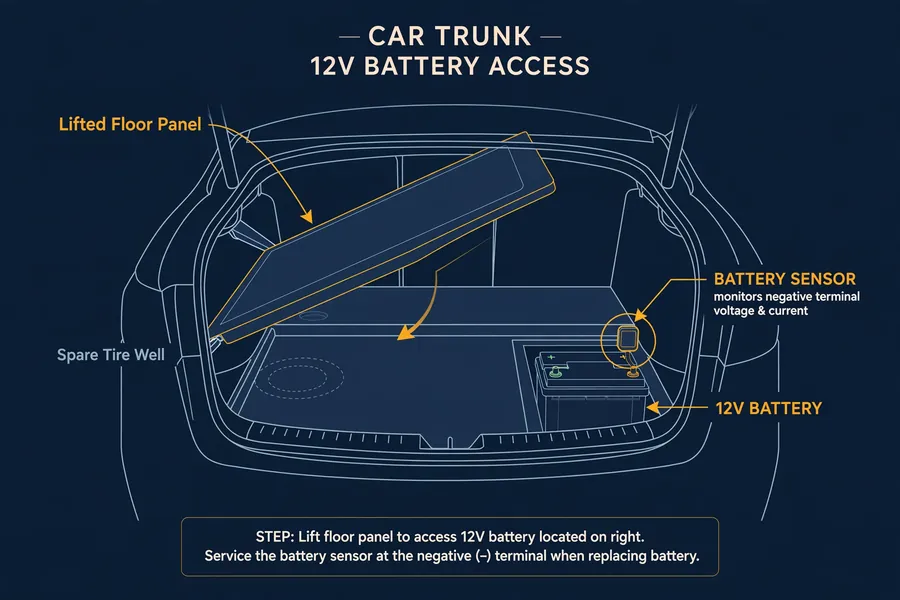
Your BMW constantly monitors the battery’s state of charge through the Intelligent Battery Sensor (IBS) on the negative terminal. When the control unit (DME) sees the battery discharging faster than the alternator is replenishing it, it triggers the warning and activates power management: non-essential consumers are shut down in stages to preserve enough charge to start the engine.
That’s why the warning often arrives with company — power windows, mirrors, seat heating, or the sunroof may stop working. Those aren’t separate faults; they’re the car deliberately shedding load. The warning is a symptom, not a diagnosis: it tells you that the battery is losing the battle, not why.
If the battery is already too weak to crank the engine, start with our jump-start guide for the 3 Series — then come back here to find out why it went flat in the first place.
Causes ranked by likelihood
Every source we checked lists roughly the same suspects — but none of them tells you which to check first. This table does, ordered by how often each cause is actually behind the warning:
| Cause | How common | Telltale clue | Fix |
|---|---|---|---|
| 1. Aging battery (4–5+ years) | Most common | Warning appears more in cold weather; slow cranking; battery date code is old | Replace with the correct AGM/lead-acid type and register it (~$250–550) |
| 2. Short trips / infrequent driving | Very common | Warning clears after long drives, returns after days of short hops | Regular 30-minute drives or a battery tender; no parts needed |
| 3. Parasitic drain — faulty IBS sensor | Common | Warning even after long drives; sometimes paired with other electrical quirks | Measure sleep-mode draw; replace the IBS sensor if it’s the culprit |
| 4. Parasitic drain — module or accessory staying awake | Common | Battery flat after sitting 1–3 days; sleep draw over ~100 mA | Fuse-pull isolation to find the circuit (Comfort Access handles, telematics/TCU, aftermarket gear, stuck lights are the usual suspects) |
| 5. Cold weather | Seasonal | Warning only on very cold mornings | Test the battery first; BMW service bulletin SIB 61 03 14 documents a software correction for warnings below 15°F |
| 6. New battery never registered | Common after replacement | Warning appeared right after a battery swap | Register the battery with a BMW-capable scan tool — the car must learn the new battery’s specs |
| 7. Alternator / charging fault | Less common | Warning plus dim lights; running voltage below ~13.5V | Test charging voltage; replace the alternator if it’s not delivering |
| 8. Key stored too close / car never sleeps | Occasional | Warning after the car sits; key habitually kept near the car | Store the key well away from the car so systems can sleep |
| 9. Outdated vehicle software | Rare | Persistent warning with no other cause found | Dealer software update |
Symptom finder: what’s most likely in your case
Pick the situation that matches yours — each tab gives you the most likely cause and the exact next step:
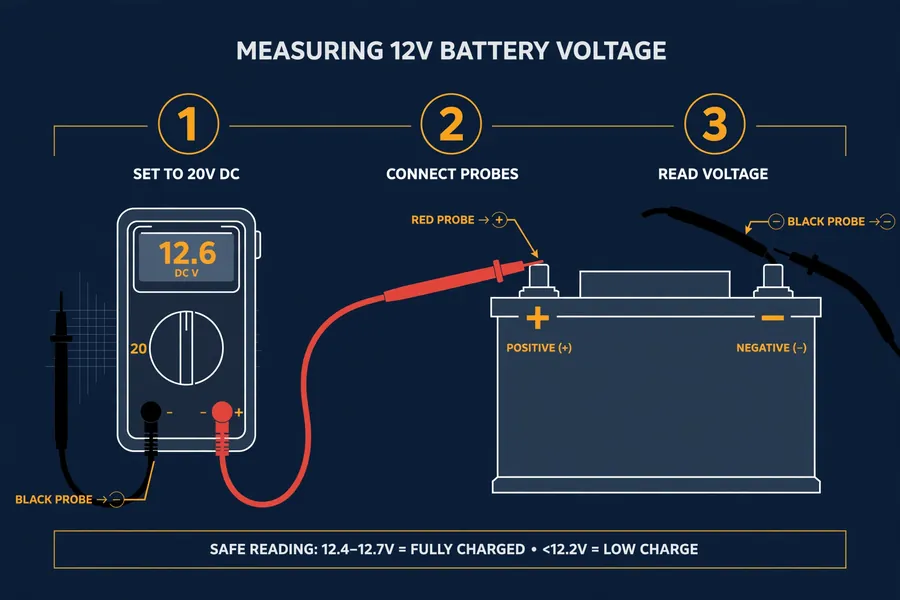
Most likely: an aging battery, or a parasitic drain if the battery is healthy.
Next step: measure the resting voltage (diagram above — red probe to +, black to −, meter on 20V DC). If it reads under 12.4V after sitting, charge the battery fully and retest. If a good battery still goes flat after a few days parked, you have a drain — move to the sleep-mode draw test in the diagnosis section below.
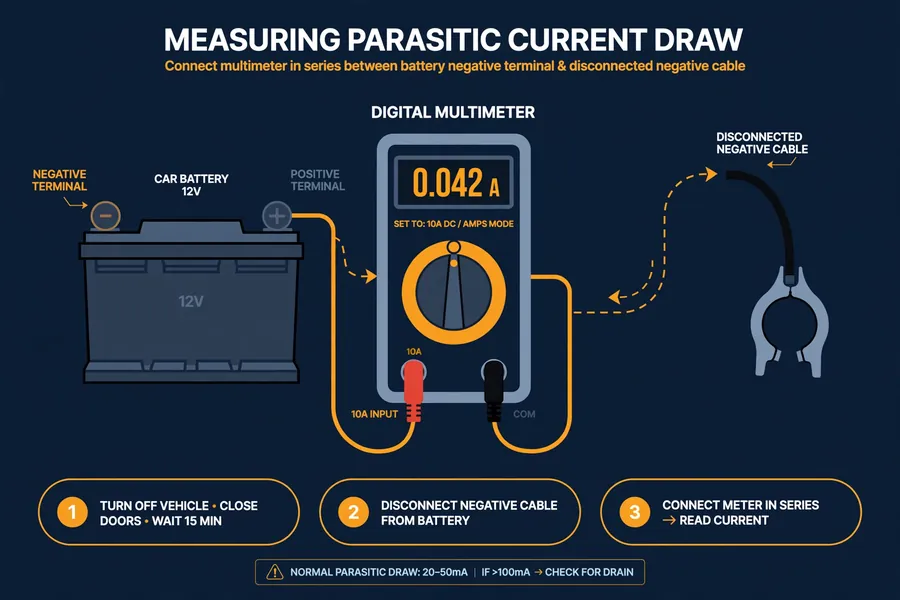
Most likely: a parasitic drain — something is drawing current while the car should be asleep. Long drives rule out the “short trips” cause, so whatever is awake is winning against the alternator.
Next step: the sleep-mode draw test (diagram above). Wait ~16 minutes after locking the car, then measure current in series on the negative side. Under ~50 mA is normal; over ~100 mA means something is staying awake — then do the fuse-pull isolation to find the circuit. Prime suspects: the IBS sensor itself, Comfort Access door handles, the telematics/TCU module, or an aftermarket accessory on permanent live.
Most likely: the new battery was never registered to the car — or the terminals aren’t clean and tight.
Next step: confirm the battery was registered with a BMW-capable scan tool (the car must be told the new battery’s type and capacity, or it charges it wrong). Then check both terminals for corrosion and tightness — the IBS sensor sits on the negative terminal (diagram above). Also possible: the new battery sat on a shelf and wasn’t fully charged, or the wrong type was fitted (many BMWs with auto start-stop require AGM).
Most likely: a battery that’s marginal in mild weather and fails when cold saps its capacity — but there’s also a documented software angle.
Next step: test the battery properly first (voltage + load test). If the battery tests healthy, know that BMW service bulletin SIB 61 03 14 documents this exact warning appearing below 15°F as the state of charge approaches the start-capability limit — and describes an ISTA/P reprogramming that decreases the message sensitivity by 10%. Ask a dealer or BMW specialist whether your car’s software is current.
How to diagnose it yourself, step by step
Work through these in order. Each step rules something out before you move to the next — that’s the whole discipline of electrical diagnosis.
Step 1 — Voltage test (5 minutes)
Set your multimeter to 20V DC. Resting test: engine off for several hours (overnight is ideal), red probe to the positive terminal, black to negative. Compare the reading against the reference table below. Running test: start the engine and measure again — 13.7–14.7V means the alternator is charging. Much below ~13.5V with the engine running points at the alternator, not the battery.
Step 2 — Charge and retest
If the resting voltage is low, fully charge the battery with a proper charger (a 24-hour trickle charge, not a 10-minute drive) and retest. A battery that won’t hold above ~12.4V after a full charge is done — replace it. Note the warning itself needs no reset: it clears on its own once the underlying issue is fixed, typically after 5–30 minutes of driving.
Step 3 — Sleep-mode draw test
This is the test that finds parasitic drains. Lock the car and wait about 16 minutes — BMWs take roughly that long to enter sleep mode, and measuring earlier gives a false high reading. Disconnect the negative cable, then connect your multimeter in series between the negative terminal and the cable (meter on the 10A DC input to start, then switch down to the mA range for a precise reading).
How to read it: under ~50 mA is normal. Over ~100 mA means something is staying awake. Be honest about the gray zone: published “normal” figures vary by source — BMW’s own STEP training material cites 40 mA, community testing lands around 30–60 mA — so treat <50 mA as the practical pass line, not a factory law.
Safety: never connect the meter across the terminals in amps mode (that’s a short circuit through the meter’s fuse). In series only, as shown.
Step 4 — Fuse-pull isolation
If the draw is high, keep the meter connected and pull fuses one at a time. When the current drops sharply, you’ve found the misbehaving circuit — then check what lives on it (Comfort Access handles, the telematics/TCU unit, and aftermarket accessories are repeat offenders).
Step 5 — Full-system scan
A BMW-capable scanner reads the power-management fault codes that a generic reader misses. BMW’s own service bulletin SIB 61 03 14 lists the relevant ones — see the fault-code table below. If you’re not equipped for steps 3–4, this is the point to hand the car to a BMW specialist: ask for a parasitic-draw diagnosis specifically, not just “a battery check.”
Battery voltage reference
Print this or keep it on your phone. Resting means the engine has been off for several hours:
| Voltage | State of charge | What to do |
|---|---|---|
| 12.6V or higher | 100% | Healthy — no action needed |
| 12.4V | ~75% | Good, but keep an eye on it |
| 12.2V | ~50% | Charge soon |
| 12.0V | ~25% | Charge immediately |
| 11.8V or lower | Effectively dead | Deep-charge and retest, or replace |
| 13.7–14.7V (engine running) | Charging | Alternator working normally; well below ~13.5V running = suspect the alternator |
Fault codes from BMW’s service bulletin
BMW North America’s service information bulletin SIB 61 03 14 documents the power-management codes tied to this warning. If your scan shows any of these, you’re looking at a genuine energy-management event — not a glitch:
| Fault code | Meaning |
|---|---|
| 213901 | Power management: consumer shutdown — the car deliberately switched loads off |
| 8040BD / 8020E8 | Terminal 30F reset / deactivation |
| 8040B9 / 93076B | Terminal 30B deactivation — start-capability limit reached |
| 800E89 | FRM: start-capability limit reached with lights active |
What each fix costs
Honest ranges, not single numbers — prices vary by region and model. The battery row is the well-documented one; everything else depends on which component failed:
| Job | DIY | Independent shop | Dealer |
|---|---|---|---|
| Battery replacement (AGM, the correct type for most BMWs) | ~$200–300 parts + BMW-capable scan tool for registration | $250–400 | $400–550+ |
| Battery registration alone (if a shop did the swap but skipped it) | — | Often bundled with the job | Often bundled with the job |
| Parasitic-drain diagnosis | Your time + a multimeter | Shop-dependent — ask for 1–2 hrs diagnostic time up front | Shop-dependent — ask for an estimate up front |
One cost trap to avoid: fitting a cheaper non-AGM battery where BMW specifies AGM (most cars with auto start-stop). The car’s charging profile is programmed for the battery type it was registered with — the wrong type dies early, and you’ll be buying twice.
Warning still on with a new battery?
This is almost never a bad new battery. Work through this list before you blame the part:
- Registration skipped. The #1 cause. The car must be told the new battery’s type and capacity — without registration it charges the new battery with the old battery’s profile, and the warning persists. A BMW-capable scan tool or a shop visit fixes it in minutes.
- Terminals not clean and tight. Corrosion or a loose clamp on either terminal — including the IBS sensor on the negative terminal — creates exactly these symptoms.
- New battery wasn’t fully charged. Batteries lose charge sitting on shelves. A fresh battery at 12.2V off the shelf still needs a full charge before it behaves.
- Wrong battery type fitted. If the car calls for AGM and got a conventional lead-acid (or vice versa), register the correct type and replace it — mismatched chemistry won’t settle down.
Preventing it from coming back
- Drive it properly. A 30-minute run at least once a week beats ten 5-minute trips. Short-hop driving is the #2 cause of this warning for a reason.
- Use a battery tender if the car sits for days at a time — a maintainer (not a trickle charger left indefinitely) keeps the battery at full charge without overcharging.
- Unplug what you don’t need. Dashcams on permanent live, chargers left in 12V sockets, and aftermarket accessories are all silent drains.
- Park the key away from the car. It costs nothing and lets every module sleep properly.
- Replace proactively at 4–5 years. Batteries rarely die suddenly — they fade, and the discharge warning is often the first public symptom of the fade.
And if you’ve just had the car serviced, remember to reset the service reminder so CBS starts the new interval cleanly.
Frequently asked questions
Causes and procedures cross-checked against YouCanic’s BMW battery-discharge guide, BMW service bulletin SIB 61 03 14, and owner-forum consensus (Bimmerpost, E90Post, Bimmerforums). Sleep-mode current figures are published ranges, not a single factory spec — BMW’s STEP training material cites 40 mA; community sources report roughly 30–60 mA. Last verified: September 2026.