BMW MAF Sensor Dying? 8 Symptoms and the 5-Minute Test
Short answer: The classic BMW MAF sensor symptoms are a rough or hunting idle, stalling when you come to a stop, hesitation or flat spots on acceleration, hard starting, noticeably worse fuel economy, black smoke from the exhaust, and a check-engine light with codes P0100–P0103. The fastest check is the 5-minute unplug test: with the engine off, disconnect the MAF electrical connector and restart — if drivability improves, the sensor signal is the prime suspect. Confirm with live data: at a warm idle a healthy MAF reads roughly your engine’s displacement in grams per second (about 3.5–3.9 g/s on a 3.0L N52). Try cleaning the element once with MAF-specific cleaner; if symptoms persist, replace the sensor — ideally an OE-supplier unit — for a roughly 30-minute DIY job.
A mass airflow sensor rarely dies outright. It degrades, and that slow fade is exactly what makes BMW MAF sensor failure so annoying to pin down: the car runs badly enough to notice, but not badly enough to hand you an obvious answer. The sensor’s reading feeds nearly every fueling calculation the engine computer (the DME) makes, so a drifting MAF corrupts idle quality, throttle response, emissions, and fuel economy all at once — a scatter of symptoms easy to misattribute to spark plugs or vacuum leaks. This guide lays out the eight symptoms in order of how often they point at the MAF, the codes and live-data numbers a technician would check, the famous unplug test and its honest limits, and the real decision every owner faces: clean it, or replace it.
What the MAF actually measures: hot-film operation in one paragraph
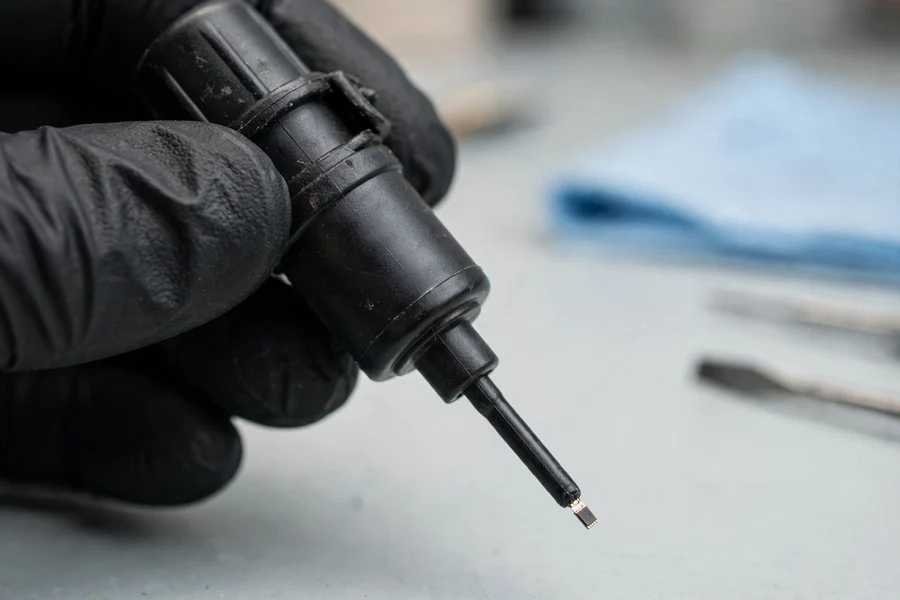
The mass airflow sensor sits in the intake stream between the airbox and the throttle body, and on BMWs of this era it is a hot-film design: a tiny heated film (older designs used a wire) is held at a constant temperature by current from the DME. Incoming air cools the film; the more air flowing past, the more current the DME must supply to hold the temperature. That current is the measurement — the DME converts it into a mass-airflow value, in grams per second, and uses it as the master input for injector pulse width. Get the air measurement wrong and everything downstream of it — fueling, trims, idle control — goes wrong with it.
That architecture explains the MAF’s two classic failure modes. A contaminated element (dust, oil mist from an oiled air filter) is insulated from the airstream, so it under-reports airflow and the DME injects too little fuel — a lean-running car with positive fuel trims. A degraded or over-reporting element exaggerates airflow, so the DME over-fuels — a rich-running car, sometimes with black exhaust smoke. And an element with a failing connection reports a jumping, noisy signal that makes the engine hunt and stumble.
8 BMW MAF sensor symptoms, ranked by how often they point here
None of these is exclusive to the MAF — ignition and vacuum faults can mimic several of them — but this is the order in which they show up on a failing sensor. The more of them you can check off, the stronger the case.
1. Rough or hunting idle
The single most common early sign. At idle the airflow is small, and a hot-film sensor is least forgiving at the bottom of its range — so a slightly dirty or drifting element that still behaves at cruise will misbehave at 700 rpm. You’ll feel the idle dip and surge a hundred rpm or more, sometimes settling, sometimes not.
2. Stalling at stops or right after startup
Take the rough idle one step further and the engine can’t hold on at all: it dies as you coast to a light, or stalls a few seconds after a cold start. This is the symptom that most often converts “something feels off” into “I need to fix this today,” and a P0101-range code found alongside a stall-at-idle pattern is the classic MAF signature.
3. Hesitation and flat spots on acceleration
Press the pedal to merge and the car thinks about it first: a distinct flat spot or stumble before power arrives, or power that surges unevenly through the mid-range. A lagging MAF signal makes the DME fuel for the air it measured a moment ago rather than the air entering now — and on a turbo engine like the N20, where airflow changes violently with boost, the hesitation can be pronounced.
4. Hard starting or extended cranking
Crank time stretches out, sometimes with a couple of attempts before the engine catches. The DME relies on the MAF to know how much air is present for the first injection events; a dead-on-arrival reading at key-on forces it to guess.
5. Noticeably worse fuel economy
A sudden, otherwise unexplained drop in mpg — no change in driving habits, tire pressures fine — is a strong MAF tell, especially paired with any drivability symptom above. An over-reporting element makes the DME pour in fuel the engine doesn’t need, mile after mile. Owners commonly notice this one first, because the fuel gauge is an honest witness.
6. Black smoke from the exhaust
In severe cases of a rich mixture, unburned fuel leaves the tailpipe as black smoke, most visible under acceleration. This is the exhaust-visible proof of over-reporting: the DME believes far more air is entering than actually is. Don’t confuse this with the faint haze every direct-injection engine makes on a cold morning.
7. Check-engine light with P0100–P0103
The codes are the least ambiguous symptom, but note the order: many failing MAFs cause weeks of bad drivability before they ever set a hard code, because the sensor drifts within the plausible range. The light is confirmation, not the first warning. The full code table and the BMW-specific shadow codes are decoded below, alongside our check-engine-light causes guide if the light is all you have to go on so far.
8. Reduced power with no warning light
The quiet one: the car just feels flat, less eager than you remember, with no light and no stall. A MAF that reads consistently low by ten or fifteen percent keeps the mixture lean-ish and the DME keeps trimming against it; you get a car that runs but never quite delivers. It’s also the symptom most often “fixed” by accident — drivers adapt their right foot until a scan reveals the trims sitting far from zero.
MAF-related fault codes: P0100–P0103 and their followers
Generic OBD2 codes are the shared language every scan tool speaks; BMW’s DME also stores its own manufacturer shadow codes (in the 2Cxx/2Dxx range) that don’t always illuminate the check-engine light. Knowing the family helps you read the whole story instead of chasing one code in isolation.
| Code | Meaning | What it usually indicates |
|---|---|---|
| P0100 | MAF circuit malfunction | Wiring or connector fault; or the sensor has died outright |
| P0101 | MAF range / performance problem | The classic: sensor reads, but the value is implausible — dirty, drifting, or dying element |
| P0102 | MAF input low | Signal near zero — unplugged sensor, broken signal wire, short to ground |
| P0103 | MAF input high | Signal pegged — short to power, bad ground, or a wildly over-reporting element |
| P0171 / P0174 | System too lean (bank 1 / bank 2) | MAF under-reporting airflow — or unmetered air entering after the sensor |
| P0172 / P0175 | System too rich (bank 1 / bank 2) | MAF over-reporting airflow; the DME is drowning the engine in fuel |
Read the combination, not the code alone. A P0101 standing by itself is a strong MAF case. P0101 alongside lean codes on both banks points at under-reporting — but it can also be a cracked intake boot or a loose clamp letting air in after the sensor, which the MAF never saw. Rich codes with no MAF code at all deserve a look at the MAF’s live data anyway, because an over-reporting element can stay just inside the plausibility limits while doing real damage to fuel economy. And if you see the car’s increased emissions warning on the dash, treat it as the same family: the DME has noticed the mixture drifting far enough to threaten the catalyst.
Reading the MAF like a technician: live data in grams per second
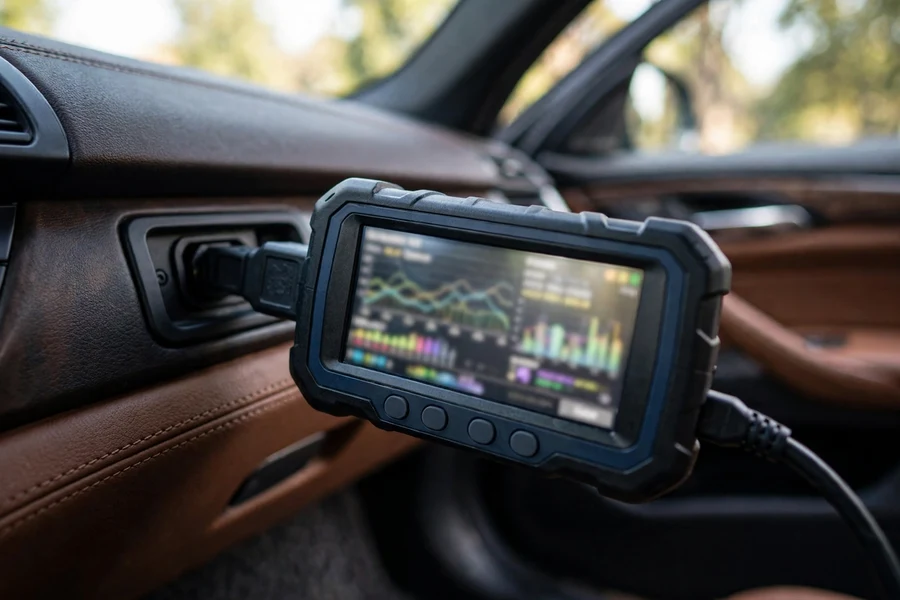
A $20 Bluetooth adapter and any OBD app that reads live data will show you the MAF’s actual output in grams per second — and this is where the sensor either convicts or clears itself. Two checks matter: the value at a warm idle, and how smoothly it responds when you snap the throttle.
| Engine | Warm idle reading (approximate) | Red flag |
|---|---|---|
| N52 3.0L (E90 328i) | ~3.5–3.9 g/s | Stuck near 0, or swinging wildly at idle |
| N20 2.0L turbo (F30 328i) | ~2.5–3.0 g/s | Same — near-zero or erratic readings |
| B48 2.0L turbo (G20 330i) | ~2.5–3.0 g/s | Same — near-zero or erratic readings |
The rule of thumb behind those numbers: at a warm idle, MAF flow in g/s lands roughly near the engine’s displacement in liters, and these community-observed figures are approximations, not factory specifications — what you’re hunting for is something grossly wrong, not a tenth of a gram. A healthy sensor holds a steady value at idle and rises smoothly when you blip the throttle. A dying one does one of three things: sits near zero despite the engine clearly running (dead element or broken wire), reports a steady value far from the expected range (drifted calibration), or jumps erratically between low and high values with the engine sitting still. That last pattern is the sensor telling on itself; no vacuum leak makes the MAF’s own signal bounce like that.
The fuel-trim cross-check: your lie detector for vacuum leaks
Fuel trims are how you separate a bad MAF from a vacuum leak without a smoke machine. A vacuum leak admits a fixed amount of unmetered air, which is a huge proportion of total airflow at idle and a tiny proportion at 3,000 rpm. So with a leak, short-term trims read high at idle and fall sharply when you hold the revs. A failing MAF misreports across the range: trims stay elevated (under-reporting) or depressed (over-reporting) at both idle and cruise. If your trims clean up at rpm, suspect the intake boots first. If they don’t, the MAF is back on the table — and the live-data check above is the tiebreaker.
The 5-minute unplug test — and what it honestly proves
This is the most famous MAF diagnostic in the BMW community, and it works — within limits you should understand before you trust it. With the engine off, unplug the MAF’s electrical connector, then start the car and drive it gently around the block. With no signal to work from, the DME falls back to pre-programmed substitute values for airflow and runs a conservative, slightly rich map.
What an improvement proves: if the rough idle, stalling, or hesitation smooths out with the sensor disconnected, the MAF’s signal was actively corrupting the fueling. The substitute map is crude but stable, so a better-running car unplugged means a bad-running sensor plugged. In practice, this is a strong positive.
What it doesn’t prove: the fallback map runs deliberately rich and ignores fine airflow detail, which also masks vacuum leaks — a cracked intake boot will seem to “disappear” with the MAF unplugged too. So a positive test narrows it to “air-measurement problem,” not specifically “the sensor is dead,” and it can’t distinguish a failed element from a corroded connector or chafed wiring. It will set a code you’ll need to clear afterward. Run it, read the result honestly, then confirm with live data or the trim check before buying parts. Don’t drive unplugged for days: the rich fallback wastes fuel and loads the catalytic converter.
MAF symptom checker
Answer three questions and get the most likely cause — and the next test to run. Not a substitute for a scan, but it points the scan in the right direction.
Clean or replace: the honest answer
Every MAF thread eventually reaches this fork, and the honest answer is: cleaning is worth exactly one attempt, and only in the right circumstances. A hot-film element gets its accuracy back when the problem is surface contamination — road dust, oil mist from an over-oiled aftermarket air filter, general grime. In those cases a proper cleaning can genuinely restore the reading. But cleaning cannot fix a cracked film, a degraded calibration, or worn electronics, and many experienced BMW techs will tell you plainly that cleaning a MAF that has genuinely failed is a coin flip at best — some replace outright rather than spend an afternoon on it.
If you clean, do it right, because the element is fragile. Remove the sensor from the intake tube (never spray it in place — you’ll wash grime deeper into the housing and risk overspray on the connector). Use only a dedicated MAF sensor cleaner: brake cleaner, carb cleaner, and WD-40 leave residues or attack the film, and compressed air can destroy it. Spray the element from several angles in short bursts, never touch or scrub it — not with a swab, not with a fingertip — and let it air-dry fully for at least 15 to 20 minutes before reinstalling. Clear the codes, drive a normal mixed cycle, and watch whether the symptoms return. If they do, or if a second cleaning changes nothing, the sensor’s calibration is gone and no solvent will bring it back. Replace it.
OEM vs aftermarket: why the MAF is not the part to cheap out on
Mass airflow sensors are calibration-sensitive parts, and the BMW owner community has a well-documented, long-running pattern here: cheap no-name aftermarket MAFs have a habit of setting fresh codes out of the box, idling worse than the worn sensor they replaced, or dying within months — sending owners back to buy the good one anyway (community-reported across owner forums for years). The recurring advice from people who have done this job twice is consistent: buy from the OE supplier.
On most 3 Series engines the original equipment supplier is VDO (Continental’s brand, heir to Siemens’ sensor business), and Bosch supplies MAFs on several BMW engines as well. The practical move: pull your old sensor first and read the BMW part number stamped on the housing — match that, whether you buy the genuine BMW-boxed part or the identical OE-supplier unit. A sensor that merely “fits” but carries the wrong calibration curve will talk to the DME with the wrong accent, and you’ll be diagnosing your new part. Genuine BMW-boxed is the safe ceiling on price; the same part in the OE supplier’s own box is typically the value sweet spot. Avoid oiled “performance” air filters — oil mist is one of the fastest ways to contaminate the new element.
Cost bands and DIY difficulty
This is one of the friendliest repairs on the car. The sensor is accessible in the open intake tract — no bumper removal, no lifting the car, no special tools beyond a screwdriver and possibly a hose-clamp driver. Budget roughly 20 to 30 minutes, most of it spent letting the cleaner dry if you’re attempting a cleaning first. No coding or registration is required afterward on these generations; clear the fault codes with your scan tool, drive normally, and the DME relearns its trims on its own. (If you’re curious what the other end of the mixture system costs when it fails, our O2 sensor replacement guide covers that job’s diagnosis and pricing.)
| Route | Typical all-in cost | Notes |
|---|---|---|
| DIY cleaning | Under $20 | One can of MAF-specific cleaner; worth one attempt |
| DIY, budget aftermarket sensor | ~$60–$120 | Community-reported pattern of repeat failures — not recommended |
| DIY, OE-supplier sensor (VDO/Continental, Bosch) | ~$150–$250 | The value sweet spot; match the BMW part number |
| DIY, genuine BMW sensor | ~$300+ | Maximum certainty, dealer pricing |
| Independent BMW specialist | ~$220–$380 | Part plus roughly an hour of labor at shop rates |
| BMW dealer | ~$350–$550 | Genuine part, dealer labor rate, diagnostic fee often included |
All figures are owner/specialist-reported bands from the US market, approximate and variable by region — treat them as planning ranges, not quotes. Difficulty: 1 out of 5 (Easy). One electrical connector, two screws or clamps, and the sensor lifts out of the tube. The most common DIY mistake is forcing the connector tab instead of squeezing the release, and the second is reinstalling a cleaned sensor before it is fully dry.
Where the MAF sits on E90, F30, and G20
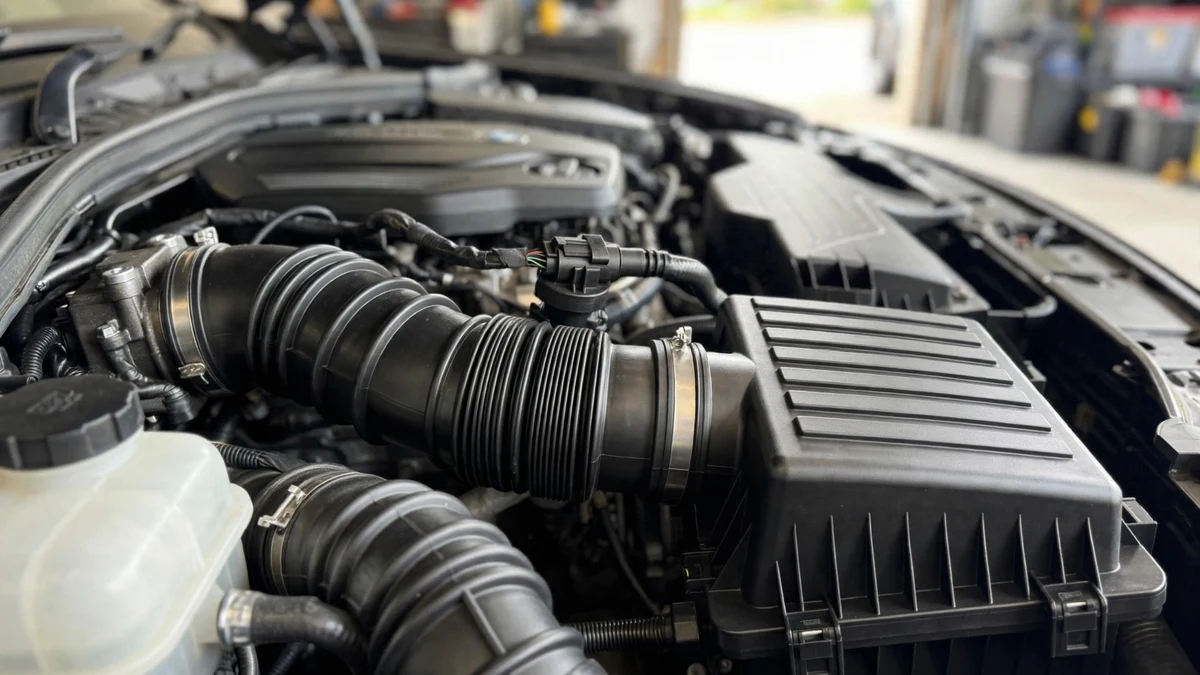
The location barely changes across generations: follow the intake tube from the airbox toward the throttle body and you’ll find the sensor clipped or screwed into the tube with a single wiring connector on top. On the E90 (N52), it’s in-line in the intake tube just after the air filter housing. On the F30 (N20/N26), it’s integrated into the intake tubing near the airbox — slightly tighter access but the same two-minute removal. On the G20 (B48), the layout is equivalent, buried a little deeper under the engine cover. In every case you’re looking for the one sensor with a wiring plug sitting before the throttle body — anything with a plug after it is a MAP or temperature sensor, a different part with a different job.
MAF vs oxygen sensor: know which side you’re diagnosing
These two sensors get confused constantly because they both end up in mixture discussions, but they work opposite ends of the engine. The MAF measures air going in — the feedforward sensor that tells the DME how much fuel to inject. The O2 sensors measure exhaust coming out — the feedback loop that tells the DME whether its guess was right. A failing MAF can force trims far enough to set O2 or catalyst-efficiency codes downstream, which is why chasing the last code in the list can send you to the wrong sensor. Rule of thumb: P0100–P0103 or wrong trims from the start means investigate the MAF first; P0030–P0167 heater/circuit faults or a lazy O2 signal means the exhaust end — see our BMW 3 Series O2 sensor replacement guide for that job. Diagnose the input before you blame the feedback.
Can you keep driving on a bad MAF?
Short, gentle trips are generally tolerable — the car will run, just badly. But don’t treat it as a long-term condition. A rich-running engine fouls spark plugs, wastes fuel, and loads the catalytic converter with unburned hydrocarbons; a lean-running one raises combustion temperatures. The more immediate concern is the stalling: an engine that dies as you pull into traffic is a safety problem, not just a drivability one.
Frequently asked questions
Can a bad MAF sensor cause misfires?
Yes, indirectly. A MAF that under-reports airflow makes the DME inject too little fuel, and a lean-enough mixture will misfire — especially at idle. If misfire codes appear alongside lean codes (P0171/P0174) or a P0101, check the MAF and intake for leaks before replacing coils and plugs.
Can I drive with the MAF sensor unplugged?
Briefly, for diagnosis — not as a lifestyle. Unplugged, the DME runs a conservative substitute map that is stable but deliberately rich, so fuel economy drops and the catalytic converter takes the extra load. It also sets a fault code. Use the test for a few minutes around the block, then fix the actual problem.
Why didn’t a new MAF fix my code?
Three usual suspects. First, a vacuum leak or damaged intake boot after the sensor — the old MAF was measuring correctly all along. Second, a cheap aftermarket unit with the wrong calibration, which is its own fresh problem. Third, damaged wiring or a corroded connector — inspect the pins and harness before condemning any sensor, new or old.
Can a dirty air filter cause MAF symptoms?
It can cause hesitation and poor economy by restricting airflow, and a filthy filter is often what contaminated the MAF element in the first place. Always replace the air filter when you service the MAF — installing a fresh sensor behind a disintegrating filter just restarts the contamination cycle. Skip oiled “performance” filters; oil mist is a documented MAF killer.
Do I need to reset or code anything after replacing the MAF?
On E90, F30, and G20 3 Series models there is no coding or registration step for a MAF swap. Clear the stored fault codes with your scan tool, then drive normally for a few mixed cycles — the DME relearns its fuel trims automatically. If symptoms persist after a quality replacement, the fault was never the sensor.