BMW 3 Series Wheel Bearing Noise: Find the Corner, Fix Costs

That humming, howling drone that rises with your speed is one of the most distinctive sounds a BMW 3 Series makes — and it’s usually a wheel bearing announcing its retirement. The good news: a bad wheel bearing is one of the easiest problems to pin down yourself. With a two-minute test on an empty road, you can identify which corner is failing with near certainty before you ever visit a shop.
Short answer: BMW 3 Series wheel bearing noise is a hum, howl, or growl that rises with road speed (not engine speed) and changes when you steer. The classic test: noise that gets louder turning left points to the right-side bearing, and noise louder turning right points to the left — because turning loads the outside wheels. Confirm it with the free “weave test” below, then budget $450–$900 per corner at an independent shop or $120–$260 in parts for DIY.
In this guide
- What a failing wheel bearing sounds like
- Noise diagnosis: bearing vs tire vs CV joint vs differential
- The turning test — which corner is failing
- Front vs rear bearing noise
- Bearing noise vs tire noise: the three checks that settle it
- Bearing types by generation: bolt-on hub vs press-in
- What wears out a 3 Series wheel bearing
- Replacement cost by generation, axle, and shop type
- DIY difficulty: tools, time, and whether you should
- At the shop: diagnosis fee and avoiding a wrong-corner replacement
- FAQ
What a failing wheel bearing sounds like
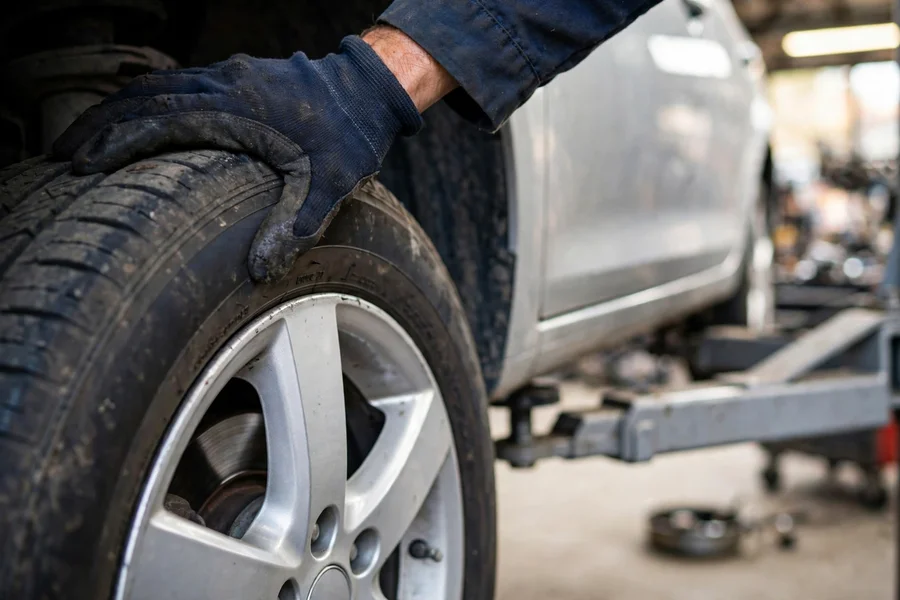
BMW 3 Series wheel bearing noise starts subtle and follows a predictable arc. Owners almost always describe the same progression: first a faint drone or whirring audible only above 50–60 mph, easily mistaken for wind noise. Weeks later it thickens into a howl or growl that’s obvious at 40 mph, and in the final stages it becomes a rumbling roar with a vibration you can feel through the floorpan — sometimes through the steering wheel if it’s a front bearing.
The single most reliable signature is that the noise tracks road speed, not engine speed. Hold a steady 60 mph and shift gears — a bearing drone won’t flinch, because the wheels are still turning at exactly the same speed. An exhaust or engine noise changes with revs; a differential or transmission noise changes with the gear you’re in. A wheel bearing changes only with how fast the wheel spins. That’s your first filter, and it eliminates half the false alarms.
The three sound signatures
- Hum / drone: the early and middle stage. A steady, tonal hum — owners often say “it sounds like I’m driving on knobbly tires” or compare it to an airplane propeller. Constant pitch for a given speed.
- Howl: the same hum grown louder and more aggressive, typically 40–70 mph. This is the stage where passengers notice before you do, because you’re acclimated to the sound.
- Growl / rumble: advanced wear. A rough, low growl with noticeable vibration. At this point the bearing has significant play, and it deserves prompt attention — the wear is accelerating.
One honest caveat before the diagnosis tables: in early stages, bearing noise and tire noise sound genuinely similar, and the turning test below is what separates them. If the noise doesn’t change at all when you steer, keep reading the bearing-vs-tire section — cupped or chopped tires are the most common reason for a false bearing diagnosis on the 3 Series.
Noise diagnosis: bearing vs tire vs CV joint vs differential
A howl that rises with speed has four usual suspects on a BMW 3 Series. This table is the quick-sort before you go hunting corners.
| Sound | Changes with steering? | Most likely source |
|---|---|---|
| Hum/drone rising with speed, louder in one turning direction | Yes — louder one way, quieter the other | Wheel bearing (opposite side to the loud turn) |
| Hum/roar rising with speed, same both directions, changes with road surface | No | Tire wear (cupped/feathered tread) |
| Rhythmic clicking or popping on tight, slow turns (parking lot, full lock) | Only at high steering angle | CV joint (xDrive models; rear-wheel-drive 3 Series rears rarely click) |
| Whine that follows engine speed/gear, fades coasting in neutral | No | Transmission or differential, not a wheel bearing |
| Rumbling plus a wobble or shimmy at 50–60 mph | Often worse on braking | Control arm bushings — read our control arm bushing guide for the overlap |
The CV joint row deserves one line of caution: a worn outer CV joint clicks rather than hums, and it does so at low speed with the wheel cranked — a completely different performance from a bearing drone at highway speed. Quiet in the parking lot, loud on the motorway curve? That’s a bearing.
The turning test — which corner is failing
This is the diagnostic trick every technician uses first, and it works on any BMW 3 Series generation. On a quiet stretch of road at a steady 50–60 mph with nothing behind you, ease the car gently left and right within your lane — a gentle weave, not a swerve. Listen for the drone rising one way and easing the other.
The load logic (verified)
In a turn, the car’s weight transfers onto the outside wheels and off the inside ones. A worn bearing complains loudest when it’s loaded — so the noise points at the opposite side to the loud turn:
| You turn… | Loaded (stressed) side | If noise gets louder… | Suspect corner |
|---|---|---|---|
| Left | Right wheels | Turning left | Right-side bearing |
| Left | Right wheels | Turning right (noise fades left) | Left-side bearing unloads — healthy or not the loaded one |
| Right | Left wheels | Turning right | Left-side bearing |
| Right | Left wheels | Turning left (noise fades right) | Right-side bearing unloads |
| Straight | Both sides equally | Same in all directions | Use the corner finder below, then front/rear checks |
A memory aid that fits on a sticky note: loud LEFT turn = RIGHT bearing; loud RIGHT turn = LEFT bearing. It’s the inverse of what feels intuitive, which is exactly why so many people replace the wrong corner first.
Corner finder
Two questions, then a likely corner — with the load logic explained.
Answer both questions to get the likely corner and the reasoning behind it.
Front vs rear bearing noise
Side-to-side is settled by the turning test, but front-vs-rear by ear is genuinely unreliable — noise travels through the unibody and the driver’s seat is a poor microphone. These three methods, in order, pin down the axle:
- The passenger test. Have someone sit in the back seat on each side. Rear-bearing noise is dramatically more obvious from the back seat; front-bearing noise barely changes when you move from front to back. It’s crude but surprisingly effective.
- Steering feel. A failing front bearing often feeds a faint vibration through the steering wheel at speed, because the bearing sits inside the steering knuckle. Rear bearings channel their vibration into the floorpan and seats instead.
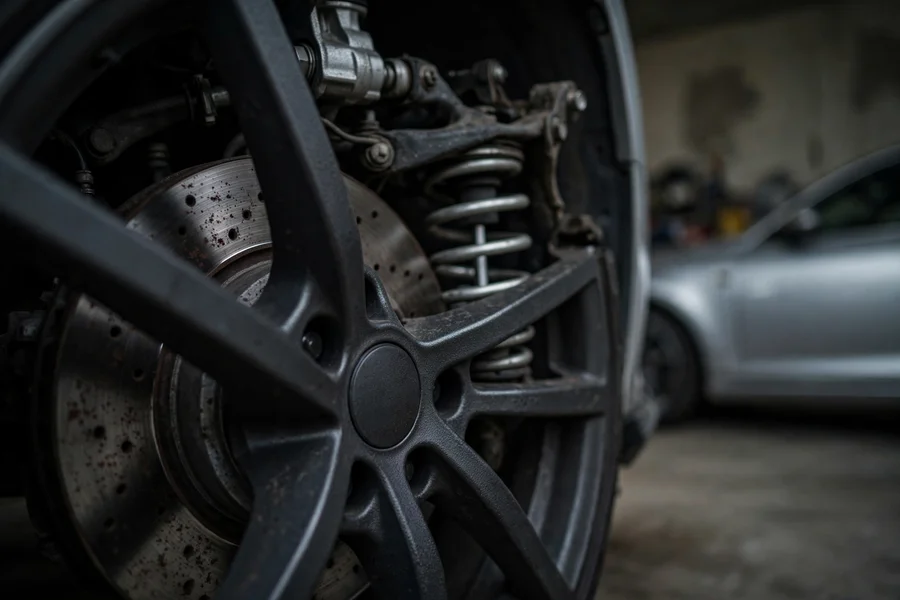
- The lift-and-spin check. With the car safely on a lift or jack stands (never just a jack), spin each suspect wheel by hand and feel the coil spring with your other hand. A worn bearing transmits a roughness or “grittiness” you can feel in the spring even when the wheel spins quietly. Also rock the wheel top-to-bottom: noticeable play at 12-and-6 o’clock is bearing or ball joint, and on the 3 Series the bearing is the usual winner.
A stethoscope on the knuckle while the wheel spins on a lift is the shop’s gold standard, but the hand-on-the-spring method gets you the same answer for free. One safety note worth repeating: never run the engine in gear with wheels off the ground to “listen” unless the car is properly secured on a lift — spinning wheels at speed with the car on jack stands is how people get hurt.
Bearing noise vs tire noise: the three checks that settle it
Cupped, feathered, or chopped tire tread hums at speed in almost exactly the way a bearing does — and it also rises with road speed, which is why tires cause the most misdiagnosed bearing replacements. Run-flat tires, which most 3 Series models wore from the factory, are particularly good at producing a drone that mimics a bearing when the tread wears unevenly. Before you price out a hub, run these three checks in order:
- The road-surface test. Find a stretch where the asphalt changes texture — a newly paved section meeting old concrete, for example. Hold your speed steady through the transition. If the drone’s pitch or volume changes with the surface, it’s almost certainly the tires. A true bearing drone is indifferent to pavement because the noise comes from inside the hub, not from rubber meeting road.
- The tread check. Run your palm firmly around each tire’s tread, in both directions. Cupping feels like shallow scallops; feathering feels sharp one way and smooth the other. Either one is a tire-noise guarantee. Also check pressures — underinflated sidewalls flex and drone — and eyeball the inner edges for the uneven wear that worn shocks and bad alignment cause.
- The rotation test. Rotate tires front-to-back on the same side. If the noise moves with the tire (front drone becomes rear drone), it’s the tire. If it stays at the same corner, it’s the bearing. This test is free, takes twenty minutes, and has settled more arguments than any forum thread.
One more pattern worth knowing: tire noise tends to stay level as you drift gently from lane to lane, while bearing noise swells and fades with each weave. If you find yourself thinking “it’s louder when I turn but I can’t tell which way” — that’s still data. Any steering change at all leans bearing; none at all leans tire.
Bearing types by generation: bolt-on hub vs press-in
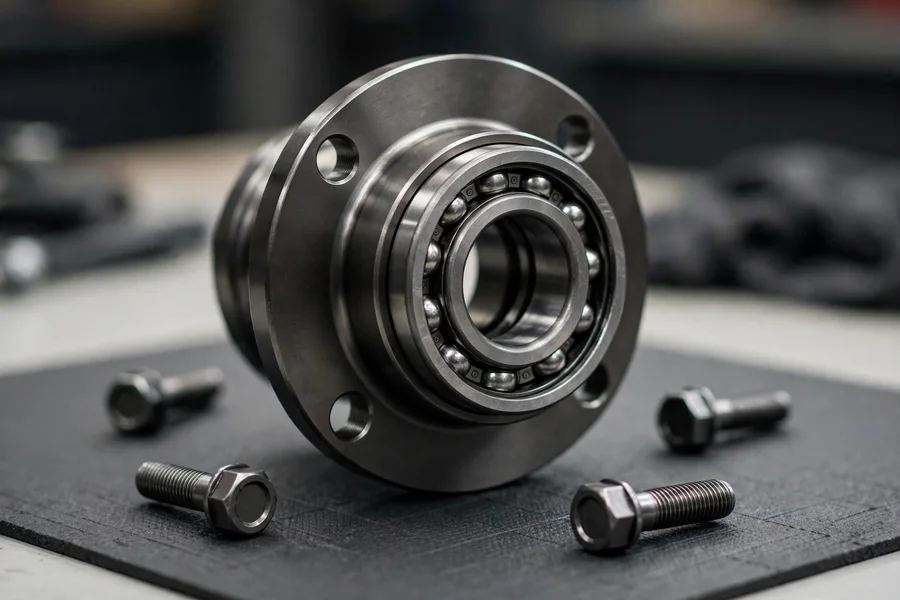
Not all 3 Series bearings are built the same way, and the design decides whether this is a relaxed afternoon job or a fight. Most modern 3 Series use a bolt-on hub assembly: the bearing comes pre-pressed into the hub flange as one sealed unit, and replacement is just unbolting four bolts from the knuckle and fitting the new unit. No press, no bearing pullers, no removing the knuckle.
| Generation | Front | Rear | What it means |
|---|---|---|---|
| E90 (2006–2013) | Bolt-on hub assembly | Press-in bearing cartridge | Fronts are easy; rears need a press or on-car puller tool |
| F30/F31/F34 (2012–2019) | Bolt-on hub assembly (4 bolts) | Bolt-on hub assembly | DIY-friendly all four corners |
| G20 (2019–present) | Bolt-on hub assembly | Bolt-on hub assembly | DIY-friendly all four corners |
The E90 rear is the odd one out — a bearing cartridge pressed into the knuckle, which is why E90 rear jobs cost more at a shop (more labor hours) and why some owners hand that corner to an independent BMW specialist rather than doing it in the driveway. Every other corner on every generation is a bolt-on unit, held to the knuckle with four bolts (the F30 famously uses Torx-head bolts torqued to 80 Nm plus a 90° turn — a detail covered well in FCP Euro’s FCP Euro’s F30 front bearing replacement walkthrough).
That generation split also explains a pattern owners notice: on the E90, fronts are reported failing more often than rears partly because they’re the ones most owners actually hear and replace; on the F30, DIY write-ups frequently point at the rears first, with some guides noting drones starting to appear at higher mileages. Treat all of that as owner-reported observation, not specification — BMW publishes no bearing service interval.
What wears out a 3 Series wheel bearing
Wheel bearings are sealed for life — there is no service interval and no maintenance to do — but “sealed” doesn’t mean invincible. On the 3 Series, the usual killers are:
- Impact damage. A hard pothole hit or curb strike dents the bearing’s hardened races. The damage may not make noise for weeks, then the dented race starts the classic drone. If your noise appeared a few weeks after a big hit, that’s not a coincidence.
- Water and grit intrusion. Failed seals let water and road grit into the grease. Cars that regularly see deep puddles, flood water, or winter salt spray fail earlier — corrosion inside a sealed bearing is invisible until the noise starts.
- Run-flat sidewalls. Most 3 Series shipped on run-flats, whose ultra-stiff sidewalls transmit more shock to the hub than a conventional tire. It’s not a defect — it’s the trade-off for being able to drive 50 miles on a flat — but it’s one reason 3 Series bearings live a slightly harder life than the same-size bearing on a softer-riding car.
- Worn suspension companions. Badly worn shocks, sagging springs, or shot control arm bushings change the loads the bearing sees with every bump. The bearing rarely fails alone — it fails after its neighbors did. If a bearing fails and the bushings are visibly cracked, the two are related more often than not.
As for mileage: BMW publishes no expected lifespan, so anyone quoting a number as specification is guessing. What owner reports consistently describe is that F30 rear bearings are a common complaint once cars move well past the 80,000-mile mark, with DIY guides routinely calling it a wear-item job on high-mileage F30s — while G20s are mostly still too young for a clear pattern. Treat that as reported experience, not a schedule. Some bearings last the life of the car; others fail after one bad winter.
Replacement cost by generation, axle, and shop type
Wheel bearing pricing is a parts-plus-labor story where the labor half varies wildly. The part itself — a bolt-on hub assembly from an OE supplier — is a commodity. The labor depends on whether your corner is bolt-on (about an hour) or press-in (two to three hours), and whether the quote comes from a dealer, an independent BMW specialist, or your own driveway.
Typical cost per corner (parts + labor, 2026)
Bars show relative position of each range on a $0–$1,400 scale. E90 press-in rears run toward the top of each band because of the extra labor.
| Corner | DIY (parts) | Independent | Dealer |
|---|---|---|---|
| E90 front (bolt-on) | $120–$200 | $450–$650 | $800–$1,100 |
| E90 rear (press-in) | $90–$150 | $550–$850 | $900–$1,400 |
| F30 front or rear (bolt-on) | $130–$220 | $500–$850 | $850–$1,300 |
| G20 front or rear (bolt-on) | $140–$260 | $550–$950 | $900–$1,400 |
A few honest pricing notes. First, hub assembly quality matters more than with most parts: OE-supplier brands (the manufacturers that actually built the part for BMW) cost noticeably more than budget hubs, and cheap bearings have a real reputation for failing early. This is one part where buying the budget option often means doing the job twice. Second, an alignment is frequently recommended afterward — not because the bearing affects alignment geometry directly, but because the knuckle, strut, and tie-rod hardware all get disturbed during the job, and a $150–$200 alignment protects your tires from the uneven wear that caused the original noise confusion in the first place.
Should you replace bearings in pairs?
Honest answer: no — just replace the failed one. Wheel bearings don’t wear like brake pads; the other bearing on the axle may have years of life left, and there’s no safety case for preemptive replacement. The exception is if both corners on an axle are clearly droning (the turning test is inconclusive because both are noisy), or if you’re already paying for an alignment and the second bearing is growling — in which case doing both now saves a second round of labor later. Otherwise, one corner is the right call, and any shop insisting on pairs as a policy is upselling.
If you’re budgeting the broader picture of 3 Series running costs, our brake pad replacement cost guide covers the other common per-corner repair, and the 3 Series maintenance schedule shows where bearings fit into the long-term ownership plan.
DIY difficulty: tools, time, and whether you should
For every bolt-on corner — everything except the E90 rear — this is a moderate DIY job, roughly a 3 out of 5 on the difficulty scale. With basic tools and a clean workspace, one side takes 45 minutes to two hours once you’ve done the first one. The procedure is conceptually simple: remove the wheel, brakes, and (on xDrive) axle nut; unbolt the four hub bolts from behind the knuckle; swap in the new hub assembly; torque to spec.
- Essential: jack and stands (or a lift), breaker bar, torque wrench, Torx bit sockets (F30 rears and updated bolts need large Torx/TP bits — check yours before you start), penetrating oil for corroded hub bolts, and new mounting bolts.
- Commonly needed: a slide hammer or hub puller if the old hub is seized into the knuckle with corrosion — this is the single most common reason a “45-minute job” becomes a Saturday.
- E90 rear only: a hydraulic press or an on-car bearing puller/press tool. Without one, this corner belongs at a shop; it’s not a hand-tools job.
- Torque discipline: hub bolts and axle nuts are stretch-critical hardware with angle specs. Always use a torque wrench and always use new bolts — reusing stretched hub bolts is a false economy.
The safety bottom line applies to every repair here: a failing bearing will not get better, only louder and looser, and a badly worn bearing can seize. If the noise has progressed from hum to growl with vibration, move the appointment up. And if you’re buying a 3 Series with a mystery drone, our used BMW 3 Series buying guide covers what to check on the test drive before money changes hands.
At the shop: diagnosis fee and avoiding a wrong-corner replacement
If you’d rather have a professional confirm the corner before parts are ordered, most independent BMW specialists will diagnose a bearing on a lift for a modest fee — often $80–$150, frequently waived if you book the repair with them. The shop version of your weave test is a stethoscope on each knuckle while the wheel spins; it takes minutes and is essentially never wrong.
Two tips to keep the visit cheap and accurate. First, bring your turning-test result. A shop that listens to “it’s louder turning left, so I suspect the right side” and then verifies on the lift is a shop that’s doing it right; one that waves it off and starts guessing is a shop to walk away from. Second, ask how they’re confirming the corner — “stethoscope on the lift” is the right answer, and it also rules out the tire false alarm for free. Given how often cupped tires get misdiagnosed as bearings, a good specialist will check the tread before quoting a hub.
Frequently asked questions
Can I keep driving with a bad wheel bearing?
For a short time and gently, yes — but not indefinitely. A worn bearing gets progressively louder and looser, and in extreme cases it can seize, which at speed is genuinely dangerous. A loud growl, vibration through the wheel or floor, or play at 12-and-6 all mean: don’t delay the appointment.
Do wheel bearings get replaced in pairs?
No — just the failed one. Bearings don’t wear symmetrically like brake pads, and there’s no safety reason to preemptively replace the other side. Only do both if the second corner is clearly noisy too, which saves a second round of labor and alignment.
How long does a wheel bearing replacement take?
A bolt-on hub corner typically takes 1–2 hours of shop labor (45 minutes for the second side once everything’s apart). An E90 press-in rear runs 2–3 hours. Add a day of scheduling and, if you’re replacing both rears on an E90, expect the car to be in for most of a day.
Do I need an alignment after replacing a wheel bearing?
Usually recommended, yes. The knuckle, strut, and tie-rod hardware are disturbed during the job, and a fresh alignment ($150–$200) protects your tires from the uneven wear that can sound exactly like another bad bearing. Cheap insurance on a job this size.
How can I tell bearing noise from tire noise for sure?
The road-surface test is the decider: a drone that changes with pavement texture is tires; a drone that’s indifferent to pavement but changes when you steer is a bearing. The tire rotation test settles the rest — if the noise follows the tire, it’s the tire.