BMW xDrive Transfer Case Fluid Change: ‘Lifetime’ Lie
Your BMW’s maintenance schedule has a conspicuous blank spot. Engine oil, brake fluid, coolant, spark plugs — all listed, all on intervals. But the three gearboxes under your xDrive 3 Series — transfer case, front differential, rear differential — get no interval at all. BMW calls their fluid “long-term rated” and says to touch it only during repairs. Specialists call that a warranty-period accounting decision, not an engineering one. And in 2025 and 2026, two federal class actions asked a court to agree.
This guide covers all three units on every xDrive 3 Series generation — E90, F30, and G20: what each one does, the fluid each takes, the real service intervals, the symptoms of neglected fluid, dealer vs. shop vs. DIY costs, and the tire-mismatch rule that quietly kills transfer cases — built from published specifications, specialist guides, and live court reporting.
Short answer
A bmw xdrive transfer case fluid change — plus fresh oil in the front and rear differentials — is due roughly every 30,000 to 60,000 miles if you plan to keep the car past its warranty. The transfer case takes BMW DTF-1 (about one liter), the differentials take 75W-85 or 75W-90 hypoid gear oil depending on generation, and the three-unit service runs roughly $150–$220 in parts — versus thousands if a neglected transfer case fails. BMW’s “long-term rated fluid” position means there is no factory interval; the intervals in this guide are specialist and owner guidance, not BMW’s.
In this guide
- What “lifetime fill” really means — and why BMW says it
- The three units you’re actually servicing
- Symptoms your xDrive fluids are finished
- Fluid specs and capacities by generation
- Service intervals: BMW’s position vs. specialist guidance
- The tire rule that destroys transfer cases
- DIY overview: what the job actually involves
- What the service costs: dealer vs. independent vs. DIY
- The class-action lawsuits challenging “lifetime” fluid
- Interactive: is your 3 Series due?
- Frequently asked questions
What “lifetime fill” really means — and why BMW says it
Open the maintenance booklet for an xDrive 3 Series and you will find transfer case oil and differential oil described as “long-term rated” fluids that only need attention when a repair is performed — except on certain M models, where an interval exists. That is BMW’s official position, as quoted in the 2025 federal transfer case complaint (The Autowire, September 2026). There is no contradiction to resolve here: BMW genuinely publishes no replacement interval for these fluids under normal use. The question is whether “long-term rated” means the fluid actually survives the car’s long term.
It helps to know why the phrase exists. Starting with the 2003 model year, BMW covered scheduled maintenance for four years or 50,000 miles on every new car. When the manufacturer pays for scheduled service, every line item removed from the schedule is money saved during the warranty period — and it makes the ownership-cost story look better on paper. The front-differential complaint makes this allegation directly: that BMW adopted the “lifetime” designation as a marketing strategy to promote lower service costs and fewer service visits. That is the plaintiff’s claim, not a court finding — but the economic logic is hard to wave away.
From a lubrication standpoint, the claim never made much sense. Differential ring-and-pinion sets use hypoid gearing, where the teeth slide across each other under load rather than rolling — contact that consumes extreme-pressure additives, oxidizes the oil through heat cycles, and shears down viscosity. None of that shows up on a dashboard: a fluid can be full to the fill line and completely tired. The transfer case adds its own wrinkle — a wet clutch pack whose friction behavior depends on clean, in-spec fluid.
Owners and specialists who drain this fluid at 60,000 miles find it dark, thin, and full of metal — and watch the consequences arrive right around warranty expiration. Two federal lawsuits, filed eleven months apart, now argue the same thing in court.
The three units you’re actually servicing
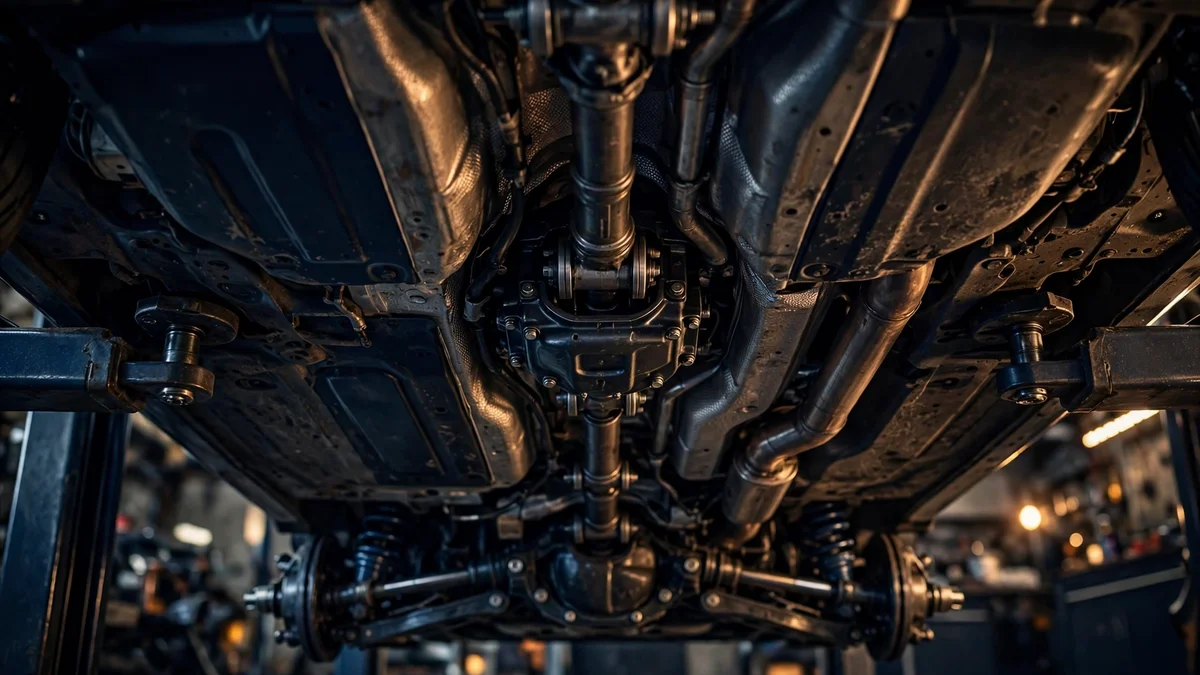
An xDrive 3 Series has three separate gearboxes, each with its own housing, fluid, and failure mode. Servicing “the xDrive fluids” means all three.
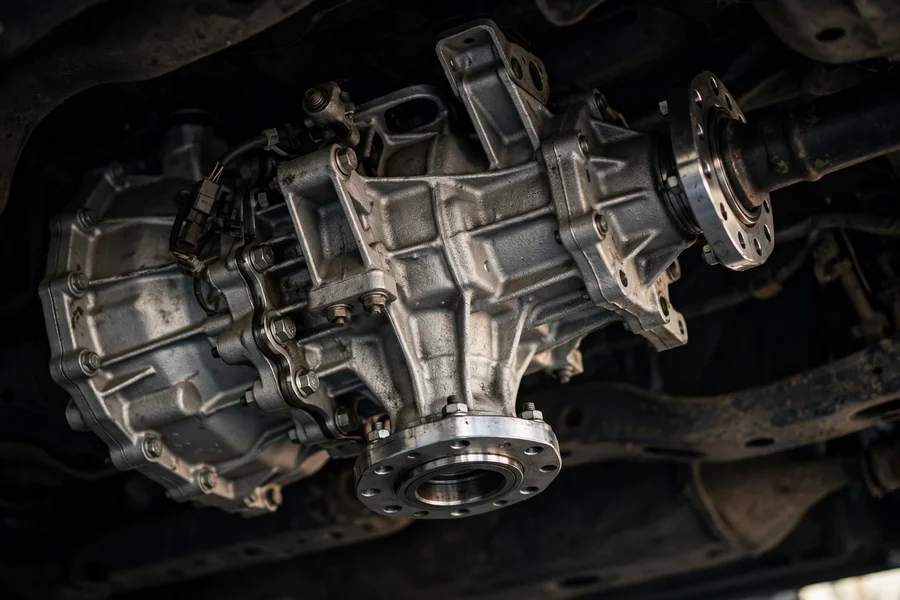
The transfer case bolts to the back of the transmission and is the heart of xDrive. An electronically controlled wet clutch varies the torque split — normally about 40:60 front-to-rear — redirecting power within a tenth of a second when the ABS/DSC system detects slip. It is the most failure-prone and most expensive of the three units. The F30 uses the ATC35L unit, the G20 the newer ATC13/ATX13 family; all take BMW DTF-1, the current branding of the oil previously sold as TF0870.
The front differential splits the transfer case’s output between the front wheels. A conventional hypoid unit holding roughly 700–800 ml on the F30, it hides behind underbody panels and is easy to overlook. The F30 takes BMW’s G2 hypoid gear oil here — and this is the unit at the center of the 2026 front-differential lawsuit, which alleges BMW stopped scheduling its fluid changes by the mid-2010s.
The rear differential is the familiar final drive at the back axle — a conventional open differential (unless your car has the M Sport limited-slip unit, which uses its own fluid). Depending on generation it takes BMW Hypoid G1 75W-85 or SAF-XO 75W-90, roughly one liter. It even appears in BMW’s older maintenance literature with an interval, which makes the front diff’s omission from the same schedules one of the more awkward facts in the 2026 complaint.
Symptoms your xDrive fluids are finished
There is no dashboard warning for tired driveline oil, so owners meet the problem through feel. These are the symptoms specialists and the lawsuit record associate with neglected fluid, in the order they typically arrive.
Binding or shuddering in slow, tight turns. This is the signature symptom. Pulling into a parking space or making a full-lock U-turn, the car jerks or shudders instead of rolling smoothly — the transfer case’s clutch pack can no longer modulate the front-rear speed difference cleanly as the fluid degrades. BMW service bulletin SIB 27-02-20, first issued in May 2020 for the ATX13-X transfer case, describes exactly this jerking and shuddering, and its first prescribed fix is replacing the transfer case oil (The Autowire).
Low-speed shudder on light acceleration. A shudder pulling away from a stoplight — often described as feeling like the car might stall — is the same clutch-pack problem under load. The federal transfer case complaint describes cars jerking or shuddering especially when shifting gears, navigating turns, or at low speeds, and stresses that no warning lights appear when the transfer case is damaged, making the issue difficult to diagnose until it is too late (ClassAction.org).
Front-end noise or whine. A worn differential whines or howls from an axle, changing with road speed. In the 2026 front-differential case, the plaintiff first noticed front-end noise at around 47,000 miles; the dealer’s diagnosis read “internal damage (metal shavings)” with no fluid loss — the fluid was present but no longer protecting anything.
The no-warning problem. All of these symptoms share one trait: the car will not tell you. There is no fluid-life monitor for these units, no check-control message, no early fault code. By the time the shudder is obvious, the clutch pack or gear set may already be damaged beyond what fresh fluid can fix — which is the entire economic argument for scheduled service.
Fluid specs and capacities by generation
This is the part that had to be verified, because the wrong oil in a transfer case clutch pack or limited-slip diff can cause the exact damage you are trying to prevent. The table reflects published BMW part numbers and specification sheets from fluid vendors, cross-checked against specialist guides. Anything marked verify by VIN is where BMW varied the spec by build date or option.
| Unit | E90 xDrive (2006–2011) | F30 xDrive (2012–2019) | G20 xDrive (2019+) |
|---|---|---|---|
| Transfer case | BMW DTF-1 (was TF0870); ~1 liter | BMW DTF-1 (was TF0870); ~1 liter | BMW DTF-1; ~1 liter |
| Front differential | 75W-90 GL-5 gear oil; ~0.6–0.7 L (verify by VIN) | BMW Hypoid Axle Oil G2, 75W-85 (p/n 83 22 2 413 511); ~0.7–0.8 L | 75W-85 GL-5 hypoid (G2/G5 spec); ~0.6–0.7 L (verify by VIN) |
| Rear differential | BMW SAF-XO 75W-90 GL-5; ~1 L | BMW Hypoid Axle Oil G1, 75W-85 (p/n 83 22 2 295 532); ~1 L | BMW SAF-XO 75W-90 GL-5 (p/n 07 51 2 293 972); ~0.9–1.0 L (verify by VIN) |
The transfer case line is the most solid in the table: DTF-1 is the current branding of the oil BMW previously sold as TF0870 (part numbers 83 22 2 409 710 and 83 22 0 397 244 among others), rated API GL-4 / SAE 75W, and one 1-liter bottle covers every 3 Series generation (BimmerWorld’s specification page confirms the fitment and capacity). Note that a single drain-and-fill on the F30’s ATC35L typically yields only about 400 ml — roughly half the capacity — because fluid stays trapped inside; some owners service it twice in succession to replace most of the old oil.
The differential lines need more care. On the F30 the front and rear diffs genuinely take different oils — G2 75W-85 up front, G1 75W-85 in the rear — and FCP Euro’s F30 front-diff DIY guide recommends the OE G2 fluid, sold in 500 ml bottles (two for the ~700–800 ml fill). The G1/G2 labels are BMW’s product names, not API GL-1/GL-2 grades. On the G20, the rear diff is documented as SAF-XO 75W-90 GL-5 at roughly 0.9–1.0 liters for the M340i; base models should be confirmed by VIN. For the E90, 75W-90 GL-5 is the established owner and specialist guidance for both diffs — confirm against your car before filling.
Two hard rules apply everywhere: never put ATF or standard gear oil in the transfer case — it takes DTF-1 only — and if your rear diff is the M Sport electronically controlled limited-slip unit, it uses its own fluid, not the open-diff oil listed here.
Service intervals: BMW’s position vs. specialist guidance
BMW publishes no replacement interval for these fluids under normal use — “long-term rated,” replaced during repairs. Everything below that line is what independent specialists and experienced owners actually do, so the table keeps the two columns separate.
| Unit | BMW’s stated position | Specialist / owner guidance |
|---|---|---|
| Transfer case | No interval; replace during repairs | Every 30,000–60,000 miles (many settle on 50,000) |
| Front differential | No interval (omitted from schedules since ~mid-2010s) | Every 30,000–60,000 miles, with the transfer case |
| Rear differential | Listed with an interval in older schedules | Every 30,000–60,000 miles, with the transfer case |
Fluid vendors and specialists converge on the 30k–60k window: BimmerWorld states BMW recommends a transfer case fluid change at every fifth engine oil service (~50,000–60,000 miles), while FCP Euro’s guidance for the related X3 chassis puts it at 30,000 miles for long, trouble-free use. Use 30,000 for hard-driven cars, 50,000–60,000 for normal use — and drain all three units in one lift session.
One caution from the forums: if you buy a high-mileage xDrive with unknown history and the fluid comes out black and burnt, changing it is still the right call for differentials — but fresh fluid cannot rebuild a worn clutch pack or pitted gear set. The service is preventive maintenance, not resurrection. Cars already showing the parking-lot binding symptom should be diagnosed before assuming a fluid change will cure them.
The tire rule that destroys transfer cases
Here is the failure mode no fluid change can prevent: mismatched tires. The transfer case’s clutch pack manages brief front-to-rear speed differences — cornering, slip, lost traction. If your tires force a permanent speed difference between the axles, the clutch slips constantly, overheats, and wears out, and the fluid cooks with it. This is how owners kill a transfer case without ever missing a service.
The community rule of thumb is within 1% rolling diameter, front to rear — BMW’s factory staggered fitments meet it. For tread wear, BMW’s own technical guidance (TIS) states the tread depth difference across all wheel positions must not exceed 2 mm, a figure owners have quoted from TIS screenshots for years (G20 Bimmerpost discussion). Treat 1% as the enthusiast rule and 2 mm as BMW’s own tolerance.
Replace tires in sets of four on an xDrive, or at minimum as matched axle pairs within that 2 mm window. A single new tire alongside three half-worn ones creates exactly the permanent speed difference the clutch pack hates. Mixing brands or models across axles is risky even at the same nominal size — the same “225/40R18” from two manufacturers can differ measurably, and star-marked versus non-star-marked versions of the same tire have been documented differing by 5 mm. If you must mix, measure actual circumference rather than trusting the sidewall.
A transfer case that died from tire mismatch will not be saved by fresh DTF-1 — and a dealer diagnosing a failed unit will check your tires first. When you change the driveline fluids, measure tread depths too; if the rears are more than 2 mm off the fronts, budget for tires before you blame the fluid.
DIY overview: what the job actually involves
All three services are drain-and-fill jobs — no programming, no adaptation resets, no special tools beyond a fluid pump and hex sockets. Plan a full afternoon on jack stands for all three units. The car must be level for correct fill levels, the fluid should be warm (a short drive first), and the golden rule is the same everywhere: crack the fill plug loose before you drain anything. A drained unit with a seized fill plug is a tow truck.
Transfer case. Access is from underneath; on the F30 you may need to drop the transfer case support bracket for fill-plug access. Many units have no drain plug — owners suction old fluid out through the fill hole, which is why only about 400 ml typically comes out of the F30’s unit. Refill with DTF-1 until fluid just weeps from the fill hole with the car level, and torque the plug to spec (owner-documented at 60 Nm on the F30). Because one pass replaces only about half the fluid, servicing it twice in one session — drive briefly between fills — gets mostly fresh oil in the unit.
Front differential. The most straightforward of the three. Remove the underbody panels (roughly twenty fasteners), and the drain and fill plugs are directly accessible with a 14 mm hex bit. FCP Euro’s step-by-step F30 guide puts the job at 30–45 minutes: fill plug out first, drain, new drain plug at 60 Nm, pump in ~700–800 ml of G2 until it runs from the fill hole, new fill plug at 60 Nm. BMW treats the plug seals as one-time-use — budget two new plugs, just over $10.
Rear differential. Same drill: fill plug first, drain, refill roughly one liter until it seeps from the fill hole with the car level. Confirm your exact fluid for your build date before filling — BMW varied the G20 rear-diff spec — and check whether you have the M Sport limited-slip unit, which takes its own fluid.
Honestly stated, this is a beginner-to-intermediate driveway job if you own jack stands, a torque wrench, and a fluid transfer pump — a $20 pump and a level car matter more than experience. If any plug will not break loose cleanly, stop and take it to a shop: a rounded fill plug turns a $150 afternoon into a real problem.

What the service costs: dealer vs. independent vs. DIY
Driveline fluid service is cheap to do and ruinous to skip. The ranges below are typical figures from specialist guides, owner reports, and court filings — budgeting numbers, not quotes.
| Service | DIY (parts) | Independent BMW shop | Dealer |
|---|---|---|---|
| Transfer case fluid change | ~$50–$70 (1 L DTF-1) | ~$250–$400 | ~$400–$700+ |
| Front differential fluid change | ~$110–$140 (fluid + plugs) | ~$150–$300 | ~$300–$500 |
| Rear differential fluid change | ~$40–$60 (1 L gear oil) | ~$120–$250 | ~$250–$450 |
| All three units | ~$150–$220 | ~$400–$800 | ~$800–$1,500+ |
| Transfer case replacement (failed unit) | — | ~$5,000–$7,000 | ~$7,000–$13,000 |
| Front differential replacement (failed) | — | ~$1,500–$2,500+ | ~$6,200 (per 2026 case filing) |
DIY figures are grounded: FCP Euro budgets about $130 all-in for the F30 front differential, and transfer case fluid runs about $50 per liter. The replacement figures should focus the mind — $7,000 to $13,000 for a transfer case (ClassAction.org), $6,199.01 out of pocket for the front-differential plaintiff’s replacement at 47,000 miles (The Autowire), and $5,000–$7,000 for a complete xDrive failure at a shop (BMW Insights). A $200 fluid service every 50,000 miles is the cheapest insurance.
The class-action lawsuits challenging “lifetime” fluid
Everything in this section is allegation, not finding — no class has been certified and BMW has not been found liable. The filings are public and dated; here is what they say.
November 2025 — the transfer case suit. On November 24, 2025, four BMW owners filed a proposed class action in the U.S. District Court for New Jersey (Sangenito et al. v. BMW of North America, 2:25-cv-17858; amended December 26, 2025), covering 2019–2025 xDrive vehicles including the G20 3 Series. The complaint alleges BMW knew of a transfer case defect since at least 2018 — citing service bulletin SIB 27-02-20, first issued in May 2020 for jerking or shuddering from the ATX13-X transfer case, whose first prescribed fix is replacing the transfer case oil — while telling owners the fluid was “long-term rated.” It further alleges BMW’s counsel said in November 2025 the company was considering extending the transfer case warranty, without committing to notify owners or reimburse past costs. Claimed costs: $250–$1,300 for fluid replacement, $7,000–$13,000 for a full replacement, with no warning lights before failure.
September 2026 — the front-differential suit. In September 2026, Autoblog (September 16, 2026) and The Autowire (September 24, 2026) covered a new proposed class action in the U.S. District Court for the Eastern District of Pennsylvania. Plaintiff Alex Heckler alleges the front differentials on xDrive-equipped G05 X5, G06 X6, and G07 X7 models through the 2025 model year fail prematurely because BMW treats the fluid as good for the life of the vehicle. Heckler’s 2020 X5 M50i needed a front differential at roughly 47,000 miles — just past the four-year warranty — costing $6,199.01, with the dealer’s record noting internal metal shavings and no fluid loss. The complaint calls “lifetime” a marketing strategy, and notes BMW’s 2026 maintenance publication began recommending front-diff fluid changes at roughly five years or 50,000 miles for newer M models — but not the allegedly identical earlier hardware.
Two lawsuits, two driveline components, one argument: fluid sold as permanent allegedly is not. Whatever the courts decide about “lifetime,” your drivetrain only cares about clean oil.
Interactive: is your 3 Series due?
xDrive driveline service planner
Pick your generation and mileage. The planner applies the specialist guidance from this guide — service every 50,000 miles — and estimates costs. BMW publishes no interval, so this is owner guidance, not a factory schedule.
Frequently asked questions
How often should you change BMW xDrive transfer case fluid?
BMW publishes no interval, calling the oil “long-term rated.” Specialists service it every 30,000–60,000 miles — most settle on 50,000 — with both differentials at the same time. Past 60,000 miles with unknown history, treat all three units as due.
What fluid does the BMW xDrive transfer case take?
BMW DTF-1 — the current branding of the oil previously sold as TF0870 (API GL-4 / SAE 75W). One 1-liter bottle covers E90, F30, and G20 3 Series. Never substitute ATF or standard gear oil: the clutch pack depends on this fluid’s friction properties.
Can I use 75W-90 in my BMW front and rear differentials?
It depends on the generation. The F30 specifies 75W-85 — BMW Hypoid G2 up front and G1 in the rear — and the G1/G2 labels are BMW product names, not API grades. E90 and G20 rear diffs generally take SAF-XO 75W-90 GL-5; M Sport limited-slip rear diffs need their own fluid. Confirm by VIN.
What causes the xDrive shudder in slow, tight turns?
Binding or shuddering in parking-lot maneuvers is the classic sign of degraded transfer case fluid: the clutch pack can no longer modulate the front-rear speed difference cleanly. BMW bulletin SIB 27-02-20 describes this exact symptom and prescribes a transfer case oil change as the first fix. Mismatched tires can cause the same symptom — check tread depths before assuming the fluid is the culprit.
Can mismatched tires really damage the transfer case?
Yes. A permanent front-to-rear rolling-diameter difference makes the clutch pack slip constantly, overheating it and cooking the fluid. Keep diameters within about 1% front to rear, and tread depth differences under 2 mm across all four tires per BMW’s technical guidance. Replace tires in matched sets of four.
Is BMW’s “lifetime fluid” claim being challenged in court?
Yes — twice. A November 2025 federal class action in New Jersey challenges the “long-term rated” transfer case fluid on 2019–2025 xDrive models, and a September 2026 federal suit in Pennsylvania challenges the “lifetime” front-differential fluid on 2019–2025 X5, X6, and X7 models. Both are allegations; no class has been certified.
If this guide has convinced you xDrive maintenance goes deeper than the transfer case, keep reading: the complete BMW 3 Series guide for the full ownership picture, the ZF 8HP transmission fluid change guide — the transmission on the other side of your transfer case labors under the same “lifetime fill” fiction — and the xDrive vs. RWD breakdown if you are still weighing whether the all-wheel-drive hardware and its maintenance are worth it for how you drive.