BMW 3 Series Fuse Box Location: E90, F30 & G20 Finder
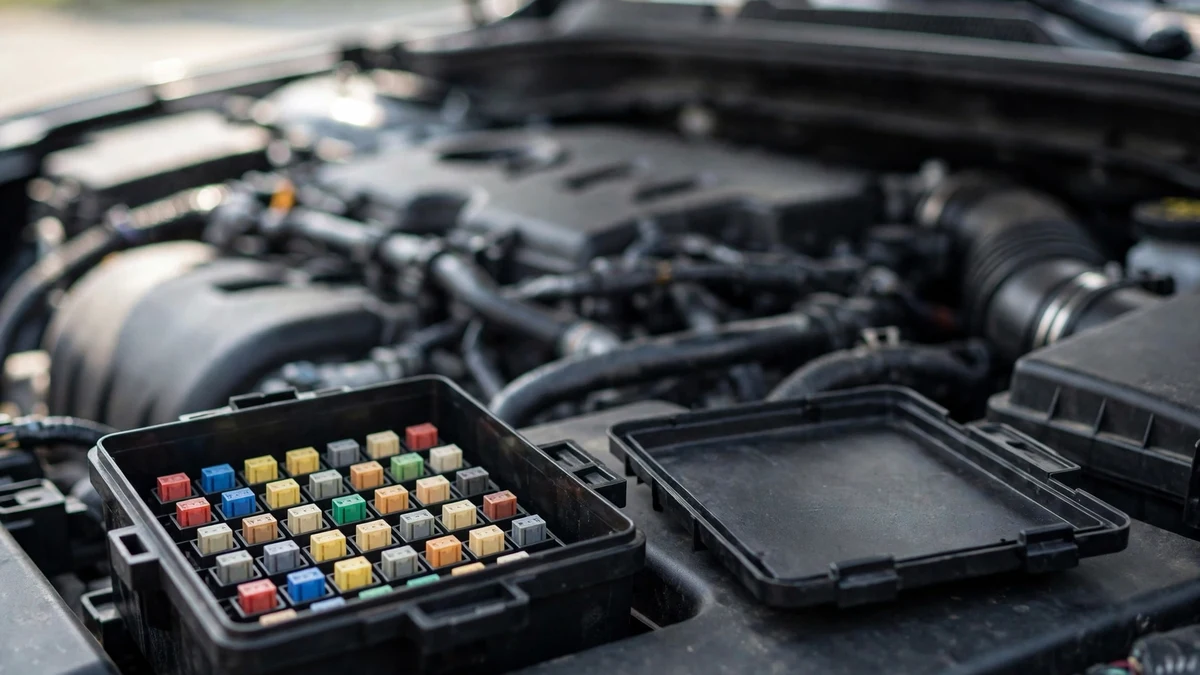
Short answer: BMW 3 Series fuse box locations vary by generation. E90 (2006–2013): main fuse box behind the glove compartment; high-current fuses in a rear power distribution panel by the battery in the trunk. F30 (2012–2018): a front power distribution box in the engine compartment plus the main fuse box in the luggage compartment (right side, under the floor cover). G20 (2019+): three fuse boxes — front-right behind the passenger footwell panel, front-left in the engine area, and rear in the right side of the luggage compartment. Fuse numbers vary by year and options, so always confirm on your car’s paper fuse card.
On this page
- Fuse box locations by generation
- E90 fuse box: location and access
- F30 fuse box: location and access
- G20 fuse box: location and access
- Interactive fuse finder
- Verified fuse charts (fuse numbers and amps)
- How to read the paper fuse card
- Fuse types used in the 3 Series
- How to test and replace a fuse
- Fuse box FAQ
Fuse box locations by generation
Every BMW 3 Series has more than one place where fuses live. There is the main junction/fuse box that holds most of the everyday circuits (lights, windows, sockets, wipers), and there are high-current distribution points that protect big loads like the starter, the junction box itself, and the power steering. The exact split changed with each chassis generation, which is why a fuse diagram from an E90 will not help you on an F30, and an F30 diagram will not help you on a G20.
Use this table as your starting point, then follow the generation-specific access steps below. The single most important document in this whole process is the folded paper fuse card that BMW clips inside each fuse box — it lists the exact fuse numbers for your car, because assignments shift with model year, engine, and options.
| Generation | Years | Main fuse box | Secondary fuse locations |
|---|---|---|---|
| E90/E91/E92/E93 | 2006–2013 | Behind the glove compartment (junction box fuse panel) | Rear power distribution panel by the battery in the trunk (high-current fusible links); E-box engine electronics module under the hood |
| F30/F31/F34 | 2012–2018 | Luggage compartment, right side, under the carpeted floor cover | Front power distribution box in the engine compartment; high-current fusible links (FL1–FL5) in the trunk box |
| G20/G21 | 2019–present | Front-right, behind a panel at the passenger footwell | Front-left fuse box in the engine area; rear fuse box in the right side of the luggage compartment |
E90 fuse box: location and access
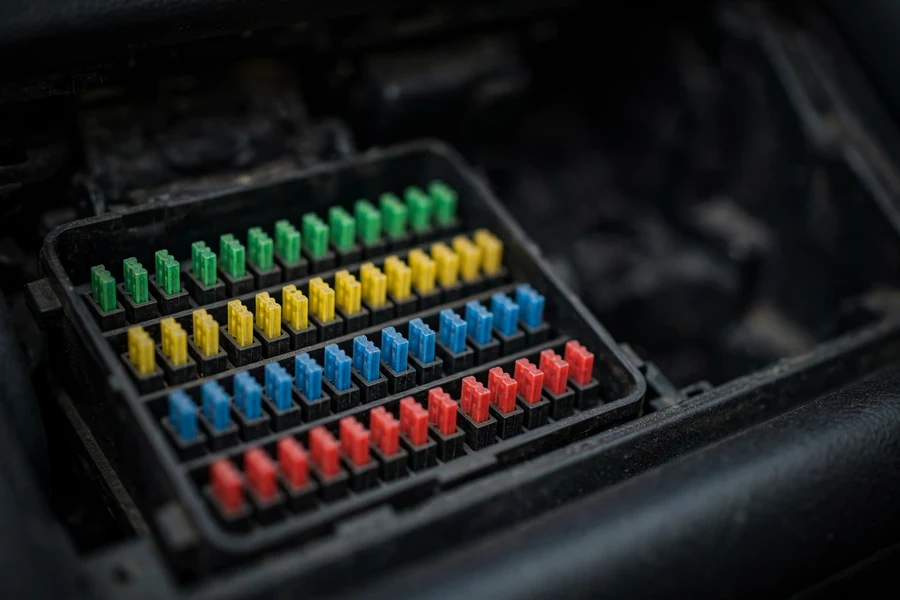
The E90-generation 3 Series (2006–2013, including the E91 wagon, E92 coupe, and E93 convertible) keeps its main fuse box behind the glove compartment. This is the junction box fuse panel, holding the fuses for almost everything you will check yourself: 12V sockets, horn, wipers, windows, lights, and fuel pump.
How to open the E90 fuse box
- Open the glove compartment and empty it so you can work comfortably.
- Look at the back panel of the glove box interior. You will see two quick-release retaining clips or latches (on some cars they look like large thumb screws).
- Turn both latches and pull the trim cover away. The fuse panel is directly behind it.
- Check the back of the trim cover — BMW clips the paper fuse assignment card there. If a previous owner lost it, replacements are printed in your owner’s manual.
One caution that trips up a lot of E90 owners: the fuse layout changed during production. Cars built to March 2007 use one assignment, cars from March 2007 to September 2007 use another, and cars from September 2007 onward use a third. A fuse number that is correct for a 2011 car can be completely wrong for a 2006. The verified charts below use the late (post-September 2007) layout, with early-car equivalents noted where they could be confirmed. If your fuse card disagrees with any number on this page, your card wins.
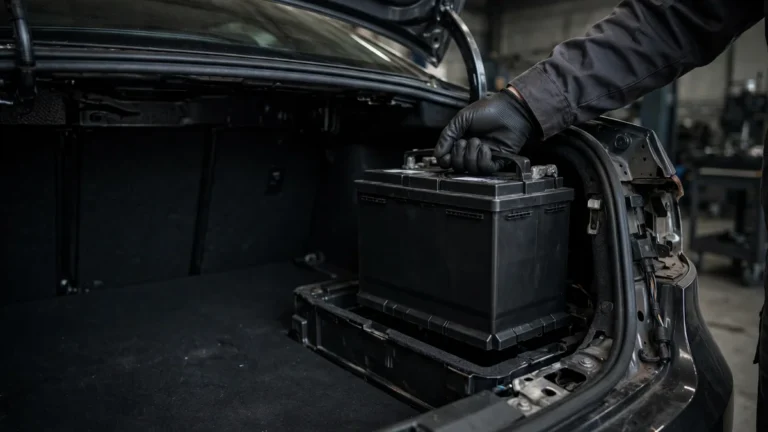
The rear power distribution panel in the trunk sits next to the battery (the E90’s battery lives in the right side of the trunk). It contains high-current fusible links — 100A and 250A fuses feeding the junction box, the starter, and the power steering. These rarely blow, and if one does, the car usually has a serious electrical fault that needs professional diagnosis rather than a driveway fuse swap.
F30 fuse box: location and access
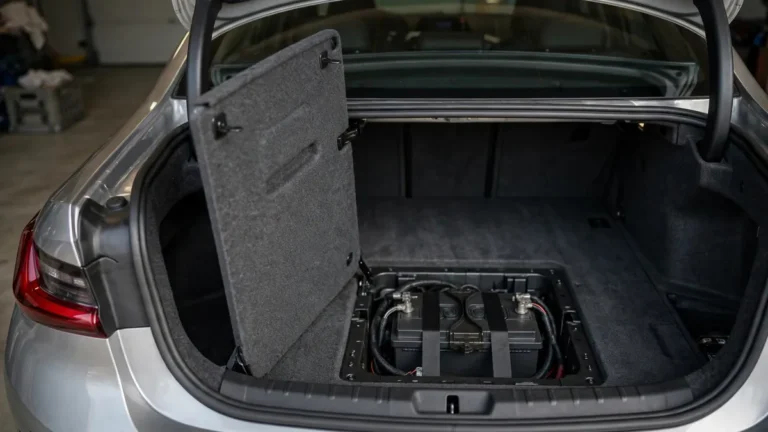
The F30 generation (2012–2018) moved things around. The main fuse box is in the luggage compartment: lift the carpeted trunk floor cover and you will find a black plastic fuse box toward the passenger side of the trunk floor. Pop its cover off and you will see the fuse schematic card plus a plastic fuse removal tool clipped inside. The second box is the front power distribution box in the engine compartment, which handles engine-bay circuits and, notably, the front 12V power socket fuse.
How to open the F30 fuse boxes
- Trunk box: open the trunk, remove anything sitting on the floor, and lift the carpeted floor cover. The fuse box sits toward the passenger side. Release the cover clips to open it.
- Take out the fuse schematic leaflet and the fuse puller tool — both live inside this box from the factory.
- Engine compartment box: open the hood and look for the power distribution box (a rectangular black housing). Release its lid clips to access the fuses inside.
- Match the symbol on the fuse card to the dead circuit. The F30 card groups fuses by box, so make sure you are reading the right section.
The trunk box also holds five high-current fusible links (FL1–FL5, 50A to 125A) feeding the rear module, the main fuse box, energy distribution, and the main relay. Like the E90’s rear panel, these are not routine DIY items — a blown fusible link means something upstream failed hard.
G20 fuse box: location and access
The G20 (2019–present) spreads its fuses across three boxes, which is why owners often struggle. The most-used box is the front-right fuse box, located behind a trim panel at the passenger footwell (front right of the cabin). A second box sits in the engine compartment (front-left area), and a third lives in the right side of the luggage compartment. Each has its own fuse card, and the fuse numbering runs into the 200s and 300s — a big jump from the E90 and F30 numbering.
How to open the G20 fuse boxes
- Front-right (passenger footwell): look under the dashboard on the passenger side for a trim panel. Remove or unclip it to reveal the fuse box behind.
- Engine compartment: open the hood and locate the power distribution box to the right of the engine (when facing it). Release the lid.
- Luggage compartment: check the right side of the trunk behind a removable side panel.
- Read the card in the box you opened — with three boxes, it is easy to hunt through the wrong one. The 12V socket fuse, for example, lives in the rear box on many G20s, not the footwell box.
G20 fuse assignments are the most option-dependent of the three generations. Features like the thermoelectric cup holder, surround-view cameras, and hybrid system components each add fuses that simply do not exist on a base car. Treat every number in the charts below as a starting point and confirm it on your car’s card.
Interactive fuse finder
Pick your generation and the dead component. The finder returns the fuse box to open plus the fuse number and amp rating — but only where that number could be verified against owner’s-manual-sourced diagrams. Where it could not be verified, it tells you which box to check on your fuse card instead. Never install a fuse based on a guess.
BMW 3 Series fuse finder
Select your generation and the component that stopped working.
Your result will appear here.
Fuse numbers verified against owner’s-manual-sourced diagrams. Assignments vary by year and options — always confirm on your car’s paper fuse card before replacing anything.
Verified fuse charts (fuse numbers and amps)
These are the only fuse numbers on this page stated as fact. Each one was verified against owner’s-manual-sourced fuse diagrams for the model years shown. Everything else — including horn and wiper fuses where noted — varies too much by year and options to publish responsibly, so those rows point you to the box and your fuse card instead. A wrong fuse number wastes your time; a missing one just costs thirty seconds with the card.
E90 (2006–2013) — behind the glove compartment
| Component | Fuse box | Fuse no. | Amps | Type | Notes |
|---|---|---|---|---|---|
| 12V power sockets / cigarette lighter | Glovebox | F8 | 20A | Mini | Verified 2011–2012 layouts |
| Horn | Glovebox | F57 | 15A | Mini | Verified 2012 layout; early cars (to 03/2007) used F16 15A |
| Windshield wiper control | Glovebox | F50 | 30A | ATO | Verified 2012 layout; early cars (to 03/2007) used F39 30A |
| Fuel pump (EKPS) | Glovebox | F70 | 20A | Mini | Verified 2011 layout; early cars (to 03/2007) used F40 20A |
| Power windows (window control) | Glovebox | F62 / F63 / F64 | 30A | ATO | Verified 2012 layout; F62/F64 rear windows, F63 window control |
If your E90 was built before March 2007, the numbers above may not apply — that layout used F30 20A for the 12V sockets, F16 15A for the horns, F39 30A for the wipers, and F40 20A for the fuel pump. This is exactly why the production split matters, and why the fuse card clipped to your glovebox cover is the final authority.
F30 (2012–2018) — trunk box and front power distribution box
| Component | Fuse box | Fuse no. | Amps | Type | Notes |
|---|---|---|---|---|---|
| 12V power sockets / cigarette lighter | Front (engine compartment) | F69 | 20A | ATO | Verified 2012 & 2015 layouts; F66 and F162 also feed sockets |
| Fuel pump (relay/control) | Trunk (right side) | F165 | 20A | ATO | Verified 2013 & 2018 layouts |
| Power windows | Trunk (right side) | F83 / F84 | 30A | Mini | Verified 2012 & 2013 layouts; anti-trapping window circuits |
| Horn | Trunk (right side) | Check fuse card | — | — | Not verifiable to one number; many F30s drive horns via the front electronic module |
| Windshield wipers | Front box, then trunk box | Check fuse card | — | — | Not verifiable to one number; varies by year and options |
G20 (2019–present) — footwell, engine, and trunk boxes
| Component | Fuse box | Fuse no. | Amps | Type | Notes |
|---|---|---|---|---|---|
| 12V power sockets / cigarette lighter | Rear (right side of trunk) | F273 | 20A | ATO | Verified 2020 layout; confirm — some cars route sockets through the footwell box |
| Fuel pump (relay/control) | Rear (right side of trunk) | F271 | 30A | ATO | Verified 2020 & 2022 layouts |
| Power windows | Front-right (passenger footwell) | F20–F23 | 30A | ATO | Verified 2020 & 2022 layouts; F20 driver door, F21 passenger front, F22/F23 rear doors |
| Horn | Rear (right side of trunk) | Check fuse card | — | — | Not verifiable to one number; varies by year and options |
| Windshield wipers | Footwell box, then rear box | Check fuse card | — | — | Not verifiable to one number; varies by year and options |
A note on sources and honesty: the numbers above come from diagrams derived from BMW owner’s manuals, cross-checked across at least two model years wherever possible. Owner forums are full of confident-sounding fuse numbers that turn out to belong to a different year, a different engine, or a different continent’s spec. If you find a forum post that contradicts this page or your fuse card, trust the card — it was printed for your exact build.
How to read the paper fuse card
BMW does not print words like “cigarette lighter” on its fuse cards. It prints fuse numbers with small pictogram symbols — a horn icon, a seat icon, a socket icon — and the full symbol key lives in your owner’s manual. Here is how to work through it without guessing:
- Find the right card. Each fuse box has its own card. If the component you are chasing could live in two boxes (sockets on the F30, for instance), read both cards.
- Find the symbol. Match the pictogram for your dead component — the owner’s manual decodes every symbol if one is unfamiliar.
- Read the fuse number next to it. That number corresponds to a labeled slot in the box. On the E90 the slots are numbered directly; on the F30 and G20 the card shows a position map.
- Check the amp rating printed on the fuse itself. The number on top of a blade fuse (5, 7.5, 10, 15, 20, 30, 40) is its rating. It must match the card — if someone previously installed the wrong rating, that alone can explain a repeat failure.
- Look for the fuse puller. BMW clips a small plastic puller inside the box (F30 and G20; on the E90 check the card holder). Use it rather than pliers or fingers — it grips the fuse body without cracking it.
If the card is missing entirely, do not work from a random internet diagram for a different year. The owner’s manual for your model year contains the same assignment tables, and a BMW dealer parts counter can print the card for your VIN.
Fuse types used in the 3 Series
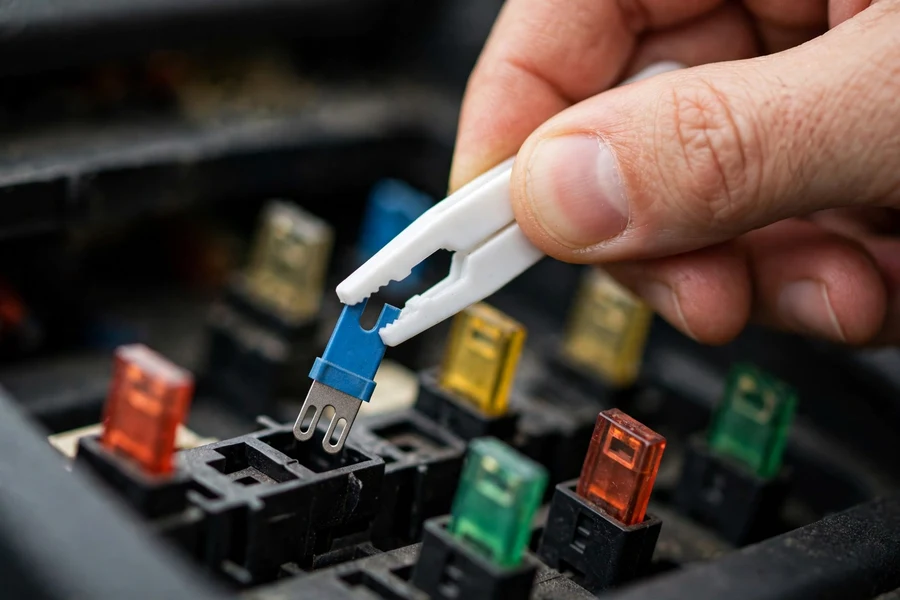
All three generations use color-coded blade fuses, and the color tells you the rating at a glance. Buy the same physical size and the same rating — a fuse that fits but is rated higher will not protect the circuit.
| Fuse type | Size | Typical ratings in the 3 Series | Where you find them |
|---|---|---|---|
| Mini blade (ATM/APM) | Smallest | 5A, 7.5A, 10A, 15A, 20A | Most everyday circuits: sockets, horn, fuel pump control, modules |
| Standard blade (ATO/ATC) | Medium | 20A, 30A, 40A | Heavier loads: windows, wiper control, seat modules, 12V sockets (F30/G20) |
| Maxi blade | Large | 40A, 50A, 60A | Big consumers: blower motor, DSC module, engine cooling fan |
| High-current fusible links | Bolted strips | 50A–250A | Rear distribution panels (E90 trunk panel, F30 FL1–FL5); not routine DIY replacements |
Standard color coding applies: tan/orange is 5A, brown is 7.5A, red is 10A, blue is 15A, yellow is 20A, green is 30A, and orange (large) is 40A. If the fuse you pull out is a different color from what the card specifies, a previous owner installed the wrong rating — replace it with the correct one and investigate why it was changed.
How to test and replace a fuse
Difficulty: easy. Cost: a few dollars for a mixed box of blade fuses; a basic multimeter costs about the same as a takeaway coffee and is worth owning if you do any DIY. Allow ten minutes the first time, five once you have done it.
Step 1 — Visual check
Pull the suspect fuse with the plastic puller and hold it up to the light. A good blade fuse has an unbroken metal strip visible through the translucent plastic body. A blown fuse shows a break, gap, or blackened/scorched mark in that strip. If the plastic body itself is melted or discolored, the circuit overheated — do not just replace the fuse; read the “repeatedly blowing” section below.
Step 2 — Multimeter test (the reliable way)
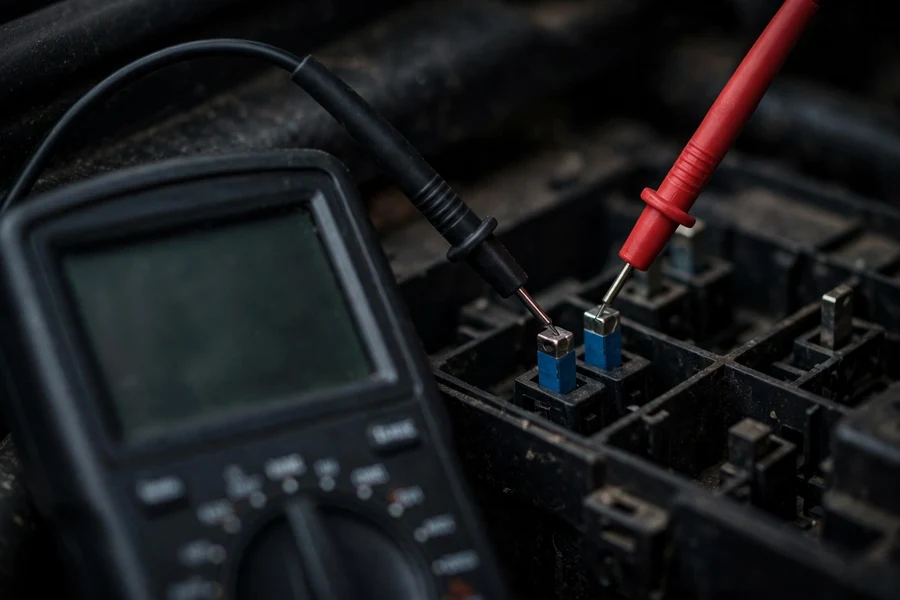
Some fuses fail in ways you cannot see. A multimeter removes all doubt, and you do not even need to remove the fuse on many boxes:
- Set the multimeter to continuity mode (the diode/beep symbol) or to resistance (ohms).
- With the ignition off, touch one probe to each of the two small exposed metal test points on top of the fuse. You can do this with the fuse still seated in the box.
- Continuity mode: a beep means the fuse is good; silence means it is blown. Resistance mode: near-zero ohms is good; infinite/overload reading is blown.
Step 3 — Replace with the exact same rating
This is the safety rule the owner’s manual prints in bold, and it is non-negotiable: replace a blown fuse only with a fuse of the same amp rating and the same physical type. A higher-rated fuse will not blow when it should, which means the wiring becomes the fuse — and wiring on fire is how electrical faults turn into insurance claims. Never bridge a fuse with foil or wire, and never “temporarily” fit a bigger one.
- Confirm the ignition and the affected circuit are off.
- Match the replacement fuse’s rating to the number on the fuse card (and the color code above).
- Push it firmly into the same slot until it seats fully.
- Test the component. Then recheck the fuse after a day or two of normal use — an early re-blow points to an underlying fault.
What a repeatedly blowing fuse means
A fuse that blows once after years of service is usually just age or a momentary overload (a phone charger shorting in the 12V socket is the classic). A fuse that blows again immediately or within days is telling you something, and the message is one of these:
- A short circuit. Damaged, chafed, or pinched wiring is touching ground — common where harnesses pass through body panels or near moving parts like seats and trunk hinges.
- A failing component. A fuel pump, blower motor, or window regulator drawing more current than it should as it wears out will keep popping its fuse. If your fuel pump fuse keeps going, read our guide on why a 3 Series won’t start before throwing parts at it.
- Water intrusion. On the E90, a clogged cowl drain can soak the electronics box area; corrosion there causes exactly the kind of intermittent shorts that eat fuses.
- The wrong fuse was installed before. A lower-rated fuse than specified will blow under normal load. Check the card, not the fuse that was in there.
If a new correct-rated fuse blows straight away, stop replacing it. Each blown fuse is a symptom, and continuing to feed the short risks damaging the control module behind the fuse — a far more expensive repair than the wiring fault itself. At that point the car needs proper electrical diagnosis. Repeated unexplained electrical issues can also show up as battery drain or check engine light faults, so note any other symptoms for the technician.
One related tip: if you are pulling fuses to chase a parasitic drain, be aware the car needs time to fall asleep before your readings mean anything, and disconnecting the battery entirely will reset adaptations — our battery registration guide and jump-start guide cover the battery-side precautions.
Fuse box FAQ
Where is the fuse box on a BMW 3 Series?
It depends on the generation. On the E90 (2006–2013) the main fuse box is behind the glove compartment. On the F30 (2012–2018) it is in the luggage compartment on the right side under the floor cover, with a second box in the engine compartment. On the G20 (2019–present) there are three: behind the passenger footwell panel, in the engine compartment, and in the right side of the trunk. Each generation also has high-current distribution fuses near the battery.
Which fuse is for the cigarette lighter / 12V socket?
On the E90 it is F8 (20A) in the glovebox fuse box; on the F30 it is F69 (20A) in the front engine-compartment box; on the G20 it is F273 (20A) in the rear trunk box. These were verified against owner’s-manual-sourced diagrams, but assignments shift by year and options, so confirm the number on your car’s paper fuse card before swapping anything. The 12V socket fuse is the single most commonly replaced fuse on all three generations — usually killed by a faulty charger or an overloaded inverter.
What if my fuse card is missing?
Do not work from a random internet diagram — fuse assignments change by model year, engine, and options, and a wrong-year diagram will send you to the wrong slot. Your owner’s manual contains the assignment tables for your model year, and a BMW dealer’s parts counter can print the correct card for your VIN. Until you have one of those, treat every fuse number you find online as unverified.
Can I use a higher amp fuse temporarily?
No — not even temporarily. The fuse is sized to protect the wiring, not the component. A higher-rated fuse lets fault current flow until the wire itself overheats, which can melt insulation and start a fire. Always replace with the exact same amp rating and physical fuse type. If the correct fuse keeps blowing, the circuit has a short or a failing component that needs diagnosis, not a bigger fuse.
Why does my fuse keep blowing after I replace it?
A repeat blow means the underlying fault is still there: a short circuit from chafed or pinched wiring, a component drawing too much current as it fails (fuel pump, blower motor, and window regulators are common culprits), water intrusion corroding connections, or a previously installed wrong-rated fuse. Stop replacing the fuse and have the circuit diagnosed — continuing to feed a short risks destroying the control module behind the fuse, which costs far more than the wiring repair. For related electrical troubleshooting, see our TPMS reset guide and the complete 3 Series guide.