BMW Coolant Bleed Procedure: Self-Bleed in 12 Minutes
Short answer
The BMW coolant bleed procedure uses the car’s electric water pump to purge air with the engine off: switch the ignition on (engine off), turn on the low-beam headlights, set the heater to maximum with the blower on its lowest speed, then floor the accelerator for about 10 seconds. The pump runs a self-bleed cycle of roughly 12 minutes — you’ll hear it cycle on and off with coolant gurgling at the expansion tank. Keep the tank cap closed during the cycle; when the pump stops, top the level to the maximum mark and check for leaks. The routine is the same idea on E90, F30 and G20 cars, with small per-generation differences covered below.
On a modern BMW 3 Series there is no belt driving the water pump — which changes how you bleed the cooling system. The pump is electric and commanded by the engine computer (DME), so BMW built a self-bleed routine into the car: a set sequence of ignition, climate and pedal inputs wakes the pump to run a timed purge cycle with the engine cold and off. No scan tool, no vacuum pump, no special equipment — on E90 and F30 cars, at least. Once you’ve watched it push air bubbles out of the expansion tank, you’ll never bleed a cooling system the old way again.
This guide covers the exact verified sequence for every 3 Series generation — E90, F30 and G20 — where the per-generation differences are real (F30’s hazard lights and ECO PRO quirk, G20’s dual-circuit layout) and where they aren’t. Plus the tools checklist, honest costs, the coolant spec you must not get wrong, and the symptoms of a bleed that didn’t take.
In this guide
- Why bleeding matters on an electric-pump BMW
- Tools, parts, and the right coolant
- What it costs: DIY vs shop
- Bleed method by generation and engine
- Coolant capacities: what we could verify
- Find your exact bleed steps
- Before you start: prep and safety
- The full step-by-step DIY
- G20 (B46/B58) notes: the dual-circuit wrinkle
- 8 common bleeding mistakes
- Signs your bleed failed
- FAQ
Why bleeding matters on an electric-pump BMW
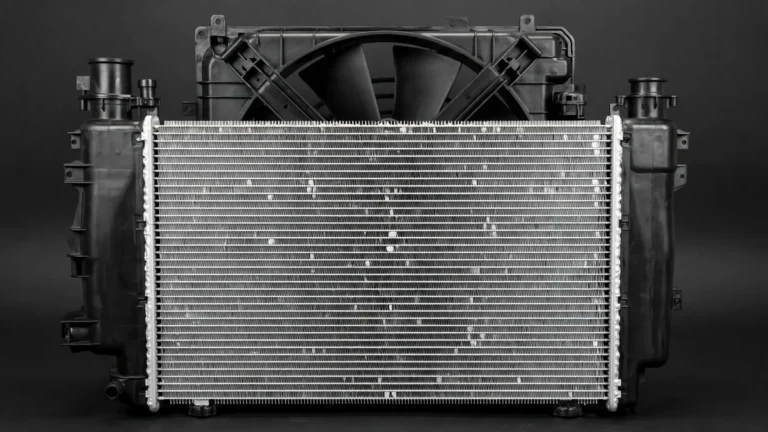
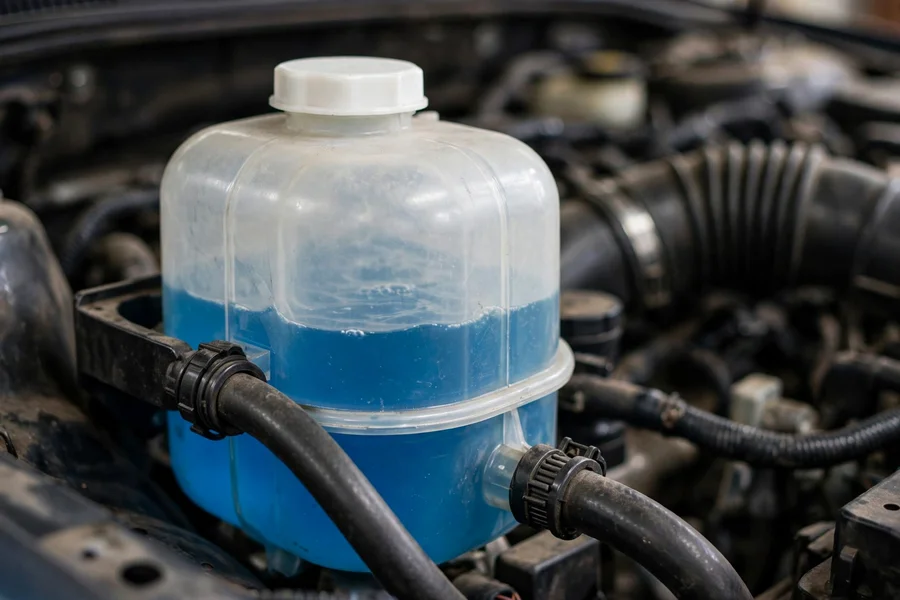
On older BMWs, belt-driven bleeding was physical: run the engine, squeeze hoses, crack a bleed screw, dodge hot coolant. The 3 Series moved to an electric water pump with the E90’s N52, and the pump only runs when the DME tells it to — good news and bad news in one package. Good news: the DME can run the pump with the engine off, circulating coolant through block, heater core and radiator on a timer — a controlled purge no human could replicate by squeezing hoses. Bad news: pour coolant in and drive off without bleeding, and the pump happily circulates a coolant-and-air mix.
Trapped air creates hot spots the temperature sensor can’t always see, and it collects in the heater core first — hence the classic symptom: a gauge that looks fine while the cabin blows lukewarm air. Air also lets the electric pump run partially dry, a documented trigger for the pump’s reduced-power “dry run” fault code (2E83). Our water pump failure symptoms guide covers a pump that has actually failed; this article is about the cheaper problem of a healthy pump pumping bubbles. After any opening of the system — pump, thermostat, hoses, radiator, expansion tank or a flush — a proper bleed is not optional.
Tools, parts, and the right coolant
The bleed itself needs nothing the car doesn’t already have, but have the right consumables on hand first. Discovering mid-bleed that you’re short half a gallon of coolant or that your battery can’t finish the cycle kills the job.
| Item | What to get | Why it matters |
|---|---|---|
| Correct BMW coolant (concentrate) | E90/F30: BMW blue (G48-type). G20 2019+: BMW HT-12 green | The two specs must never be mixed. Get the full breakdown in our BMW 3 Series coolant type guide. |
| Distilled water | 1–2 gallons, distilled only — never tap water | 50/50 mix with concentrate. Tap water minerals cause corrosion and scale inside the radiator and heater core. |
| Battery charger or maintainer | A basic 4–10 amp smart charger on the under-hood jump points | The 12-minute pump cycle runs entirely on battery. A weak battery can die mid-bleed or refuse to start the cycle. |
| Funnel and measuring jug | Clean funnel that fits the expansion tank neck | Lets you pour slowly without spilling — spilled coolant is slippery, toxic to pets, and a pain to rinse off. |
| Expansion tank bleeder screw | One spare plastic screw (a few dollars) | E90/F30 tanks have a small plastic bleed screw that gets brittle with heat cycles. A spare avoids a snapped screw ruining your afternoon. |
| Gloves and safety glasses | Nitrile gloves, eye protection | Coolant is poisonous and irritates skin. Always work on a cold engine — never open a hot cooling system. |
| Drain pan and rags | Large low-profile pan if you’re draining first | Catch every drop. Spilled coolant is an environmental hazard and lethal to animals. |
On coolant choice — the single most expensive mistake on this list: E90 and F30 cars take the traditional BMW blue coolant, while G20 cars from 2019 onward were factory-filled with green HT-12. Topping a green system with blue (or vice versa) compromises the corrosion package it was designed around. When in doubt, match what’s in the tank and read the coolant type guide before buying.
What it costs: DIY vs shop
Bleeding is one of the cheapest jobs on a 3 Series — you pay for fluids, not labor. Typical US ranges for 2026 are below; regional pricing varies.
Bleed method by generation and engine
The core routine — ignition on, engine off, heat max, blower low, accelerator held — is shared across all three generations: BMW’s technical instructions describe the same sequence from the E90’s N52 through the F30’s N20/N55. The differences are the details that trip people up: lights, driving mode, pedal-hold time, and on the G20, a second cooling circuit. The picker below gives your exact steps; this table is the at-a-glance reference.
| Generation / engines | Bleed method | Key differences to know |
|---|---|---|
| E90 (2006–2011) N52, N54, N55 | Electric-pump self-bleed: ignition ON, engine OFF, accelerator floored ~10 s, ~12-min pump cycle | Turn on the low-beam headlights first — without them, the ignition (terminal 15) can switch itself off mid-cycle and interrupt the bleed. Keep the tank cap closed during the cycle. |
| F30 (2012–2018) N20, N26, N55 | Same electric-pump self-bleed: ignition ON, engine OFF, accelerator floored 10 s, ~12-min cycle | Switch on the low beams and the hazard-warning lights. The driving experience switch must not be in ECO PRO. |
| F30 LCI 330i/320i (2016–2018) B46, B48 | Same pedal-triggered self-bleed; owners report 8–12 min cycles | B-series engines do have an electric pump. Turn off auto climate, set heat to max manually, fan to lowest, and leave the car undisturbed — opening doors can wake modules and interrupt the routine. |
| G20 330i (2019+) B46 | Pedal-triggered self-bleed, ~11–12 min cycle | Uses green HT-12 coolant — never mix with blue. Verify against BMW TIS for your model year; some cars need service-mode activation. |
| G20 M340i (2019+) B58 | Dual-circuit bleed via diagnostic/service routine; low-temp circuit has its own small tank | BMW’s factory method uses a vacuum filler and bleeds both circuits. The pedal routine is widely reported to work, but a shop with a vacuum filler is the safer call here. |
Coolant capacities: what we could verify
Coolant capacity figures are hard to pin to one authoritative number per engine — BMW ties capacity to exact model, transmission and equipment, and forum figures conflict. Below is what we could verify against BMW technical documents or TIS-derived sources; where we couldn’t, we say so — your owner’s manual is the authority.
| Engine | Fitted to | Total system capacity | Status |
|---|---|---|---|
| N55 | E90 335i (2011), F30 335i/435i | ~10 liters (~10.5 qt) | Verified via TIS-derived source |
| B58 | G20 M340i (both circuits) | ~10 liters total across both circuits | Owner-reported; verify in manual |
| N52 / N54 | E90 325i/328i/330i/335i (2006–2010) | See owner’s manual | Not verified to our standard |
| N20 / N26 | F30 320i/328i | See owner’s manual | Not verified to our standard |
| B46 / B48 | F30 LCI 330i/320i, G20 330i/320i | See owner’s manual | Not verified to our standard |
Practical buying advice: for a full drain-and-fill, get two gallons of the correct concentrate and two gallons of distilled water — mix 50/50 with margin to spare; running short mid-fill is how air gets in. For a top-up bleed after a hose or tank replacement, one gallon of each is usually plenty.
Find your exact bleed steps
Pick your generation and engine for the tailored sequence, coolant spec, and capacity — or an honest “check your manual” where we couldn’t verify a figure.
Bleed-step finder
Select your generation and engine for the exact self-bleed sequence.
Choose your generation and engine to see the exact bleed sequence, coolant spec, and capacity.
Before you start: prep and safety
Difficulty: easy to moderate — if you can pour liquid into a funnel and follow a sequence, you can do this. Time: 30–60 minutes total; the 12-minute pump cycle is the fixed cost, plus prep and the cool-down level check. One hard safety rule, non-negotiable: never open a hot cooling system. Work on a stone-cold engine — ideally a car that has sat overnight. Hot coolant under pressure erupts from the expansion tank and causes severe burns.
- Work cold. If the car has been driven today, wait 4–6 hours. Touch the upper radiator hose: warm at all means you’re too early.
- Park level. A level surface gives an accurate coolant level reading. Some DIYers raise the nose slightly to coax air toward the tank — harmless, but BMW’s procedure doesn’t require it.
- Hook up the charger. Clip a charger or maintainer to the under-hood jump points (never the trunk battery posts directly — that can damage the junction box). The pump cycle draws real current for 12 minutes with the engine off; a marginal battery can die mid-cycle or refuse to start the routine. If you’ve seen the increased battery discharge warning recently, charge fully first.
- Close the doors, kill the radio. Once the cycle starts, leave the car alone — opening doors or windows wakes control modules and can interrupt the routine, especially on F30 and G20 cars.
- Have coolant mixed and ready. Pre-mix your 50/50 concentrate and distilled water in a clean jug before you start. Fumbling with mixing mid-cycle wastes time while the pump is running.
- Know your tank layout. E90 and F30 have one expansion tank with the filler cap and a small plastic bleed screw beside it. G20 B58 cars add a second, smaller tank for the low-temperature circuit — find both first (see G20 notes).
The full step-by-step DIY
This is the complete procedure for E90 and F30 cars (N52, N54, N55, N20, N26), which share the verified BMW technical sequence. G20 owners: use the picker above for your model-year specifics. Read the whole sequence once before touching anything — mid-pump-cycle is a bad time to discover you missed a step.
Step 1 — Fill the system first
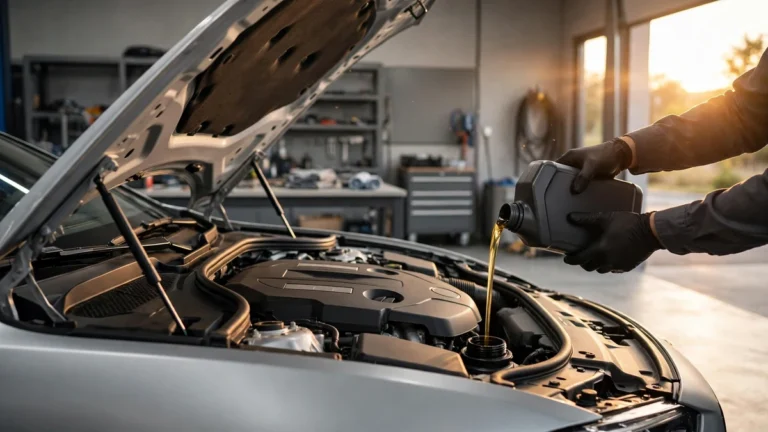
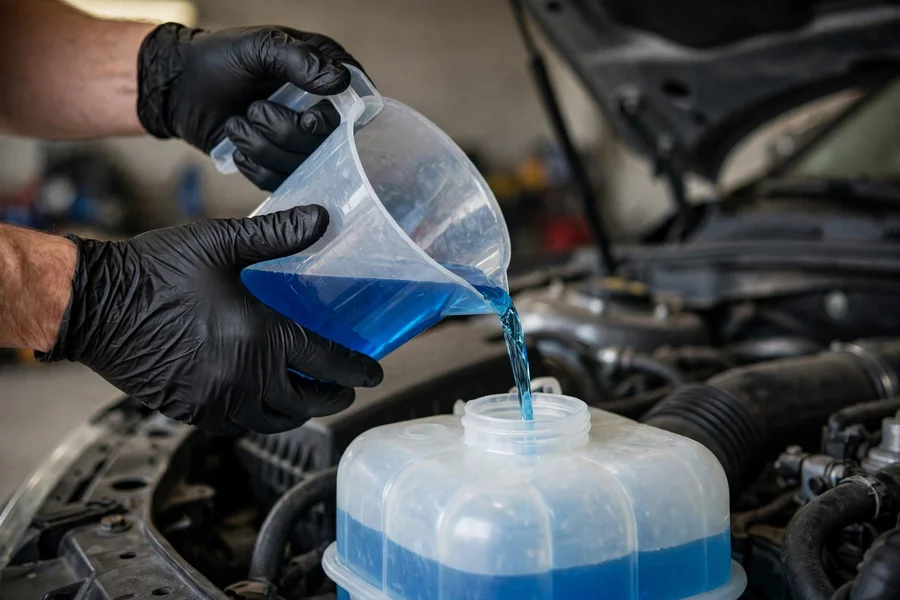
If you’ve drained the system, refill before bleeding. With the engine cold, open the expansion tank bleeder screw a turn or two, then pour your 50/50 mix in slowly until bubble-free coolant seeps from the bleed screw. Snug the screw back down gently — these plastic screws snap if overtightened — and bring the tank to the maximum mark. Close the cap until the arrows line up. For a simple top-up after a minor repair, just verify the level sits between minimum and maximum.
Step 2 — Ignition on, engine off
Connect the battery charger. Get in and, without touching the brake (or clutch on manuals), press the Start button — with the fob inserted on key cars. The dash lights up but the engine stays off: exactly the state you want.
Step 3 — Lights on
Switch on the low-beam headlights — the step everyone skips. With the lights off, the ignition (terminal 15) can switch itself off after a few minutes to save the battery, killing your bleed halfway through. On F30 cars, also switch on the hazards.
Step 4 — Climate to max heat, lowest fan
Set the temperature to maximum on both sides and drop the blower to its lowest speed. This opens the heater valve fully so the pump pushes coolant and trapped air through the heater core. On F30 cars, keep the driving switch out of ECO PRO; on B46/B48 cars, turn off automatic climate first and set everything manually.
Step 5 — Floor the accelerator for 10 seconds
Press the accelerator all the way to the floor and hold it for about 10 seconds, then release. Nothing dramatic happens — no dashboard message, no chime. The DME has accepted the command. If the pump begins cycling within a minute, you’re in business.
Step 6 — Let the pump work (about 12 minutes)
Now wait. Over roughly 12 minutes the electric pump cycles on and off, pushing coolant through the block, radiator and heater core while air migrates to the expansion tank — you’ll hear gurgling at the tank and a faint pump whir that comes and goes. Do not open the expansion tank cap during the cycle. BMW’s instructions are explicit: opening it mid-bleed means starting over. Set a timer and walk away.
Step 7 — Top up and leak-check
When the pump goes quiet for good, the cycle is done. Switch the ignition off, wait a minute, then set the expansion-tank level to the maximum mark — it usually drops as air leaves the system. Inspect every hose connection, the tank, the radiator end tanks and the pump area for weeping or drips: a bleed doubles as a free leak inspection.
Step 8 — Verify with a drive and heat cycles
Start the engine and let it reach full operating temperature with the heater on. Confirm strong, hot air from the vents — weak heat means remaining air. Take a 15–20 minute drive with the gauge dead center. Cool overnight, recheck the tank level cold, and top up if needed. A small top-up over the next couple of drives is normal; a low coolant warning is most likely on a cold start — top up, don’t panic. A level that keeps dropping means a leak, not a bleed problem.
G20 (B46/B58) notes: the dual-circuit wrinkle
The G20 complicates the picture in two ways: a new coolant spec and, on the M340i’s B58, a second cooling circuit. The 330i’s B46 runs the familiar single-circuit layout and the pedal-triggered routine works the same way, with one addition — on push-button cars, press the START-STOP button three times quickly (foot off the brake) to activate service mode, and keep the driver’s door closed throughout.
The M340i’s B58 splits cooling into a high-temperature circuit (engine) and a low-temperature circuit (turbocharger and charge-air cooling), each with its own expansion tank — the low-temp one is smaller. BMW’s factory method for these engines is vacuum filling: fill under vacuum, then run the roughly 11-minute diagnostic bleed routine so both circuits purge. Owners report the pedal routine working on G20 B58s too, but this is the one engine where a shop with a vacuum filler is the safer call for a first-timer. An incompletely bled turbo circuit risks localized overheating around the turbo — not just weak cabin heat.
And the coolant rule bears repeating because G20s are where it bites: these cars left the factory with green HT-12, so a previous owner or quick-lube top-up with blue leaves you with a mixed system. The fix is a full drain, flush and refill with the correct green coolant — covered in our coolant type guide. Bleeding correctly is pointless if the fluid itself is wrong.
8 common bleeding mistakes
- Opening the system hot. The one that sends people to the emergency room. The expansion tank cap stays on until the engine is stone cold — no exceptions.
- Opening the cap mid-cycle. Venting pressure during the bleed interrupts the routine and you start the 12 minutes over.
- Skipping the headlights. No low beams, no guaranteed terminal-15 power. The ignition times out, the pump stops halfway, and you wonder why the bleed “didn’t work.” F30 adds hazard lights to the same step.
- Leaving the F30 in ECO PRO. The driving experience switch must not be in ECO PRO — the DME won’t run the routine properly. Comfort or Sport is fine.
- Weak battery, no charger. The top reason the pedal trick “does nothing.” Twelve minutes of pump, lights and modules on a tired battery won’t start the cycle — or leaves you with a dead car. Charge first.
- Wrong or mixed coolant. Blue in a green car or vice versa, or any universal “all makes” coolant. Match the factory spec for your generation and never mix colors.
- Snapping the bleeder screw. The little plastic screw on the expansion tank gets brittle with age and heat. Turn it gently, and keep a spare — it costs a few dollars and saves the job.
- Bleeding once and calling it done. Many owners run the cycle twice, topping up between runs, then recheck the level cold over the next few drives. The second cycle is cheap insurance.
Signs your bleed failed
A successful bleed is boring: the gauge sits centered, the heater blows properly hot, the tank level stays put, and the engine bay stays dry. A failed one announces itself quickly — usually on the first drive:
- No cabin heat (or heat that fades at idle). The classic trapped-air signature: air collects in the heater core first, so the vents blow lukewarm while the gauge looks normal. Re-bleed.
- Gurgling or sloshing behind the dash. Air moving through the heater core. Some gurgling during the bleed cycle is normal; gurgling on the drive home is not.
- Temperature gauge climbing or warning lights. An air pocket at the thermostat or coolant temp sensor can spike the gauge fast. If you get a yellow-then-red temperature warning, shut the engine off immediately and re-bleed once everything is cold.
- Coolant level that keeps dropping. A small top-up over the first couple of heat cycles is normal. A level that falls repeatedly after that means a leak — pressure-test the system instead of bleeding a third time.
- The pump running dry. A pump starved of coolant by a big air pocket can log the 2E83 dry-run fault. If a scan shows it right after a coolant service, suspect the bleed before the pump — the water pump symptoms guide explains how to tell the difference.
Bleeding is maintenance, not a repair interval. BMW treats coolant as a long-life fill — our 3 Series maintenance schedule covers when a drain-and-fill makes sense — but any time the system is opened for a repair, the bleed above finishes the job properly.
FAQ
Can I bleed the cooling system with the engine running?
No — not on any electric-pump 3 Series (E90, F30, G20). The self-bleed routine runs with the ignition on and the engine off: the DME drives the electric pump on a timer while the engine stays cold and stationary. Starting the engine defeats the routine and pressurizes the system while you’re purging air from it.
Why doesn’t anything happen when I hold the accelerator down?
Almost always one of five things: a weak battery (charge it — the cycle needs adequate voltage), the low-beam headlights aren’t on (ignition timed out), your foot was on the brake, the F30’s driving experience switch is in ECO PRO, or a door is open and modules keep waking. Fix the inputs and retry; the pump should begin cycling within a minute of the pedal hold.
Do I need a vacuum coolant filler?
Not for E90 or F30 cars — the pedal-triggered self-bleed is BMW’s own documented procedure. For the G20 M340i’s B58, BMW’s factory method is a vacuum fill because of the dual-circuit layout; the pedal routine is widely reported to work too, but a vacuum fill is the safer choice on that engine.
How do I know the bleed actually worked?
Three checks: the heater blows properly hot at idle and at speed, the temperature gauge sits dead center on a 15–20 minute drive, and the cold coolant level stays at the maximum mark over the next few days. A small top-up after the first couple of heat cycles is normal; repeated drops mean a leak, not a bleed problem.
Can I mix blue and green BMW coolant?
No. E90 and F30 cars use the blue (G48-type) coolant; G20 cars from 2019 use the green HT-12 formula, and mixing the two corrosion packages degrades the protection the system was designed around. A mixed system needs a full drain, flush and refill with the correct spec — see our BMW 3 Series coolant type guide.