BMW 3 Series Blower Motor Not Working? 4 Symptoms, 4 Fixes
Short answer: A BMW 3 Series blower motor not working is most often a failed final stage unit (E90) or blower regulator (F30) — not the motor itself — especially if the fan only works on high, is intermittent, or keeps running after you shut the car off. Check the blower fuse first, then measure voltage at the motor connector with the fan commanded on: voltage present but no spin means the motor is dead, while no voltage points to the FSU/regulator or its wiring. Regulator replacement is a straightforward DIY; the motor itself is a bigger job.
How the blower system actually works
Before you replace anything, it helps to know which part does what. Your 3 Series does not use a simple on/off switch for the cabin fan. The IHKA climate control panel on the dashboard sends a small control signal — roughly 0 to 8 volts DC — to an electronic speed controller, which then feeds the correct amount of power to the blower motor itself. That speed controller is the part that fails most often, and BMW calls it different names depending on the generation.
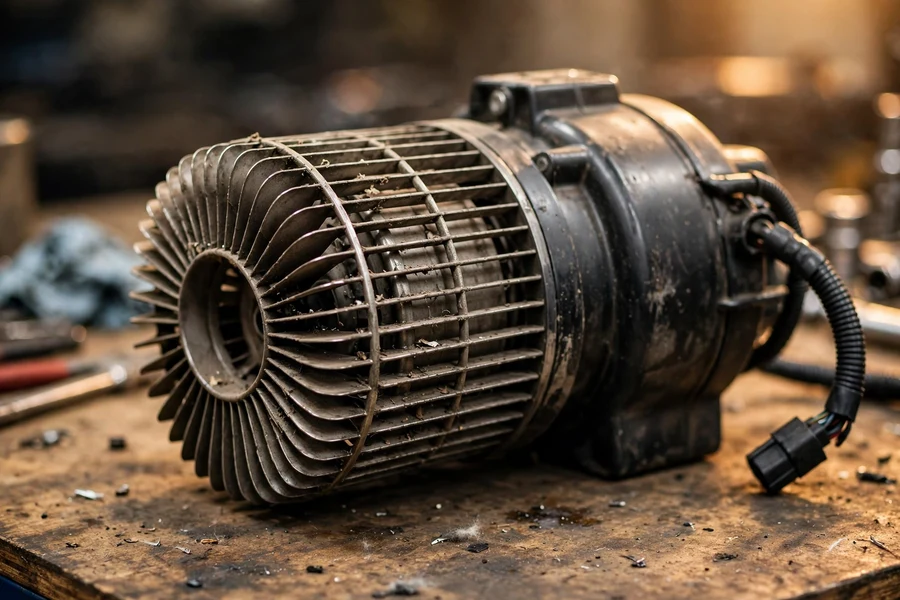
On the E90 generation (2006–2011), the controller is the final stage unit, widely known as the FSU (or FSR, final stage resistor — though it is not actually a resistor pack; it is an electronic module using MOSFET transistors in linear mode, which is why it runs hot and eventually cooks itself). It sits in the passenger footwell, mounted to the blower motor housing, where the passing airflow is supposed to keep it cool. On the F30 generation (2012–2018), BMW renamed the same job to the blower motor regulator (sometimes called the output stage). It does the same thing — translates the IHKA’s control signal into variable motor speed — and fails in similar ways, though owner-reported patterns suggest it is somewhat less failure-prone than the E90’s FSU. Our E90 vs F30 comparison covers the broader generational differences if you are deciding which chassis you own or shop for.
The failure modes matter because each one produces a different symptom. When the FSU’s or regulator’s transistors fail, they typically fail switched fully on — which is why one of the classic symptoms is a fan that keeps blowing after you have removed the key and locked the car. Left overnight, that will flatten the battery and can trigger the increased battery discharge warning or leave you with a battery that keeps dying. A dying blower motor, by contrast, usually announces itself with noises — chirping, squealing, or a rattle that changes with fan speed — or by working fine when cold and quitting once it warms up, as worn brushes lose contact with heat expansion.
Diagnose by symptom: the tables
Start with the symptom that matches your car. These tables rank the most likely causes first for each generation, based on owner-reported failure patterns and BMW’s own service information. Work the “first check” column before buying parts.
Fan completely dead — no airflow at any speed
| What you notice | E90 most likely cause | F30 most likely cause | First check |
|---|---|---|---|
| Nothing at any speed, but the climate panel lights up and responds | Blown Fuse 88, failed FSU, or dead motor | Blown blower fuse (check fuse leaflet), failed regulator, or dead motor | Fuse first, then voltage at the motor connector |
| Nothing, and the climate panel is dark or frozen | IHKA power supply issue (Fuse 77 circuit) or failed panel | IHKA / junction box electronics | Fuse 77 on E90; scan for IHKA fault codes |
| Fan runs with the key out and drains the battery | FSU transistors failed switched-on | Regulator failed switched-on | Pull the blower fuse immediately, then replace the FSU/regulator |
Weak airflow at all speeds
| What you notice | E90 most likely cause | F30 most likely cause | First check |
|---|---|---|---|
| Weak everywhere, even on max | Clogged cabin microfilter | Clogged cabin microfilter | Pull the filter, hold it to a light |
| Airflow fades as you raise the speed | Worn motor brushes or voltage drop | Worn motor or regulator struggling | Voltage at the motor connector on max |
| Weak from some vents only, strong from others | Blend-door actuator or duct issue — not the blower | Same — actuator or duct issue | Listen for clicking actuators behind the dash |
Only works on high (or stuck at one speed)
| What you notice | E90 most likely cause | F30 most likely cause | First check |
|---|---|---|---|
| Only max speed works, lower speeds dead | Classic FSU failure | Classic regulator failure | Replace the FSU/regulator — testing rarely needed |
| Fan stuck at one speed no matter the setting | FSU output stage failed | Regulator output stage failed | Same — replace the speed controller |
| Speeds died again shortly after a cheap replacement | Low-quality aftermarket FSU (owner-reported pattern) | Low-quality aftermarket regulator | Fit an OEM or quality-brand part |
Intermittent — works sometimes, cuts out, or delayed
| What you notice | E90 most likely cause | F30 most likely cause | First check |
|---|---|---|---|
| Cuts in and out over bumps or when you touch the dash | Loose connector at the FSU or motor | Loose connector at the regulator or motor | Wiggle-test the connector with the fan switched on |
| Works when cold, dies once warmed up | Worn motor brushes/bearings | Worn motor brushes/bearings | Test voltage at the motor while it is failing, not cold |
| Chirping or squealing that changes with fan speed | Motor bearings failing | Motor bearings failing | Plan a motor replacement — lubrication is a stopgap |
| Up to a minute delay before the fan starts after engine start | Less common; test as intermittent | Faulty blower regulator — BMW issued service action SI B64 07 13 for F30/F31/F32/F34 built September–October 2013 | Check whether your VIN falls in the campaign range; the fix is a regulator replacement |
Interactive: pick your symptom
Blower symptom picker
Choose what your fan is doing and your generation — you get the most likely cause and the single best first test.
Select your symptom above — you will get the most likely cause and the single best first test.
The 5-minute diagnostic order
If you want the shortest path to an answer, work this order. Each step takes a minute or two and rules out a whole category of fault before you spend money on parts.
- Key-off check: lock the car, walk away for a minute, then listen at the vents. Fan still running with no key in the car? Pull the blower fuse now and order an FSU/regulator — diagnosis complete.
- Fuse: check the blower fuse with a multimeter, not just your eyes (Fuse 88 on the E90; use the fuse leaflet on the F30). One blown fuse is a check; two blown in a row means the motor is overloading the circuit — stop replacing fuses and test the motor.
- Filter (weak airflow only): pull the cabin microfilter and hold it up to a light. If no light passes through, no air is reaching the cabin either — replace the filter before touching any electrical part.
- Wiggle test: with the fan switched on, wiggle the connector at the FSU/regulator. If the fan cuts in and out, you have a connection fault, not necessarily a dead part — re-seat it and add dielectric grease.
- Voltage test: probe the motor connector with the fan commanded on. Voltage present but no spin means a dead motor; no voltage means a dead FSU/regulator or its wiring. This is the step that ends the guessing.
FSU vs blower motor: the voltage test that settles it
This is the test that stops the parts-guessing. The chain has three links — IHKA panel, speed controller, motor — and a multimeter tells you exactly which link is broken. You need the fan to be misbehaving while you test: a motor with worn brushes will often spin up fine when cold and only fail once it warms up, so testing a cold motor can give you a false “it is fine.”
Step 1 — Check the control signal. At the FSU/regulator connector, the IHKA sends its speed command on a thin wire (on the E90 this is pin 3, blue/red), measured against ground (pin 4, brown). Owner-tested values run roughly 0 volts for off up to about 8 volts for full speed. If you command different fan speeds and this voltage tracks your commands, the panel and wiring are doing their job.
Step 2 — Check power at the motor connector. The motor itself is fed through thick wires carrying battery voltage (the FSU’s connector has unswitched +12V and ground on the thick wires; the thin wire is only the control signal). With the fan commanded on, probe the motor connector. Voltage present but the motor does not spin? The motor is dead — replace it. No voltage at the motor, but a healthy control signal arriving at the FSU/regulator? The speed controller is dead — replace it. No control signal at all? The problem is upstream: the IHKA panel, its power supply, or the wiring between them.
Step 3 — The two field tests. If the fan is completely dead, try the old cowl tap: with the fan switched on, give the cowl area at the base of the windshield a firm thump with your palm. If the blower sputters to life, the motor’s brushes are worn and the motor is on borrowed time — plan the replacement rather than just the FSU. And for intermittent faults, the wiggle test is genuinely useful: with the fan on, wiggle the connector at the FSU/regulator. If the fan cuts in and out, you have a connector or contact problem, not necessarily a failed part. Dielectric grease and a careful re-seat sometimes buys years.
One caution from collective owner experience: do not condemn a motor just because it spins when you feed it 12 volts directly on the bench. These are brush motors with greaseless bearings, and the classic failure is heat-related — a bench test on a cold motor proves almost nothing. Test under the conditions in which it fails.
Blower fuse locations by generation
A blown blower fuse is an uncommon cause — the fuse usually only blows because the motor is drawing too much current as it dies — but it is a two-minute check, so do it first. Fuse assignments vary by year and equipment, so always confirm against your own car’s fuse diagram before swapping anything.
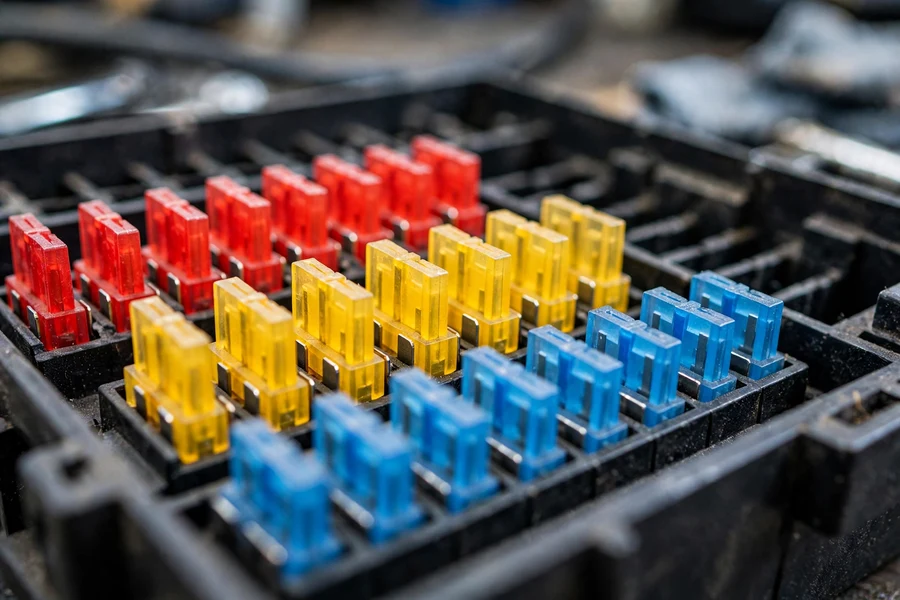
E90 (2006–2011): the blower fuse is Fuse 88, a 40A MAXI fuse in the glovebox junction box, labeled “Blower” on the fuse diagrams for most model years. Note that very early E90s (built before roughly March 2007) use a different fuse numbering scheme — on those cars the blower output stage circuit is protected elsewhere in the panel, so check the leaflet in your glovebox fuse box. The climate panel itself is on a separate low-amperage circuit (Fuse 77, 10A, shared with the glovebox and trunk lights), which is why a dead panel and a dead fan are different faults.
F30 (2012–2018): BMW moved and renumbered fuses across the F30’s production run, and we could not verify a single blower fuse number from a reliable source that holds for every model year — so we will not guess one. Open the trunk fuse box and pull the fuse leaflet stored there (owners report the sheet lives in the trunk box on the F30), then look for the fuse labeled “blower” or “fan motor with output stage” in the front fuse box. That phrasing is what BMW uses on the diagrams. Check it with a multimeter rather than by eye: a fuse can look intact and still be open.
If the fuse is blown, replace it once with the correct rating and watch what happens. If it blows again, the motor is almost certainly drawing excessive current — replacing the fuse repeatedly without addressing the motor risks overheating the wiring. And if your fan runs constantly with the key out, do not wait for a diagnosis: pull the blower fuse now to protect the battery, then replace the FSU/regulator.
When the problem is the IHKA control panel
The IHKA panel is the least likely culprit on an E90 or F30, but it is worth knowing how to rule it out. The telltale sign is in Step 1 of the voltage test: if the panel lights up, accepts your inputs, and yet sends no control signal to the FSU/regulator, the fault is upstream of the speed controller. Before condemning the panel, check its power supply and ground, and have the car scanned — IHKA fault codes and a dead LIN-bus signal to the regulator will show up on a BMW-capable scanner.
On much older BMWs (E36/E46 era), dead climate panels were often a single failed capacitor that owners resoldered, and that fix is well documented on the owner forums. On the E90 and especially the F30, the panel is a more integrated module and board-level repair is rarely practical — a used or rebuilt panel plus coding is the usual route if it is genuinely dead. If your panel works normally in every respect except the fan, though, put the panel at the bottom of your suspect list and work the fuse, FSU/regulator, and motor first.
DIY: replacing the FSU / blower regulator
Difficulty: easy to moderate — about 1 hour, basic hand tools. This is one of the more satisfying BMW DIYs because the part is cheap and the access is reasonable. On the E90 the FSU lives in the passenger footwell, mounted to the blower housing; on the F30 the regulator is in the same neighborhood behind the lower right instrument panel trim (BMW’s own service instructions for the regulator start with removing that trim). You will be working upside-down in a footwell, so a headlamp helps more than any special tool.
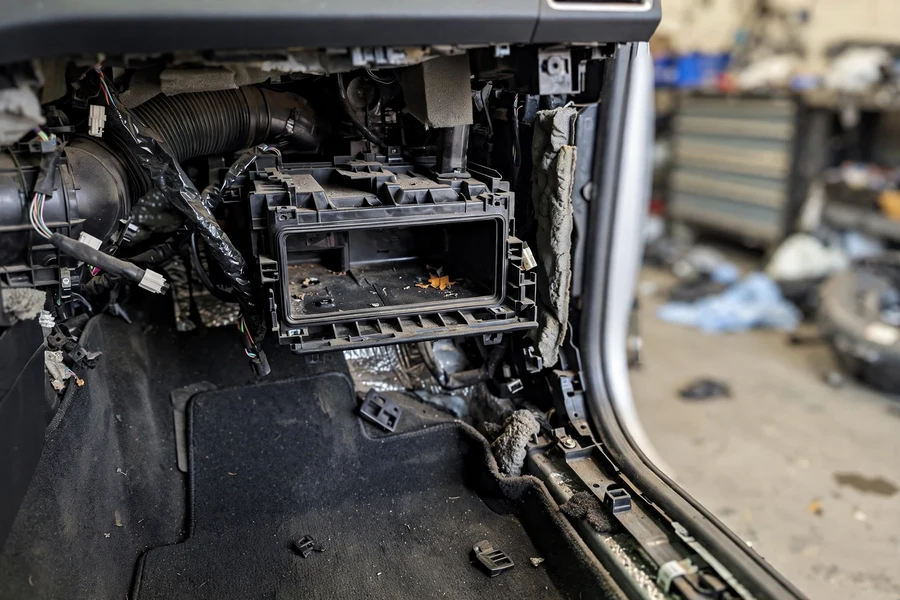
The general procedure: disconnect the battery (you are working around airbag wiring under the dash), remove the under-dash trim panel on the passenger side, locate the speed controller plugged into the blower housing, disconnect its electrical connector, release its retaining clip or screws, and twist or slide the old unit out. Installation is the reverse — the new unit seats into the housing so the heatsink sits in the airflow. Reconnect everything, reconnect the battery, and test every fan speed before refitting the trim. If any speed is still dead, re-seat the connector before suspecting the new part.
Part choice matters here. Owner-reported patterns consistently show that the cheapest no-name FSUs and regulators have a high early-failure rate — some owners end up buying the part two or three times. A quality aftermarket or OEM unit (typical street price $50–$120, versus roughly $180 at the dealer counter) is the sensible middle ground. Because these parts are usually non-returnable once installed, do the voltage test first rather than throwing a part at the symptom.
DIY: replacing the blower motor
Difficulty: moderate — about 2 to 3 hours, patience required. The blower motor sits in the same passenger-footwell area, deeper in the HVAC housing. On the E90 and F30 you do not need to remove the dashboard — a major mercy, since on older BMWs (the E36 especially) this job meant a dash pull and a very large labor bill. You will remove the under-dash trim, the cabin microfilter housing for access, and sometimes the glovebox, then unbolt the motor and maneuver the fan cage out of the housing. Take a photo of the wiring orientation before you disconnect anything, and replace the cabin microfilter while you are in there — it is right in front of you and a clogged filter shortens the new motor’s life.
This is a good DIY if you are comfortable with trim removal and tight working positions, but there is no shame in handing it to an independent BMW shop: most of the cost is labor, and a shop that does these regularly will finish in about half the book time. If your motor died by drawing excessive current, also replace the FSU/regulator at the same time — a struggling motor overheats the speed controller, and owners who replace only one often end up doing the job twice.
Honest repair cost bands
These are typical US cost bands as of 2026 — your region, part brand, and shop rate will move the numbers, but the ratios hold: the speed controller is a cheap part with modest labor, while the motor itself costs more in both parts and labor.
FSU / blower regulator: the part runs $50–$120 for a quality aftermarket or OEM unit (about $180 at the dealer parts counter). DIY total is just the part: $50–$120. An independent shop typically charges $250–$400 all-in, and a dealer $400–$650.
Blower motor: the motor itself runs $150–$300. DIY total is the part plus a cabin filter: $150–$300. An independent shop typically charges $500–$800, and a dealer $800–$1,200.
One more honest note: if a shop quotes you a blower motor replacement and the price looks like a dash-pull job (well over $1,200 at an independent), ask what the labor covers. On the E90 and F30 the motor comes out through the passenger footwell — a quote priced like the older dash-out procedure deserves a second opinion. And if you are evaluating a car rather than repairing one, run the fan through every speed on the test drive; our used 3 Series buying guide and reliability by year breakdown both flag HVAC weak points worth checking. For the full ownership picture, see the complete 3 Series guide and the maintenance schedule (cabin filter intervals included).
FAQ
Why does my BMW blower only work on high?
This is the signature symptom of a failed speed controller — the final stage unit (FSU) on the E90 or the blower regulator on the F30. The module can no longer vary the motor speed, so only the full-speed path works. Replacement of the FSU/regulator fixes it in the large majority of cases; it is a roughly one-hour DIY in the passenger footwell.
Why does the fan keep running after I turn the car off?
The speed controller’s transistors have failed switched fully on, so the motor gets power even with the ignition off. Pull the blower fuse immediately to stop it draining the battery, then replace the FSU (E90) or blower regulator (F30). Do not keep driving it this way — a flat battery is the best-case outcome.
How do I know if it is the FSU or the blower motor?
Measure voltage at the motor connector with the fan commanded on. If voltage is present but the motor does not spin, the motor is dead. If there is no voltage at the motor but the IHKA’s control signal (roughly 0–8V) is reaching the FSU/regulator, the speed controller is dead. Noises like chirping or squealing, and a fan that works cold but quits hot, point to the motor rather than the controller.
Where is the blower motor fuse on a BMW 3 Series?
On the E90 it is Fuse 88, a 40A MAXI fuse in the glovebox junction box (very early cars built before about March 2007 use different fuse numbering — check the leaflet in your fuse box). On the F30 the fuse number varies by model year, so check the fuse leaflet stored in the trunk fuse box and look for the fuse labeled “blower” or “fan motor with output stage.”
Can I drive with a bad blower motor or FSU?
Mechanically, yes — the car will drive normally. But you lose defogging and cabin heating/cooling, which is a safety issue in cold or humid weather, and a failed-on FSU will drain the battery overnight. A failed blower will not damage the engine, so drive to the parts store or shop without worry — just do not ignore a fan that runs with the key out.