BMW Motor Mounts Worn? Vibration Fixes & Costs
Your BMW 3 Series idles like a paint shaker at every red light — yet the moment you pull away, it smooths out and drives perfectly. No warning lights, no loss of power, no strange smell. Most owners assume the worst: a dying transmission, tired injectors, something expensive inside the engine. The real culprit is usually far humbler and far cheaper: two fluid-filled rubber mounts, each about the size of a hockey puck, quietly failing underneath the engine.
Engine mounts are a wear item BMW never puts on a service schedule, which is why they surprise people: they work silently for years, then fail in a way that mimics serious mechanical trouble. This guide covers the symptoms, what BMW’s hydraulic mounts are and why they fail, the two free tests that confirm it, honest repair costs, and whether this is a driveway job.
Short answer
BMW motor mount replacement is the fix when your 3 Series vibrates at idle in Drive but smooths out in Neutral or Park — the signature symptom of failed hydraulic engine mounts. BMW fits fluid-filled hydraulic mounts (not solid rubber) across the E90, F30, and G20 generations for extra refinement; once the fluid leaks out, the mount collapses and idle shake travels straight into the cabin. Budget $600–$1,200 at an independent BMW specialist for both mounts, $120–$300 in parts for DIY (a moderate-to-hard 3–6 hour job that requires supporting the engine), or $1,200–$2,200 at the dealer. Confirm it first with a flashlight check for wet, collapsed mounts plus the two-minute brake-torque test below — both are free.
In this guide
- What motor mounts actually do
- The five symptoms of failed motor mounts
- Hydraulic vs conventional vs solid mounts: what BMW uses and why
- How to diagnose bad mounts at home
- Interactive: is it your motor mounts?
- Replacement difficulty and the procedure, step by step
- What motor mount replacement costs
- The transmission mount: replace it at the same time?
- FAQ
What motor mounts actually do
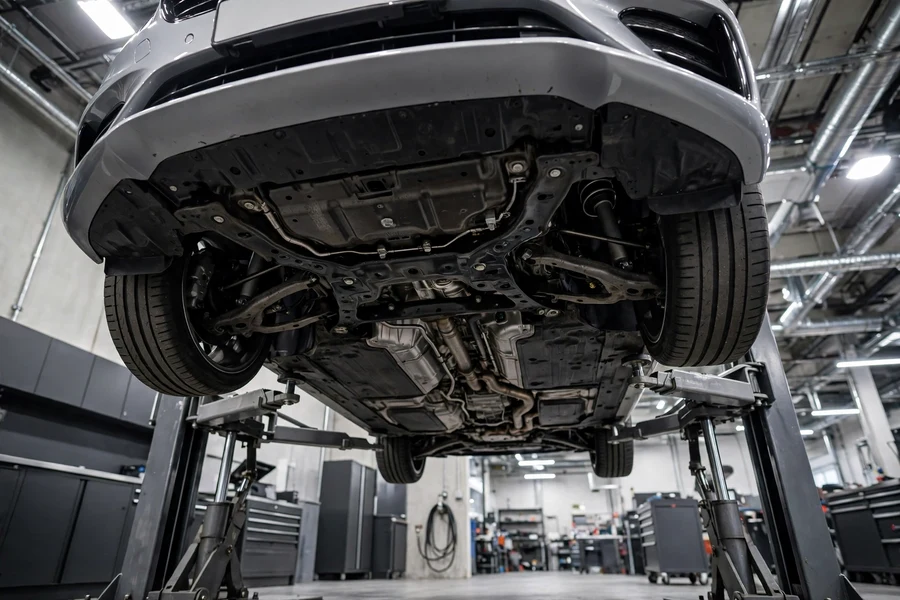
A BMW 3 Series engine doesn’t bolt directly to the car. It hangs between two engine mounts — one per side, sitting on the front subframe — plus a single transmission mount at the back of the gearbox. Together they do two jobs that pull in opposite directions: hold the powertrain firmly against the torque that twists the engine under acceleration, while not transmitting the engine’s vibration into the cabin.
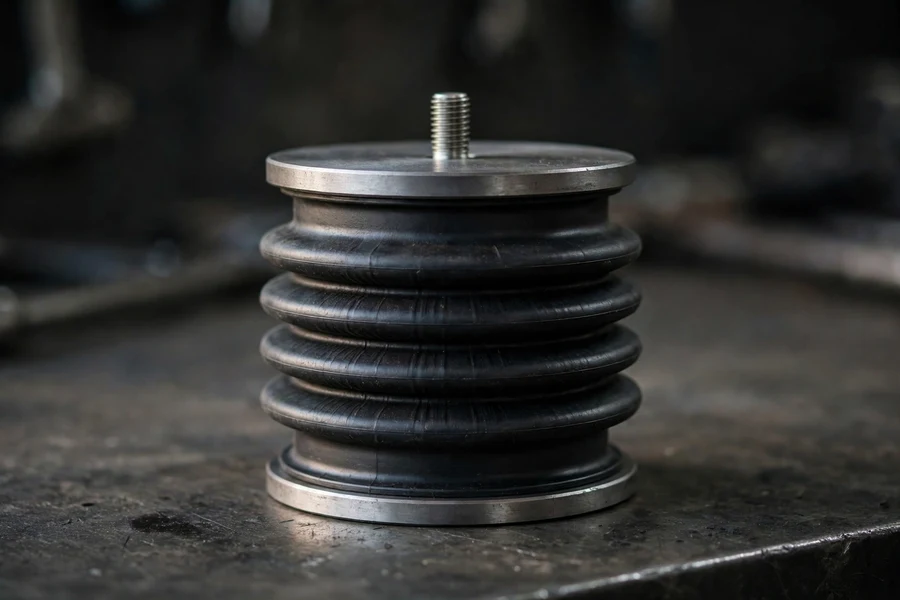
That second job is the hard one. An engine at idle is essentially a controlled explosion machine shaking at roughly 700 revolutions per minute, and a luxury car’s whole promise is that you barely feel it. Rubber alone can only do so much — stiff enough to hold the engine steady under hard acceleration is too stiff to absorb idle shake; soft enough for a glass-smooth idle lets the engine lurch under load. BMW’s answer, used across the E90, F30, and G20 generations, is the hydraulic mount: a rubber shell containing sealed chambers of glycol-based fluid connected by narrow passages. When the engine shakes at idle frequency, fluid is forced back and forth through those passages, and the resistance converts vibration energy into a tiny amount of heat instead of letting it reach the subframe.
The failure mode is almost always the same: heat cycles, vibration, and oil contamination age the rubber until the seal gives up, the fluid weeps out, and the mount becomes a hollow shell. It can then neither damp vibration nor hold its designed height — the engine sags on that side and every idle shake gets a direct path through the subframe into your seat and steering wheel. Because the mount still looks roughly intact from above, owners often chase the symptom through ignition parts and injectors first.
The five symptoms of failed motor mounts
Motor mount failure has a distinctive fingerprint. No single symptom below proves the mounts are gone — but the first two together are close to a diagnosis on their own.
| Symptom | What it feels like | Why mounts cause it |
|---|---|---|
| Vibration at idle, worse in Drive | Steering wheel, seat, and mirrors buzz at stoplights; smooths out in Neutral or Park | Failed mounts can’t damp idle-frequency shake, and Drive loads the engine harder than Neutral |
| Clunk on acceleration or deceleration | A dull thud from the front when you tip into the throttle or lift off | The engine rocks on dead mounts and hits the limit of its travel |
| Visible engine movement | Engine visibly rocks or lurches on startup, shutdown, or when revved in Park | Collapsed mounts no longer locate the engine against torque reaction |
| Fluid leak or collapsed mount | Oily residue on the mount or subframe below it; mount looks squashed | Hydraulic fluid has escaped — the mount is running on an empty shell |
| Vibration follows engine speed, not road speed | Shake present at idle, fades as revs rise; unchanged by steering or road surface | Engine-borne vibration is rpm-dependent; tire and bearing issues are speed-dependent |
1. Vibration at idle, worse in Drive
In Drive with your foot on the brake, the torque converter drags against the brakes — the engine works harder at idle than in Neutral or Park and shakes with more energy. Healthy hydraulic mounts absorb it; dead mounts pass it straight through the subframe into your seat, steering wheel, and mirrors. Shift to Neutral at the same stoplight and the load drops, the shake fades, and the car feels normal again.
That Neutral test cleanly separates mount failure from the lookalikes. A misfire shakes in Neutral too and usually brings a flashing check engine light. Wheel bearings and tire problems don’t shake at idle at all — they’re silent until the car is rolling, as our wheel bearing noise guide explains. If the vibration lives only at idle and retreats the moment you shift out of Drive, the mounts are the prime suspect.
2. Clunk on acceleration or deceleration
Collapsed mounts leave slack in the engine’s mounting — it rocks forward and back before the remaining rubber catches it. Tip into the throttle and torque twists the engine one way with a dull thud; lift off and it rocks back with another. On manual cars this can make gearchanges feel vague, because the whole powertrain moves relative to the shifter. Don’t confuse it with the sharper clunk of worn control arm bushings, which happens over bumps and under braking rather than with throttle changes.
3. Visible engine movement
With the hood open and the engine running, have someone blip the throttle while you watch from the side (never lean over a running engine). A healthy 3 Series engine barely stirs. An engine on collapsed mounts visibly rocks or lurches, and on startup or shutdown the whole powertrain shudders as it settles. This test also catches what the flashlight check misses: a mount can be internally torn and moving excessively while still looking dry from outside.
4. Fluid leak or collapsed mount
Because BMW’s mounts are hydraulic, failure often leaves physical evidence: a dark, oily weep on the mount’s rubber bellows or on the subframe directly beneath it. That fluid is the damping medium — once it’s out, the mount is done, even if the vibration hasn’t become obvious yet. Compare the two sides: a failed mount often sits visibly shorter than its partner, and the engine may list slightly toward the collapsed side. One caution from experience: engine oil leaks (the 3 Series has several famous ones, covered in our oil leak guide) drip down onto the mounts and both destroy the rubber and mimic a mount leak, so trace the wetness upward before you blame the mount itself.
5. Vibration follows engine speed, not road speed
Rev the engine gently in Park: if the vibration rises and falls with rpm while the car is stationary, the source is bolted to the engine — mounts, misfire, or accessory drive. If the shake only appears at certain road speeds regardless of gear, it’s in the wheels, tires, or driveline. Mount vibration has a characteristic envelope: worst at idle, fading as revs climb past 1,500 rpm. A vibration that’s worst at idle and gone at cruise is almost never tires, bearings, or alignment.
Hydraulic vs conventional vs solid mounts: what BMW uses and why
Not all engine mounts are built the same, and the type fitted decides both how the car feels and how the mount fails. Three designs cover everything you’ll encounter on a 3 Series — factory or aftermarket.
| Hydraulic (BMW factory) | Conventional rubber | Solid / polyurethane | |
|---|---|---|---|
| Construction | Rubber shell with sealed fluid chambers and metering passages | Solid rubber block bonded to steel plates | Hard polyurethane or solid rubber, minimal give |
| Vibration isolation | Excellent — fluid damping targets idle-frequency shake | Good, but a compromise between softness and control | Poor — most engine vibration reaches the cabin |
| Engine control under load | Good — stiffens effectively as fluid resists fast movement | Moderate — soft rubber allows more rock | Excellent — engine barely moves |
| Failure mode | Fluid leaks out; mount collapses and goes hollow | Rubber cracks and tears with age | Rarely fails; transmits harshness instead |
| Typical service life | Owner reports commonly cite 80,000–120,000 miles | Similar or slightly longer in mild climates | Effectively the life of the car |
| Best for | Any stock 3 Series — this is what the car was tuned around | Budget replacement; older or high-mileage cars | Track cars where NVH doesn’t matter |
BMW chose hydraulic mounts for one reason: refinement is the product. An inline-six at idle produces exactly the low-frequency shake that fluid damping absorbs and plain rubber merely muffles. The trade-off is finite life — solid rubber would last longer, but the cabin would buzz at every stoplight. It’s the same philosophy behind the fluid-filled bushings in the front control arms: BMW spends the complexity budget where your hands and seat feel the difference.
Should you “upgrade” to solid or polyurethane mounts? For a street-driven 3 Series, the honest answer is no. Poly mounts transform the car’s character — idle vibration and drivetrain shunt become cabin features — in exchange for crisper throttle response that matters on track and barely registers in traffic. With the engine held rigid, every worn bushing downstream gets loaded harder too. Stick with hydraulic mounts for anything with a commute. One more distinction: the transmission mount is conventional rubber, not hydraulic — it lives a cooler, easier life and typically outlasts both engine mounts.
How to diagnose bad mounts at home
Two checks, about fifteen minutes, no tools beyond a flashlight. Do the visual check first — a leaking mount is a failed mount regardless of what the driving test says.
Check 1: the flashlight inspection
With the engine cold, shine a flashlight down each side of the engine bay toward the mounts, which sit low between the engine and the subframe. You’re looking for three things: wetness — dark oily residue on the mount’s rubber bellows or dripped onto the subframe below it; collapse — rubber that looks squashed, cracked, or separated from its steel plates; and asymmetry — one mount sitting visibly lower than the other, or the engine listing slightly to one side. A mount that’s wet with hydraulic fluid has failed even if the car still feels fine — the damping is gone and the vibration is coming.
The view from above is limited, so check from below too: safely raise the front of the car (our complete 3 Series guide covers safe lifting points) with the undertray removed. This is also where you’ll spot the confounding factor — engine oil from a valve cover or oil filter housing leak coating the mounts. Oil destroys mount rubber, so if the mounts are soaked, fix the leak with the mounts or you’ll do this job twice.
Check 2: the brake-torque test
This is the test BMW technicians use to load the mounts on demand, and it takes two minutes in an empty parking lot:
- Find flat ground with clear space ahead and behind the car. Start the engine and let it reach normal idle.
- Press the brake pedal firmly — hard enough that the car cannot move — and keep it planted for the whole test.
- Shift into Drive. With your other foot, gently raise the revs to about 2,000 rpm and hold for two or three seconds, then release.
- Feel and listen: a healthy car strains smoothly against the brakes. Bad mounts produce a clunk or thud as the engine rocks, and you may feel the car lurch.
- Repeat in Reverse. Drive loads one mount hardest; Reverse loads the other — testing both gears tests both mounts.
- Have a helper watch the engine from the side (well clear of the car): excessive rocking or lifting on one side is a failed mount announcing itself.
Safety notes, because this test loads the powertrain hard: never do it with anyone standing in front of or behind the car, don’t hold high revs for more than a few seconds, and don’t repeat it a dozen times — it’s a diagnostic load, not a party trick. If the brakes feel at all uncertain, skip the test and rely on the visual check plus the idle-in-Drive symptom.
Ruling out the lookalikes
Before you order parts, run through the three common misdiagnoses. Misfires shake in Neutral and Park too, usually trigger a check engine light, and feel uneven rather than a steady buzz — see our maintenance schedule for ignition service intervals. Wheel, tire, and bearing issues are silent at a standstill; if your shake needs road speed, it’s not the mounts. Worn control arm bushings clunk over bumps and under braking, not with throttle tip-in. When all four boxes of the mount fingerprint are checked, the diagnosis is about as certain as driveway diagnostics get.
Is it your motor mounts?
Three questions, one verdict — built from the symptom fingerprint in this guide.
Answer all three questions to get a verdict and your next step.
Replacement difficulty and the procedure, step by step
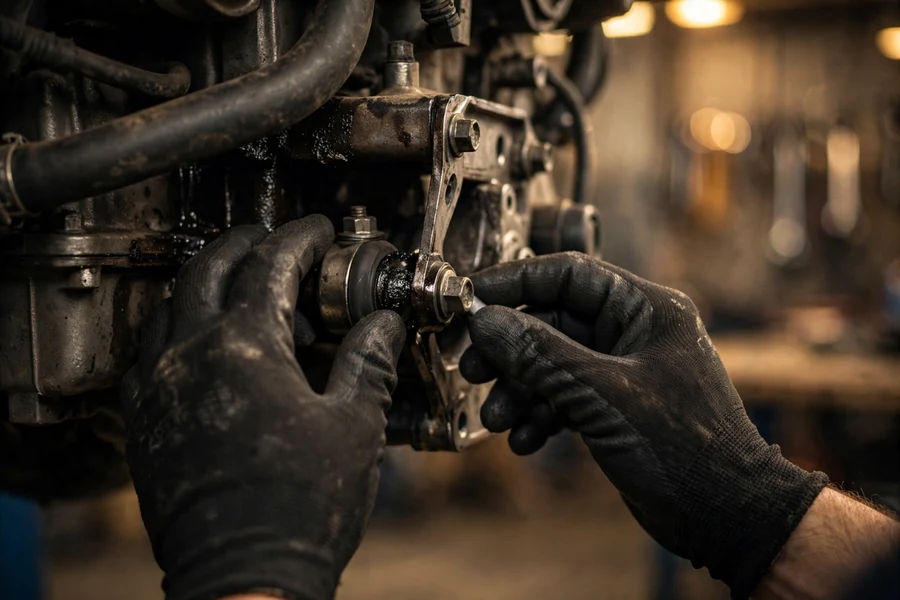
Motor mount replacement on a 3 Series is a moderate-to-hard DIY job — about 3.5 out of 5. The concept is simple (unbolt the old mount, bolt in the new one) but the execution is an access fight: the mounts live low between the engine and subframe, and you must lift the engine a couple of inches to swap them. A shop bills roughly 2–4 hours for both sides; a first-time DIYer should budget 3–6 hours. The hard requirement is safely supporting the engine’s weight — an engine support bar across the strut towers is the right tool; a floor jack with a wood block under the oil pan is the common driveway substitute, used with extreme care.
- 1. Secure the car. Park on flat ground, chock the rear wheels, raise the front onto jack stands, and remove the underbody tray. Never work under a car supported only by a jack.
- 2. Support the engine. Set the support bar (or carefully position the floor jack with a broad wood block to spread the load — never jack directly on the bare oil pan). Take up just enough tension to carry the engine’s weight.
- 3. Do one side at a time. Unbolt the mount from the subframe and from the engine-side bracket. Keeping the other mount bolted up tilts the engine slightly and gives you the clearance you need — unbolting both at once leaves the engine hanging with nowhere to pivot.
- 4. Lift, swap, lower. Raise the engine an inch or two — just enough to free the mount. Slide the old mount out, set the new one in, and lower the engine back onto it. Start all fasteners by hand before tightening.
- 5. Torque to spec and repeat. Tighten every fastener to the vehicle-specific torque value (look it up for your chassis and engine — mount hardware is load-critical and specs vary), then repeat on the other side and refit the undertray.
What makes it harder than it looks: on xDrive models the front axle hardware crowds the driver’s-side mount — the side most DIYers hand to a shop. Heat shields and undertray fasteners seize with age, so penetrating oil the night before pays for itself. And the classic DIY mistake is supporting the engine from the oil pan without spreading the load — a cracked pan turns a $200 parts job into a four-figure one. If any of that makes you uneasy, paying a specialist 2–4 hours of labor is entirely reasonable.
What motor mount replacement costs
Motor mounts are a parts-cheap, labor-moderate repair — the bill is mostly the hours spent reaching them. These are 2026 typical ranges for both engine mounts as a pair, which is how the job should be quoted; if a quote looks suspiciously low, check whether it’s per mount.
Typical cost, both engine mounts (parts + labor, 2026)
Bars show relative position of each range on a $0–$2,200 scale. xDrive models and the G20 tend toward the top of each band.
| Route | Both mounts, fitted | What’s included |
|---|---|---|
| DIY | $120–$300 | Pair of quality hydraulic mounts; your Saturday; engine support bar if you don’t own one |
| Independent BMW specialist | $600–$1,200 | Parts plus 2–4 hours labor; the value sweet spot for most owners |
| BMW dealer | $1,200–$2,200 | Genuine parts, highest labor rate; owner-reported quotes cluster here |
Two honest pricing notes. First, mount quality matters: the cheapest mounts have a reputation for failing early or transmitting more vibration than stock, and this is a miserable job to do twice — buy OE-supplier tier or genuine. Second, always replace both mounts as a pair. They share the same age, heat, and oil exposure, so when one is done the other is close behind — and the extra labor while you’re already set up is minimal.
The transmission mount: replace it at the same time?
The transmission mount is the third leg of the powertrain’s mounting — a single conventional rubber mount at the back of the gearbox — and the “while you’re in there” question comes up on every mount job. Here’s the honest breakdown: unlike the engine mounts it is not hydraulic, it lives in a cooler spot away from exhaust heat, and it typically outlasts both engine mounts. It does not automatically need replacement.
Replace it when inspection says so: rubber torn or separated from its bracket, visible sagging, or a clunk traced to transmission movement. On a high-mileage car where the mount shows its age, doing it with the engine mounts is cheap insurance — the part is inexpensive and the car is already in the air. On a lower-mileage car with a healthy mount, leave it alone. Either way, actually look at it during the job rather than replacing on autopilot.
Frequently asked questions
How do I know if my BMW needs motor mounts?
The telltale combination is vibration at idle in Drive that smooths out in Neutral or Park, plus a fluid leak on a mount or a clunk on throttle tip-in. Confirm with the flashlight inspection and brake-torque test above — a wet, collapsed mount is a failed mount.
Can I drive with bad motor mounts?
For a while, gently, yes — failed mounts won’t strand you tomorrow. But they don’t heal, and excess engine movement stresses everything attached to the engine: coolant hoses, wiring, the exhaust flex section, and fan-to-shroud clearance. Book it within weeks, not seasons.
Should I replace the transmission mount at the same time?
Only if inspection says it’s worn — torn rubber, sagging, or a clunk traced to transmission movement. The transmission mount is conventional rubber rather than hydraulic and usually outlasts both engine mounts. On high-mileage cars it’s cheap insurance while the car is already on the lift; on lower-mileage cars with a healthy mount, leave it alone.
How long does a BMW motor mount replacement take?
An independent specialist typically bills 2–4 hours for both engine mounts; dealers often book the car for the day. DIY takes 3–6 hours the first time, mostly spent on access and safely supporting the engine — the actual unbolt-and-swap per side is quick once you can reach the hardware. xDrive models run longer on the driver’s side.
How long do BMW motor mounts last?
BMW publishes no service interval — they’re a “replace on condition” part — but owner reports commonly put failure between 80,000 and 120,000 miles. Heat, oil leaks on the rubber, and rough roads shorten that; gentle highway miles stretch it. No maintenance extends mount life beyond fixing oil leaks promptly.