BMW Key Fob Not Working? Battery Fix & Key Not Detected
Short answer: When a BMW key fob is not working, the battery is the cause in most cases — but the battery depends on your generation. E90 fobs without Comfort Access use a sealed rechargeable cell that can’t be replaced; E90 fobs with Comfort Access take a CR2032; F30 fobs take a CR2450; G20 fobs take a CR2032 per the driver’s guide. If a fresh, correct battery doesn’t fix it, the ranked suspects are interference, bad fob placement, a failed Comfort Access antenna, or the CAS module.
In this guide
- Three battery systems: why BMW fobs are so confusing
- Which battery does your BMW key fob take?
- Battery finder: pick your chassis and Comfort Access
- How to replace the fob battery (slab fobs)
- E90 diamond key: the sealed rechargeable cell
- Key not detected: causes ranked by likelihood
- Emergency start when the fob won’t talk to the car
- Comfort Access: how it works and how it fails
- Key-related fault codes, decoded
- Costs: from a $5 battery to an $800 dealer key
- When you actually need a dealer or locksmith
- BMW key fob FAQ
A dead key fob is one of those problems that feels expensive and urgent — you press the button, nothing happens, and your mind jumps straight to a $500 dealer key. Here’s the truth that shapes this entire guide: a dead battery is not a dead key. Most “BMW key fob not working” cases are a $3–$8 coin cell, a fob sitting too close to a phone, or an E90 owner discovering their fob’s battery was never replaceable in the first place. The expensive outcomes (new key, CAS module work) are the minority, and each has a clear diagnostic path.
This guide covers every 3 Series generation — E90, F30, and G20 — because BMW changed the key system three times across them, and the wrong advice for one generation is useless for another.
Three battery systems: why BMW fobs are so confusing
BMW 3 Series key fobs don’t all take the same battery — and it’s not just a different cell size. BMW used three fundamentally different battery systems across the generations, which is why the #1 owner mistake is following advice meant for a different chassis:
| Chassis | Fob shape | Battery | Replaceable? |
|---|---|---|---|
| E90 (2006–2013), without Comfort Access | Diamond key | VL2020 rechargeable (soldered, sealed) | No, by design — charges in the ignition slot while you drive |
| E90 (2006–2013), with Comfort Access | Diamond key, CA variant | CR2032 | Yes — small door on the fob’s back, ~30-second swap |
| F30 (2012–2019) | Slab fob (all variants) | CR2450 | Yes — back cover pops off after removing the blade, ~2 minutes |
| G20 (2019+) | Slab fob | CR2032 (per the driver’s guide) | Yes — same back-cover design as the F30 |
The CR2032 and CR2450 look similar — both are 3-volt lithium coin cells — but they are not interchangeable. The CR2032 is 20 mm in diameter and 3.2 mm thick with roughly 200–240 mAh; the CR2450 is 24 mm across and 5.0 mm thick with roughly 600–620 mAh (manufacturer spec ranges). Each fob compartment is machined for one cell only; the wrong one won’t seat or make reliable contact. The most common self-inflicted failure: an F30 owner reads generic advice, buys a CR2032, wedges it in, and concludes the fob is dead.
Why the bigger cell in the F30? Comfort Access polls the fob constantly, draining it far faster than button presses. Owner experience puts typical fob battery life at roughly 2–3 years in CA fobs versus 3–5 years in non-CA fobs (an owner pattern, not a manufacturer spec).
Which battery does your BMW key fob take?
Identify your fob first. The E90 diamond key is the older, narrower fob that slides into the dashboard ignition slot; the F30/G20 slab fob is the wider rectangular unit with a button that releases the mechanical key blade. Then: do you have Comfort Access? CA cars have ridges on the outer door handle for touch-unlock and start with the fob in your pocket.
Not sure about Comfort Access? The interactive finder below handles that — it will point you to the physical check and give you the right answer anyway. Getting this step right is everything: the whole repair hinges on matching the cell to the fob.
Battery finder: which battery and why your key still isn’t detected
Which battery does my fob take?
Stage 1: pick your chassis and Comfort Access status. Scroll to Stage 2 if the fob still won’t work with a fresh battery.
Choose your chassis and Comfort Access status to see your exact battery.
Stage 2: the fob still isn’t detected — why?
Already fitted the correct battery (see Stage 1) and the fob still misbehaves? Describe the symptom for the ranked causes and the emergency workaround.
Choose a symptom above for the likely causes, ranked by how often owners report them.
Built from owner-manual excerpts and owner reports — not a substitute for your driver’s guide. Verify the battery type against the cell inside your fob before buying.
One rule covers every slab-fob swap: buy a quality-brand cell and put it in + side up. Owner reports include fobs that still threw the “replace battery” warning after two new cells — traced to wrong or weak batteries and poor contact, not a dead fob.
How to replace the fob battery (slab fobs: F30, G20, E90 with Comfort Access)
The battery swap is the easiest DIY on this site — genuinely a 1-out-of-10 job, about two minutes, with no tools beyond the key itself:
- Press the release button and pull out the mechanical key blade. The blade hidden inside the fob is the only tool you need.
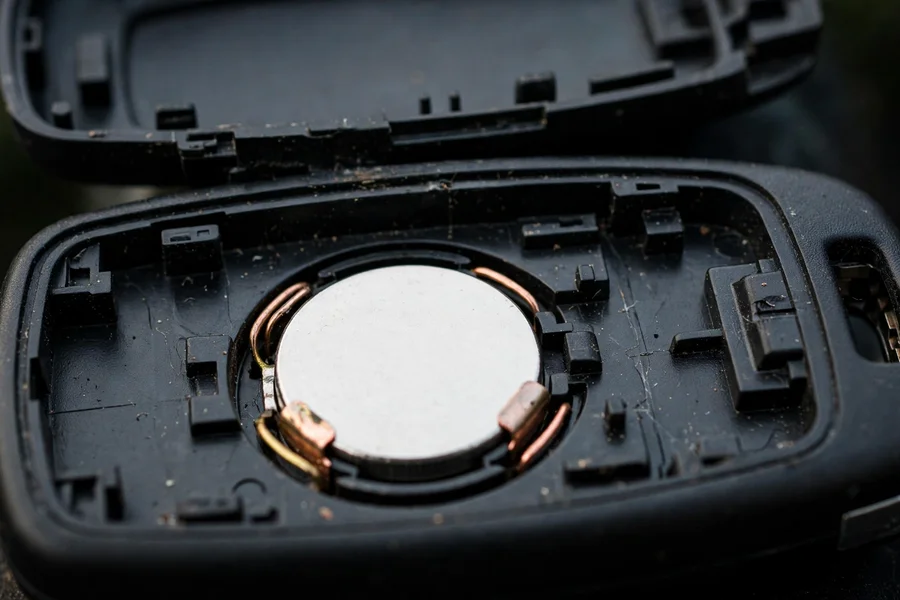
- Pop the back cover. On slab fobs, use the blade’s tip in the back slot to lever the cover off (a plastic pry tool works too — never a screwdriver on the contacts). On the E90 CA diamond key, the back has a small door above the roundel instead.
- Note the orientation, remove the old cell, insert the new one + side up. Match the cell to the finder result above — CR2450 for F30, CR2032 for G20 and E90-with-CA.
- Snap the cover back on, reinsert the blade, test everything. Lock, unlock, trunk, Comfort Access touch, and a start. The “remote key battery discharged” warning clears itself in most cases after a correct swap.
No reprogramming is needed after a battery swap — the fob’s identity lives in non-volatile memory. Modern fobs re-pair automatically once powered; the “re-sync ritual” some owners describe (lock, insert, start, lock again) is owner ritual, not a documented requirement. If the fob doesn’t work with a fresh, correct cell, run the finder checklist — wrong cell, dead-on-arrival cell, + side down, dirty contacts — before assuming worse.
E90 diamond key: the sealed rechargeable cell explained
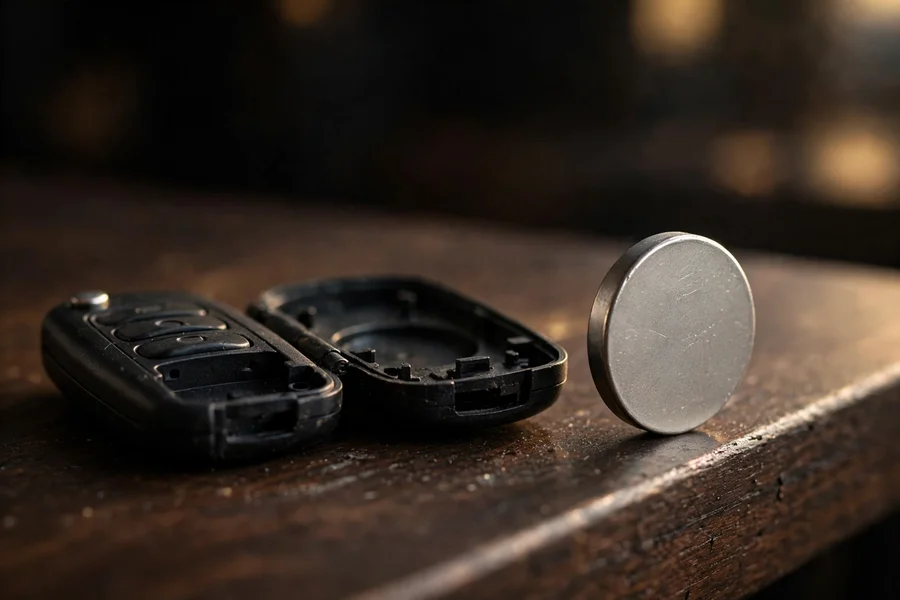
If your E90 doesn’t have Comfort Access, your fob is the odd one out: a sealed diamond key with a soldered VL2020 rechargeable cell inside and no battery door. The owner’s manual says it plainly — “use each remote control at least twice a year for longer road trips in order to maintain the batteries’ charge status” — because the cell charges only while the key is inserted in the ignition slot with the car driven. This is how most of them die: the spare fob lives in a drawer for years, the cell self-discharges, and the owner assumes it’s broken.
The recovery: drive with it in the slot. Insert the key, do a proper longer drive, and the inductive charging brings the cell back. Alternate your fobs on long trips going forward — the manual’s twice-a-year guidance is the maintenance schedule for these keys. If a key that gets regular slot time still dies quickly, the cell has reached the end of its chemical life.
Replacing the VL2020 is an advanced, optional job: cut open the sealed fob, desolder the old cell, solder a new VL2020 with legs onto the board, glue the shell shut. Fiddly electronics work with a real risk of destroying the fob. The dealer’s answer is a whole new key at full replacement cost. But if the fob revives after a long charge, just rotate your keys and the problem never comes back.
Key not detected: the causes, ranked
The battery is the cause most of the time — rule it out first with the correct, quality cell. When the battery is known good, owners report a consistent ranking of what comes next. Work through it in order:
| # | Cause | Typical symptom | The fix |
|---|---|---|---|
| 1 | Dead or weak fob battery | “Remote key battery discharged” warning; buttons weak or dead | Swap the correct cell (finder above). The $3–$8 fix that resolves most cases. |
| 2 | Radio interference | Works sometimes; dies near your phone or laptop | Carry the fob away from electronics — especially a phone in the same pocket. Remove metal key cases. |
| 3 | Bad fob placement | Key not detected at start with a fresh battery | Keep the fob in the central cabin area. Trunk, glovebox, footwell, and door pockets all weaken the signal. |
| 4 | Comfort Access antenna fault | Buttons work but touch-unlock is dead | Move the key to where a different antenna can reach it (back seat, roof area) as a diagnostic test. BMW scan for antenna codes, then a specialist. |
| 5 | CAS module failure | No crank, red key warning, start refused but remote locking works | Specialist diagnosis — module replacement plus coding. No DIY fix. |
| 6 | De-synchronized or damaged key | Nothing works with a fresh battery; fob was soaked or cracked | Replacement key from a dealer or automotive locksmith — see below. |
| 7 | Weak vehicle 12V battery | Key issues plus dim lights and odd warnings | Check the car’s battery first — a low 12V system makes key electronics behave erratically. See our battery discharge guide and battery keeps dying guide. |
Interference is the most-reported non-battery cause across owner forums — a phone transmitting next to the fob desensitizes the fob’s receiver. The test is free: carry the fob in the opposite pocket from your phone for a day. If the drama stops, you’ve found it.
Emergency start: get moving when the fob won’t talk to the car
If the fob is dead and you need to drive now, BMW built a backup into every generation — an inductive/RFID path that reads the fob’s transponder without its battery:
- E90: insert the fob into the dashboard ignition slot. The slot reads the transponder inductively even with a dead battery — the same slot that charges the rechargeable diamond key.
- F30 / G20: hold the fob against the marked spot on the steering column (a key symbol) while pressing start. The NFC/RFID backup reads the fob at close range. The exact marking varies — check BMW’s digital owner’s manual for your car if you can’t spot it.
- Every generation: the mechanical blade hidden inside the fob unlocks the driver’s door manually. Pop the little cap on the door handle to reveal the lock cylinder.
If the emergency procedure doesn’t work either, the fob’s transponder is likely damaged or the car-side receiver (CAS/antenna) has failed — professional territory, covered below. In the common case — dead battery, interference — the emergency path gets you home while the replacement cell ships.
Comfort Access: how it works and how it fails
Comfort Access is the keyless system: fob in your pocket, touch the ridges on the door handle to unlock, touch the top of the handle to lock, and start with the fob anywhere in the cabin. Under the skin it’s a network of low-frequency antennas — center console, under the rear seats, trunk, and each door handle — that triangulate the fob so the car knows you’re outside for unlock and inside for start.
That antenna network is where Comfort Access failures live, and they fail differently from battery problems. The signature split: the buttons work fine, but touch-unlock doesn’t. One dead handle among four working ones means that handle’s antenna or touch sensor — individual handle failures with age are common, and the pattern is itself the diagnosis. Touch-unlock dead everywhere while buttons work means the antenna network or its module.
One reported pattern worth knowing: the center-console antenna sits where drinks get spilled, and liquid damage can short it — owners have traced dead Comfort Access to a coffee incident. Quick self-test: move the key to where a different antenna can reach it (back seat, roof area) and see if behavior changes. If it does, you’ve isolated a dead zone — a strong lead for the technician.
The battery connection: Comfort Access fobs drain faster because the car polls them constantly — that’s why the F30 uses the bigger CR2450. If your CA fob eats batteries every couple of years, that’s the system working as designed; budget the $5 cell as routine maintenance rather than treating each death as a mystery.
Key-related fault codes, decoded
When the fob and car stop agreeing, the Car Access System (CAS) and Comfort Access modules store manufacturer-specific codes that generic OBD-II scanners usually can’t see — you need a BMW-capable tool. This is a natural companion to our OBD2 scanner guide, which explains which tools can actually read CAS codes. The codes below are as commonly referenced in owner and specialist discussion, not official BMW documentation — strong leads, not certainties:
| Code | Plain-English meaning | What it points to |
|---|---|---|
| 930784 | Front aerial antenna: short circuit, open line, or faulty | A CA antenna circuit has failed — owners have traced this to an unplugged or damaged center-console sensor. Antenna-side, not the fob. |
| 9308B0 | Comfort Access system fault | A general CA flag; battery, antenna, and CAS causes all route through here. Needs narrowing. |
| A804B | CAS: key not detected / transponder communication error | CAS can’t talk to the fob’s transponder — could be the key, an antenna, or the module. |
| A8062 | CAS internal EEPROM fault | Reported as a dead CAS module — replacement plus coding. Single-sourced; treat as a lead. |
How to use this table: if “key not detected” persists with a fresh battery and no interference, a BMW-capable scan of the CAS module narrows the field enormously. An antenna code (930784 family) means an antenna-side repair; A804B keeps both key and module in play; A8062 means the module itself is gone. Handing a technician these stored codes turns a vague “key doesn’t work” complaint into a targeted diagnosis — and protects you from paying for a new key when the antenna was the problem all along.
Costs: from a $5 battery to an $800 dealer key
The money line: a dead battery is not a dead key, and the repair ladder climbs from single dollars to hundreds with nothing in between. All estimates (US pricing; Europe typically 20–30% less):
| Repair | Typical cost (US) | Notes |
|---|---|---|
| DIY battery (CR2032/CR2450 two-pack) | $3–$8 | Typical street price. Buy a quality brand; weak cells are a real false trail. |
| Dealer battery swap | ~$25–$50 (estimate) | Owner-reported, not quotes — five minutes of service-advisor time. |
| Aftermarket fob + programming | $100–$250 | Quality varies; dealers may refuse to program non-OE keys. |
| Locksmith replacement key | $250–$450 | Automotive locksmith with BMW tooling; usually the cheapest full-key route. |
| Dealer replacement key | $400–$800 | 2015–2025 3 Series; key commonly $300–$500+ before $135–$300 programming. VIN-specific order, 1–3 days. |
Bar widths are proportional to the top of each range (max $800). Estimates, US pricing — the jump from battery to key is the whole story.
The chart makes the strategy obvious: spend the $5 first, every time. Even if you’re convinced the fob is dead, the battery costs less than the diagnostic fee you’d pay to be told it was the battery. The one exception is the E90 sealed rechargeable fob — no battery to buy, so go straight to the recharge-by-driving procedure or the key-replacement math.
When you actually need a dealer or locksmith
Some key problems have no DIY answer, and knowing the boundary saves money on both sides. You’ve crossed into professional territory when: the fob does nothing with a fresh, correct, quality-brand battery and clean contacts; interference and placement are ruled out; the emergency-start position fails too; or a BMW scan shows antenna/CAS codes. Then the suspect is the fob’s electronics, an antenna, or the CAS module itself.
Replacement keys are VIN-specific: the dealer orders the key matched to your car’s immobilizer — 1–3 days, proof of ownership required (title or registration plus ID). There is no DIY programming on CAS/FEM cars: the rolling-code immobilizer means the key must be paired with BMW-level tooling, which is what the $135–$300 programming charge covers. The aftermarket route is mixed: an automotive locksmith with BMW tooling can cut and program a key for $250–$450, but a cheap aftermarket fob is a gamble — quality varies, and dealers may refuse to program non-OE keys.
Practical tip: get quotes from both a dealer and an independent automotive locksmith before committing. Locksmiths are frequently cheaper for the same programmed key; the dealer is the fallback for complicated module states (CAS faults, multiple lost keys). If you’ve lost all keys, say so upfront — that’s a bigger job than adding a spare.
A “key not detected” no-start is not a no-start with the key working fine. If the key is detected but the engine won’t crank or catch, the problem is downstream — see our won’t-start guide. If the key works but one door won’t lock or unlock, the fault is in the door — see our door lock actuator guide. Sort “is it the key or the car?” before spending money.
BMW key fob FAQ
What battery does a BMW key fob take?
It depends on the generation: an E90 (2006–2013) without Comfort Access uses a sealed rechargeable VL2020 you cannot replace; an E90 with Comfort Access takes a CR2032; an F30 (2012–2019) takes a CR2450; and a G20 (2019+) takes a CR2032 per the driver’s guide. CR2032 and CR2450 are not interchangeable.
Why does my BMW say “key not detected” with a new battery?
Work through the ranked causes: interference from a phone in the same pocket, the fob sitting in the trunk or glovebox, a failed Comfort Access antenna, or a CAS module fault. Try the emergency start position first (F30/G20: fob against the key symbol on the steering column; E90: fob in the dash slot), then move the fob away from electronics.
Do I need to reprogram my BMW key fob after changing the battery?
No. The fob’s identity is stored in non-volatile memory — a battery swap is like changing batteries in a TV remote. Modern fobs re-pair automatically once powered. If it doesn’t work with a fresh correct cell, check for the wrong cell type, a dead-on-arrival battery, + side down, or dirty contacts first.
How much does a replacement BMW key cost?
In the US, an automotive locksmith typically charges $250–$450 for a cut and programmed key; a dealer charges $400–$800 total (key plus $135–$300 programming). BMW keys are VIN-specific, take 1–3 days to order, and require proof of ownership. There is no DIY programming on CAS/FEM cars.
How can I start my BMW if the key fob battery is dead?
E90: insert the fob into the dashboard ignition slot — it reads the transponder inductively even with a dead battery. F30/G20: hold the fob against the key symbol on the steering column while pressing start. Unlock the door first with the mechanical blade hidden inside the fob.
Most “BMW key fob not working” stories end with a $5 battery and two minutes — the expensive endings are rare, and each announces itself clearly once you know what to look for. Match the cell to your chassis, rule out interference and placement, learn your generation’s emergency start, and you’ll never again wonder whether a silent fob needs a battery or a $500 key. For the rest of the ownership picture, the complete BMW 3 Series guide ties it all together, and our E90 vs F30 comparison maps the generational differences that matter far beyond the key fob.