BMW 3 Series Control Arm Bushing: Fix the 50–60 MPH Shimmy
Cruising at 60 mph, your 3 Series’ steering wheel starts to shudder in your hands. Touch the brakes and it gets worse — a juddering pulse through the wheel that feels exactly like warped brake rotors. So you do the sensible thing: you price up a brake job. And that is where most owners spend money fixing a problem their car does not have.
That 50–60 mph steering shimmy — present at cruising speed, intensified under light braking — is the signature failure of the BMW 3 Series control arm bushing: the fluid-filled hydraulic bushing in the front thrust arm (also called the tension strut). It is one of the most common chassis failures across the E90, F30, and G20 generations — and one of the most misdiagnosed, because the symptom mimics brake shudder and sends owners shopping for rotors they do not need.
Short answer
The classic bmw 3 series control arm bushing symptoms are a steering-wheel shimmy around 50–60 mph that worsens under light braking, vague highway steering, and a dull clunk over bumps. The culprit is the fluid-filled hydraulic bushing in the front thrust arm, which typically fails between 50,000 and 75,000 miles — oily weep on the bushing is the sure sign it is done. Quality bushings run about $40 per side; complete upgraded arms cost roughly $200 a pair, and an independent shop job for both sides typically lands between $600 and $900 including alignment.
In this guide
- The shimmy that isn’t your rotors: the money-saving misdiagnosis
- What the control arm bushings actually do
- The full symptom list, ranked by how they arrive
- Interactive: shimmy symptom checker
- How to diagnose it yourself: visual and driving tests
- Bushings vs. warped rotors vs. wheel balance: the comparison table
- Why the hydraulic bushings fail at 50–75k miles
- E90 vs. F30 vs. G20: generation differences and the M3 upgrade path
- The upgrade ladder: OEM, Meyle HD, Powerflex, monoballs
- What the repair costs: DIY vs. independent vs. dealer
- Buying advice: pairs, preload, and what to avoid
- Frequently asked questions
The shimmy that isn’t your rotors: the money-saving misdiagnosis
Start with the most expensive mistake this symptom produces. A 3 Series owner feels the steering wheel judder under braking, reads “warped rotors” in a forum thread, and orders rotors and pads — a front brake job that can run several hundred dollars (see our BMW 3 Series brake pad replacement cost guide). If the brakes were genuinely worn, that money was not wasted. But when the root cause is a blown thrust-arm bushing, the shimmy survives the brake job unchanged, because the rotor was never the problem.
Here is why the confusion is so persistent. Under braking, weight transfers forward and the front wheels drag rearward against the pavement — a force resisted mainly by the thrust arms and the large bushing at each arm’s subframe end. When that bushing’s damping fluid has leaked out and the rubber has fatigued, the wheel oscillates fore-and-aft under braking load, and the steering rack translates it into a side-to-side judder. It feels exactly like a warped rotor, but the rotor is a bystander.
One long-running Bimmerforums discussion of the “50 mph shimmy” nails the mechanism: the thrust-arm bushing takes much of the front suspension’s load, particularly when braking, wears out faster than the other bushings, and is typically the cause of the 50–60 mph shimmy (Bimmerforums). The owner stories follow the same arc: a shimmy that starts around 50 mph, worsens under braking, and disappears only when the arms or bushings are replaced.
The practical takeaway: if your pads and rotors still have life and the shimmy appeared gradually at cruising speed first, diagnose the bushings before buying rotors. A free visual inspection can save you from a brake job you did not need.
What the control arm bushings actually do
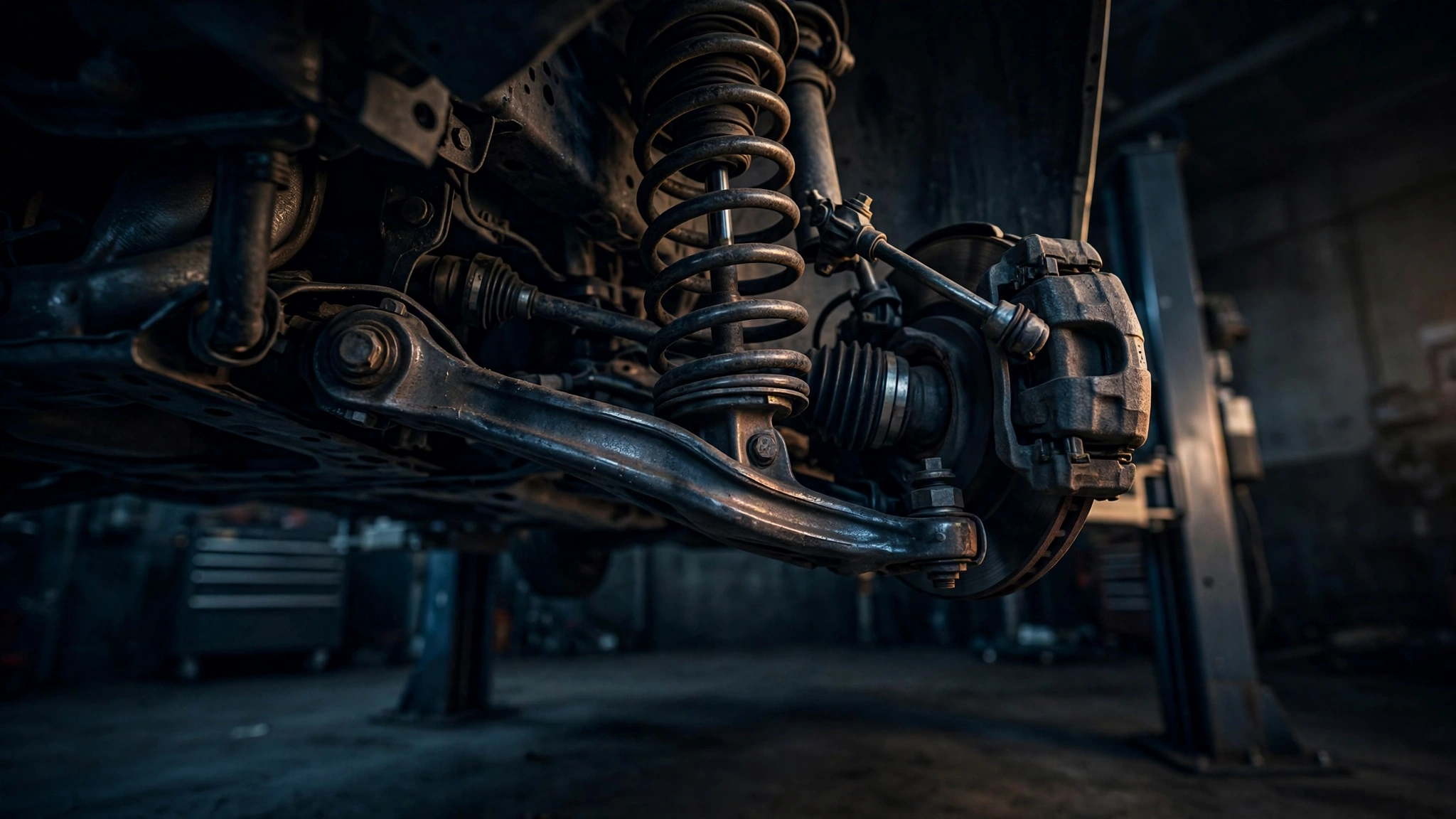
Each front corner locates its wheel with two lower arms. The lower control arm (wishbone) handles vertical and lateral loads, ending in a ball joint at the wheel carrier. The thrust arm — also called the tension strut — runs diagonally from the wheel carrier back to the front subframe, managing fore-aft loads: acceleration squat and, above all, braking forces.
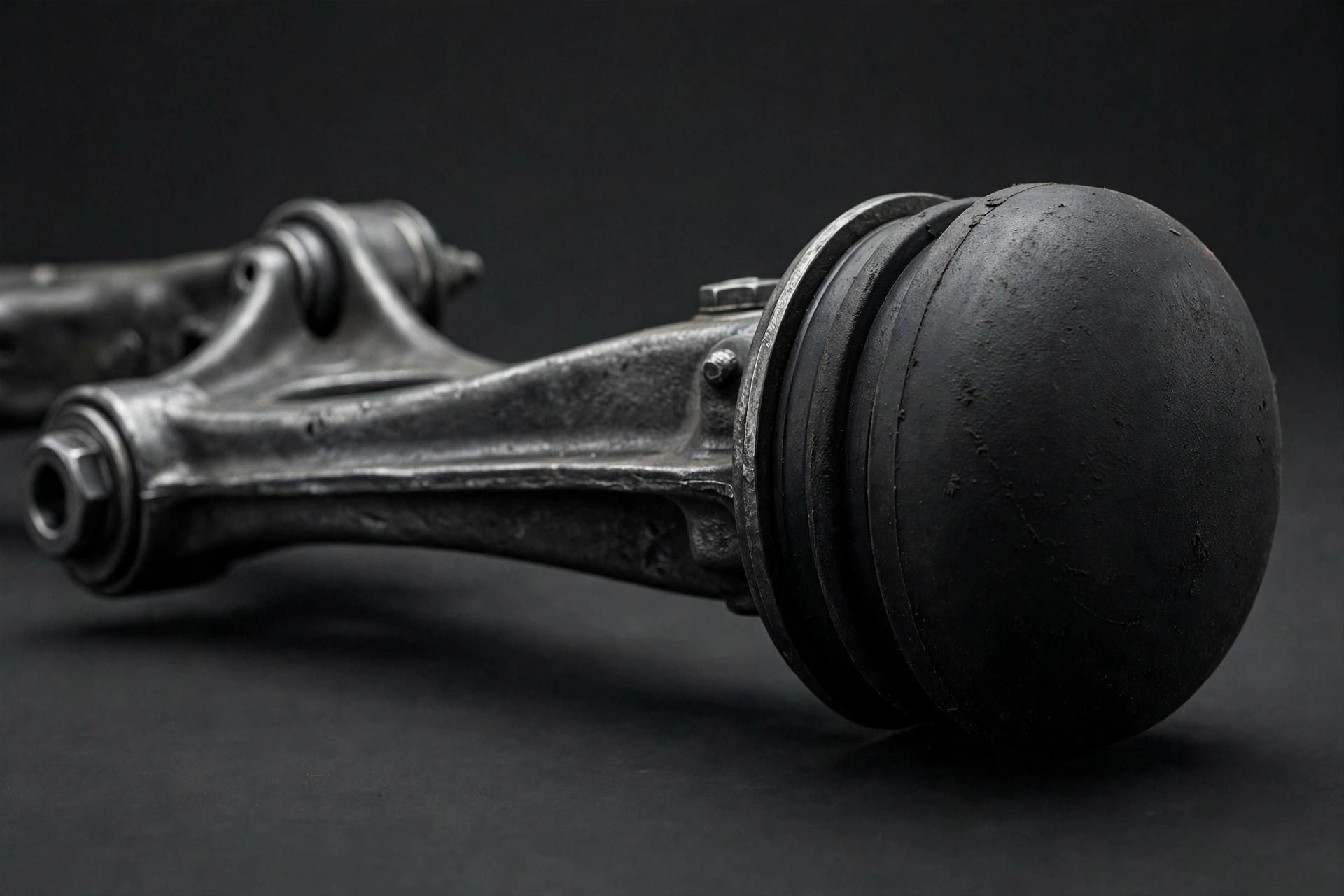
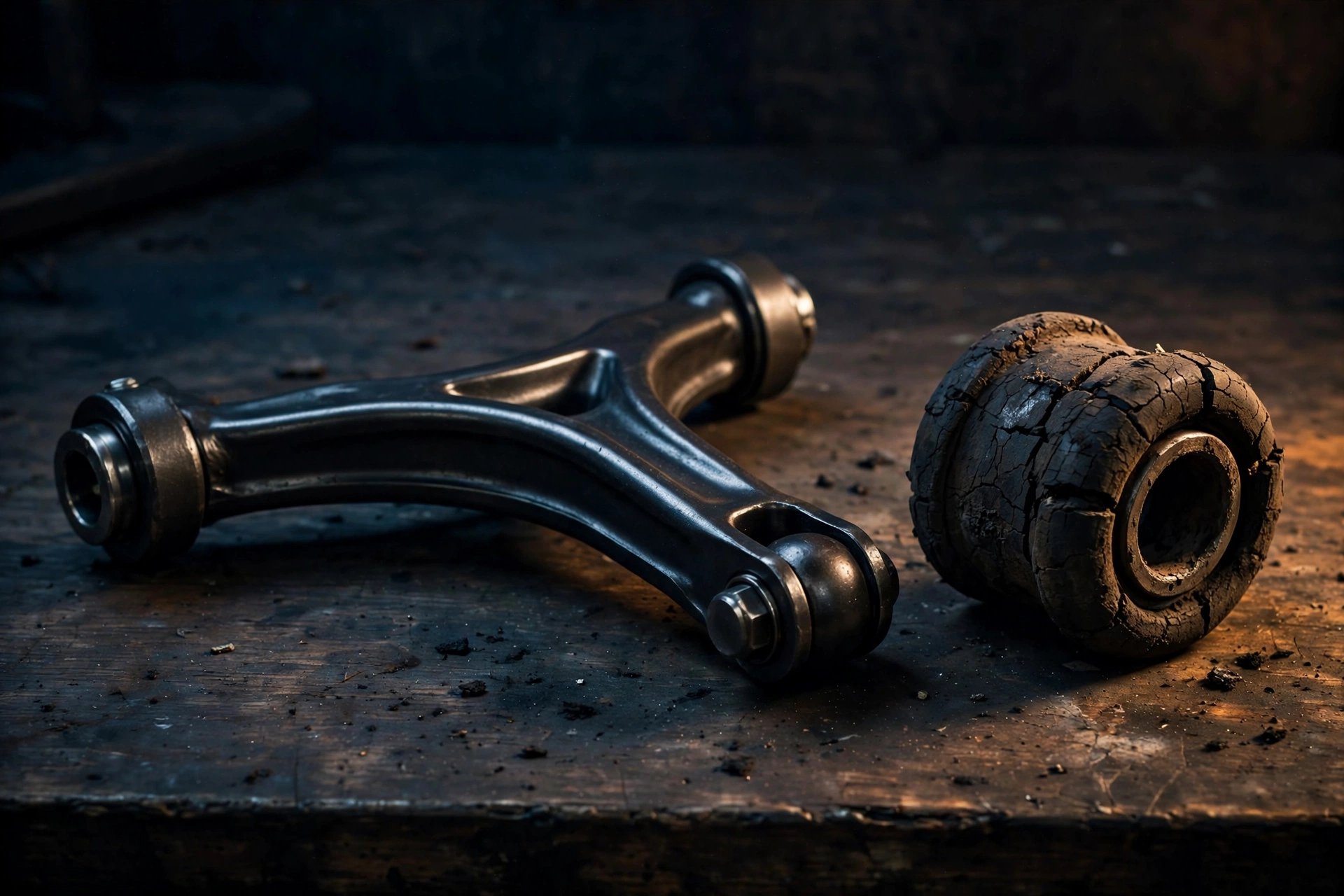
The thrust arm’s subframe-side bushing is the part that fails. On a stock car it is a hydraulic (fluid-filled) bushing: rubber with internal damping-fluid chambers, tuned soft for ride comfort. Continual deflection fatigues the rubber, it cracks, the fluid escapes, and the bushing fails completely — a failure mode Turner Motorsport documents on its thrust-arm upgrade page. Pelican Parts’ technical writeup lists the consequences: degraded handling, wheel shimmy, delayed steering and braking response, unwanted alignment change, and poor tire wear (Pelican Parts).
Compare that with the lower control arm bushing, a conventional solid-rubber part. Longtime E90 owners report it lasts the life of the car on street duty — it is always the thrust-arm bushing that fails. One widely quoted E90Post breakdown sums up the hierarchy: shimmy at highway speed and/or when braking, fluid leaking out is a sure sign they are done (E90Post).
The full symptom list, ranked by how they arrive
These symptoms rarely arrive together. In the order owners report them:
1. Steering-wheel shimmy at 50–60 mph. The signature: a fine, rapid tremor through the wheel at cruising speed, often first noticed on smooth highway. It may come and go with road surface or temperature, which is why owners frequently dismiss it early.
2. Shimmy that worsens under light braking. Touch the brakes from highway speed and the tremor becomes a judder. This is the symptom that sends owners down the warped-rotor path — but the brake pedal itself usually stays calm (see the comparison table).
3. Vague, wandering steering. The car feels less planted, needs small constant corrections, and feels unsettled over expansion joints. One F30-platform owner described oversteer surprises he had originally chalked up to the car’s character (F30 Bimmerpost).
4. Clunking over bumps or on initial braking. A dull knock from the front end when the suspension loads up — speed bumps, braking to a stop, pulling away. The wheel is shifting in the failed bushing until it hits the end of its travel.
5. Uneven front tire wear. The failed bushing lets alignment change dynamically, so the tire scrubs. By the time you see feathering on the inner edges, the bushings have been gone a while.
6. Visible fluid weep on the bushing. The hydraulic bushing’s tell: dark, oily residue staining the bushing housing or the subframe around it. In the E90 community this is treated as a definitive diagnosis — if you can see fluid, the bushing is finished (E90Post).
Interactive: shimmy symptom checker
Answer four questions about your shimmy and get a starting verdict: thrust-arm bushings, brake rotors, or wheel balance. A triage tool — the hands-on tests below are the confirmation.
Shimmy symptom checker
1. When does the shaking happen?
2. Do you feel a pulse in the brake pedal itself?
3. What changes the shake?
4. Have you inspected the thrust-arm bushings (where the arm meets the subframe)?
How to diagnose it yourself: visual and driving tests
The thrust-arm bushing is one of the easier wear items to confirm without special tools. Work through these in order.
The flashlight inspection. With the front wheels at full lock, you can see each thrust arm running from behind the front wheel back to the subframe. The bushing is the large round rubber joint where the arm bolts to the subframe. Look for dark oily residue or wet staining (leaked damping fluid — the definitive sign), rubber that is cracked, split, or bulging, and a sleeve that has shifted off-center. Compare both sides; asymmetry tells a story.
The 9-and-3 wheel rock. Jack up one front corner onto a stand, grab the tire at 9 and 3 o’clock, and push-pull firmly. A healthy bushing allows almost no fore-aft movement. A distinct clunk or visible wheel shift means the bushing has failed. Rock at 12 and 6 too — movement there points more toward ball joints or wheel bearings.
The light-brake test. On an empty road at 60 mph, brake with light, steady pressure. Bushing shimmy typically appears under light-to-moderate braking and may fade under hard braking, when the bushing compresses solid and can no longer oscillate. Rotor shake usually intensifies with braking force and heat — and you will feel it in the pedal.
The tire-rotation test. If the shake sits at one speed regardless of braking, rotate the tires front-to-rear before spending on suspension. If the shimmy changes character or moves to the seat, the cause is in the tire/wheel assembly — balance, a bent rim, or a damaged tire — not the bushings.
The pry-bar check. On a lift or ramps, lever a long pry bar between the thrust arm and the subframe: a failed bushing lets the arm move with little resistance and deforms visibly; a healthy one resists firmly. Most independent shops use this test — it takes about two minutes per side.
Bushings vs. warped rotors vs. wheel balance: the comparison table
These three causes overlap, which is why the misdiagnosis is so common. The differences are consistent once you know what to feel for.
| Characteristic | Thrust-arm bushings | Brake rotors | Wheel balance / tires |
|---|---|---|---|
| Shake at 50–60 mph cruising | Yes — the signature symptom | Usually no | Yes — locked to a narrow speed band |
| Under light braking | Worsens noticeably | Worsens | No change |
| Under hard braking | May fade as the bushing compresses solid | Worsens with heat and force | No change |
| Brake pedal pulsation | No — pedal stays calm | Yes — pedal pulses underfoot | No |
| Clunk over bumps | Yes — dull knock from the front | No | No (a bent wheel may thump rhythmically) |
| Vague, wandering steering | Yes — needs constant correction | No | No |
| Moves with tire rotation | No | No | Yes — the definitive test |
| Visual evidence | Oily weep or cracked rubber on the bushing | Blue heat spots or uneven pad deposits on the rotor | Missing wheel weights, visible rim damage |
The single most useful distinction is the pedal: if the brake pedal pulses, suspect rotors; if the wheel shudders but the pedal is calm, suspect bushings. Not infallible, but it separates the two causes correctly in most cases.
Why the hydraulic bushings fail at 50–75k miles
The failure mileage is remarkably consistent: owner reports cluster around 50,000 to 75,000 miles — one F30-platform owner found his driver’s-side thrust-arm bushing finished at just 57,000 miles (F30 Bimmerpost). There is no factory replacement interval — BMW treats the bushing as a lifetime part — so the failure usually announces itself rather than being caught on schedule.
Driving conditions move the number. Cars on rough roads, with frequent hard braking, or wider aftermarket wheels fail earlier in the range; garage-kept highway cars stretch toward the upper end. But the pattern is a wear item with a predictable life, not a defect — which is why the aftermarket built an entire upgrade ladder around it rather than BMW issuing a revised part.
E90 vs. F30 vs. G20: generation differences and the M3 upgrade path
The bushing problem spans all three modern 3 Series generations, but each has its own upgrade culture.
E90 (2006–2011): the M3 bushing upgrade. The forum-famous path. E90 M3 thrust-arm bushings are solid rubber — no fluid chambers, stiffer, and a direct press-fit into the stock arm. Owners have run them for over a decade as the durability upgrade for this chassis: no fluid to leak, firmer steering, much longer life. Pressing them in needs a hydraulic press and correct dies, so owners without a press buy complete arms pre-installed. Note: M3 arm upgrades are a rear-wheel-drive proposition — xDrive cars run different front suspension geometry, so verify fitment for your drivetrain.
F30 (2012–2019): the monoball era. On the F30 the conversation has shifted toward sealed spherical-bearing “monoball” replacements. A monoball replaces the rubber-and-fluid bushing with a sealed ball joint in a machined aluminum housing — zero deflection, effectively infinite life. The trade-off is NVH: one detailed owner review rates it roughly 3–4 out of 10 versus stock, with more road texture and pothole thump transmitted, but calls the handling payoff transformative — “SPORT level steering feel in COMFORT MODE” (F30 Bimmerpost). One subtlety: the stock F30 bushing sits slightly off-center while the monoball is centered, so caster shifts a touch — get an alignment afterward.
G20 (2019+): still early, same physics. The G20 uses a similar hydraulic thrust-arm bushing, and as these cars accumulate mileage the same 50–60 mph shimmy is beginning to surface in owner reports. Aftermarket monoball and upgraded-arm options are already listed for the G20 chassis, but long-term data is thinner because fewer G20s have crossed the failure-mileage window. Approaching 60,000 miles with vague steering? The bushing is a prime suspect.
The upgrade ladder: OEM, Meyle HD, Powerflex, monoballs
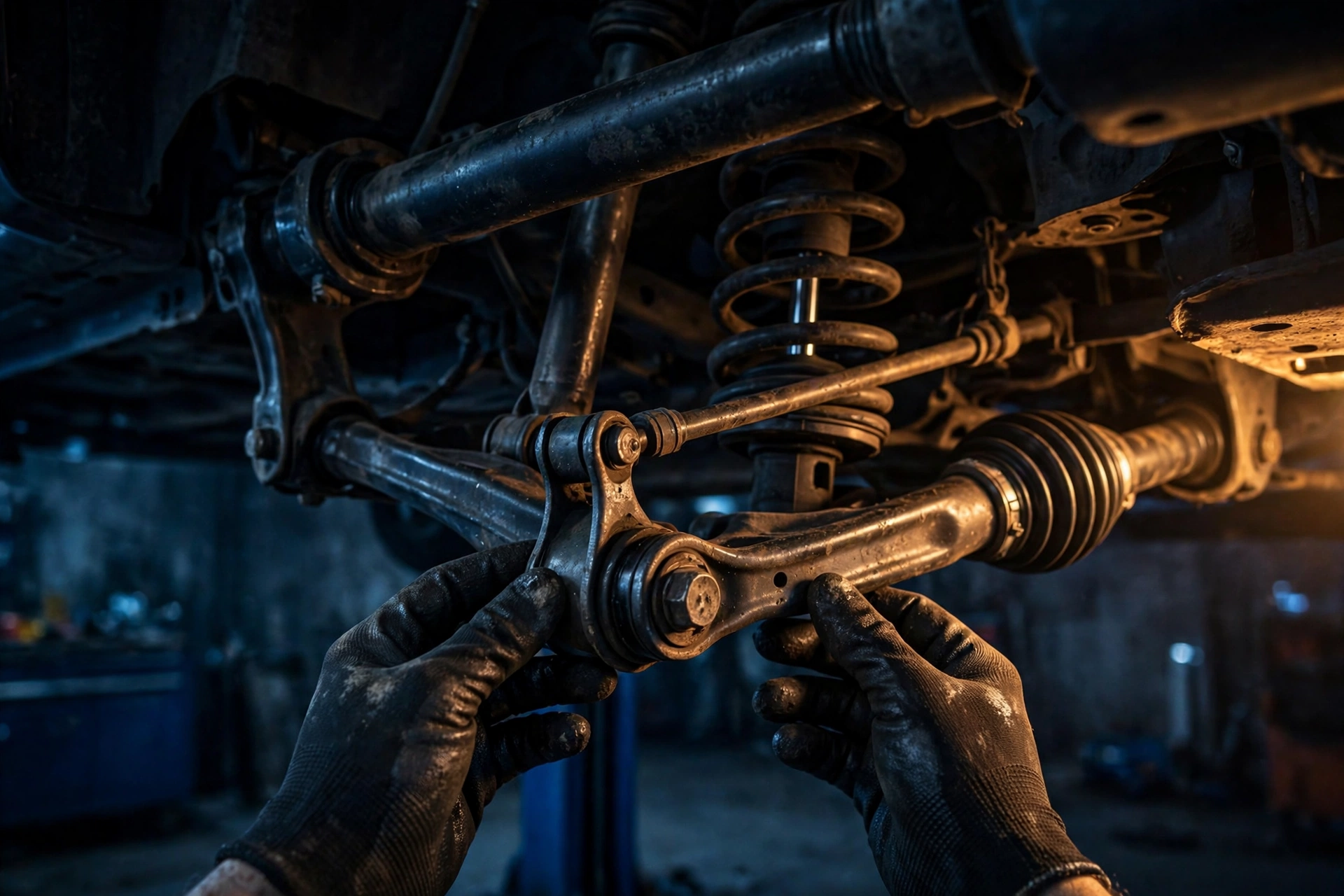
When the bushings are done, you choose a philosophy: factory comfort, hardened durability, or maximum precision. The ladder, mildest to wildest, with approximate September 2026 costs:
Rung 1 — OEM / OE supplier (Lemförder). The stock replacement: a new hydraulic bushing (or complete arm) identical to what failed. Ride and noise stay exactly as BMW intended, and the part will last another 50,000–75,000 miles. The downside is obvious — you are reinstalling the same wear item. Sensible if you plan to sell the car soon or prioritize factory refinement.
Rung 2 — Meyle HD. The enthusiast default. Meyle’s “heavy duty” thrust arms use a solid-rubber bushing with no fluid chambers — stiffer than stock, far more durable, and close enough to stock comfort that most owners report only a small change in ride. Complete arms cost roughly $200 a pair — barely more than bushings plus press labor. The pick for most owners.
Rung 3 — Powerflex (polyurethane). A stiffer polyurethane bushing pressed into your existing arm. Sharper steering and excellent longevity, with a modest increase in harshness. Owners report paying around $150 for pre-pressed Powerflex bushings from BMW specialists. Polyurethane needs its supplied lubricant at installation and occasional re-greasing to stay quiet — skip that and squeaks follow. Owner feedback is more mixed than for Meyle HD, particularly on noise.
Rung 4 — Monoballs. The rubber bushing is replaced by a sealed spherical bearing: zero deflection, effectively infinite bushing life. Turner Motorsport’s thrust-arm monoball kit lists at $1,006.99 (sale; $1,059.99 before the June 2026 update) with pre-installed arms (Turner Motorsport). Expect a real NVH increase — roughly 3–4 out of 10 per the F30 owner review — in exchange for steering precision no rubber bushing can match. Best for enthusiastic drivers and track-day cars; overkill for a commuter.
| Option | Bushing type | Approximate parts cost (pair) | Comfort vs. stock | Best for |
|---|---|---|---|---|
| OEM / Lemförder | Hydraulic (fluid-filled rubber) | ~$200 (arms) / ~$40 per bushing | Identical | Factory feel; short-term ownership |
| Meyle HD | Solid rubber, no fluid | ~$200 (arms) | Near-stock, slightly firmer | Most owners — the fix-and-forget choice |
| Powerflex | Polyurethane | ~$150 (pre-pressed bushings) | Firmer, needs periodic greasing | Sporty street cars |
| Monoballs | Sealed spherical bearing | ~$500–$1,000 (kit with arms) | Noticeably harsher (NVH ~3–4/10) | Enthusiasts, track-day cars |
What the repair costs: DIY vs. independent vs. dealer
Parts are cheap; the spread is in labor. Three scenarios for both sides, with September 2026 pricing:
DIY, bushing-only: roughly $100–$200. A pair of quality bushings runs about $40 per side — but removing and installing thrust-arm bushings needs a hydraulic press (or a proper bushing tool set) and correctly sized dies. Owners describe it as straightforward with a press and miserable without one. Budget for new hardware and penetrating oil.
DIY, complete arms: roughly $200–$300. The smart DIY play: a pair of Meyle HD or OE-supplier complete arms costs about $200, arrives with bushings and ball joints pre-installed, and bolts on with hand tools in a few hours. No press needed. Add an alignment afterward ($100–$150).
Independent shop: roughly $600–$900 for both sides. Shops typically quote 2–3.5 hours of labor plus parts and alignment. Complete upgraded arms are usually recommended over bushing-only replacement, since the labor difference is small and you get fresh ball joints in the bargain.
Dealer: $800+ per side. The outlier — one F30-platform owner was quoted $800 in parts and labor for a single side (F30 Bimmerpost), putting a two-side dealer job comfortably north of $1,500. The parts are commodity items and the job is routine for any BMW indie, so the dealer premium buys little here.
Buying advice: pairs, preload, and what to avoid
Always replace in pairs. If one thrust-arm bushing has failed at 60,000 miles, the other has lived the identical life on the identical roads. Replacing one side leaves asymmetric bushing stiffness — the car can pull or feel uneven under braking — and you will pay the labor twice when the second side follows within months.
Torque the bushing bolts at ride height. The subframe-side bushing bolt must be tightened with the suspension loaded at normal ride height — on ramps or with the car on the ground, not hanging on a lift. Tightening with the wheel drooping twists the bushing into a permanent preload that destroys it quickly. Any competent BMW shop knows this; if you are DIYing, plan for it.
Consider the ball joints and alignment together. The thrust arm’s wheel-side ball joint has done the same mileage as the bushing — and complete arms include a new one, which is half the argument for buying arms instead of bushings. Fresh bushings also change the wheel’s resting position slightly, so get an alignment check after the job to protect your tires.
Avoid no-name arms. The price gap between bargain-bin control arms and Meyle HD or Lemförder is small — often under $50 a pair — and the quality gap is not. Cheap arms arrive with soft rubber, sloppy ball joints, and bores that do not hold the bushing properly. Owners who buy them typically buy twice.
Do not ignore it indefinitely. A failed bushing is not an imminent-safety failure — the arm stays attached — but the constant oscillation accelerates tire wear, loads the ball joints and tie rods unevenly, and can slightly lengthen stopping distances. Owners have driven thousands of miles on the shimmy, but every one of those miles is wearing something else.
Frequently asked questions
What are the symptoms of bad control arm bushings on a BMW 3 Series?
Steering-wheel shimmy at 50–60 mph that worsens under light braking, vague or wandering highway steering, a dull clunk over bumps, and uneven front tire wear. The definitive sign is dark, oily damping-fluid weep on the thrust-arm bushing at the subframe.
Can bad control arm bushings feel like warped rotors?
Yes — the classic misdiagnosis. A failed thrust-arm bushing lets the wheel oscillate under braking, producing a judder that feels exactly like warped rotors. The tell: with bushings the brake pedal stays calm; with rotors it pulses. Diagnose the bushings before buying rotors.
How long do BMW 3 Series control arm bushings last?
Stock fluid-filled thrust-arm bushings typically last 50,000–75,000 miles; rough roads and hard braking push failures earlier. Lower control arm bushings are solid rubber and generally last the life of the car on street duty. Solid-rubber upgrades and monoballs last substantially longer.
Should I replace the bushings or the whole control arm?
For most owners, the whole arm. A pair of Meyle HD or OE-supplier complete arms costs roughly $200 — barely more than bushings plus press labor — bolts on with hand tools, and includes fresh ball joints. Bushing-only makes sense only if you already own a press.
Are M3 control arm bushings a good upgrade for a regular 3 Series?
On the E90, yes — the forum-famous upgrade. M3 thrust-arm bushings are solid rubber with no fluid chambers, stiffer, and a direct fit. Note it is a rear-wheel-drive fitment; xDrive cars use different front suspension geometry, so verify fitment.
Is it safe to drive with worn control arm bushings?
The car remains drivable — the arm stays attached — but worn bushings accelerate tire wear, load ball joints and tie rods unevenly, and can slightly lengthen stopping distances. Schedule the repair soon; it is not an emergency tow.
If the 50–60 mph shimmy brought you here, you now have the full picture: why the thrust-arm bushing fails, how to tell it apart from rotors and balance without spending a dollar, and which rung of the upgrade ladder fits your car. For the bigger ownership picture, the complete BMW 3 Series guide and the maintenance schedule put this repair in context — and if your diagnosis pointed at the brakes after all, the brake pad replacement cost guide breaks down exactly what that job should run, so you pay for the right repair, once.