BMW 3 Series Brake Job Cost: Dealer vs Indy vs DIY, by Generation
Short answer
bmw 3 series brake pad replacement cost runs roughly $250–$450 per axle at an independent BMW shop for standard brakes, $450–$800+ at a dealership, and $150–$260 in parts if you do the job yourself. Adding rotors roughly doubles the bill, and M Sport brakes or the latest G20 can push a dealer front-axle job past $1,000. The tables below break it down by generation, so you can tell a fair quote from a padded one.
- Brake cost calculator
- Brake job costs by generation
- Rotor sizes and why they change the price
- What actually drives your brake job bill
- How long pads and rotors last
- Can you do a BMW brake job yourself?
- The pad-wear sensor and CBS reset
- Quote traps to watch for
- Frequently asked questions
- Methodology and confidence
Few maintenance bills surprise 3 Series owners like the first brake quote. A dealer hands you a four-figure estimate, the internet says brakes are a $200 driveway job, and both can be right — for different cars, in different situations. The spread comes down to three things: which generation and brake package your car has, whether the rotors need replacing too, and who does the work.
This guide is strictly about cost: generation-by-generation bands for the E90 (2006–2013), F30 (2012–2019), and G20 (2019–present) across dealer, independent, mobile, and DIY channels. For how the 3 Series evolved — and why a 2007 328i costs less to brake than a 2024 M340i — start with the complete BMW 3 Series guide; inspection intervals live in the 3 Series maintenance schedule.
BMW brake cost calculator
Pick your generation, axle, service, and channel for a September 2026 US planning estimate — bands, not quotes.
Get your estimate band
Brake job costs by generation
Everything below is per front axle, the reference point because front brakes do most of the stopping and wear first. Rear work typically costs 10–15% less on standard brakes. “DIY” is parts only; the other channels include parts and labor but exclude tax, shop fees, and extras like a brake flush.
Front axle: pads-only replacement
Pads-only means new pads, a new wear sensor, and clean-and-lube of the caliper hardware — no rotors. YourMechanic’s live estimator is a useful anchor: its 328i page averaged $239 for a mobile pad replacement, while a 2014 328i front job priced at $384.71 mobile versus $447.64–$629.12 at a shop or dealer (YourMechanic’s 328i brake pad estimates, September 2026).
| Generation / brakes | Dealer | Independent | Mobile mechanic | DIY parts |
|---|---|---|---|---|
| E90 325i/328i (2006–13) | $450–$650 | $280–$450 | $320–$500 | $120–$220 |
| E90 330i/335i (2006–13) | $500–$750 | $320–$500 | $350–$550 | $150–$260 |
| F30 320i/328i (2012–19) | $450–$650 | $300–$480 | $350–$500 | $140–$250 |
| F30 335i/340i (2012–19) | $550–$800 | $350–$550 | $400–$580 | $180–$300 |
| F30/F32 M Sport brakes | $700–$1,000 | $450–$700 | $500–$750 | $250–$450 |
| G20 330i standard (2019+) | $500–$750 | $350–$550 | $400–$600 | $180–$320 |
| G20 M340i / M Sport | $700–$1,050 | $480–$750 | $520–$820 | $300–$560 |
Front axle: pads and rotors together
This is the full refresh: pads, rotors, and sensor. It is the right call when rotors measure at or below minimum thickness, are deeply scored, cracked, or pulsating. The jump is steepest on M Sport hardware, where a single performance rotor can cost several times what a standard one does. One F30 owner’s dated report shows the dealer spread: over $1,000 for front pads and rotors at the dealer versus $717 at an independent shop (owner-reported quotes, 2021).
| Generation / brakes | Dealer | Independent | Mobile mechanic | DIY parts |
|---|---|---|---|---|
| E90 325i/328i (2006–13) | $700–$1,000 | $450–$700 | $500–$750 | $220–$400 |
| E90 330i/335i (2006–13) | $800–$1,100 | $520–$800 | $580–$850 | $300–$520 |
| F30 320i/328i (2012–19) | $800–$1,100 | $550–$800 | $600–$880 | $280–$450 |
| F30 335i/340i (2012–19) | $900–$1,250 | $620–$900 | $680–$980 | $350–$560 |
| F30/F32 M Sport brakes | $1,200–$1,700 | $800–$1,200 | $900–$1,300 | $500–$900 |
| G20 330i standard (2019+) | $950–$1,350 | $650–$1,000 | $700–$1,050 | $420–$680 |
| G20 M340i / M Sport | $1,400–$2,000 | $950–$1,500 | $1,000–$1,600 | $650–$1,200 |
What about the rear axle?
The exception is M Sport cars, where the rear hardware is also upsized (345 mm rotors on both F30 and G20 M Sport setups) and the savings shrink. Shops quote axles separately because wear is rarely equal — if only the fronts are worn, paying for a rear job you don’t need is one of the most common ways brake bills inflate.
Why the bands are wide. Dealer labor rates can differ by $80+/hour between metro areas, and genuine versus aftermarket parts can double the parts line. Treat these as planning ranges, not prices any shop must honor.
Rotor sizes and why they change the price
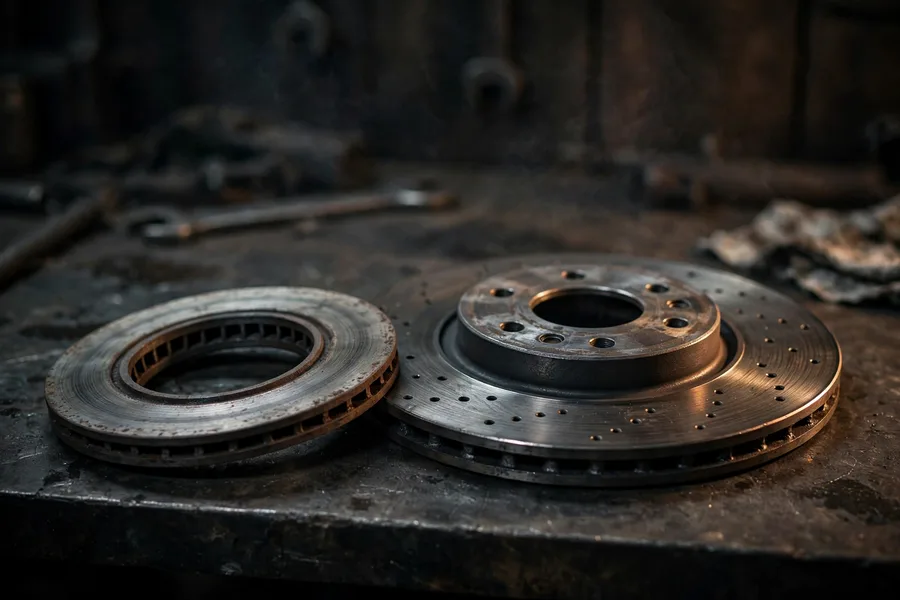
BMW never fitted one brake system to every 3 Series — rotor diameter, caliper type, and construction vary by engine output, production date, and options. Confirm what your car actually has before ordering parts or judging a quote: decode the VIN, check the option codes, or measure the hardware.
| Setup | Front rotors | Rear rotors |
|---|---|---|
| E90 328i, built through 08/2007 | 300 × 24 mm | See note |
| E90 328i, built from 09/2007 | 312 × 24 mm | See note |
| E90 330i | 330 × 24 mm | 336 × 22 mm |
| E90 335i | 348 × 30 mm | 336 × 22 mm |
| F30 320i/328i (standard) | 312 × 24 mm, 1-piston caliper | 300 × 20 mm |
| F30 335i/340i (standard) | 340 × 30 mm, 4-piston caliper | 330 × 20 mm |
| F30 M Sport (option 2NH) | 340 or 370 × 30 mm, 4-piston | 345 × 24 mm, 2-piston |
| G20 330i (standard) | 330 × 24 mm, 1-piston caliper | 330 × 20 mm |
| G20 M340i / M Sport brakes | 348 × 36 mm, 4-piston, 2-piece | 345 × 24 mm |
| G20 M Performance | 374 × 36 mm, dimpled & slotted | 345 × 24 mm |
The E90 split trips up owners most: 328i front rotors are 300 mm on cars built through August 2007 and 312 mm from September 2007, and the wrong size causes squeal and vibration that never beds out (owner discussion of the 2007 production split). The 335i’s 348 × 30 mm fronts versus the 330i’s 330 × 24 mm fronts were documented the same way (E90 owner rotor-size reference). On the F30, an owner-compiled hardware reference breaks it down: 335i/340i cars run 340 mm front rotors with 4-piston calipers, 320i/328i cars run 312 mm with single-piston calipers, and the M Sport option jumps to 340 or 370 mm fronts with 345 mm rears (F30 brake hardware reference). For the G20, BimmerWorld confirms the 330i’s 330 mm single-piston setup, the 348 mm four-piston M Sport hardware, and the 374 mm M Performance rotors, and warns that BMW’s brake naming and mid-production changes make fitment tricky (BimmerWorld G20 brake reference).
What actually drives your brake job bill
1. Which brake package your car left the factory with. This is the biggest lever. An F30 M Sport front kit can cost anywhere from just over $200 with aftermarket rotors and pads to just under $800 with genuine BMW drilled and slotted parts (FCP Euro’s M Sport brake guide; guide-era pricing). On the G20, live September 2026 pricing tells the same story: an OEM M Sport front pad set lists around $259 while a single M Performance dimpled front rotor lists above $530 (BimmerWorld pricing, September 2026). Standard-brake cars simply have cheaper, smaller parts.
2. Whether the rotors survive. Rotors are a measure-and-decide item, not a fixed-schedule one. BMW’s 2018 brake-service bulletin told technicians the minimum thickness is stamped on the rotor and that rotors at or above it should not be replaced, while pad replacement is prohibited below it (summary of BMW’s 2018 brake bulletin). Deep scoring, cracking, or pulsation also force replacement. A shop that insists on new rotors “as policy” should show you measurements.
3. The wear sensors. BMW uses one pad-wear sensor per axle. Once a sensor has contacted the rotor and tripped, it cannot be reused — plan on a new one with every pad job on that axle, typically $10–$25. Owner parts receipts put a single sensor around $11 (dated 2021, F30 brake-job discussion), so it is a small line item — but skipping it is the classic cause of a warning light that won’t reset after new pads.
4. The parts tier. Genuine BMW, OEM (same manufacturer, BMW box removed), and quality aftermarket each step the price down, often dramatically. FCP Euro’s standard F30 front-brake guide budgets roughly $200 in parts for pads, two rotors, and a sensor using quality aftermarket brands (FCP Euro’s F30 front brake guide; guide-era pricing, expect more in 2026). Make sure the quote tells you which tier you are getting.
5. The channel and your zip code. Dealer labor rates run well above independent rates in most markets, and the parts markup stacks on top. That is why the dealer column in the tables above runs roughly 40–60% above the independent column for the same hardware. Mobile mechanics usually land between the two for pads-only work; they carry less overhead than a shop but cannot always handle rotor replacement or seized hardware as efficiently.
How long do BMW brake pads and rotors last?
BMW does not prescribe a brake-pad replacement mileage — pad life is condition-based and monitored by CBS, with inspection cadence covered in the 3 Series maintenance schedule. As planning ranges, not promises: heavy city or aggressive driving, roughly 20,000–35,000 miles on a set of fronts; mixed driving, 30,000–50,000; mostly highway and gentle use, 50,000–70,000 or more. Fronts almost always wear first because braking bias loads the front axle.
Rotors live on a different clock: thickness and condition, not mileage. A widely repeated owner rule of thumb is that rotors often last through two sets of pads (owner discussion), which matches BMW’s guidance that rotors at or above minimum thickness should be reused (BMW’s 2018 brake bulletin summary). Corrosion from cars that sit and scoring from pads worn to metal are what actually retire rotors — so catching pads before the sensor trips is the cheapest thing you can do for rotor life.
Can you do a BMW brake job yourself?
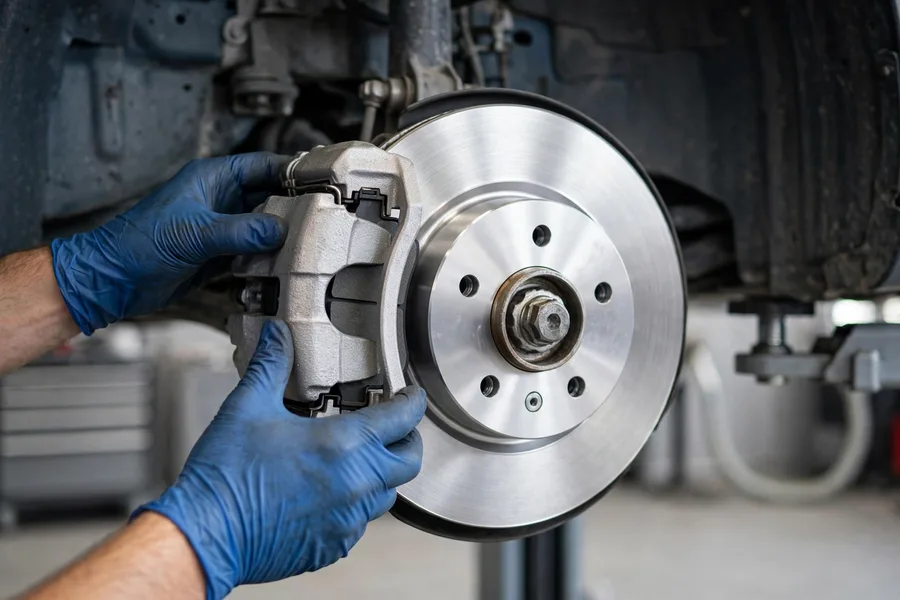
Yes — a 3 Series brake job is one of the most approachable DIY tasks on the car, and it is where the biggest savings live. FCP Euro’s F30 front-brake guide budgets about 30 minutes per corner once you have done it before, lists jack stands, a caliper compressor, sockets, ratchets, a torque wrench, and caliper support as the required tools, and notes the wear sensor routes to the inner driver-side front pad (FCP Euro’s F30 front brake guide). The same source budgets roughly $200 in parts for standard front pads, two rotors, and a sensor — guide-era pricing, so treat it as a floor at 2026 checkout. M Sport fixed multi-piston calipers service a little differently from standard sliding calipers but are described as similar in overall difficulty (FCP Euro’s M Sport brake guide).
The caveats: older E90s in rust-belt states can have seized caliper bracket bolts and rotor screws that turn a one-hour job into an afternoon; owners recommend penetrating oil the night before (owner tips). Never work under a car held only by a jack — use proper stands — and torque wheel bolts to spec. Bed the new pads with a series of moderate stops, and do not reset the brake-pad CBS reminder until the new pads and sensor are actually installed. If that sounds outside your comfort zone, an independent BMW shop is the value play.
The DIY breakeven is fast. Even buying a torque wrench and jack stands from scratch, one DIY axle job typically pays for the tools — every job after that is parts-cost only.
The pad-wear sensor and CBS reset
Each axle has one wear sensor, and it is a one-time-use part: once it trips, replace it with the pads or the warning will not clear. Reset the corresponding front or rear brake-pad CBS item only after the repair — resetting early just restarts a countdown the car cannot honor. If a reset will not take, the usual suspects are a sensor that was not seated or routed correctly, a damaged connector, or a sensor that was already consumed.
This article covers cost, so it does not reproduce the reset procedure. The full step-by-step — including how brake-pad CBS items differ from the brake-fluid CBS item — lives in the BMW 3 Series brake-fluid and CBS reset guide.
Quote traps: how brake quotes get inflated
Run every quote through this list before you approve it.
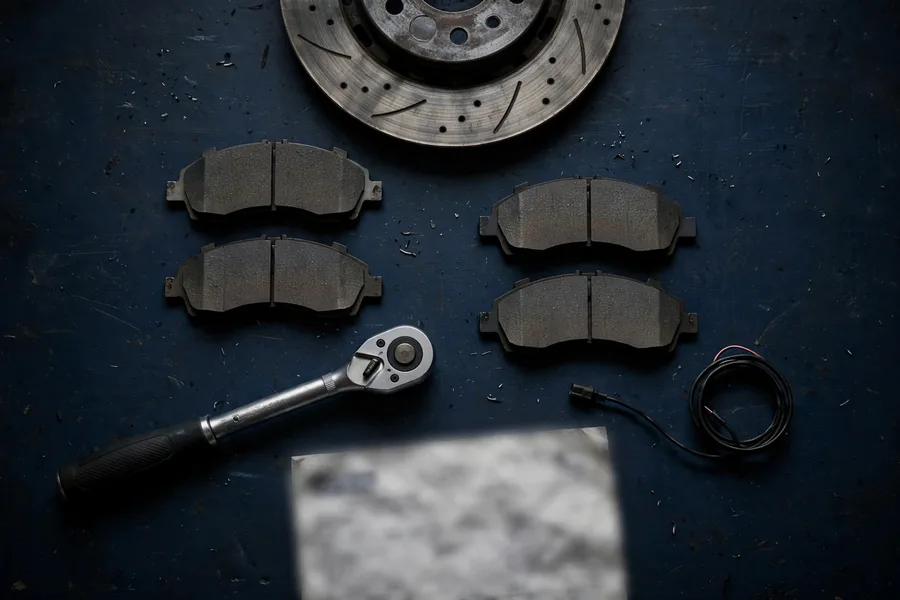
- “Rotors must be replaced with pads.” BMW’s own bulletin says rotors at or above minimum thickness should not be replaced (bulletin summary). Ask for the measured thickness and the stamped minimum before approving rotors.
- Both axles when only one is worn. Fronts and rears wear at different rates. Approving a four-corner job when only the fronts are due can double a bill for no reason.
- Genuine-only pricing presented as the only option. Genuine BMW parts are the priciest tier; ask what the same job costs with OEM or quality aftermarket parts.
- Caliper replacement without evidence. Calipers are replaced for seized pistons, torn boots, or leaks — not as routine maintenance. Ask what failed.
- A brake flush bundled silently. Fluid service is a separate CBS item on its own schedule (see the brake-fluid reset guide), not an automatic part of a pad job.
- The pads-only quote that “discovers” rotors. Ask up front: what rotor thickness would trigger replacement, and will you call me with measurements before adding them?
- Pads with no sensor included. A quote that omits the $10–$25 sensor can mean a second visit — or a warning light that never clears.
Frequently asked questions
Brake cost is only one piece of 3 Series ownership math. The complete BMW 3 Series guide puts it in context with every other maintenance cost by generation, the maintenance schedule tells you when inspections are due, and the brake-fluid and CBS reset guide walks through the service-reminder side of the job once the wrenches are down.
Methodology: these ranges are US planning estimates synthesized in September 2026 from YourMechanic’s live 328i estimator, live retailer parts pricing (BimmerWorld), FCP Euro DIY cost guides, and dated owner-reported dealer and independent quotes (2021). They exclude tax, shop fees, brake-fluid service, and caliper repairs. Dealer rates vary most by metro area; DIY assumes you own basic tools. Anchor data points (estimator figures, listed parts prices, bulletin guidance) carry high confidence; the composite bands are planning ranges, not quotes. Last verified: September 2026.