BMW LPFP Failure Means Long Cranks and Stalls
BMW LPFP failure means the in-tank low-pressure fuel pump can no longer hold its nominal output of about 5 bar (73 psi), so the engine starves for fuel. The classic pattern on a 3 Series is a long crank before starting, stalling or dying while driving (often after 20–45 minutes, then restarting once cooled), limp mode with reduced power, and low-fuel-pressure fault codes such as 29DC, 29F1, 29F2, or EKP module codes 6292 and 6293. On direct-injected engines the weak low-pressure pump also starves the high-pressure pump, so confirming low-side pressure with a BMW-capable scan tool is the key test before replacing anything. Typical repair cost runs roughly $250–$450 DIY, $650–$1,000 at an independent BMW shop, and $1,050–$1,350 at a dealer — and the pump is replaced through an access panel under the rear seat, with no fuel-tank drop required.
Low-pressure vs high-pressure: don’t mix them up. Your 3 Series fuel system has two stages on direct-injected engines (N54, N55, N20/N26, B48, B58): the LPFP (this article) is the electric pump inside the fuel tank that delivers about 5 bar to the engine, while the HPFP is the mechanically driven pump on the engine that ramps fuel up to roughly 50–200 bar for the direct injectors. The two fail differently and are diagnosed differently — our companion guide covers BMW HPFP failure symptoms, testing, and costs in full, so this article stays on the low-pressure side.
What the LPFP does and what pressure it should make
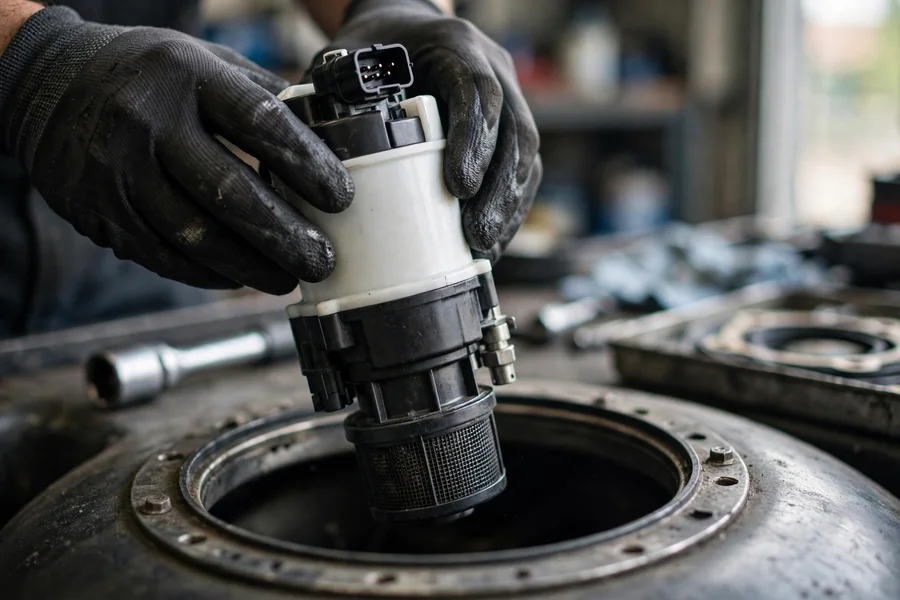
The LPFP — low-pressure fuel pump — is the electric pump that lives inside the fuel tank. It is the first stage of the fuel system: it draws fuel through a strainer sock, pushes it forward through the fuel filter and lines, and delivers it to the engine bay at a steady low pressure. What happens next depends on your engine.
On port-injected 3 Series engines (such as the M54 in the E46 or the N52 in the E90), there is no high-pressure pump at all — the in-tank pump is the entire fuel-delivery system and feeds the fuel rail directly, with a regulator setting rail pressure (about 3.5 bar on the M54, per BMW service documentation). On direct-injected engines (N54, N55, N20/N26, B48, B58), the LPFP is the feed pump: it supplies the mechanically driven HPFP on the engine, which then multiplies that pressure for the direct injectors. A weak LPFP on a direct-injected car therefore shows up as high-pressure-side symptoms — the HPFP simply has nothing to work with.
The pump doesn’t run at a fixed speed. The DME (engine computer) tells the EKP module — the electronic fuel pump control module in the trunk — how much fuel the engine needs, and the EKP drives the pump with a pulse-width-modulated signal, varying its speed with demand. You’ll typically hear the pump prime for about two seconds when you unlock the car; that prime is the system building pressure before you even press the start button.
Nominal low-pressure values, confirmed across BMW service documentation and thousands of owner datalogs:
| Engine family | 3 Series fitment | LPFP nominal pressure | HPFP? | Notes |
|---|---|---|---|---|
| N54 / N55 | E90 335i, F30 335i | ~5 bar (73 psi) | Yes | The reference value techs check first; healthy pumps hold it at idle and under load. |
| N20 / N26 | F30 328i | ~5 bar (73 psi) | Yes | Same low-pressure target as the N55; EKP-controlled. |
| B48 / B58 | G20 330i / M340i | ~5 bar (73 psi), owner logs commonly show 5–6 bar | Yes | Slightly higher readings under load are normal on these engines. |
| M54 / N52 (port injection) | E46, E90 325i/328i/330i | Feeds rail directly (no HPFP) | No | The in-tank pump is the only pump; rail pressure is set by the regulator (~3.5 bar on M54). |
Pressure figures vary slightly by model year and operating condition — always confirm against live data on your own car rather than treating a table as gospel. The diagnostic rule that matters: a healthy LPFP holds a steady ~5 bar at idle and under load. Readings that sag, or jump erratically between roughly 3.9 and 7.9 bar (values repeatedly logged by owners chasing this fault), point at a pump that is failing even if it still runs.
LPFP failure symptoms
A dying LPFP rarely quits without warning. The symptoms progress as the pump loses its ability to hold pressure, and they overlap with HPFP and EKP faults — which is why testing matters before buying parts. The most reported pattern, in order of appearance:
- Long crank. The starter turns noticeably longer than usual before the engine catches, especially on the first start of the day. Residual pressure has bled off overnight and the weak pump is slow to rebuild it.
- Stalling or dying while driving. The engine cuts out, sometimes with no warning, then restarts after a cool-down of 20–45 minutes. This heat-soak pattern is the signature of an overheating EKP module or a thermally fading pump.
- Crank, no start. The starter spins normally but the engine never catches. If you don’t hear the 2-second prime when you unlock the car, the pump likely isn’t running at all.
- Limp mode / reduced power / drivetrain malfunction. On direct-injected cars, low feed pressure starves the HPFP, the DME sees rail pressure drop under load, and it pulls power to protect the engine. See also our BMW drivetrain malfunction guide for the full warning-light picture.
- Surging, hesitation, or misfire-like stumbling under load. Full-throttle acceleration is where fuel demand peaks; a marginal pump falls behind exactly there.
- Whining or whirring from under the rear seat. Fuel pumps are nearly silent when healthy — a new, loud whine is the motor telling you its bearings or brushes are going. Our BMW 3 Series won’t start guide covers the no-start decision tree this symptom feeds into.
- Symptoms only below a quarter tank. Fuel cools and lubricates the pump. If problems appear only at low fuel levels, the pump is marginal and running dry is finishing it off.
Because these symptoms overlap with HPFP, EKP, and ignition faults, use this matrix to aim your testing before spending money:
| Symptom | LPFP | EKP module | HPFP | More likely elsewhere |
|---|---|---|---|---|
| Long crank, starts eventually | Likely | Possible | Possible | Leaking injectors, weak battery |
| Dies after 20–45 min, restarts when cool | Possible | Likely | Unlikely | Crankshaft sensor (heat soak) |
| Crank, no start, no prime heard | Likely | Likely | Unlikely | Blown fuel-pump fuse, wiring |
| Limp mode under full throttle only | Likely | Possible | Likely | Boost leaks, charge pipe |
| Stumbling at low fuel level only | Likely | Unlikely | Unlikely | Faulty fuel-level sender |
| Loud whine from rear seat area | Likely | Unlikely | Unlikely | — |
| Rough idle, misfires, fuel smell | Unlikely | Unlikely | Possible | Coils, plugs, injectors |
Fault codes that point at the LPFP
A BMW-capable scan tool (one that can talk to the DME and the EKP module — generic OBD-II readers often can’t, see our best OBD2 scanner for BMW picks) will usually store one or more of these. BMW’s own technical service information (SI B13 03 09) lists 29DC, 29F1, 29F2, and 2FBF as the low-fuel-pressure faults to watch:
| Code | Module | Meaning | What it tells you |
|---|---|---|---|
| 29DC | DME | Cylinder injection cutout — fuel pressure too low | The DME shut off injectors to protect the engine; low-side delivery is the first suspect. |
| 29F1 | DME | Fuel pressure plausibility, low pressure | Measured low pressure doesn’t match the expected value — sensor, pump, or EKP. |
| 29F2 | DME | High-pressure fuel system pressure too low | Often misread as an HPFP code — but a starving LPFP causes it just as often. Check low pressure first. |
| 2FBF | DME | Fuel pressure on release of injection too low | Delivery-side fault; the pump isn’t keeping up with demand. |
| 6292 | EKP | Fuel pump motor voltage too low | The control module itself is faulting — suspect the EKP module or its power supply before the pump. |
| 6293 | EKP | Fuel pump motor current too high | The pump is drawing excess current (seizing motor) or the module’s driver stage is failing. |
| P0087 | DME (generic OBD-II) | Fuel rail/system pressure too low | The one generic code a basic reader will show; follow it with BMW-specific diagnosis. |
A critical diagnostic habit: on direct-injected cars, 29F2 does not automatically mean the HPFP is bad. Owner communities report dealers repeatedly replacing the HPFP for 29F2 when the actual fault was the low-pressure pump starving it. Log the low-pressure value first — if it’s sagging or erratic, the HPFP is a victim, not the culprit.
LPFP diagnostic lab: find your failure in 60 seconds
Answer the questions below and the tool will narrow your symptom to the most likely cause — LPFP, EKP module, HPFP, or something else entirely — with a confidence rating and the exact next test to run.
How to test the LPFP before replacing it
Never replace a fuel pump on symptoms alone — the EKP module and the HPFP mimic it. Work this list in order; each step is cheap and rules something out.
- Listen for the prime. Unlock the car and put your ear near the rear seat. About two seconds of whirring means the pump runs. Silence means it doesn’t — but that implicates the EKP module, fuse, or wiring just as much as the pump.
- Scan the DME and the EKP module. A BMW-capable tool is non-negotiable here: generic readers can’t see the EKP module where codes 6292 and 6293 live. DME codes 29DC, 29F1, 29F2, and 2FBF confirm a low-pressure-side fault.
- Read live low-pressure data. This is the decisive test. At idle you want a steady ~5 bar (73 psi). Then log it under load — a full-throttle pull in 3rd gear. A healthy pump holds pressure; a failing one sags deeply or jumps erratically (owner logs of failing pumps show swings roughly between 3.9 and 7.9 bar). Erratic readings are as damning as low ones.
- Check voltage at the pump connector. With a helper pressing the start button, back-probe the pump connector under the rear seat access cover. The EKP module drives the pump with a PWM signal, so expect a demand-dependent voltage (technical write-ups typically show around 10 volts) rather than full battery voltage. Voltage present but no prime means a dead pump; no voltage means the fault is upstream.
- Check the fuse and connector. A blown fuel-pump fuse or a corroded connector under the rear seat gives identical symptoms to a dead pump and costs nearly nothing to find. Inspect the EKP connector for heat damage or melting — a known failure point, especially where higher-draw aftermarket pumps have been fitted.
- Note the fuel level. If every symptom appears below a quarter tank and vanishes above half, you’re looking at a marginal pump, a faulty level sender, or a pickup issue — useful information before the tank is opened.
One safety note: on direct-injected cars, never try to measure the high-pressure side with a mechanical gauge — rail pressures in the hundreds of bar will destroy a normal gauge and can injure you. Low-side testing with a scan tool is the safe route.
Should you DIY this repair? Score yourself
The LPFP swap is mechanically simple — no tank drop, just an access panel — but you’re opening a fuel tank. Answer honestly; the tool scores whether DIY makes sense for you.
The EKP module: the pump’s boss
About half of all “fuel pump” misdiagnoses are really the EKP module — the electronic fuel pump control module. Understanding it saves you from replacing a good pump.
The EKP sits between the DME and the pump, mounted in the trunk area (check model-specific documentation for the exact spot on your chassis). The DME calculates how much fuel the engine needs; the EKP translates that into a pulse-width-modulated drive signal that varies the pump’s speed. It also monitors the pump electrically, which is why its own fault codes — 6292 (motor voltage too low) and 6293 (motor current too high) — are so valuable: they tell you the control side is faulting before you blame the pump.
The EKP’s signature failure is heat. The module’s driver stage overheats after 20–45 minutes of driving, shuts the pump down, and the engine dies. After a 20–45 minute cool-down it works again — until the next drive. Owners who’ve caught it in the act report the module being too hot to hold comfortably. If your car matches that pattern and stores 6292/6293, replace the module, not the pump.
Three EKP facts worth knowing:
- A failing pump can kill an EKP, and vice versa. A seizing pump draws excess current, overheating the module’s driver stage; a failing module starves the pump of proper drive. When one has clearly failed, test the other — owners report the module’s connector melting, particularly where higher-draw aftermarket pumps have been fitted.
- Replacement modules typically need coding. The EKP is matched to the car — community reports consistently note that a new module needs programming/coding to the vehicle (some like-for-like used swaps report working without it, but don’t count on that). Budget for coding at a shop with BMW software if you’re DIYing.
- Don’t condemn the pump on EKP codes. If 6292/6293 are present, the module is telling you it has the problem. Replacing the pump for EKP codes is one of the most common wasted repairs in this system.
LPFP replacement cost: dealer vs independent vs DIY
Cost bands below are approximate, compiled from Kelley Blue Book’s fair repair range data (which puts a 3 Series fuel pump replacement at $1,033–$1,290 parts and labor at dealer-typical rates) and widely quoted independent-shop and owner-community figures. Your quote will move with local labor rates, your chassis, and whether the EKP module or filter unit needs attention at the same time.
Figure 1: Typical LPFP replacement cost bands for a BMW 3 Series (parts + labor). Bands are approximate and vary by chassis, region, and parts choice. Dealer-range data: Kelley Blue Book fair repair range.
What drives the numbers: the pump module itself is the big variable. Owner-community parts pricing typically lands the assembly around $250–$450 for quality aftermarket or OEM-supplier units, versus roughly double at a dealer’s parts counter. Labor is modest — shops generally book 1.5 to 2.5 hours because access is through the rear seat, not a tank drop. Add the EKP module and the bill climbs: owners report dealer quotes around $500 for the module alone, versus a fraction of that for the part itself before coding.
Replacing the LPFP: the procedure
Honest difficulty: intermediate. Mechanically this is one of the friendlier BMW repairs — pull the rear seat, open an access cover, swap a module. The difficulty is all in fuel safety: you’re opening the fuel tank inside the car’s cabin. If any step below makes you uneasy, the independent-shop band above is money well spent.
- Run the tank low. Do the job at or below a quarter tank. Less fuel means less spillage and less vapor. Work outdoors or with the garage door fully open.
- Disconnect the battery ground. Non-negotiable. You’re about to unplug an electrical connector inches from an open fuel tank — eliminate every spark source, including power tools.
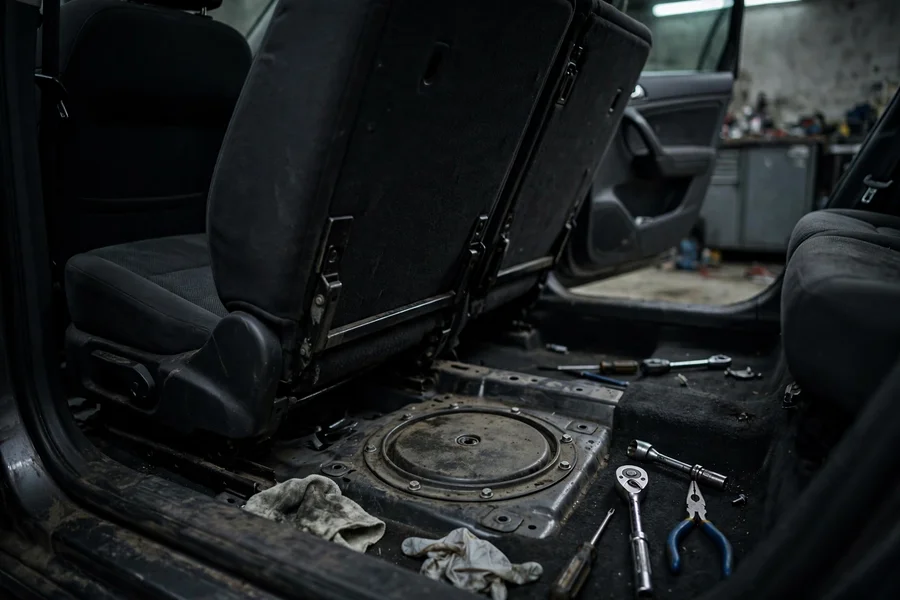
- Remove the rear seat bottom. On E90 and F30 cars it pulls straight up with firm force at the front edge; G20 similar. Fold it forward or lift it out.
- Open the access covers. You’ll find round metal covers on both sides, each held by small nuts (10 mm on E90/F30). The passenger (right) side is the pump module; the driver (left) side on E90 cars is the filter/sender unit. Clean the area thoroughly before opening anything — grit falling into the tank goes straight toward your injectors and HPFP.
- Disconnect the electrical connector and fuel lines. Press the release tabs on the electrical connector. The fuel lines use quick-connect fittings — push the line in first, then release the clip and pull. Have rags ready; residual fuel will drip.
- Remove the lock ring. The large plastic or metal ring threads the module into the tank. A proper lock-ring spanner wrench is the right tool; a brass drift and hammer works with care (brass won’t spark). Mark the module’s orientation before lifting it out.
- Lift out the old module. Go slowly — the fuel-level float arm hangs below and bends easily. Note how the strainer sock, internal hoses, and sender sit; compare with the new unit.
- Fit the new tank seal, then the new module. Always use a new seal/gasket (usually included with the pump). Seat the module in the same orientation, hand-tighten the lock ring, then snug it firmly — no published torque theatrics needed, just properly seated.
- Reconnect lines and connector, refit covers and seat. Fuel lines should click audibly home. Reconnect the battery, unlock the car, and listen for the prime — then check for leaks and fuel smell before driving.
On E90 cars, consider the driver-side filter unit while you’re in there: BMW calls it a “lifetime” filter, but owners chasing low-pressure issues have measured meaningful pressure gains after replacing a clogged one. On F30 and later cars the filter is integrated into the pump module, so it comes with the new pump automatically. Either way, replace the tank seal — reusing a compressed seal is how fuel smells in the cabin start.
Making the next pump last
Fuel pumps die early for preventable reasons. Keep the tank above a quarter — the pump relies on surrounding fuel for cooling and lubrication, and chronic low-fuel running is the most commonly cited killer in owner communities. Buy fuel from busy stations (stale or contaminated fuel clogs the strainer), and address a noisy pump promptly: a whining pump is already telling you its remaining life is measured in months. When buying a used 3 Series, a long crank on the test drive and any stored 29DC/29F2 codes are negotiation leverage — see our used BMW 3 Series buying guide and keep the pump on your 3 Series maintenance schedule radar past 100,000 miles, the mileage where community reports cluster.
Frequently asked questions
Can a bad LPFP damage the HPFP?
Yes — this is the failure owners underestimate. The HPFP is lubricated and cooled by the fuel the LPFP feeds it; running it starved accelerates its wear, and owner communities widely report HPFP and injector damage following an ignored LPFP failure. If your low-pressure readings are bad, fix the LPFP promptly rather than driving on it and turning one repair into two.
How long does a BMW LPFP last?
Owner-community reports cluster around 100,000–150,000 miles for original pumps, but there’s wide variance: pumps run chronically below a quarter tank or on contaminated fuel die much earlier, while gently used ones can outlast the car. Treat 100k miles as the point to start listening for the whine and watching for long cranks, not a scheduled replacement interval.
Can I keep driving with a failing LPFP?
Short, gentle trips at low load are usually possible while you arrange the repair — but every drive risks a stall, potentially at speed or in traffic, and continued starvation can damage the HPFP and injectors. Don’t take it on the highway or far from home, keep the tank above half to help the pump, and fix it within days, not weeks.
Does the EKP module need coding after replacement?
Typically yes. The EKP fuel pump control module is matched to the vehicle, and community reports consistently show a new module needs programming/coding with BMW software before it will drive the pump correctly. Some like-for-like used swaps are reported to work without coding, but that’s the exception — budget for a coding session at a BMW specialist if you’re replacing it yourself.
Should I replace the fuel filter with the LPFP?
On E90 3 Series cars, yes — consider it. The fuel filter lives in the driver-side in-tank unit under the other rear-seat access cover; BMW calls it a “lifetime” filter, but owners chasing low-pressure faults have measured real pressure gains after replacing a clogged one, and you’re already in the tank. On F30 and G20 cars the filter is integrated into the pump module itself, so a new pump automatically means a new filter.