BMW 3 Series Serpentine Belt: When to Replace It ($40 Part)
Short answer: the bmw 3 series serpentine belt replacement interval is roughly every 60,000–90,000 miles or every 4–6 years, whichever comes first — and the belt’s tensioner and idler pulleys should be replaced with it. On E90-generation cars (N52/N54 engines), this is not optional preventative fluff: a shredded belt can be dragged through the front crank seal and into the engine, turning a $40 part into a totaled motor. FCP Euro’s N52 guide recommends an 80,000-mile belt change with the tensioner and idler pulley replaced at the same time, while a Gates technical bulletin calls for inspecting the belt drive system at 60,000 miles and replacing worn components by 90,000. Replace the belt early, replace the pulleys with it, and never drive on an oil-soaked belt.
In this guide:
- Why this $40 part matters more than you think
- The E90’s signature failure: how a shredded belt kills an engine
- Serpentine belt replacement interval by engine
- The 60k vs 100k debate, settled
- How to inspect your serpentine belt
- Tensioner and idler pulleys: replace them as a set
- Oil contamination: the silent belt killer
- DIY replacement: what the job actually involves
- What it costs: DIY vs shop
- Engine & mileage checker
- Frequently asked questions
Why this $40 part matters more than you think
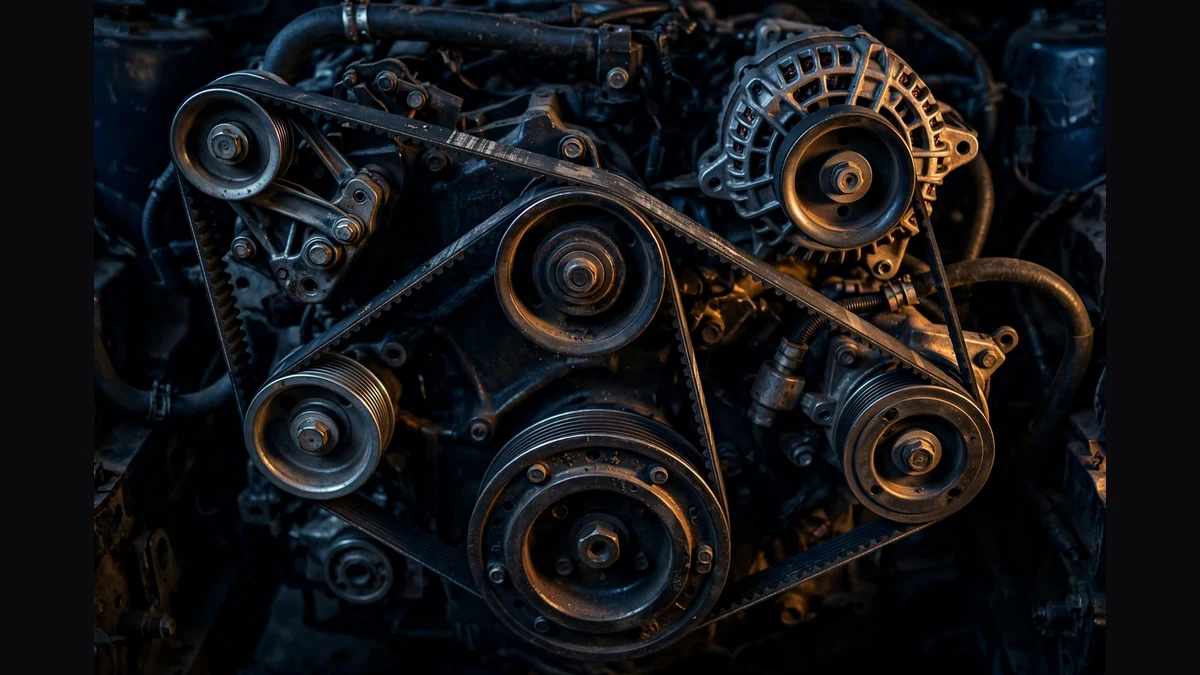
The serpentine belt — also called the accessory belt or drive belt — is the single rubber loop that drives everything bolted to the front of your engine. On the N52 found in most E90 3 Series cars, it spins the power steering pump, the alternator, and the A/C compressor. If the belt or tensioner fails, you lose power steering and your battery stops charging, usually within seconds of each other. FCP Euro’s N52 belt guide warns that “if either of the bearings in the pulleys seizes, the belt can snap and get sucked into the engine.”
First, a critical distinction. Every 3 Series since the E46 uses a timing chain, not a timing belt, to sync the crankshaft and camshafts. The serpentine belt is entirely separate: external, exposed, and designed to be a wear item. A broken serpentine belt won’t instantly bend valves — but on certain BMW engines what happens next is arguably worse, because the belt’s remains can end up inside the engine.
There is also a generational difference: on the older M54 (E46), the belt also drove the mechanical water pump — lose the belt and the engine overheats fast. The N52, N54, N55, N20, B48, and B58 all use electric water pumps, so a snapped belt kills power steering and charging instead, and — on the E90 in particular — creates the conditions for the failure this article is really about.
The E90’s signature failure: how a shredded belt kills an engine
This is the story every BMW forum veteran knows, and it is why belt maintenance on the 3 Series is not like belt maintenance on a Camry. On 2006–2013 BMWs with the N52 or N54 engine, when the serpentine belt shreds, the pieces frequently wrap themselves around the crankshaft pulley. The rotating pulley then drags the belt shreds into the front crankshaft seal, cutting through it and pulling debris into the crankcase. From there, as belt manufacturer Gates documents in technical bulletin TT004-16, the shreds find their way either into the timing chain — causing the engine to jump time — or into the oil pump, starving the engine of oil. The bulletin calls the eventual result “catastrophic engine damage, and a costly repair bill.”
Three things cause the initial shred, per Gates: oil contamination, misaligned pulleys, or a worn tensioner. Note the first: BMW mounted the oil filter housing directly above the belt drive on these engines, so a leaking gasket drips oil straight onto the belt. An oil-soaked belt softens, slips, walks off its pulleys, and shreds — and then the seal-ingestion sequence begins.
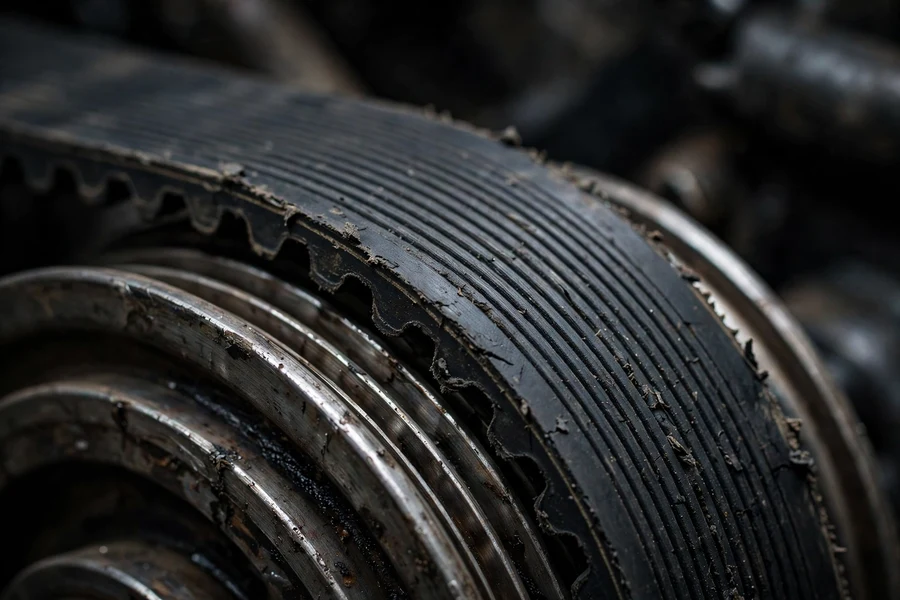
This is not a theoretical failure mode. Owner reports fill the forums. In one bimmerforums thread, an E90 330i owner describes his belt shredding on the road; after a roadside belt replacement the car would only crank without starting — until he drained the oil and found bits of belt inside it. Responders lay out the N-engine diagnosis: a broken belt wraps around the crank pulley, cuts into the crankshaft seal, and in severe cases the dragging belt unscrews the crank bolt, undoing cam-to-crank timing. An e90post thread shows the same on an N54 335i: a belt piece wedged behind the vibration damper, with owners warning that shredded belts get “sucked through the front main and all over inside” the engine.
When ingestion happens, the repair is brutal: drop the oil pan, fish rubber out of the crankcase, replace the front crank seal, and in the worst cases retime or replace the engine. Against that, a $40 belt and a Saturday morning look like the deal of the century — which is the entire point of this guide.
Serpentine belt replacement interval by engine
BMW has never published one clean, universal serpentine belt interval — much of it was folded into “condition-based” maintenance or left to dealer inspection. So the numbers below are compiled from the strongest available sources: specialist guides, manufacturer technical bulletins, and the Bentley manual. Where guidance differs by engine, that is the whole point of the table — the ingestion risk and the belt layout are not the same across generations.
| Engine | 3 Series models | Recommended interval | Basis |
|---|---|---|---|
| M52 / M54 | E46 (1999–2006) | 60,000 miles / 4 years | BMW service information; belt also drives the mechanical water pump, so failure overheats fast |
| N52 / N51 | E90 325i, 328i, 330i (2006–2013) | 80,000 miles; inspect at 60,000 | FCP Euro N52 guide; Gates bulletin: inspect at 60k, replace worn parts by 90k |
| N54 | E90 335i (2007–2010) | 60,000–80,000 miles; err early | Highest documented belt-ingestion rate of any 3 Series engine; tensioner failure is the usual trigger |
| N55 | F30 335i (2012–2015) | 60,000–80,000 miles | Same front-seal exposure as N54; owners widely treat belt + tensioner + idler as a set |
| N20 / N26 | F30 328i (2012–2016) | 80,000 miles | Community consensus (f30.bimmerpost); belt does not drive the electric water pump |
| B48 | F30 LCI 330i (2016–2018) | 80,000 miles | Carryover guidance; long-term failure data thinner than for the N engines |
| B58 | G20 M340i (2019+) | 80,000 miles | Carryover guidance; ingestion-style failures not yet a documented pattern on the B58 |
Two footnotes on that table. First, the N54 earns its stricter guidance honestly: belt-shredding horror stories in E90 communities skew heavily toward the twin-turbo 335i, where a failed tensioner lets the belt slip and chew itself up. Second, “inspect at 60,000” is doing real work in the N52 row — Gates sets 60k as the inspection point and 90k as the replacement deadline for worn components, which means a belt that looks fine at 60k is not one you ignore until 100k.
The 60k vs 100k debate, settled
Ask five BMW owners when to change the serpentine belt and you will get five answers. Here is what each camp is actually citing, and which one to trust.
The 100,000-mile camp points to modern EPDM rubber, which doesn’t crack like old neoprene, and Gates’ 60,000–90,000-mile service-life rating. Owners who have pulled 100k-mile BMW belts that looked fine cite this as proof. The problem: the internal cord structure can fail while the surface still looks acceptable — as one F30 owner was told about his good-looking 92,000-mile belt, you cannot see inside it to know if it’s ready to let go.
The 60,000-mile camp cites the Bentley manual (replace every four years), the Gates bulletin (inspect at 60k, replace worn parts by 90k), and BMW’s older E46 service information (belt replacement around 60,000 miles). FCP Euro splits the difference at 80,000 miles for the N52.
The practical answer: plan on the belt at 60,000–80,000 miles — 60k for N54/N55 cars where ingestion is documented, 80k for N52/N20/B-series cars with oil-free drive systems. Age matters as much as mileage: the Bentley manual’s four-year guidance exists because heat cycling ages rubber regardless of miles. If you don’t know when the belt was last changed — extremely common on used BMWs — assume it is due now.
How to inspect your serpentine belt
Inspection is a five-minute job with a flashlight, done with the engine off and cool. Look at both the ribbed underside and the smooth back of the belt, and run your finger lightly along the ribs to feel for damage your eyes miss. Here is what to look for, and what each sign means.
| Sign | What you’re seeing | Verdict |
|---|---|---|
| Cracking across the ribs | Fine cracks on the ribbed side, visible when the belt is bent | Replace — the classic end-of-life signal for older belts |
| Glazing or shiny spots | Smooth, glossy patches where the rubber has hardened | Replace — hardened belt slips instead of gripping |
| Frayed edges or missing chunks | Threads peeling at the edges, pieces of rib missing | Replace immediately — shredding has started |
| Oil or coolant on the belt | Wet, dark, or swollen-feeling rubber | Replace the belt AND fix the leak — a contaminated belt is a failed belt |
| Squealing on cold start | High-pitched squeal that fades as the engine warms | Inspect now — worn belt, weak tensioner, or contamination |
| Belt riding off the pulley edge | Belt lip hanging over the front edge of the tensioner pulley | Replace belt + tensioner — the tensioner is failing |
| Wobbling or noisy pulleys | Pulley that wobbles, or bearings that sound gritty when spun by hand | Replace the affected pulley/tensioner — a seized bearing snaps belts |
One caveat: EPDM belts often skip the cracking stage entirely. Several owners in the F30 belt-change thread pulled 92,000- and 120,000-mile belts that “looked fine” — and changed them anyway, because a belt that looks fine can still be structurally finished. Inspection catches obvious failures; the mileage and age guidance covers the invisible ones.
Tensioner and idler pulleys: replace them as a set
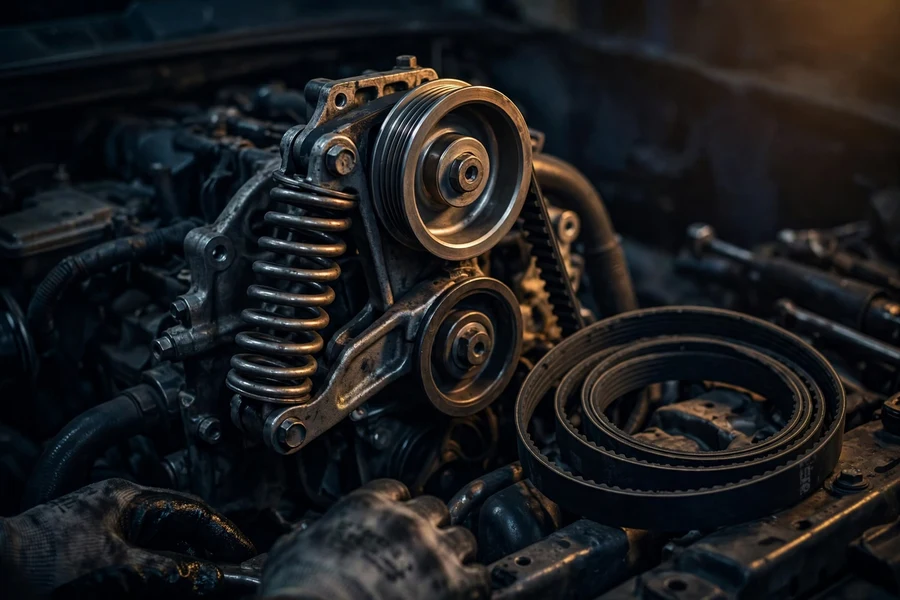
Experienced E90 owners repeat one sentence like scripture: the tensioner is more important than the belt. As one long-time owner put it in an e90post discussion, “if there is not enough tension on the belt and it comes off you might need a new engine.” When the tensioner’s spring weakens or its bearing wears, the belt walks off the edge, slips, and shreds — and then the ingestion sequence begins. A new belt on a dying tensioner is barely an improvement.
That is why the standard practice is to service the whole drive system at once: belt, tensioner, and idler pulley (the N52 uses one; some engines use two). FCP Euro recommends the belt every 80,000 miles “and that the belt tensioner and idler pulley should get replaced along with it” — because “if either of the bearings in the pulleys seizes, the belt can snap and get sucked into the engine.” A seized bearing destroys a healthy belt in minutes: the pulley stops turning and the friction shreds the belt.
The telltale signs of a failing tensioner are worth memorizing, because they appear before the belt does:
- Belt walking off the pulley edge. Open the hood monthly and check the belt’s position relative to the front edge of the tensioner pulley. If the belt lip is hanging over the edge or the belt sits visibly off-center, the tensioner is on its way out.
- Visible wobble at idle. The tensioner arm is supposed to move slightly with engine load; excessive oscillation or a bouncing arm means the damping is gone.
- Chirping or squealing that follows RPM. A bearing on its way out makes noise that rises and falls with engine speed.
- Gritty bearings on the spin test. With the belt removed, spin each pulley by hand. A healthy pulley spins smoothly and quietly; a gritty, notchy, or wobbling pulley is done. Several owners who pulled pulleys at 90,000 miles found worn bearings even though the pulleys were still quiet with the engine running.
One nuance: on the N54, a few owners found the real trigger was worn engine mounts letting the engine flex until a pulley contacted the subframe — later cars got a notched subframe for clearance. And on the E46, pulley layouts vary enough that a bimmerforums thread exists just to sort deflection pulleys from adjustable ones — confirm your car’s layout before ordering a kit.
Oil contamination: the silent belt killer
If the tensioner is the most important mechanical part of this story, oil is the most important chemical one. Oil soaks into the belt, softens and swells the rubber, and turns a grippy belt into a slippery liability. On the N52/N54, BMW mounted the oil filter housing directly above the belt drive system, so a leaking gasket drips oil straight onto the belt. Gates names oil contamination as one of the three causes of belt shredding, and multiple forum owners trace their belt failures directly back to an unattended leak.
The rule is simple: never put a new belt onto an oily drive system. If you see oil on the belt or pooled around the pulleys, the leak must be fixed first — otherwise the new belt is on borrowed time from day one. This is the one half of a two-way relationship between belts and leaks: oil-contaminated belts fail early (this article’s angle), while belt debris can also damage seals from the inside. That second half — belt shreds destroying seals — is covered in our 3 Series oil leak guide, which walks through the leak points that threaten your belt in the first place.
DIY replacement: what the job actually involves
Replacing the belt system is one of the most approachable BMW DIYs — but the difficulty varies sharply by engine, so set expectations by chassis, not by the job’s reputation.
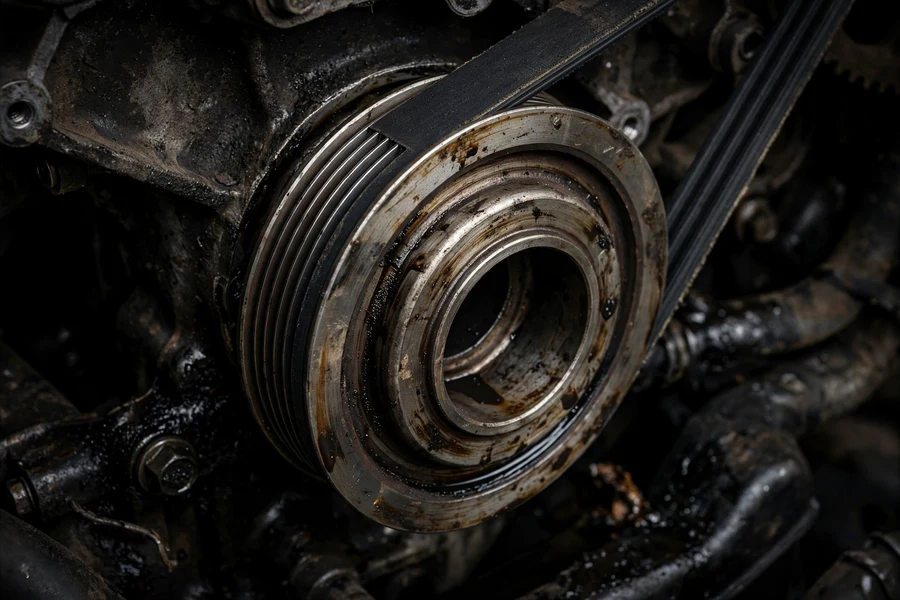
E90 (N52): the easy one. FCP Euro describes a sub-one-hour job needing only sockets, ratchets, and a torque wrench: airbox and electric fan shroud off, rotate the tensioner with a T60 bit to release the belt, then unbolt the idler pulley and tensioner. Their N52 torque figures are 40 Nm for the idler bolt and 25 Nm plus 90° for the tensioner’s aluminum bolt — verify against your model year’s documentation, since bolt designs vary. Photograph the old belt’s path before removal, and make sure every rib seats fully in every groove — a mis-seated belt walks off and shreds itself.
F30 (N20/N26/N55): moderately harder, mostly an access puzzle — about 1.5 hours with roughly $90 in parts once you can reach everything, which is the catch.
F30 LCI (B48/B46): the awkward one — one of the three tensioner bolts is blocked by the intake manifold, with owners debating whether the manifold must come off to reach it. If you own a 2016+ 330i, confirm the access situation for your exact engine before ordering parts.
E46 (M54): easy belt access, though the mechanical fan shroud crowds the front of the engine, and the belt must come off for the water pump — so the two jobs are natural companions.
Regardless of engine, two rules apply. First, photograph the belt routing before you touch anything — BMW bays are tight and the routing is not obvious once the belt is off. Second, never reuse a tensioner bolt specified as single-use, and confirm torque figures against documentation for your specific engine — the numbers differ by engine and year, and this article deliberately prints no universal table.
Good “while you’re in there” companions: the oil filter housing gasket if it is weeping even slightly, and — on the E46 — the water pump and thermostat. On N-engine cars the water pump is electric and unrelated to the belt, so there is no reason to touch it during a belt service.
What it costs: DIY vs shop
Belt service is one of the cheapest insurance policies in BMW ownership, precisely because the parts are inexpensive and the labor is modest. The numbers below reflect typical US pricing; shop rates vary by region.
| Option | What’s included | Typical cost |
|---|---|---|
| DIY: belt only | Serpentine belt, your labor | $20–$40 |
| DIY: full drive kit | Belt + tensioner + idler pulley(s) | $80–$120 |
| Independent BMW shop | Belt-only replacement | $160–$350 |
| Independent BMW shop | Belt + tensioner + idler pulleys | $400–$500 |
| Dealer | Belt service with OEM parts | $500–$800+ |
The $400–$500 independent-shop figure for the full service comes up repeatedly in owner reports, and it lines up with published estimates: one pricing service estimates $163 on average for a belt-only replacement on a 3 Series, with shop and dealer prices reaching $300–$530 for the belt alone. Add the tensioner, pulleys, and their labor and you land in the $400–$500 range at a good independent shop — the sweet spot if you are not doing it yourself.
The economics only make sense as the full kit. Paying $160–$350 for a belt-only replacement while leaving a worn tensioner in place is false economy: the tensioner is the part most likely to cause the catastrophic failure, and its labor is nearly free when done with the belt.
Serpentine belt checker: replace now, or inspect?
Pick your engine and enter your mileage and belt age for a verdict based on the intervals in this guide.
Frequently asked questions
How often should I replace the serpentine belt on my BMW 3 Series?
Every 60,000–80,000 miles or every 4–6 years, whichever comes first. Aim for 60,000 on N54/N55 engines where belt-ingestion failures are a documented pattern, and up to 80,000 on N52, N20, and B-series engines with clean, oil-free drive systems. Always replace the tensioner and idler pulleys at the same time. If you don’t know when the belt was last changed, treat it as due now.
Can a broken serpentine belt really destroy my BMW’s engine?
Yes — mainly on 2006–2013 models with the N52 or N54 engine. When the belt shreds, the pieces can wrap around the crankshaft pulley, get dragged through the front crankshaft seal into the crankcase, and end up in the timing chain (causing the engine to jump time) or the oil pump (starving the engine of oil). Gates documents this failure mode in technical bulletin TT004-16, calling the result “catastrophic engine damage.”
Should I replace the tensioner and idler pulleys with the belt?
Yes — belt, tensioner, and idler pulley as a set, every time. The tensioner is arguably more important than the belt itself: a worn tensioner lets the belt walk off its pulley edge and shred, and a seized pulley bearing can destroy a healthy belt in minutes. A complete drive kit costs roughly $80–$120 in parts, so skipping the pulleys to save a few dollars is the textbook definition of false economy.
Does BMW specify an official serpentine belt replacement interval?
Not a single clean one for modern cars — much of it was folded into condition-based maintenance. The Bentley manual instructs owners to inspect the belt with the engine off and replace it every four years. The most useful published numbers come from elsewhere: FCP Euro recommends 80,000 miles for the N52, Gates calls for inspection at 60,000 and replacement of worn components by 90,000, and the E46’s BMW service information specified roughly 60,000 miles.
How long does it take to replace a serpentine belt on a 3 Series?
Under an hour on an E90 with the N52 (airbox and fan shroud off, then sockets and a torque wrench), and about 1.5 hours on F30 cars with the N20 or N55. The F30 LCI with the B48 can take longer because a tensioner bolt is awkwardly blocked by the intake manifold. Always photograph the belt routing before removal and confirm every rib is seated in every pulley groove before starting the engine.
How much does a BMW 3 Series serpentine belt replacement cost?
The belt itself costs $20–$40, and a complete belt + tensioner + pulley kit runs about $80–$120 in parts — a straightforward DIY. Expect roughly $400–$500 at an independent BMW shop for the full service, or $160–$350 for a belt-only replacement (not recommended, since the tensioner is the part most likely to cause a catastrophic failure). Dealers typically charge $500–$800 or more.
The serpentine belt is the rare BMW maintenance item where the part’s cost and the cost of ignoring it live in different universes. An $80 kit and an afternoon — or $400–$500 at a good independent shop — closes the door on the belt-ingestion failure that has totaled more E90s than almost any other wear item. For the rest of the picture, the complete 3 Series guide puts the belt in context, our maintenance schedule shows where this service sits in your calendar, and the oil leak guide covers the leaks that are the belt’s worst enemy. Fix the drips, change the belt on time, and the $40 part stays a $40 part.