BMW VANOS & Valvetronic: 2A82/2A87 Symptoms & Costs
There is a special kind of frustration reserved for BMW owners who open their scanner and find a wall of codes that all sound like the same problem: intake VANOS, exhaust VANOS, Valvetronic, eccentric shaft — and then, on a turbo car, a boost-pressure code for good measure. It looks like the whole engine is dying. In most cases it is not. It is one hydraulic system (VANOS), or one electric one (Valvetronic), complaining in the only language it has: fault codes.
BMW’s variable valve timing and variable valve lift systems are the reason 3 Series engines idle smoothly, pull hard from low rpm, and sip fuel on the highway. When they fail, the symptoms overlap so completely that owners routinely misdiagnose the problem — sometimes as a dead turbo, sometimes as bad coils, sometimes as “just old age.” This guide separates the two systems, decodes the fault codes that matter (2A82, 2A87, 2A83, and the Valvetronic family), and lays out what each fix actually costs.
The short answer
The classic BMW VANOS symptoms behind codes 2A82 and 2A87 are rough idle, a sudden loss of power or limp mode that often clears temporarily when you restart the car, and noticeably worse fuel economy. Both codes mean a camshaft phaser — intake for 2A82, exhaust for 2A87 — is mechanically stuck and cannot reach the timing position the engine computer commands. The usual culprit is a clogged or failed VANOS solenoid, or restricted oil supply to the phaser. BMW’s own service bulletin (SI B11 02 08) prescribes replacing both solenoids together with an oil and filter change; cleaning a solenoid is a gamble, not a fix. Valvetronic problems are the separate half of the story: when the eccentric-shaft sensor or Valvetronic motor fails, expect hard cold starts, a surging idle, and Valvetronic codes such as 2A37 or 2A47 instead of VANOS codes.
In this guide
- The failure signature: what VANOS and Valvetronic problems feel like
- Fault-code decoder: 2A82, 2A87, 2A83, and the Valvetronic family
- VANOS vs Valvetronic: two systems, one confusion
- Why owners misdiagnose this as turbo failure
- Per-engine differences: N52/N54 vs N20/N26 vs B46/B48
- Check the VANOS bolt recall before you spend a dollar
- Clean vs replace: the VANOS solenoid decision tree
- Valvetronic motor and eccentric shaft sensor: replace, don’t clean
- Real fix costs: DIY, independent shop, and dealer
- The diagnostic order that saves you money
- Frequently asked questions
Where this guide fits. This article is a system deep-dive on BMW’s variable valve timing (VANOS) and variable valve lift (Valvetronic) systems in the 3 Series. If your check engine light is on for anything else — misfires, emissions faults, cooling problems, sensors — start with our complete check engine light causes hub, which maps every common trigger and links back here whenever the codes turn out to be VANOS or Valvetronic. That hub is the map; this article is the territory for these two systems.
The failure signature: what VANOS and Valvetronic problems feel like
BMW’s bulletin SI B11 02 08 — filed with NHTSA and readable in full — describes the pattern owners know: the Service Engine Soon light comes on with reduced power, often after driving at full operating temperature — and cycling the ignition restores normal performance, until the next hot drive.
The restart-and-recover cycle is the VANOS hallmark. The full symptom list:
- Rough or hunting idle. Wrong cam timing at idle makes the engine stumble, surge, or stall at stoplights — the most reported symptom of both VANOS and Valvetronic failure.
- Sudden power loss or limp mode. The DME cuts power to protect the engine, often with a check-control message. On the N54 this arrives with boost-cut codes that mimic turbo failure (more below).
- Worse fuel economy. Cam timing that never reaches its efficient positions costs MPG long before the car feels broken.
- Rattling or tapping from the valve train. Worn phasers and timing components announce themselves audibly, especially cold.
- Hard cold starting (Valvetronic). When the eccentric-shaft sensor can’t report valve lift, the engine struggles to start and may surge or stall in the first minute.
- A light that comes and goes. Intermittent codes that clear and return are typical — the system only fails its self-test under specific temperature and load conditions.
One distinction that rules out impostors: VANOS faults make the car feel wrong across the operating range — flat, rough, or thirsty everywhere — not fine-until-boost. Wrong only under hard load? Suspect the boost system. Wrong everywhere? Suspect the valvetrain.
Fault-code decoder: 2A82, 2A87, 2A83, and the Valvetronic family
BMW’s fault texts are precise but cryptic. Pick your code:
VANOS / Valvetronic code decoder
Select the factory code your scanner reported.
Triage aid, not a diagnosis. The full reference table with generic-code equivalents follows below. If your scanner only shows generic codes, look for P0012 / P0015 as the OBD-II mirrors of 2A82 / 2A87.
The full reference table, with newer-DME variants and the generic codes a basic scanner shows instead:
| Code | Meaning | Points to | First move |
|---|---|---|---|
| 2A82 | VANOS intake – stiff; jammed mechanically | Intake solenoid or oil supply to intake phaser | Both solenoids + oil/filter |
| 2A87 | VANOS exhaust – stiff; jammed mechanically | Exhaust solenoid or oil supply to exhaust phaser | Both solenoids as a pair |
| 2A83 | Intake VANOS control fault – position not reached | Phaser can’t reach position; if solenoids don’t fix it, bearing-ledge wear | Solenoids first, then pro ledge inspection |
| 130108 / 130308 | VANOS intake/exhaust: control fault, position not reached | Newer-DME versions of 2A82/2A87 | Same as 2A82/2A87 |
| 2A32 / 2A34 | Valvetronic eccentric shaft sensor: reference | Sensor reference fault | Check connector for oil; replace sensor |
| 2A37 / 2A47 | Valvetronic eccentric shaft sensor: plausibility | Implausible readings — oil ingress likely | Replace sensor + gaskets |
| 2A43 / 2A45 / 2A3F / 2A77 | Valvetronic sensor circuit faults | Sensor electronics failing | Replace sensor + gaskets |
| 133B04 / 133E10 | Valvetronic: no adjustment possible / deactivated (N20/N26) | Lost adaptation or failing motor/sensor | ISTA recalibration, then motor/sensor |
| 3100 / 120408 | Boost pressure control deactivation (N54) | Consequential to VANOS fault — not turbo failure | Fix VANOS first; re-scan |
| P0012 / P0015 | Cam timing over-retarded (generic OBD) | Generic mirrors of 2A82/2A87 | Same as 2A82/2A87 |
Note: 2A82/2A87 are quoted verbatim from BMW’s bulletin; 2A3x and 133Bx wordings come from documented owner and specialist reports.
VANOS vs Valvetronic: two systems, one confusion
Most confusion around these codes comes from treating VANOS and Valvetronic as one thing. They are two separate systems under the same valve cover with similar symptoms. The split:
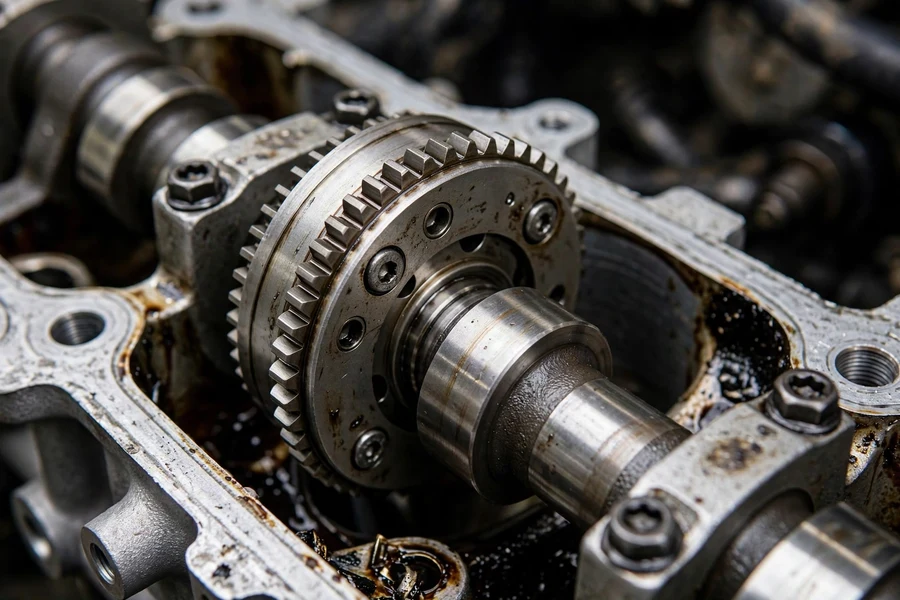
- VANOS = variable valve timing. A phaser at the front of each camshaft rotates the cam relative to the crankshaft, advancing or retarding valve opening. Oil pressure moves the phaser; the solenoids meter that oil. When a solenoid sticks or pressure drops, the cam can’t reach its commanded position and the DME stores 2A82/2A87/2A83. The system is hydraulic — oil quality and cleanliness dominate every VANOS diagnosis.
- Valvetronic = variable valve lift. An extra eccentric shaft with intermediate arms sits between the intake cam and the valves; an electric stepper motor rotates it, changing how far the intake valves open. At part load it effectively replaces the throttle plate. The eccentric-shaft sensor reports shaft position to the DME constantly; when it lies or dies, the DME stores the 2A3x family and falls back to throttle-body operation. Electric and mechanical — its failures are sensor and motor failures, not oil failures.
Why the distinction matters for your wallet: a VANOS problem is usually fixed from the outside — solenoids at the front of the head, an oil change, no valve-cover removal. A Valvetronic problem is fixed from the inside — the valve cover comes off and you pay for labor hours. Mix the two up and a $300 solenoid job becomes a $1,800 sensor replacement you didn’t need, or vice versa.
Why owners misdiagnose this as turbo failure
The most expensive misunderstanding in the VANOS/Valvetronic world has a documented mechanism. On the N54 335i, BMW’s bulletin explicitly lists 120408 (charge-air pressure control cutout) and 3100 (boost pressure control deactivation) as secondary faults stored alongside 2A82/2A87 — the boost codes are a consequence of the VANOS fault.
Here is what happens in practice. A phaser sticks, the DME sees cam timing it can’t correct, and as a protective measure it deactivates boost control — no boost, reduced power, drivetrain warning. The owner scans the car, sees “boost pressure” faults, and reasonably concludes the turbos are dying. Shops have replaced turbos, wastegates, and charge systems for this. But the bulletin’s cause section is unambiguous: insufficient oil pressure to the VANOS adjustment unit is the root, and the boost faults are downstream of it. Fix the VANOS fault and the boost codes clear on their own.
The same trap exists in milder form on the four-cylinders. On an N20 328i, a Valvetronic fault can trigger limp mode that feels exactly like a failed turbo — no power, flat delivery, drivetrain malfunction on the cluster. Before anyone quotes a turbo replacement, check for 133B04/133E10 or the 2A3x sensor codes. Standing rule for any turbo BMW: if boost codes arrive together with VANOS or Valvetronic codes, treat the valvetrain codes as primary. The turbo is almost always the victim, not the criminal.
Per-engine differences: N52/N54 vs N20/N26 vs B46/B48
Not every 3 Series engine has both systems, and the parts you’ll touch differ by family. Two consequences to carry from this table: on an N54 335i, delete Valvetronic from your checklist entirely — anyone suggesting the eccentric-shaft sensor on your 335i is thinking of the wrong engine. And on an N20, “replace the VANOS solenoid” is a 20-minute external job while “replace the VANOS valve” is a valve-cover-off job — make sure any quote names the actual part.
| Engine | 3 Series applications | VANOS | Valvetronic | What’s different here |
|---|---|---|---|---|
| N51 / N52 | E90/E91/E92/E93 325i, 328i, 330i (2006–2011) | Double VANOS | Yes (2nd gen) | The classic 2A82/2A87 engine. Known deep failure: camshaft bearing-ledge wear. Known Valvetronic failure: eccentric-shaft sensor oil ingress. 2010–2012 cars fall under the VANOS bolt recall below. |
| N54 | E90/E92/E93 335i (2007–2010) | Double VANOS | No — conventional throttle body | No Valvetronic codes possible. Sets secondary 3100/120408 boost faults with VANOS codes — the turbo-misdiagnosis engine. Solenoid and valve are one slide-in unit per cam. |
| N55 | E90/F30 335i (2011–2015) | Double VANOS | Yes (3rd gen) | Same slide-in solenoid design as the N52; Valvetronic returns, so 2A3x sensor codes rejoin the picture. |
| N20 / N26 | F30 328i (2012–2016) | Double VANOS | Yes | Solenoid and valve are separate parts: the solenoid is an external bolt-on swap, while the VANOS valve bolt needs the cover off and the cams locked (per a BMW master technician). See also our N20 vs N26 guide. |
| B46 / B48 | G20 330i (2019+) | Double VANOS | Yes (latest gen) | Newest architecture in this group. Same components, same diagnostic logic; age-related failures are simply reported less often because the fleet is younger. |
Check the VANOS bolt recall before you spend a dollar
If you drive a 2010–2012 N52-powered 3 Series, check your VIN before buying a single part. Recall 23V-707 covers roughly 155,000 vehicles — including the 328i — for VANOS assembly bolts that can loosen and break. Symptoms mirror this article: rough running, limp mode, stalling, sometimes no-start. Dealers replace the bolts at no cost.
Run your VIN through the NHTSA recall lookup — two minutes, and the repair is free if your car is covered. This is the rare “VANOS problem” that’s BMW’s bill, not yours.
Clean vs replace: the VANOS solenoid decision tree
Some owners cleaned their VANOS solenoids and “fixed” 2A82/2A87 for a weekend; others cleaned them and fixed nothing. Both outcomes are real — cleaning only addresses some failure modes. The decision tree, in order — each step cheaper than the next:
- Scan with a BMW-capable tool. Record every code, including shadow codes. Generic readers show only P0012/P0015; you want the factory 2A8x codes to identify the stuck bank.
- Audit the oil. Level, condition, spec, and honest service history. VANOS sits at the far end of the oil circuit — low, overdue, or wrong-viscosity oil is the most common root cause. If it’s due, change it to spec, clear codes, and drive before buying parts.
- Check the oil-filter-cap insert. Per BMW’s bulletin, the insert in the filter housing cap can be discarded with the old filter during a sloppy oil service — then unfiltered oil damages the solenoids and the whole cap must be replaced. One owner traced months of 2A82/2A87 misery to exactly this after a bad oil change.
- Pull the solenoids and read the screens. On the N52/N54/N55 they slide out of front bores; on the N20 the solenoid is an external bolt-on. Fine mesh screens guard the piston. Varnished screens with a freely moving piston may respond to brake-cleaner cleaning — temporarily. Packed debris, a scored bore, or metal particles mean permanent wear: cleaning is theater.
- When in doubt, replace — both. BMW’s procedure: replace both solenoids, change the oil and filter, verify with a drive. Roughly $60–$150 each DIY, under an hour on the six-cylinders.
- Codes return with new solenoids and fresh oil? Stop throwing parts. That points to the camshaft bearing ledge: worn hook-ring seals bleed oil pressure past the phaser, and no solenoid can compensate. Professional teardown — cams out, ledge assessed, seals replaced — and the point where DIY ends.
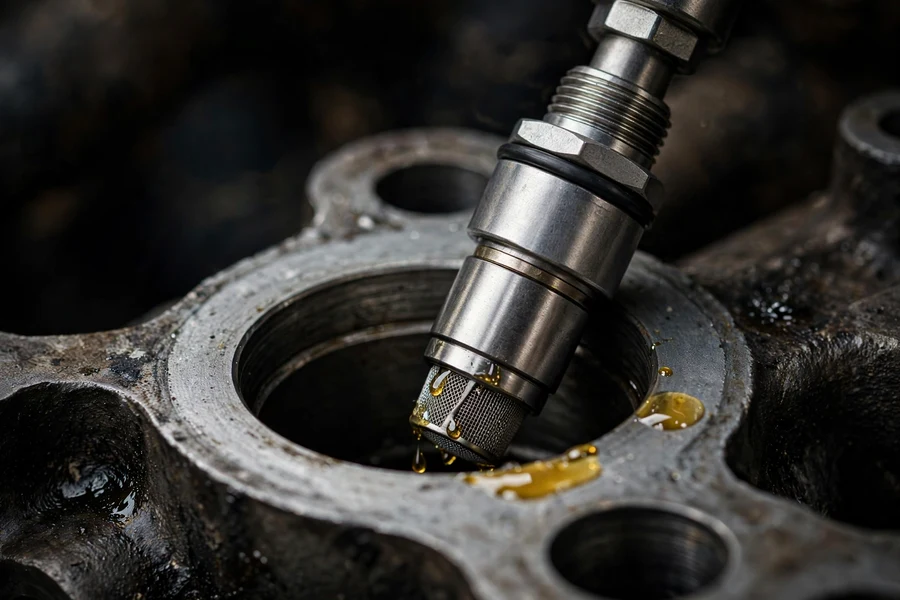
One caution: bench-testing a removed solenoid with a 9V battery is a popular forum trick; one documented attempt ended with a shorted solenoid and a no-start. Judge by piston movement, bore condition, and screens instead.
The deeper lesson: most “failed” solenoids are victims of oil neglect — they sit at the end of the oil circuit needing clean, pressurized oil to work and stay cool. As one experienced owner put it, when both solenoids code at once it’s usually an oil-delivery problem. Fix the oil first.
Valvetronic motor and eccentric shaft sensor: replace, don’t clean
Valvetronic components have no cleaning option worth discussing. Two failure-prone parts; the sensor fails first and most often:
- Eccentric shaft sensor. Lives inside the valve cover, bathed in hot oil vapor; its electronics eventually lose to oil ingress. The tell: oil inside its electrical connector. Signature symptoms per a specialist failure guide — hard cold starts, surging idle, power loss, excess fuel consumption — with the 2A3x family as confirmation. The valve cover has to come off, so replace the sensor gasket, valve cover gasket set, and actuator seal in the same job — don’t pay that labor twice.
- Valvetronic motor (servo motor). The electric stepper that rotates the eccentric shaft. Failure modes include damaged internals, low voltage, and a binding shaft overloading it. A professional technical trainer advises checking service bulletins and programming updates before replacing parts — software has cured more than a few.
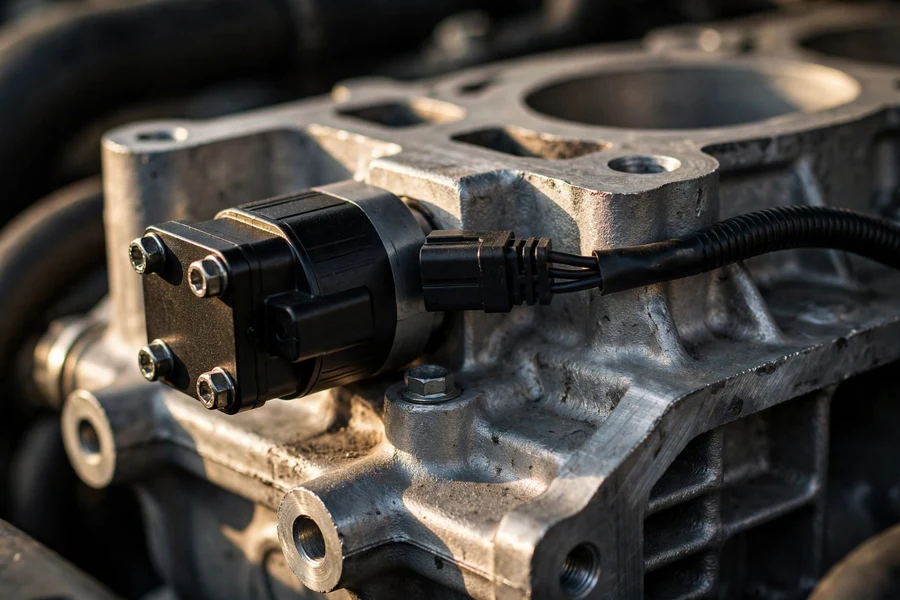
Two money-savers. First, on the N20/N26 a lost adaptation can set 133B04/133E10 and trigger limp mode with no failed part — one documented case was fixed entirely through ISTA recalibration. Always attempt the limit-learn before ordering a motor. Second, rule out the battery: the motor is a heavy electrical load, and weak voltage can produce faults that vanish once the electrical system is healthy.
Real fix costs: DIY, independent shop, and dealer
Costs below are grounded in BMW’s prescribed procedures, a recent survey of BMW VANOS repair costs, and owner-reported invoices. Ranges are regional — metro labor rates run higher — but the ratios between columns hold:
| Repair | DIY (parts) | Independent BMW shop | Dealer |
|---|---|---|---|
| VANOS solenoid pair — cleaned | $0–$40 (cleaner, maybe an early oil change) | Rarely offered as a service | Not offered |
| VANOS solenoid pair — replaced, with oil & filter | $120–$300 (both solenoids) | $400–$800 | $700–$1,200 |
| Oil filter housing cap (missing insert) | $80–$150 | $150–$300 | $200–$400 |
| Camshaft bearing ledge repair | Not a DIY job | $1,500–$2,500+ | $2,500+ |
| Valvetronic eccentric-shaft sensor + gasket set | $350–$650 | $1,200–$1,800 | $1,800–$2,500 |
| Valvetronic motor | $300–$600 | $600–$1,000 | $1,000–$1,500 |
Read the table by value. The solenoid job is the best value in BMW ownership: under an hour on the six-cylinders, fixing the large majority of 2A82/2A87 cases. The eccentric-shaft sensor is the opposite — the valve cover has to come off, so labor and gaskets dominate the invoice. Never do that job twice: if the cover is already off for a leaking gasket, replace an aging sensor while you’re in there.
At the high end, bearing-ledge work and full rebuilds ($2,500–$4,000+ all-in) are where high-mileage N52 owners face a keep-or-move-on calculation. Get the ISTA test-plan diagnosis in writing — “maybe the ledge” isn’t a diagnosis worth teardown labor.
The diagnostic order that saves you money
Ordered by cost — free checks first, expensive parts last — mirroring BMW’s own bulletin logic:
- Scan properly. Use a BMW-capable scanner. Record the factory codes (2A82/2A87/2A83/2A3x), any shadow codes, and whether boost codes (3100/120408) are riding along.
- Check the recall. 2010–2012 N52 cars: run the VIN through the NHTSA lookup for 23V-707. Free beats cheap.
- Audit the oil. Level, condition, spec, service history, plus the filter-cap insert check. Change it if due; many VANOS stories end here.
- Follow the code decoder above. Solenoid pair + oil service for 2A82/2A87; recalibration for N20 Valvetronic codes; connector check for 2A3x codes; VANOS-first for boost codes riding along.
- Clear, drive, re-scan. Intermittent VANOS faults need a hot drive cycle to re-arm. If the codes stay gone through a full warm-up and a few days of driving, you’re done.
- Escalate with evidence. Codes that return after fresh solenoids and clean oil earn a professional ISTA test plan — bearing-ledge inspection for VANOS, limit-learn and motor testing for Valvetronic.
BMW VANOS & Valvetronic problems: quick answers
What do BMW fault codes 2A82 and 2A87 mean?
Can I drive with 2A82 or 2A87 codes stored?
Will cleaning VANOS solenoids fix 2A82 and 2A87?
Are 2A82/2A87 codes a sign my BMW turbo is failing?
How much does it cost to fix BMW VANOS problems?
Does the N54 engine have Valvetronic?
What causes the Valvetronic eccentric shaft sensor to fail?
VANOS and Valvetronic failures look catastrophic on a scanner and feel catastrophic behind the wheel, but the diagnostic logic is refreshingly simple: oil and solenoids for the hydraulic side, sensors and motors for the electric side, and the factory codes — not the consequential boost codes — as your compass. If this guide saved you from a turbo quote you didn’t need, the system worked as intended. For fault codes outside these two systems, our check engine light causes hub picks up where this article leaves off, mapping every other common trigger. For the full ownership context — maintenance schedules, buyer guidance, and how these systems fit into each generation — see the complete 3 Series guide. And if you’re cross-shopping the four-cylinder cars where the N20’s split solenoid-and-valve design changes the labor math, the N20 vs N26 comparison has the details that matter.