Your BMW’s ‘Chassis Stabilization’ Warning, Decoded
Short answer: BMW chassis stabilization warning — usually phrased “Chassis stabilization malfunction. Drive moderately.” — means Dynamic Stability Control has lost confidence in the data it is seeing and has restricted itself. The most likely causes, in order, are a steering-angle sensor plausibility fault, low battery voltage, or — on xDrive cars — the transfer-case actuator. This is not the same as the ABS/DSC “trifecta”: the trifecta lights three lamps and skews toward wheel speed sensors and the ABS module, while this message skews toward steering-angle and voltage problems. Scan every module with a BMW-capable tool (generic readers miss chassis codes), note the exact code, and work through the diagnosis steps below.
In this guide
- Not the trifecta: what this warning is and isn’t
- What “chassis stabilization” actually means
- Causes ranked from most to least likely
- Fault-code table (community-reported codes)
- Step-by-step diagnosis in the right order
- Interactive diagnostic picker: match your situation to the likely cause
- Repair options with honest difficulty ratings and cost bands
- When it’s safe to keep driving — and when it isn’t
- Five frequently asked questions
Not the trifecta: read this first
If you have already seen a guide about BMW’s ABS and DSC warning lights — the infamous “trifecta” of amber ABS, DSC triangle, and BRAKE lamps glowing together — this is a different animal. The two problems overlap enough to confuse owners and parts catalogs alike, so the distinction matters before you spend money on the wrong repair.
The trifecta is a lamp combination: three dashboard lights pointing at the wheel speed sensors, the reluctor rings they read, or the ABS/DSC module itself. “Chassis stabilization” is a text message — the stability system’s internal plausibility checks failed. In practice the trifecta’s fix is usually a wheel speed sensor or a module rebuild; this message’s fix is usually steering-angle or battery related. Same system, different failure neighborhoods.
Quick separator: if you are staring at three amber lamps, start with the trifecta guide. If you got a written “chassis stabilization” message — especially after an alignment, a curb strike, a jump start, or the car sitting unused — you are in the right place.
| Chassis stabilization message | ABS/DSC trifecta | |
|---|---|---|
| What you see | Text message, often with the DSC triangle | Three amber lamps: ABS + DSC + BRAKE |
| System’s complaint | “I can’t trust my inputs” — plausibility failure | “A subsystem has failed” — component failure |
| Most common fixes | Steering-angle calibration/sensor, battery, transfer-case actuator | Wheel speed sensor, reluctor ring, DSC module rebuild |
| Typical triggers | Alignment, curb strike, battery disconnect or jump start, car sitting | Heat, mileage, road salt, vibration |
What “chassis stabilization” actually means
Your BMW’s Dynamic Stability Control (DSC) is a watchdog that never blinks. Many times per second it fuses data from a set of sensors to decide whether the car is going where you are pointing it, and it corrects any mismatch by cutting engine power and braking individual wheels — BMW’s own description confirms that DSC reduces drive power and brakes wheels individually to keep the car on a steady course. The “chassis stabilization” message appears when that watchdog can no longer trust the data, so it partially or fully restricts itself and tells you to drive moderately.
| Input | What it tells DSC | What trips the message |
|---|---|---|
| Steering-angle sensor | Where you are pointing the car | Sensor drift, lost calibration, or a mismatch with actual steering |
| Wheel speed sensors | How fast each corner is turning | Dropout or implausible readings at one or more corners |
| Yaw-rate sensor | How fast the car is rotating | Signal that disagrees with steering angle and speed |
| Lateral-acceleration sensor | Sideways force on the chassis | Stuck, offset, or noisy readings |
| Brake pressure sensors | Longitudinal forces under braking | Out-of-plausibility pressure readings |
| Transfer-case feedback (xDrive) | How torque is split front/rear | Actuator position the module cannot verify |
| System voltage | The reference everything is measured against | A weak battery corrupting multiple readings at once |
DSC only acts when its sensors agree on what the car is doing. If the steering-angle sensor says you are going straight but the yaw sensor disagrees, the system deadlocks — and rather than stabilize you on bad data, it restricts itself and posts the warning. “Drive moderately” is genuine advice: your safety nets are degraded, not just annoyed.
Causes, ranked from most to least likely
These are ordered by how often each one actually turns out to be the fix in owner repair reports and independent-shop write-ups — deliberately skewed toward what this message means, not toward the trifecta’s different center of gravity. Start at the top and work down.
1. Steering-angle sensor plausibility — the runaway #1
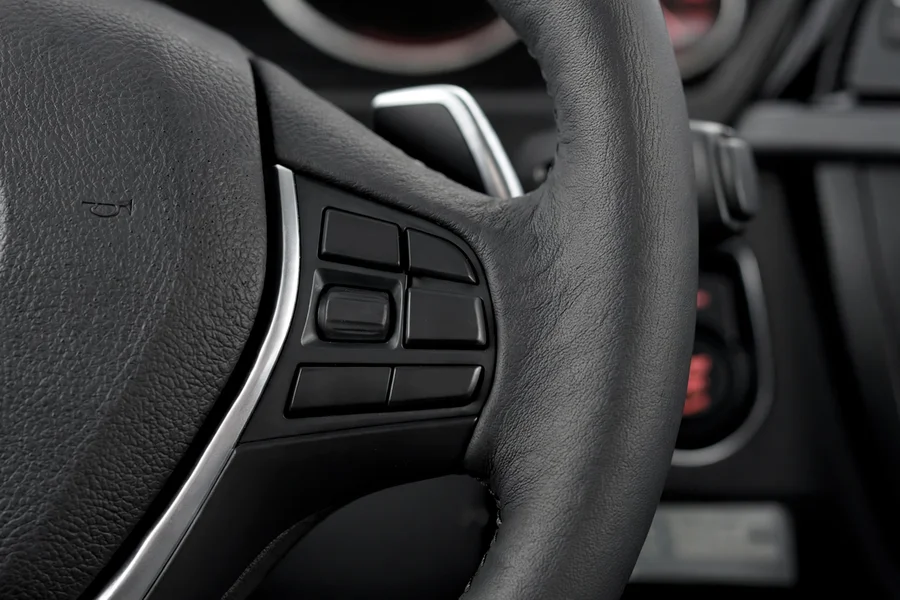
This sensor tells DSC where you are pointing the car, and it is the input most likely to disagree with reality. It lives in the column switch cluster (older chassis) or is integrated with the electric power steering (EPS) rack (newer ones), and fails in three familiar ways: it drifts out of calibration, loses its reference after a battery disconnect or jump start, or disagrees with the alignment — an off-center wheel after an alignment or curb strike means the sensor reports “straight ahead” while the car steers slightly sideways, and DSC refuses to work with that contradiction. One 2019 330i xDrive owner got the message with an off-center wheel after a curb slide; the fix path was a suspension inspection and a four-wheel alignment.
The telltale: the warning appears after alignment work, a tire change, steering-wheel removal, suspension work, or a curb strike — or the wheel simply sits off-center on a straight road. On EPS cars the sensor inside the rack can fail outright: one F30 328i owner’s dealer pulled code D3244 (steering angle faulty from the EPS) and replaced the rack. Before spending money, try the lock-to-lock recalibration in the diagnosis section — it clears the no-part cases.
2. Low battery voltage — the cheapest and most embarrassing miss
BMW chassis electronics are famously voltage-sensitive, and this warning is a classic symptom of a tired battery. The pattern is unmistakable: the message appears after the car sat unused, after a jump start, or after a battery was replaced without registration. One F25 X3 owner’s error showed up with the battery at just 67% charge; another case appeared on a car that had simply sat all summer. Voltage dips corrupt sensor references across multiple modules at once — exactly the multi-sensor disagreement this message describes.
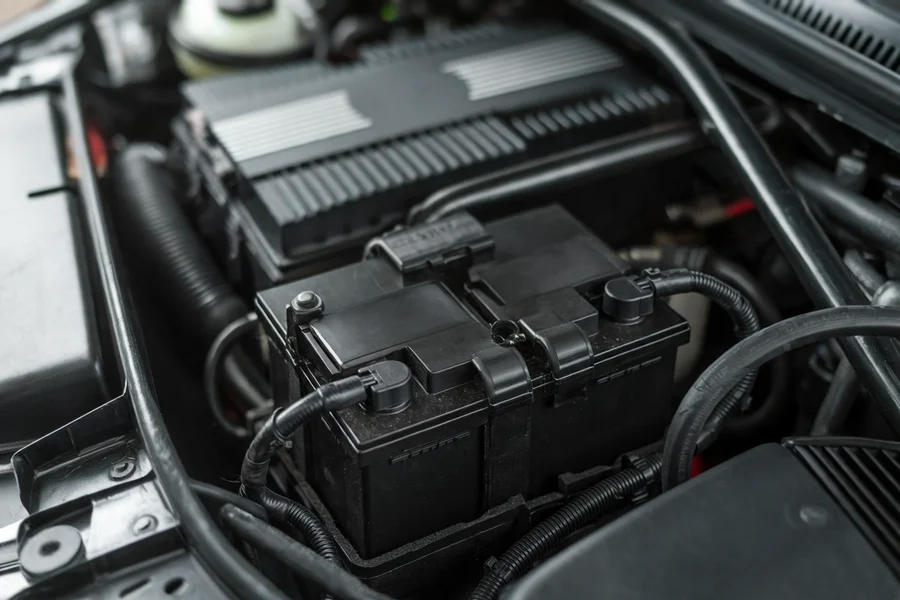
Check resting voltage and load-test the battery early — it is the cheapest fix on this list, and our battery keeps dying guide covers the voltage behavior to expect. If the battery was replaced, confirm it was registered to the car; an unregistered battery charges incorrectly and brings the warning back.
3. xDrive transfer-case (VTG) actuator — the xDrive special
On xDrive cars, DSC’s math includes the front/rear torque split, and the transfer-case actuator (BMW’s VTG) is a known weak point that feeds this message. The signature is a chassis stabilization warning arriving with 4×4/xDrive or ABS messages, sometimes intermittently, with owner-reported codes clustering around the transfer box: 48097D (“clutch position known, no four-wheel drive”), D36D44 (“signal invalid, transmitter VTG”), and 480682 (“clutch position unknown”). One 428i xDrive owner logged all three with no drivability change — the actuator had briefly lost communication. You may also hear it clicking under the car around shutdown.
This one is xDrive-only. Our xDrive versus RWD guide explains the torque split, and the transfer-case fluid guide covers the maintenance the actuator’s clutch pack depends on. Actuator replacement with programming runs roughly $800–$1,200 at a shop — far less than the full transfer case some dealers suggest.
4. Yaw-rate and lateral-acceleration sensors
If the steering-angle sensor says “straight” while the yaw-rate sensor says “rotating,” DSC sides with neither and posts the message. These sensors are usually reliable but do fail and lose calibration — lateral/vertical acceleration faults in the 482xxx family show up exactly this way. They are also collateral victims of voltage problems: a sensor that reads fine at 14 volts can read nonsense at 11, which is why the battery check comes first. Diagnose via plausibility codes in the DSC module and live data at standstill, where yaw and lateral acceleration should read near zero.
5. DSC control module itself — rare for this message
Here the delineation from the trifecta matters most. The DSC/ABS hydraulic module is a common trifecta fix, but for a pure “chassis stabilization” text message it sits well down the list. Consider it only when every sensor tests good in live data, the battery is healthy, and the message persists with internal or communication codes from the DSC unit itself. Do not start here — it is the most expensive guess and the most likely to be wrong.
6. Wheel speed sensor — the overlap case
A failing wheel speed sensor can produce this message, but it usually lights the amber ABS lamp too — sliding the case into trifecta territory. If your cluster shows ABS and DSC lamps plus the text, treat the trifecta guide as your primary diagnosis. The exception is a sensor fault early in its life, where the message appears before the lamps commit.
7. Low brake fluid and damaged wiring — the quick checks
Low brake fluid can trigger chassis warnings because the brake pressure sensors feed the same stability math — and a sinking reservoir is a safety issue regardless, so check it first. Note the lamp color: a red brake warning is a hydraulic-system message, not this one. Damaged wheel-well wiring and corroded connectors produce the intermittent version — warnings that come and go with bumps, steering input, or wet weather. Our brake fluid service guide covers the correct fluid and intervals. A visual harness inspection costs nothing; do it before buying any part.
Fault codes worth knowing
BMW chassis codes are module-specific, so the same symptom can log different codes on different chassis. The codes below are the ones owners actually reported alongside this message — use them as a map, not gospel, and confirm the plain-text meaning in your own scan tool’s module readout.
| Code | Reported meaning | Context it was reported in |
|---|---|---|
| D3244 | EPS steering-angle / motor position sensor faulty | F30 328i — dealer replaced the steering rack |
| P15DC | Chassis stabilization / ABS fault (generic-code translation varies) | F30 320i — warning appeared on a rainy day |
| 48097D | Transfer box: clutch position known, no four-wheel drive | 428i xDrive — intermittent, no drivability change |
| D36D44 | Signal invalid, transmitter VTG | 428i xDrive — same event as 48097D |
| 480682 | Transfer box: clutch position unknown | 428i xDrive — same event as 48097D |
| 5EBA | Steering-angle sensor fault family | Reported alongside DSC/ABS lamps on older chassis |
| 4809AB | Voltage supply fault | Reported with weak-battery chassis warnings |
| 482941 | Vertical/lateral acceleration sensor fault | Reported as a chassis-stabilization trigger |
Three caveats. First, generic OBD2 readers usually show nothing — chassis faults live in the DSC, EPS, and VTG modules a basic reader cannot reach. Second, a code is a symptom’s address, not a parts order: 480682 says the transfer box’s clutch position is unknown, which can mean the actuator, its wiring, or low voltage starving it. Third, clear-and-retest: fix the suspect cause, clear all chassis codes, and drive — codes that return are real; codes that don’t were ghosts of a low-voltage event. Our OBD2 scanner guide for BMW compares tools that read these modules at several budgets.
Diagnosis in the right order
Work this sequence top to bottom — each step is cheaper than the next, eliminating the most likely causes before you touch the expensive stuff.
- Record the trigger. When did the message first appear — right after an alignment, tire change, or curb strike? After a jump start or a new battery? After the car sat for a week? In the rain? The trigger usually names the cause.
- Check the battery. Resting voltage should sit around 12.4–12.6 volts; with the engine running, 13.5–14.5 volts at the terminals means the alternator is doing its job. Then load-test the battery — resting voltage alone misses batteries that collapse under load. This step alone resolves a large share of these warnings.
- Scan every module with a BMW-capable tool. Read the DSC, EPS, and (on xDrive) VTG modules — not just the engine. Write down every code showing as present or current, with the plain-text meaning your tool reports.
- Check steering-angle live data. With the wheels pointed straight ahead, the steering-angle reading should be within a few degrees of zero, and the steering wheel itself should be level on a straight road. If the wheel is off-center, the alignment — not the sensor — is the prime suspect.
- Try the lock-to-lock recalibration. Engine running: turn the wheel fully left, then fully right, then back to center, and drive a short distance. This relearns the steering-angle reference and clears the message with no parts involved — the classic fix after a battery disconnect or a long sit.
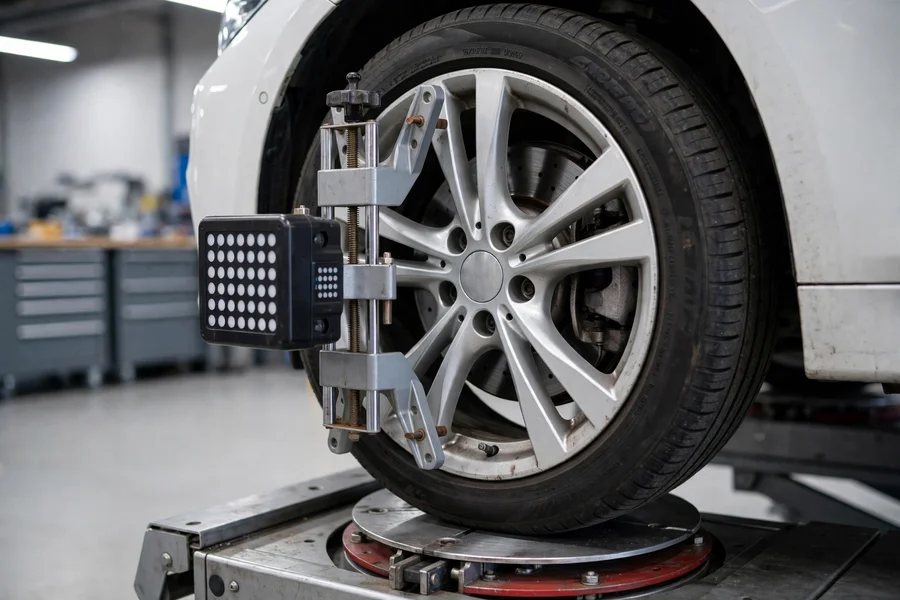
- Check the alignment. If the wheel sits off-center on a straight road, or the warning followed an alignment, suspension work, or a curb strike, get a four-wheel alignment and have the steering-angle sensor calibrated afterward. An alignment shop that skips the calibration can leave the message exactly as it was.
- xDrive only: investigate the transfer case. With VTG codes stored, listen for the actuator clicking at shutdown, check its wiring, and confirm all four tires match in size and wear — mismatched rolling circumference overworks the clutch pack and can set the same faults.
- Inspect yaw/lateral sensors and wiring last-but-one. At standstill on level ground, yaw rate and lateral acceleration should read near zero in live data. Eyeball the wheel-well harnesses for abrasion and the DSC connector for corrosion — intermittent messages that follow bumps or wet weather live here.
- Suspect the DSC module last. Only when sensors, battery, alignment, and wiring all test good, and the module reports internal or communication faults, does the module itself earn the blame.
If your scan also shows ABS and BRAKE lamps lit with corner-specific wheel speed codes, stop here and switch to the trifecta guide — that path diagnoses faster than this one for that lamp combination.
Interactive: which fault matches your situation?
Answer two questions for the most likely cause, with the reasoning shown. This narrows the field — always confirm with a scan before buying parts.
Chassis stabilization diagnostic picker
Two questions, then a likely cause — with the reasoning shown.
Choose both answers and press Diagnose.
Repair options: difficulty and honest cost bands
Bands below are approximate US-market ranges drawn from repair-estimate guides and owner-reported invoices — your region and shop will vary. The golden rule: diagnose first, buy parts second. Most chassis stabilization warnings resolve for a few hundred dollars; guessing at a four-figure rack is how this repair gets expensive.
| Repair | DIY difficulty | Parts band | Typical shop band |
|---|---|---|---|
| Four-wheel alignment + steering-angle calibration | Pro — alignment rack required | n/a | $150–$300 |
| Lock-to-lock recalibration | Easy — no tools | Free | Free / bundled |
| Battery replacement + registration | Easy | $180–$300 | $250–$400 |
| Steering-angle sensor (column-type SZL) | Medium — steering wheel and airbag removal | $200–$400 | $450–$850 incl. calibration |
| SZL module, dealer replacement + coding | Pro — coding required | n/a | $800–$1,500 |
| EPS steering rack replacement | Pro — alignment and coding after | ~$2,865 remanufactured | $3,000+ fitted |
| Transfer-case (VTG) actuator + programming | Pro — programming required | $650–$800 | $800–$1,200 |
| Yaw-rate / lateral-acceleration sensor | Easy to Medium | $150–$350 | $300–$600 incl. calibration |
| DSC hydraulic module replacement + coding | Pro — brake hydraulics plus coding | $800–$2,000 | $1,200–$2,800 |
| Wiring / connector repair | Easy to Medium | Under $50 in materials | $100–$250 |
Lock-to-lock recalibration is the free win: engine running, full left, full right, back to center, short drive. After a battery disconnect or a long sit, this is frequently the entire repair. Alignment plus calibration fixes the off-center-wheel cases — and calibration is the step alignment shops most often skip, which is why the message sometimes survives a fresh alignment.
Battery: the cheapest real repair, and the one owners discover last. Fit the correct AGM type, register it to the car, and clear the chassis codes — an unregistered battery can recreate the warning within weeks. Transfer-case actuator: mechanically straightforward, but the replacement needs programming to the car, which keeps it in shop territory. Get a quote that separates the actuator from a full transfer case — some shops quote the bigger job by default.
EPS rack: the worst case — confirm it twice before authorizing. Remanufactured F30 racks list around $2,865 before labor, coding, and alignment, so dealer-fitted totals land well past $3,000. This is the documented fix when the EPS module itself reports the steering-angle fault (the D3244 case), but it should never be the first guess. DSC module: rare for this message — exhaust every sensor and voltage possibility first.
Can you keep driving with the warning on?
Usually yes, with genuine caution — “drive moderately” is exactly what to do. Your hydraulic brakes work normally; what you have lost is some or all of the electronic safety net. DSC may no longer cut power or brake individual wheels in a slide, and xDrive torque split may be restricted.
- Safe, with caution: drive gently to a diagnosis appointment. Brake earlier, increase following distance, avoid sudden maneuvers.
- Be extra careful in rain, standing water, snow, and gravel — the exact conditions DSC exists for.
- Get it diagnosed within days, not months — you do not want to discover the helpers are gone mid-emergency.
- Stop driving and get it towed if a red brake warning appears, the pedal sinks or feels spongy, or brake fluid is visibly low.
- Stop driving if the car brakes or cuts power on its own — uncommanded intervention is unpredictable and needs immediate diagnosis.
Frequently asked questions
Is “chassis stabilization” the same as the ABS/DSC trifecta?
No, though they share a system. The trifecta is three amber lamps (ABS + DSC + BRAKE) skewing toward wheel speed sensors and the ABS/DSC module; this message is a text warning skewing toward steering-angle plausibility and voltage. Seeing the three lamps? Start with our ABS/DSC trifecta guide — it diagnoses that combination faster.
Will the lock-to-lock steering reset clear the warning?
Sometimes — and it costs nothing to try. Engine running: full left, full right, back to center, short drive. This relearns the steering-angle reference and clears the message when the cause was a lost calibration (disconnect, jump start, or a long sit). It will not fix a genuinely faulty sensor, a bad alignment, or a failing actuator.
Can a weak battery really cause a chassis stabilization warning?
Yes — one of the most common and most overlooked causes. BMW chassis electronics are highly voltage-sensitive, and a sagging battery corrupts sensor references across several modules at once, producing exactly the disagreement this message describes. The warning repeatedly appears after cars sat unused or were jump-started. Load-test the battery early; it is the cheapest fix and the most embarrassing one to miss. See our battery keeps dying guide for the voltage behavior to expect.
Why does the warning only appear in rain or after the car sits?
Two different mechanisms. After sitting: the battery sags and the steering-angle calibration can be lost — fixed by charging and the lock-to-lock reset. In rain: usually moisture — water ingress at a sensor connector, a chafed harness, or a cracked housing corrupts readings exactly when DSC needs them. A wet-weather-only message points at a failing seal or connector, not a module.
How much does it cost to fix the chassis stabilization warning?
Most cases resolve for a few hundred dollars: nothing at all (lock-to-lock reset), $150–$300 for an alignment with calibration, or $250–$400 for a battery with registration. Mid-range: a steering-angle sensor ($450–$850 fitted) or an xDrive transfer-case actuator ($800–$1,200 with programming). The worst case is an EPS steering rack at $3,000+ fitted — confirm it twice with module-specific codes before authorizing that job. Diagnose first; the code usually tells you which band you are in.
Keep diagnosing with the related guides: the BMW 3 Series complete guide links every troubleshooting article on the site, the trifecta guide covers the three-lamp version of this problem, and the xDrive versus RWD guide explains the all-wheel-drive system behind the transfer-case faults.