BMW Ignition Coil Failure: Symptoms & When to Replace
Short answer: BMW ignition coil failure symptoms include a rough idle with engine shaking, misfiring under acceleration, a flashing check engine light under load, and the “Drivetrain malfunction” warning on F- and G-series cars. Codes like P030x (cylinder misfire) or P035x (coil circuit) usually confirm it. Coils fail suddenly — BMW publishes no replacement interval — so the real skill is separating coil failure from worn spark plugs, which share nearly every symptom.
In this guide
- BMW ignition coil failure symptoms: the full picture
- Ignition coil vs spark plug: how to tell them apart
- Fault codes: P030x, P035x, and BMW-specific hex codes
- Coil failure by engine: N51/N52, N54, N55, N20/N26, B-series
- Misfire symptom checker
- Replace one coil or all of them?
- DIY ignition coil replacement: what the job actually involves
- Ignition coil replacement costs: dealer vs. independent vs. DIY
- BMW ignition coil FAQ
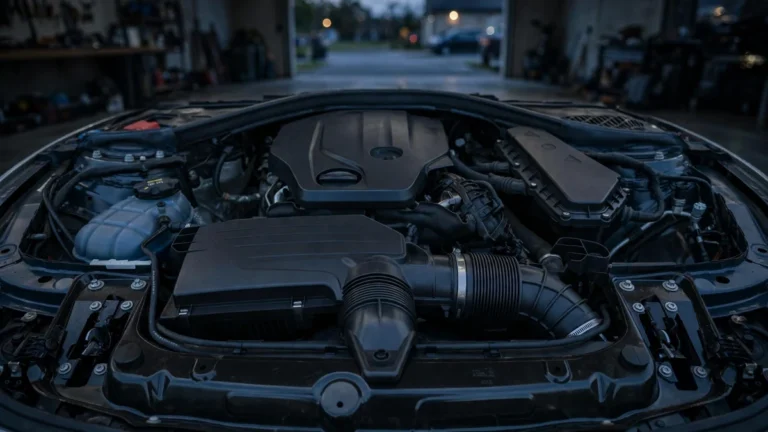
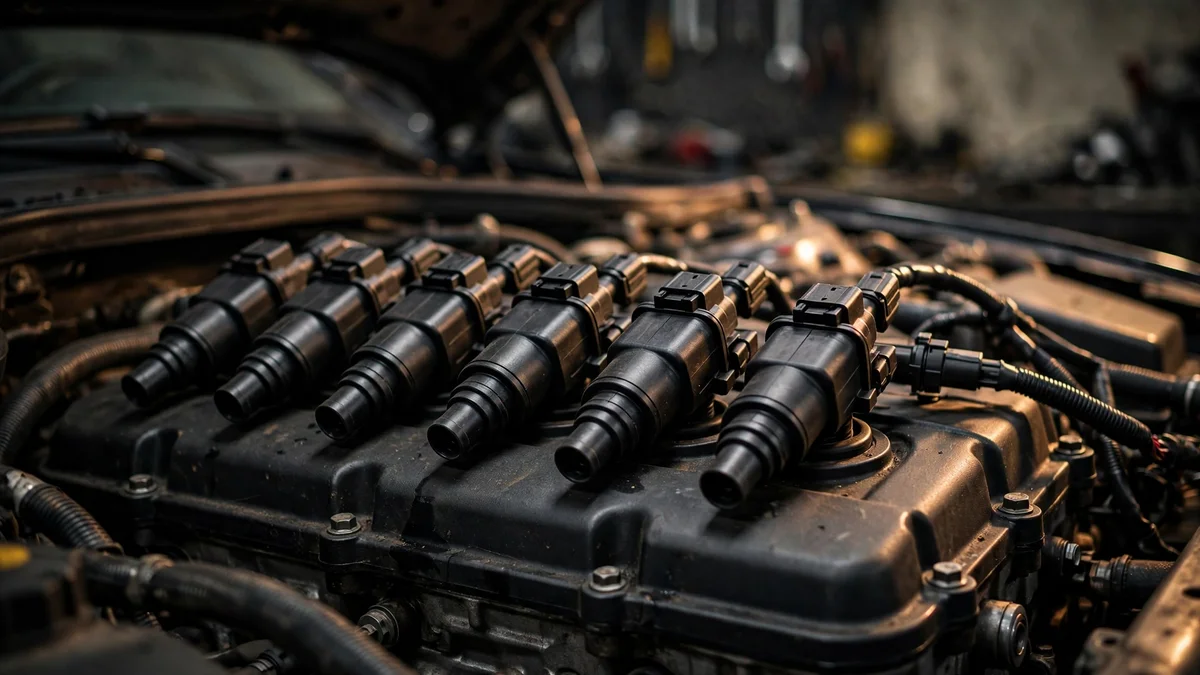
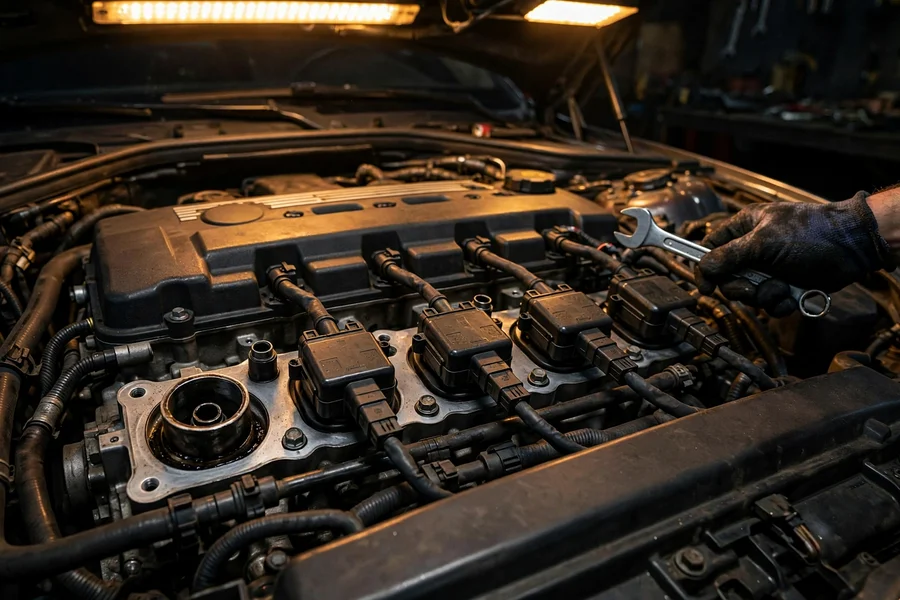
The ignition coil is one of the few parts that can turn a healthy BMW into a shaking, warning-light mess in a single acceleration. Each coil sits directly on its spark plug — coil-on-plug design — stepping 12 volts up to the tens of thousands needed to fire the plug. When a coil’s internal insulation breaks down, that cylinder stops contributing: the engine shakes, power falls off, and the DME (engine control unit) throws codes and cuts fuel to protect the catalytic converter.
It’s also one of the most misdiagnosed issues on these cars: the spark plug sits one inch below the coil and produces almost identical symptoms when worn. A worn plug forces its coil to work harder; a weak coil fouls its plug. Owners routinely replace one when they needed the other. This guide separates them — symptoms, codes, per-engine patterns, the coil-swap diagnostic, and the one-vs-all math. For the plug side — intervals, torque specs, when plugs alone are the fix — see our companion spark plug replacement guide.
BMW ignition coil failure symptoms: the full picture
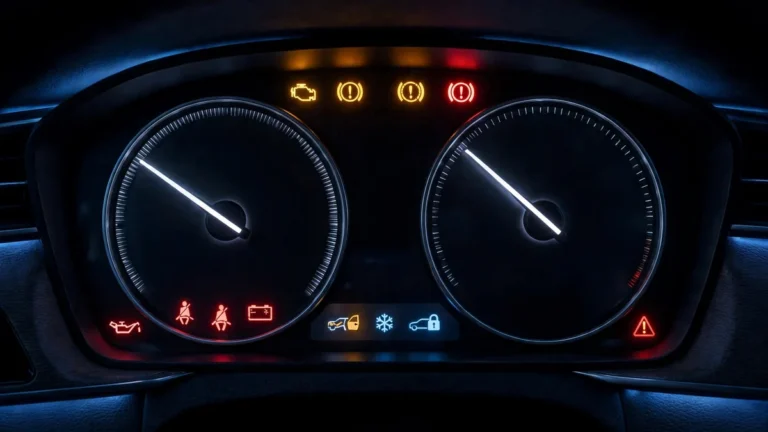
Coil failure is usually sudden: the car was fine, then under acceleration it starts bucking, the check engine light flashes, and on newer cars a “Drivetrain malfunction” warning takes over the cluster. Catching it early is what separates a cheap coil replacement from a damaged catalytic converter — unburned fuel from a misfiring cylinder is what kills cats, which is exactly why the DME flashes the light.
| Symptom | What you notice | Urgency |
|---|---|---|
| Rough idle / engine shaking | The engine visibly shakes at idle; felt through the seat and steering wheel. Exhaust may puff or pop at the tailpipe. | Moderate — drivable gently; diagnose soon |
| Misfire under load | Hesitation, jerking, or stumbling when accelerating, especially at low-to-mid RPM and full throttle. Can feel normal at steady cruise. | Moderate — avoid hard acceleration |
| Flashing check engine light | Blinks while accelerating, may go steady at idle. Flashing means an active misfire is dumping unburned fuel into the catalytic converter. | High — back off the throttle immediately; see our check engine light causes guide |
| “Drivetrain malfunction” warning | On F- and G-series cars the iDrive posts this warning and the car feels like it drops a cylinder. Often clears on restart, returns under load. | High — the DME is cutting fuel to protect the catalyst; see our drivetrain malfunction guide |
| Loss of power / poor acceleration | Feels flat and reluctant, particularly from a stop or merging. Often paired with worse fuel economy. | Moderate |
| Hard starting or extended cranking | Longer crank times before the engine catches. Multiple failed coils can cause crank-no-start (see our won’t-start guide). | Moderate |
| Backfiring / exhaust pops | Pops or bangs from the exhaust during misfire events — unburned mixture igniting late. | Moderate to high if frequent |
| Burning smell or visible coil damage | Cracked, swollen, or melted coil casing; black gunk extruding as internal insulation breaks down. | High — replace before driving further |
On E90/E60-era cars, owner experience points to the rear cylinders (#5 and #6) failing first — they sit under the cowl with the least airflow, and coils die from thermal cycling. BMW’s own service documentation states that high temperature fluctuations deteriorate the coil’s internal materials over time. Turbo cars (N54, N55, S55) stress coils harder — heat plus higher cylinder pressure — and tuned cars running higher boost kill coils faster. The rear-cylinder pattern is owner observation, not measured data, but it’s consistent enough to be worth knowing when a code names a cylinder.
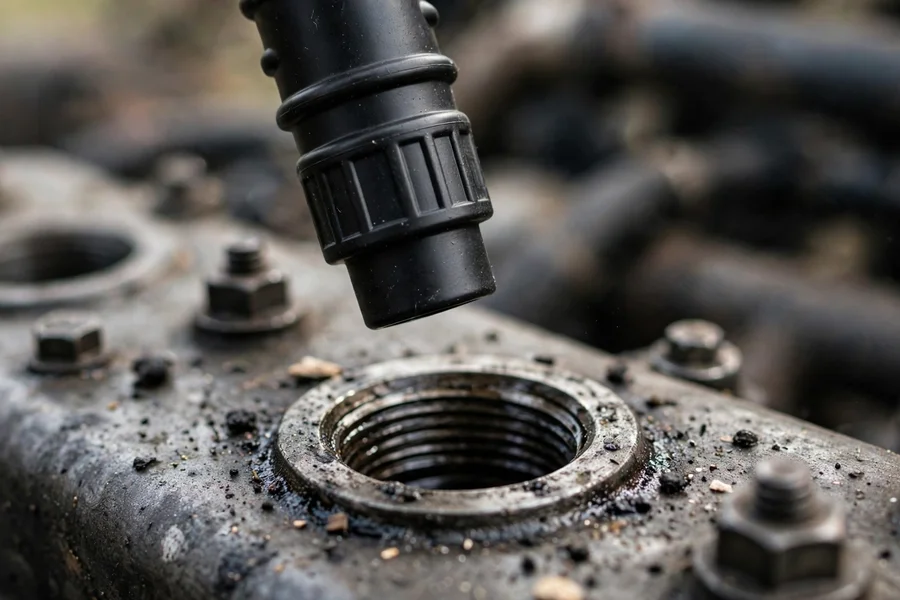
One root cause can kill a brand-new coil in weeks: oil in the spark plug well. When the valve cover gasket leaks — a known weak point on N20, N52, and N55 engines — oil pools around the coil boot, shorting the spark and degrading insulation. If you pull a coil and find its boot soaked in oil, the coil is a victim, not the criminal. Fix the leak first (see our valve cover gasket guide), then judge the coil. Skipping this is how owners replace the same coil twice.
Ignition coil vs spark plug: how to tell them apart
The codes don’t make this delineation for you: a P0303 names cylinder 3 but not the part — coil, plug, injector, or compression could all be at fault. The parts interact in both directions — a worn plug’s wider gap stresses its coil, and a weak coil fouls its plug — which is why misdiagnosis is common. Here’s how their failure signatures differ:
| Clue | Points to the coil | Points to the spark plug |
|---|---|---|
| Onset | Sudden — fine yesterday, misfiring today, often under load with a flashing CEL. Coils fail electrically and abruptly. | Gradual — performance, cold starts, and fuel economy decline over months as electrodes erode. |
| When it misfires | Under load — a weak coil fires at cruise but breaks down as cylinder pressure rises. | At idle and cold start — worn plugs struggle most in the worst mixture conditions. |
| Fault codes | P0351–P0356 (coil primary/secondary circuit) point at the coil or its wiring, not the plug. | No plug-specific code exists — plugs hide behind the shared P030x misfire codes. |
| The swap test | Misfire moves to the other cylinder after swapping coils — the definitive coil diagnosis. | Misfire moves after swapping plugs — same test, other part. |
| Recent history | Plugs recently replaced and the misfire persists or returns — suspect the coil next. | Plugs are 30,000+ miles old (less on turbo engines) — the cheaper suspect comes first. |
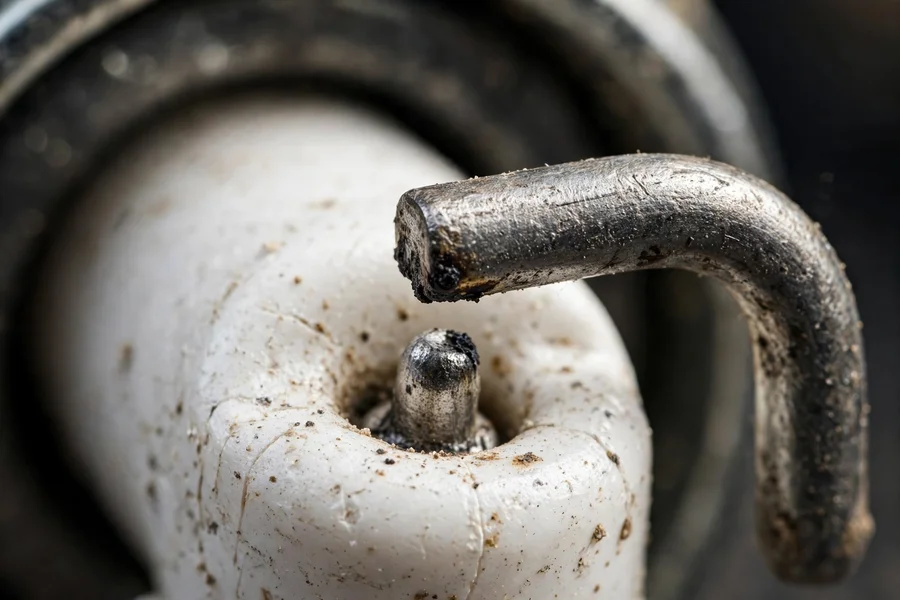
| Visual inspection | Cracked, swollen, or melted coil body; black gunk on the casing; oil-soaked boot from a valve-cover leak. | Eroded or rounded electrode, heavy carbon or oil fouling, cracked ceramic insulator. |
The coil-swap test settles it without buying a part — it works precisely because the code names the cylinder, not the component. Say your scanner reports P0304. Move the coil from cylinder 4 to cylinder 2, clear the codes, and drive until the misfire returns. If the code comes back as P0302, the fault followed the coil — it’s bad. If it stays P0304, the coil is innocent; suspect the plug (or injector) on cylinder 4, and run the same swap on the plug to isolate further. Fifteen minutes, basic hand tools, zero cost.
Two rules keep the diagnosis honest. First: always inspect the plug before condemning the coil — an eroded gap or heavy fouling means the plug is the problem (or a contributor), and its wider gap is harder for any coil to fire, which is how a dying plug takes its coil down with it. Second: if the plugs are due anyway, replace plugs first even when the coil looks suspicious — plugs are cheaper, and turbo engines call for them as often as every 30,000–45,000 miles. Our spark plug replacement guide has the per-engine intervals.
Fault codes: P030x, P035x, and BMW-specific hex codes
A scan is the fastest way to confirm a suspected coil failure. The codes split into three tiers: coil-specific codes, cylinder-specific codes that don’t name the part, and BMW’s own hex codes saying the same thing in the DME’s language. Any OBD2 scanner reads the SAE codes; the BMW hex codes need a BMW-capable tool (see our OBD2 scanner guide).
| Code | Meaning | What it tells you |
|---|---|---|
| P0351–P0356 | Ignition coil “A–F” primary/secondary circuit malfunction (cylinders 1–6) | The most coil-specific SAE codes — a circuit fault points at the coil or its wiring, not the plug. Swap-test first, then inspect the connector. |
| P0301–P0306 | Cylinder 1–6 misfire detected | Names the cylinder, not the part. Could be coil, plug, injector, or compression. Run the swap test to split coil from plug. |
| P0300 | Random / multiple cylinder misfire | Usually not one bad coil — think system-wide: lean condition, vacuum leaks, VANOS, fuel delivery. |
| P0313 | Misfire detected with low fuel | Fuel starvation, not ignition — check the fuel level logic before touching coils. |
| P1343–P1354 family (e.g. P1349, P1351) | E-chassis era BMW mapping: coil power-stage faults, misfire with fuel cut-off per cylinder | E90-era codes. P1349 (coil power output stage open circuit) is coil-specific; P1351-style codes note the DME’s per-cylinder fuel cut. |
The DME also stores its own hex codes. These mappings come from community-reported E90/F30 data rather than BMW documentation — well-established owner knowledge, moderate confidence — but they’re what you’ll actually see on a BMW-specific scan:
| BMW hex code | Applies to | Meaning |
|---|---|---|
| 29CC | E-chassis DME | Misfire, several cylinders |
| 29CD / 29CE / 29CF / 29D0 / 29D1 / 29D2 | E-chassis DME | Misfire, cylinders 1–6 respectively |
| 140010 | F-chassis DME | Misfire, several cylinders: detected |
| 140001 | F-chassis DME | Misfire, several cylinders: injection switched off (fuel cut) |
| 140101 / 140201 / … / 140601 | F-chassis DME | Misfire cylinder 1–6: detected |
| 140111 / 140211 / … | F-chassis DME | Misfire cylinder 1–6: injection switched off (fuel cut) |
The F-series “injection switched off” variants explain the car’s most alarming behavior: when the F-chassis DME sees a persistent misfire, it cuts fuel to that cylinder to save the catalytic converter and posts “Drivetrain malfunction” simultaneously. That’s why the car feels like it lost a cylinder, why the warning clears on restart, and why it returns under load. The fuel cut is self-protection, not a second failure — but driving on a known F-series misfire means fighting the DME’s self-preservation. Diagnose it instead of resetting and hoping.
Coil failure by engine: N51/N52, N54, N55, N20/N26, B-series
Coil-on-plug architecture is the same across every modern 3 Series engine, but the failure story differs by family — different heat, different OE suppliers, and in one case a factory bulletin that changes the repair guidance.
| Engine family | Found in | Coil notes |
|---|---|---|
| N51 / N52 / N52K (inline-6, NA) | E90 325i/328i/330i | The documented weak batch. BMW’s Service Information bulletin (filed with NHTSA) directs replacing all original Bosch coils with new Bosch units at the first failure on engines in service over 24 months or 10,000 miles — “since the remaining ignition coils have been subjected to the same operating conditions.” Delphi is specified for F10/F25 N52T; mixing Bosch + Delphi is permitted. The bulletin is publicly available through NHTSA. |
| N54 (twin-turbo inline-6) | E90 335i | Turbo heat plus high cylinder pressure intertwines coil and plug issues. BMW’s turbo plug interval is short (30,000–45,000 miles), so N54 misfires are frequently caused — or accompanied — by overdue plugs. Diagnose both. |
| N55 (single-turbo inline-6) | E90 LCI 335i, F30 335i/435i | Same coil-on-plug architecture; current OE suppliers Eldor and Delphi. Same turbo-heat stress pattern as the N54. |
| N20 / N26 (turbo 4-cyl) | F30 320i/328i | Identical diagnostics, four coils instead of six — making a full set cheaper. Valve cover leaks are common here, so check plug wells for oil before condemning any coil. |
| B48 / B58 (turbo 4/6-cyl) | F30 LCI 330i/340i, G20 | Newer coil designs, better heat management; no documented weak batch like the early N52 Bosch coils. Normal replace-on-failure pattern. |
The N52 bulletin is rare — an actual BMW document telling technicians to replace all coils at the first failure. Its reasoning is thermal aging: high temperature fluctuations deteriorate the coil’s materials, and every coil has lived through the same heat cycles. That logic extends to any engine where one coil fails past ~80,000–100,000 miles or five-plus years. But a coil killed at 40,000 miles by a cracked casing or damaged connector doesn’t indict the other five.
Misfire symptom checker
Answer four questions — misfire timing, warning lights, codes, plug history — and the checker narrows the field between coil, plug, and something else entirely. It doesn’t replace the coil-swap test.
Misfire symptom checker
Answer all four for a verdict.
Answer all four questions above to see the verdict.
A narrowing tool, not a substitute for a scan or the coil-swap test.
Replace one coil or all of them?
The most-asked question about coil failure — and the answer is a judgment call with evidence behind it, not a rule:
- Replace all of them when: one coil fails past ~80,000–100,000 miles or five-plus years of service. Every coil has endured the same heat cycles, and they fail in clusters in the 60,000–120,000-mile window — replacing one often buys only months before the next goes. On N51/N52/N52K engines this isn’t folk wisdom: BMW’s bulletin explicitly directs replacing all Bosch coils at the first failure past 24 months / 10,000 miles in service.
- Replace just the one when: mileage is under ~50,000, or there is a clear single-coil cause — a cracked casing, a damaged connector, oil contamination from a since-fixed valve cover leak. A young coil killed by an identifiable event doesn’t indict its siblings.
- The cost math favors the set: six OEM-supplier coils run $150–$250 in parts — barely more than two single-coil shop visits once you count repeated diagnostic time. If you’re paying shop labor anyway, five more coils cost little against a second visit.
Two caveats. First, BMW publishes no coil replacement interval — they’re a replace-on-failure part. Every mileage window here (the 60,000–120,000-mile cluster; reports from 17,000 on a tuned car to 280,000 on a pampered E90) is community observation, not manufacturer guidance. Second, “replace all” weakens if the plugs are worn: new coils on top of 90,000-mile plugs get stressed from day one. If plugs are due, do both together.
Don’t forget the coil boot: the rubber boot connecting coil to plug contains a resistor, costs a few dollars separately, and a cracked boot is a documented misfire cause on its own — identical under-load symptoms to a bad coil. Replace boots with the coils (many kits include them), and inspect the boot before condemning any coil. It’s the cheapest fix in the ignition system.
Buy OEM-supplier coils — Delphi, Eldor, or Bremi, the current original-equipment suppliers (Delphi states a 36-month/36,000-mile warranty). Aftermarket “performance” coils get a mixed-to-negative owner verdict with no verified benefit on a stock engine — no reason to pay more for an unverified part when the OE-supplier unit is $30–$60.
DIY ignition coil replacement: what the job actually involves
The honest version: ignition coil replacement is one of the easiest BMW repairs — difficulty 1–2 out of 5. Pelican Parts rates the combined coil-and-plug job at about an hour; owners report 10–60 minutes for coils alone. If you can remove an engine cover and unplug a connector without breaking it, you can do this job.
- Disconnect the battery.
- Remove the engine cover (Torx screws or clips, varies by chassis).
- Unplug the coil connector by lifting its locking clip — old plastic is brittle, so work it gently.
- Remove the small coil mounting fastener, if fitted.
- Pull the coil straight up with a twist — never yank sideways, or the boot can tear.
- Inspect the plug well — pooled oil means a valve cover leak; fix it first. Cover the open well so nothing falls in.
- Seat the new coil firmly, reinstall the fastener, and reconnect the connector until the clip clicks.
- Clear the codes with your scanner, then test-drive including a full-throttle pull, and re-scan for pending misfires.
Tools: a basic socket set and a small pick or flathead for the connector clips. Plain specification note: no published torque spec for the coil fasteners could be verified — tighten them snug, since these small fasteners thread into aluminum. Don’t trust a forum number without a BMW source. (The spark plug torque spec is a different, critical number — see our spark plug guide.)
Real pitfalls: brittle connector clips, debris in the open plug well (cover it the moment the coil comes out), and installing a new coil into an oil-fouled well without fixing the valve cover leak. Then verify properly: clear codes, do a full-throttle pull somewhere safe, and re-scan — a load-only misfire won’t show in a gentle around-the-block drive.
Ignition coil replacement costs: dealer vs. independent vs. DIY
Coil replacement is unusual: enormous DIY savings for a 30-minute task that shops bill at a full diagnostic hour plus parts markup. Figures below are estimates — directional bands, not quotes.
| Route | Single coil | Full set (6-cyl) | Notes |
|---|---|---|---|
| DIY (parts only) | $30–$60 | $150–$250 | OEM-supplier coils (Delphi, Eldor, Bremi) ~$30–60 each; full six-coil kits $150–$250. Four-cylinder cars need four. |
| Independent specialist | $150–$250 | $250–$450 | Parts plus ~1 hour of labor and the diagnostic scan. Single-coil mobile-mechanic benchmarks run $255–$625 by model. |
| Dealer | $250–$400 | $400–$700+ | Full list price on OE parts plus dealer labor. Justified under warranty; hard to justify otherwise for this job. |
Restating the full-set math: $150–$250 in parts for all six costs less than one dealer coil visit — and past 80,000 miles, “replace one” statistically becomes two or three visits. Don’t forget the tow: a coil failure on a road trip turns a driveway job into a flatbed bill plus a shop you didn’t choose. If the checker points at coils on a high-mileage car, the full set in your own garage is the cheapest outcome.
BMW ignition coil FAQ
Can I drive with a bad ignition coil on my BMW?
Gently and briefly, to get somewhere safe — not as a plan. A misfiring cylinder dumps unburned fuel into the catalytic converter, (that’s why the light flashes under load); sustained driving can destroy the catalyst, turning a $30–$60 coil into a four-figure repair. On F- and G-series cars the DME cuts fuel to the misfiring cylinder and posts a drivetrain malfunction warning — self-protection, not a fix. Back off the throttle and diagnose promptly.
Should I replace all BMW ignition coils or just the bad one?
Replace the full set if one fails past ~80,000–100,000 miles or five-plus years — every coil has shared the same heat cycles and they fail in clusters. BMW’s own service bulletin makes this explicit for N51/N52/N52K engines: over 24 months or 10,000 miles in service, replace all Bosch coils at the first failure. Under ~50,000 miles with a clear single-coil cause (cracked casing, damaged connector, oil contamination), one is fine.
How do I know if the misfire is the coil or the spark plug?
Run the coil-swap test: move the suspect coil to another cylinder, clear the codes, and drive until the misfire returns. If the code follows the coil, the coil is bad; if it stays, suspect the plug (or injector). Rule of thumb: sudden misfire under load with fresh plugs points to the coil; gradual decline with 30,000+ mile-old plugs points to the plugs. Always inspect the plug first — a worn plug’s wider gap stresses its coil.
Do I need to replace spark plugs when replacing ignition coils?
If the plugs are due or of unknown age, yes — do them together. A worn plug forces its coil to work harder and a weak coil fouls its plug; coils on worn plugs is a half-done job. If the plugs were recently replaced and one coil fails young, they can stay.
How long do BMW ignition coils last?
BMW publishes no replacement interval — coils are a replace-on-failure part. Owners report cluster failures in the 60,000–120,000-mile window, turbo/tuned engines earlier, some originals past 200,000 miles. Heat cycling is the documented killer — BMW’s bulletin states high temperature fluctuations deteriorate the coil’s internal materials. Mileage is a risk factor, not a schedule.
Coil failure is forgiving: loud symptoms, a free fifteen-minute swap test, a genuinely easy repair. The expensive mistakes are avoidable — driving hard on a flashing CEL, replacing coils without checking plugs, or seating new coils into oil-fouled wells without fixing the leak. Diagnose right with the checker and swap test, pair the job with fresh plugs if due (our spark plug guide has the intervals), and fold ignition into your 3 Series maintenance schedule so the next misfire never becomes a tow. The complete BMW 3 Series guide covers how it all fits together.