BMW Electronic Parking Brake Problems and How to Fix Them
Short answer: BMW electronic parking brake problems on the F30 (2012–2018) and G20 (2019+) 3 Series almost always come down to five causes: a failed actuator motor on one of the rear calipers, water or corrosion at the actuator connector, a dead EPB switch, low battery voltage confusing the control module, or a DSC software fault (BMW even issued service bulletin SIB 34 13 17 for actuator codes 480734/480735). A yellow parking-brake lamp means reduced function — get it checked soon; a flashing red lamp means a real fault. Never wind an EPB caliper piston back by force: retract it electronically with a scan tool first, or you will destroy the actuator.
The electronic parking brake (EPB) on a modern BMW 3 Series is one of those systems you never think about until it strands you. One morning the car refuses to release the rear brakes, or a yellow parking-brake lamp appears on the dash with a cheerful “Parking brake malfunction” message, and suddenly a system that replaced a simple cable and lever has turned into an electrical diagnosis.
This guide is about faults, not maintenance. It covers how the EPB works on the F30 and G20, what each warning color means, the five main failure modes, the diagnostic codes that matter, what to do when the brake is stuck on, and what repairs honestly cost. If you are here because you are changing rear brake pads and need the electronic service mode that retracts the caliper pistons, that procedure lives in our BMW brake pad replacement DIY — it is referenced, not repeated, below.
Does your 3 Series even have an electronic parking brake?
This is the first thing to get right, because a surprising number of fault guides gloss over it. The E90 generation (2006–2011) has a conventional cable-operated handbrake — a lever between the seats, Bowden cables, and small drum brakes inside the rear rotors. There is no actuator motor, no EPB button, and none of the fault codes in this article apply. If your E90’s handbrake barely holds, that is a cable adjustment or worn shoe problem, a purely mechanical job.
The F30 (2012–2018) switched to a fully electronic system, and the G20 (2019+) kept it with detail refinements. Here is the quick reference:
| Generation | Years | Parking brake type | What this article covers |
|---|---|---|---|
| E90/E91/E92/E93 | 2006–2011 | Cable handbrake lever | Not applicable — mechanical system only |
| F30/F31/F34 | 2012–2018 | Electronic, button on console | Fully covered: actuator, wiring, module, warnings |
| G20/G21 | 2019–present | Electronic, button on console | Fully covered; same architecture, newer software |
How the BMW EPB actually works
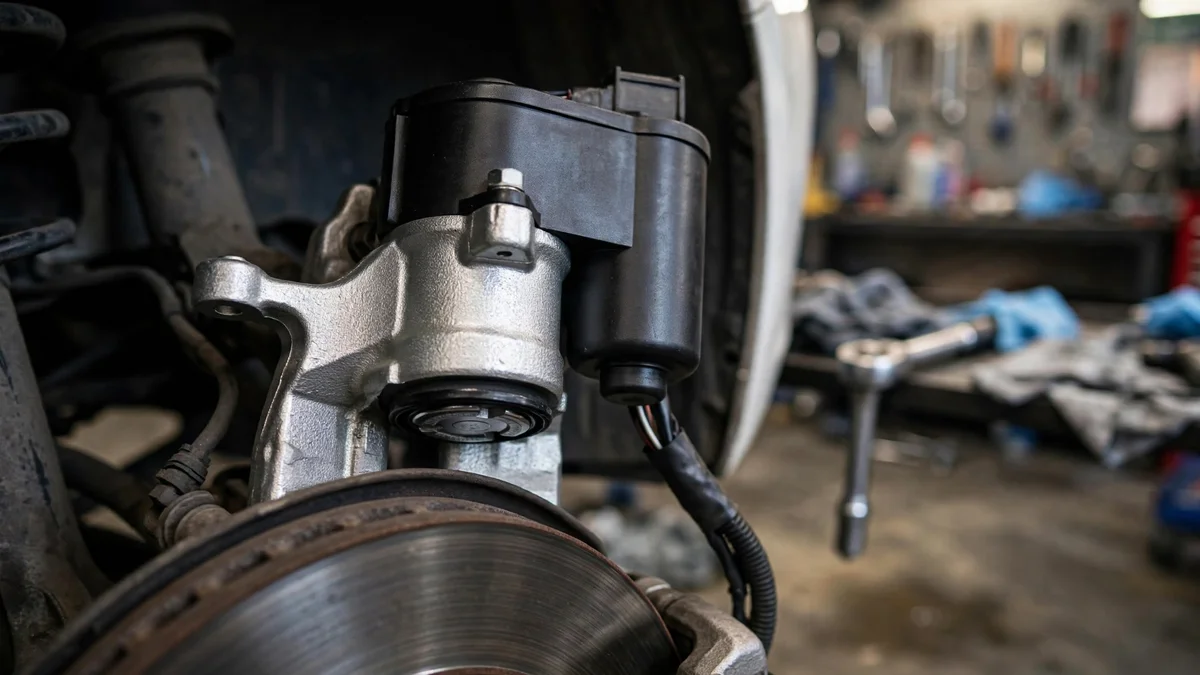
Forget cables. On the F30 and G20, each rear brake caliper carries its own small electric actuator motor bolted to the back of the caliper housing. When you pull the EPB button up, the control electronics drive both motors, which turn a spindle inside the caliper and push the piston — and therefore the pads — against the rotor with a calibrated clamping force. Pushing the button down (with the brake pedal pressed) reverses the motors and releases the pads. The whole event takes about a second, and you can hear the motors whir if you listen at the rear wheels.
There is no separate EPB control unit on these cars. The parking-brake function lives inside the DSC (dynamic stability control) module, where BMW calls it the EMF (electromechanical parking brake) function. That is why EPB fault codes show up as DSC codes, and why a DSC software problem can take the parking brake down with it. It also means a generic OBD2 reader that only talks to the engine computer will usually show nothing — you need a tool that can read the DSC module, covered in our best OBD2 scanner for BMW guide.
A few behaviors are normal and not faults. With the driver’s seatbelt fastened and the door closed, driving off releases the brake automatically. Holding the EPB button up while the car is moving triggers emergency braking through the DSC hydraulics — that is a deliberate safety feature, documented in the owner’s manual. And on the G20, an iDrive setting can make the brake apply itself automatically when you switch the car off. None of those are malfunctions, even though the first encounter with each one can be alarming.
Parking brake warning lights: what each color means
BMW uses a circled “P” symbol for the parking brake, and the color plus behavior tells you how serious the situation is. Learn these before you touch anything:
| What you see | What it means | What to do |
|---|---|---|
| Red “P”, steady | Parking brake is applied — normal | Release it normally (brake pedal + push button) |
| Yellow “P”, steady | Reduced function or a stored fault — the system may not apply or release reliably | Drive cautiously, avoid steep parking, diagnose soon |
| Red “P”, flashing, often with “Parking brake malfunction” | Active fault — the system cannot guarantee clamping force | Do not rely on it on a slope; diagnose promptly |
| Yellow “P” plus other warnings (ABS, DSC, drivetrain) | Often a system-voltage or DSC problem rather than the brake itself | Check battery voltage first (see diagnosis below) |
| No response at all from the button | Switch, fuse, or control-circuit failure | Check the switch and fuse before suspecting actuators |
One pattern deserves special attention: a yellow parking-brake lamp that appears alongside ABS or DSC warnings and a cluster of unrelated errors. On BMWs, that combination is the classic signature of low system voltage, not a brake fault. A weak battery makes the DSC module log undervoltage codes (4809AB is a common one) and the EPB is one of the first functions to complain. Always rule out the battery before buying parts — see our guide to a 3 Series battery that keeps dying if this sounds familiar.

The 5 most common EPB faults on the 3 Series
1. Actuator motor failure (the big one)
The actuator motors live in the worst possible neighborhood: bolted to the rear calipers, inches from the road, exposed to water, salt, and heat cycling. Over time the motor’s internal brushes wear, the gearbox seizes, or moisture creeps past the seals. The symptom is usually one-sided: the brake applies or releases on one wheel but not the other, or you hear the motor strain and grind on one side. The DSC module logs actuator faults — BMW’s own service bulletin SIB 34 13 17 documents codes 480734 (left actuator faulty) and 480735 (right actuator faulty), and in the cases that bulletin covers, the remedy was a DSC software update rather than parts. That bulletin is worth knowing about because it proves actuator codes do not automatically mean a dead motor.
2. Water and corrosion at the actuator connector
Before condemning a motor, look at its connector. The two-pin plug on the back of each actuator sits directly in the spray zone behind the rear wheel. Corroded pins, a cracked connector body, or a harness chafed against the suspension will produce exactly the same codes as a failed motor — the module cannot tell a dead motor from a motor it cannot reach. This is one of the cheapest fixes in the whole system: clean the pins, repair the wiring, seal the connector, and clear the codes. Cars driven through winters with road salt are the prime candidates.
3. EPB switch (button) failure
The console button is a simple momentary switch, and like any switch it can wear out or suffer a spilled coffee. When it fails, the brake usually still works electrically — it just never receives your command. Symptoms: nothing happens when you pull or push the button, sometimes with code 480A53 (parking brake button faulty). The tell-tale is that the system otherwise behaves normally: no warning lamp until you try to use it, and the brake may still auto-release on drive-off. A switch is inexpensive and the replacement is a trim-panel job, not a brake job.
4. Low battery voltage causing phantom EPB errors
BMW’s electronics are famously voltage-sensitive, and the EPB is no exception. A battery on its way out — or a car that has sat for weeks — can trigger parking-brake warnings with undervoltage codes logged in the DSC module, even though every mechanical part is fine. Owners frequently report the full light show after a deep discharge: parking brake, ABS, and DSC warnings together, dozens of stored codes, all from one tired battery. The fix is a charged or replaced battery (registered to the car, as our battery replacement guide explains), not brake parts. If your EPB fault appeared after the car sat unused or cranks slowly, start here — it is the cheapest possible outcome.
5. DSC module or software faults
Because the EPB function lives inside the DSC module, a DSC problem is an EPB problem. Beyond the SIB 34 13 17 software issue above, internal DSC faults, failed wheel-speed plausibility checks, or interrupted software updates can all disable parking-brake function. These cases usually come with company: ABS or DSC warnings alongside the parking-brake lamp, covered in more depth in our ABS and DSC warning lights guide. Software-level faults need dealer or well-equipped independent tools (ISTA) — this is not a DIY reflash.
EPB fault codes worth knowing
You need a BMW-capable scan tool reading the DSC module to see these; a basic code reader will show nothing. The codes below are the ones that recur in owner reports and BMW’s own documentation for the EMF/parking-brake function:
| Code | Meaning | Usual cause |
|---|---|---|
| 480734 | EPB actuator faulty, left | Motor, wiring, or DSC software (see SIB 34 13 17) |
| 480735 | EPB actuator faulty, right | Motor, wiring, or DSC software (see SIB 34 13 17) |
| 480A51 | Parking brake (EMF): brake cannot be applied | Actuator or mechanical seizure |
| 480A53 | Parking brake (EMF): button faulty | Console switch failure |
| 4809AB | Undervoltage in vehicle | Weak battery or charging fault — check voltage first |
The most authoritative reference for the actuator codes is BMW service bulletin SIB 34 13 17 (PDF), which documents 480734/480735 and identifies DSC software as the cause in the affected vehicles. It is a useful counterweight to the common reflex of ordering a new actuator the moment an actuator code appears: software first, parts second.
EPB fault finder: narrow it down in 30 seconds
Pick your generation and symptom. The finder points you at the most likely cause and next step — including whether this is a driveway job or a shop visit.
BMW EPB Fault Finder
Diagnosing it properly (in the right order)
EPB diagnosis goes wrong when people start with the most expensive part. Work this order instead — it is arranged cheapest-first:
- Battery voltage. Measure resting voltage at the terminals: 12.4V or higher is healthy, below 12.2V is suspect. If the car sat unused or cranks slowly, charge or replace the battery before anything else. A huge share of “parking brake malfunction” events are really “dead battery” events — our won’t-start guide covers the voltage checks in detail.
- Scan the DSC module. Use a BMW-capable tool (ISTA, BimmerLink, or a Foxwell NT-series — see our scanner guide) and read the DSC/EMF fault memory. Write down the exact codes before clearing anything. Actuator codes (480734/480735) need the left/right comparison in step 3; undervoltage codes mean the battery, not the brakes.
- Compare left and right. With the scan tool, command the EPB to apply and release while listening at each rear wheel. If one side whirs and the other is silent or grinds, you have isolated the faulty side without removing a single bolt.
- Inspect both actuator connectors. Unplug each two-pin connector at the rear calipers and look for green/white corrosion, bent pins, or cracked housings. Clean with electrical contact cleaner, apply dielectric grease, and re-test. This ten-minute check has saved many owners a $500 actuator.
- Check the switch and fuse. If the button does nothing, the EPB fuse and the switch itself come before any actuator diagnosis. The fuse box locations are covered in our fuse box guide.
Only after these steps point at a specific actuator should you order parts. And one warning that belongs in bold: never force an EPB caliper piston back with a wind-back tool or C-clamp. The piston is driven by the actuator’s spindle; forcing it strips the internal gearbox and turns a pad job into an actuator replacement. Pistons are retracted electronically through the scan tool’s service function — the full procedure is in our brake pad replacement DIY, which is the procedure reference for all pad-swap service-mode work.
What to do when the brake is stuck on
A stuck-on EPB is the nightmare scenario: the rear wheels are locked and the car will not move. Work through these in order, on flat ground with the wheels chocked.
First try: the button reset
Switch the ignition on (engine can be off), press and hold the foot brake, then push the EPB button down for about five seconds, then pull it up for five seconds. This re-initialization sequence is widely shared by BMW technicians and frequently releases a brake that is stuck due to a software or switch glitch rather than a dead motor. A caveat worth stating plainly: this procedure is technician-reported, not officially documented in the F30 owner’s manual, and it will not help if the actuator motor itself has failed. But it costs nothing and takes ten seconds, so it is always worth trying.
Second: check voltage and fuses
If the reset does nothing and the button feels dead, a blown EPB fuse or a battery too weak to drive the motors can hold the brake applied. Check the fuse, and if the battery is marginal, a jump-start or charger may give the system the voltage it needs to complete one release cycle.
Last resort: mechanical release at the caliper
If the electrics are truly dead, the brake can be released mechanically: remove the rear wheel, unbolt the actuator motor from the back of the caliper (two bolts), and manually wind the internal spindle back to retract the piston. This is a documented technician procedure for getting a car onto a tow truck, not a repair — the actuator will need proper diagnosis afterward, and you must re-secure everything before the car moves under its own power. If you are not comfortable removing a wheel and working on brake hardware, stop here and call for a flatbed. Our safe jacking guide covers the lifting points if you do proceed.
One thing not to do: do not try to overpower a stuck EPB by driving through it. Dragging locked rear brakes overheats the pads and rotors within minutes and can damage the actuator gearbox beyond the point where only the motor needed replacing.
Repair options and real costs
Cost bands below are owner- and specialist-reported US figures, not BMW list prices — they move with your region and with parts choice (aftermarket vs. OE). Use them to sanity-check quotes, not as promises.
| Repair | DIY difficulty | Independent shop (per side) | Dealer (per side) |
|---|---|---|---|
| Diagnose EPB fault (scan + inspection) | Easy (with the right tool) | $100–$180 | $180–$250 |
| Actuator motor replacement | Moderate | $350–$650 | $700–$1,100 |
| Full caliper + actuator assembly | Moderate–hard (brake bleeding) | $600–$1,000+ | $1,000–$1,600+ |
| EPB console switch replacement | Easy | $150–$300 | $250–$400 |
| DSC software update (e.g. SIB 34 13 17 cases) | Not DIY | $150–$300 | $200–$350 |
| Connector clean / wiring repair | Easy | $80–$200 | $150–$300 |
A note on parts strategy: the actuator motor is available separately from the caliper on most F30/G20 applications, and replacing just the motor is the economical fix when the caliper body and piston are healthy. If the caliper itself is seized or leaking, the assembly makes more sense — at that point you are doing brake hydraulics anyway, with bleeding to match. For context on what a full rear brake job runs, see our brake pad replacement cost guide.
What the DIY actually involves
Replacing an EPB actuator motor is a moderate driveway job: rear wheel off, unplug the connector, remove two bolts, swap the motor, reconnect, then run the EPB calibration/initialization with a BMW-capable scan tool so the module learns the new motor’s end positions. Skip the calibration and you risk fault codes or uneven clamping. What makes it “moderate” rather than “easy” is not the mechanical work — it is needing the scan tool for both diagnosis and the post-replacement calibration. If you do not have one, the labor saving rarely justifies buying one for a single job; pay the independent specialist instead.
And to repeat the delineation clearly: rear pad replacement is a different job with its own procedure. The electronic service mode that retracts the pistons for a pad swap is documented step-by-step in our brake pad replacement DIY. Do not improvise it — winding pistons back mechanically destroys EPB actuators.
EPB Repair Cost Estimator
Owner- and specialist-reported US bands, not quotes. Parts choice (aftermarket vs. OE) moves these significantly.
Keeping EPB problems from coming back
- Use the parking brake regularly. Actuators that sit unused for months are the ones that seize. If you always park in gear on flat ground and never touch the button, cycle it a few times a month.
- Keep the battery healthy. The EPB is one of the first systems to throw faults on low voltage. A battery tender during long storage prevents a whole category of phantom errors.
- Rinse the rear wheel wells in winter. Road salt accelerates connector corrosion at the actuators. A rinse after salty weeks is cheap insurance.
- Never let a shop wind back EPB pistons mechanically. If someone is doing your rear brakes, confirm they use the electronic service function first — this single mistake accounts for a depressing number of “failed” actuators.
- Address grinding early. A straining actuator gives audible warning for weeks before it seizes. Replacing it on your schedule is far cheaper than replacing it plus a tow.
Frequently asked questions
Can I drive with the parking brake malfunction light on?
A steady yellow lamp means reduced function — the car is generally drivable, but do not trust the parking brake on a slope until it is diagnosed; leave the car in gear (or Park) as well. A flashing red lamp with “Parking brake malfunction” means the system cannot guarantee clamping force, so treat the brake as unavailable and get it checked promptly. Either way, the service brakes are unaffected — this is a parking-brake fault, not a loss of stopping power.
Why won’t my BMW electronic parking brake release?
The most common reasons are a seized or failed actuator motor on one rear caliper, low battery voltage preventing the motors from running, or a switch/fuse failure. Try the reset sequence first (ignition on, foot brake held, push the button down five seconds, pull up five seconds), check the battery and fuse, and if the brake stays locked, use the mechanical release at the caliper described above — or call a flatbed rather than forcing it.
How do I reset the BMW electronic parking brake?
The widely used technician procedure: ignition ON, press and hold the foot brake, push the EPB button down for about five seconds, then pull it up for five seconds. This re-initializes the system and clears glitches. Be aware this is technician-reported rather than officially documented by BMW, so it may not work on every car — and it cannot fix a mechanically failed actuator. For a full system reset after parts replacement, a BMW-capable scan tool’s EPB calibration function is the proper method.
How much does it cost to fix a BMW EPB actuator?
Owner- and specialist-reported US bands: an actuator motor alone runs roughly $90–$180 aftermarket or $250–$450 OE for the part. Fitted and calibrated, expect $350–$650 at an independent BMW specialist or $700–$1,100 at a dealer, per side. If the caliper body is also bad, a full caliper-plus-actuator assembly pushes the job to $600–$1,000+ at an independent shop. Always rule out the battery, fuses, and connector corrosion first — those fixes cost a fraction of an actuator.
Does my E90 3 Series have an electronic parking brake?
No. The E90 generation (2006–2011) uses a conventional cable-operated handbrake lever with drum-style parking brakes inside the rear rotors. The electronic parking brake arrived with the F30 in 2012 and continues on the G20. If your E90’s handbrake is weak, you are dealing with stretched cables or worn shoes — a mechanical adjustment, not an electrical diagnosis.
Electronic parking brake faults look intimidating because the symptoms are dramatic — locked wheels, flashing warnings — but the diagnosis is methodical: voltage first, codes second, connectors third, parts last. Most owners who work that order either fix it cheaply or arrive at the shop knowing exactly what is wrong.