3 Causes of the BMW Airbag Light (and the Usual Fix)
Short answer: A BMW airbag light seat occupancy sensor fault is the most common reason the airbag warning lamp stays on in a 3 Series. A thin pressure-sensitive mat inside the passenger seat cushion cracks with age and flexing, the airbag module can no longer confirm who is sitting there, and the system deactivates the passenger airbags by default — which is exactly why the light appears. Expect BMW fault codes 93C1/93C2/93C3 (E46/E90) or 930A1A/930A1B/930A1C (F30), a dealer repair around $800–$2,000 all-in, and an independent-shop fix in the $300–$900 range (all community-reported estimates). Check NHTSA recall coverage first: some cars were recalled or given a 10-year warranty extension for this exact mat.
The red airbag lamp on a BMW 3 Series is one of the few warnings that experienced owners refuse to live with. It isn’t like a burned-out license-plate bulb or a tired washer nozzle — it means the restraint system has found a fault it doesn’t trust, and it has responded by taking part of that system offline. In the overwhelming majority of 3 Series cases, the fault is in one specific place: the passenger seat occupancy sensor, a fragile pressure mat buried inside the seat cushion that does a much more important job than most owners realize.
This guide explains what the mat does, the three causes that account for nearly every airbag light on E46, E90, F30, and G20 cars, how to read the fault codes properly, what each repair path actually costs, and the seat-sensor emulator debate — stated honestly, with the safety consequences nobody selling the emulator volunteers. This is an independent guide built from BMW technical documentation, NHTSA recall records, and documented owner repairs.
Cause 1: the occupancy sensor mat has cracked or failed
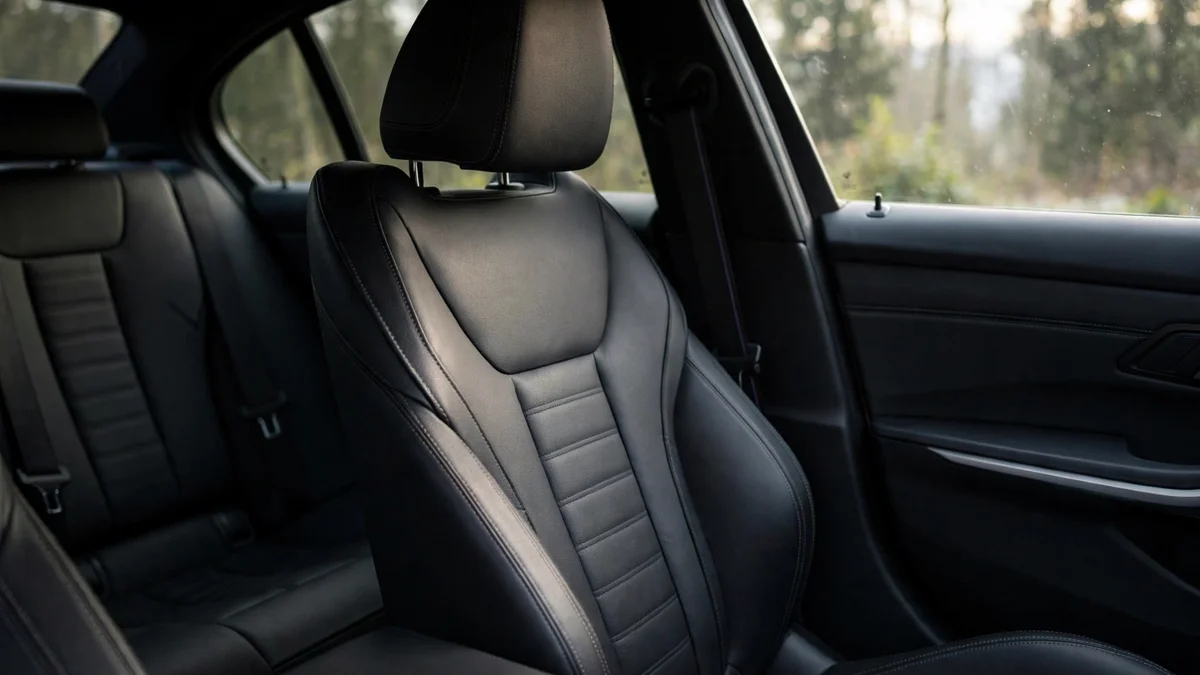
Inside every 3 Series passenger seat, sandwiched between the foam and the upholstery of the seat cushion, sits the occupant detection mat — BMW’s sensor that answers two questions before every drive: is someone sitting in this seat, and are they heavy enough for the airbag to deploy safely? The mat is a thin, pressure-sensitive film. On US-market cars it must be able to distinguish an adult from a small child, because the whole point of the system is child protection: if the passenger weighs less than roughly 30 pounds, the module keeps the passenger frontal airbag switched off so a deployment can’t injure a child.
It is a clever safety device living in a brutal environment. Every time someone sits down, shifts, slides across the bolster, or drops a heavy bag on the seat, the mat flexes. Over years of heat, cold, and thousands of load cycles, the conductive traces in the film develop micro-cracks. NHTSA’s own defect description for the 2008 recall put it plainly: depending on the manner and frequency of the front passenger’s entry and exit, small cracks develop in the mat. Once enough traces are broken, the module gets no coherent signal at all — and a sensor it cannot read is treated as a sensor it cannot trust.
Age is the dominant factor, which is why this failure concentrates on older cars: the E46 and E90 are deep in the failure window, and the F30 is entering it. Sport seats fail more often — the firmer bolsters concentrate flexing on the mat, which is why the recalls targeted sport-seat cars. Kneeling on the cushion or routinely loading heavy cargo across the passenger seat accelerates the cracking.
The failure can be intermittent at first. The light may appear on a cold morning and vanish as the car warms up — thermal expansion briefly closing the cracked traces — or flicker with a heavy passenger and stay dark with a light one. Eventually the break hardens and the lamp stays on permanently, usually with a stored fault code in the airbag module. On cars with iDrive, you may also see a check-control message about a passenger restraint system fault.
The fault codes that point at the mat
The codes below are the ones documented by BMW’s own diagnostic software (ISTA/INPA) and widely confirmed in the owner community for the occupancy-mat circuit. The crucial detail: a generic OBD2 reader will not show you any of these. Basic scan tools only talk to the engine module for emissions codes; the airbag module (called MRS on E-chassis cars and ACSM on F-chassis cars) needs a BMW-capable scanner. Our BMW OBD2 scanner guide covers which tools can actually read the SRS side of the car.
| Chassis | Typical occupancy-sensor fault codes | Notes |
|---|---|---|
| E46 (1999–2005) | 93C1 / 93C2 / 93C3; Peake table 02, code 18 | Code 18 in table 02 is the classic E46 occupancy-sensor entry |
| E90/E91/E92/E93 (2006–2013) | 93C1 / 93C2 / 93C3 | The OC3 mat fault family; 93C3 is the most commonly reported |
| F30/F31/F34 (2012–2019) | 930A1A / 930A1B / 930A1C | F-chassis coding of the same mat circuit |
| G20 (2019+) | ACSM occupancy codes (scan required) | Less documented in the community; always scan rather than guess |
One code to keep separate in your mind: 93B2, the battery safety terminal code, which is a different fault entirely and gets covered under Cause 3 below. And if your car shows a spray of unrelated SRS codes at once — occupancy, buckle switch, side sensors, module internal errors — suspect a voltage event or a failing module rather than a dead mat. A genuinely failed mat almost always presents as its own lonely code.
Cause 2: the wiring and connectors under the passenger seat
The second most common cause isn’t a failed mat at all — it’s the wiring between the mat and the module. The passenger seat on a 3 Series carries several yellow SRS connectors under the cushion: the occupancy mat feed, the seat-belt buckle switch, and sometimes the side-airbag connection. Yellow is the universal SRS color code, and every one of those plugs lives in the most hostile real estate in the cabin.
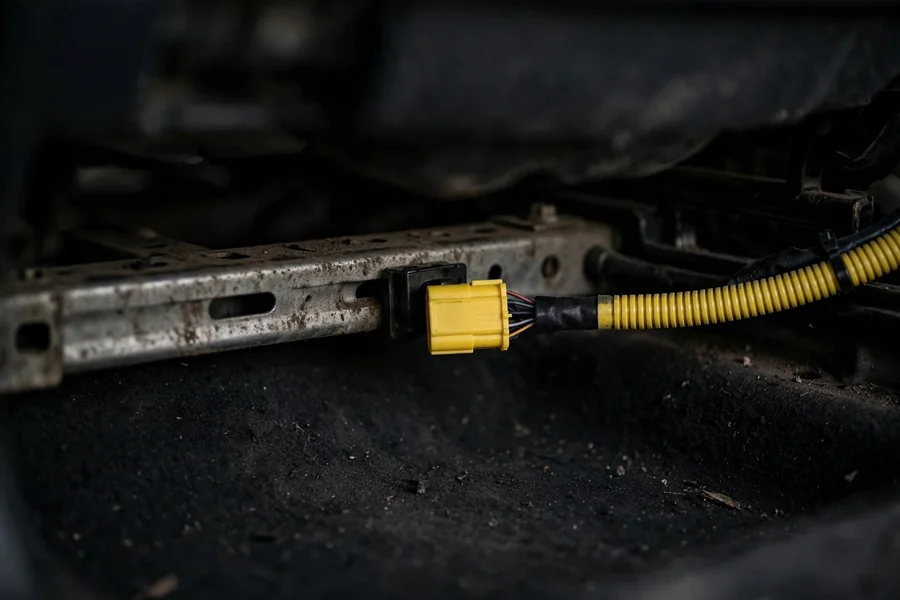
Backpacks, laptop bags, water bottles, and umbrella handles shoved under the front seat kick these connectors. Seats slid back and forth on their tracks tug the harness. Spilled drinks wick into terminals and corrode them. And if anyone has recently worked under the seat — fitting aftermarket audio, fixing a seat motor, or installing aftermarket seats — a connector may simply not be fully seated. The module’s plausibility checks are strict: an intermittent connection that flickers for a fraction of a second is enough to set a fault and light the lamp.
The diagnostic tell for wiring is timing. If the airbag light appeared within days of someone working under the passenger seat, or after an object was forced under the seat, start under the seat, not at the parts counter. With the ignition fully off (and the battery disconnected as described in the DIY section if you plan to unplug anything), check that every yellow connector is fully latched, look for green corrosion on the pins, and inspect the harness where it passes over sharp seat-frame edges for chafing. This cause is the cheapest of the three when it’s the answer — a re-seated connector costs nothing, and even a repaired harness section is a fraction of a mat replacement. It is also the cause most often missed, because a shop that skips straight to quoting a mat never looks.
Cause 3: low voltage, the battery safety terminal, or a failing module
The third cause is the miscellaneous bucket, and it’s wider than most owners expect. The airbag module is one of the most voltage-sensitive controllers in the car, and the 3 Series — particularly the E90 and F30 — is notorious for producing odd electrical ghosts when the battery weakens. A battery that sags during cranking can throw SRS faults that have nothing to do with the seats: the module browns out mid-self-test, logs implausible signals, and lights the lamp. If your airbag light appeared around the same time as slow cranking, a “battery discharge” warning, or a recent jump start, get the battery load-tested before you spend a dollar on seat parts. Our battery keeps dying guide and the battery replacement guide cover the 3 Series charging system in depth, and the fuse box diagram shows which fuses feed the restraint system if you suspect a supply issue.
Next in the bucket is the battery safety terminal, or BST — the pyrotechnic disconnect built into the positive battery cable that fires in a severe crash to isolate the battery. The BST has its own monitoring circuit, and its fault code (93B2 on E-chassis cars) is easy to confuse with the occupancy-mat family if you’re only going by hearsay. A BST fault after a collision or a botched jump start means the cable assembly needs attention, not the seat. Any shop quoting you a seat mat for a 93B2 is guessing; make them show you the actual code.
Rarest of all is the airbag module itself failing — the MRS or ACSM controller developing internal faults. The tell is a crowd of unrelated SRS codes arriving together: occupancy sensor, buckle switches, side sensors, and module internal errors in one scan. A single failed mat does not produce that pattern. Module replacement is dealer or specialist territory because the replacement must be coded to the car. If your scan looks like a fireworks display rather than a single lonely occupancy code, get a specialist diagnosis before buying anything.
Why the light switches off your passenger airbag
This is the part of the story that reframes the warning from an annoyance into a safety matter. When the airbag module loses trust in the occupancy sensor, it does not keep the passenger airbag armed and hope for the best. It takes the fail-safe route: the front passenger frontal airbags are deactivated (the NHTSA recall language notes the head protection system separately), the airbag warning lamp illuminates, and the “passenger airbag off” telltale — usually in the overhead console or center stack — lights up to tell you so.

The logic is child protection, and it’s worth understanding because it explains why the system errs the way it does. The occupancy mat exists primarily to prevent a full-force airbag deployment into a small child. If the module cannot verify who is in the seat — an adult who needs the airbag, or a child who could be killed by it — the safer failure mode is to withhold the deployment entirely. An airbag that fires into a child in a crash is a worse outcome, in the module’s math, than an airbag that stays silent for an adult. That’s the trade the engineers chose, and it’s why a cracked sensor mat doesn’t just light a lamp: it silently removes the passenger’s frontal airbag protection until the fault is repaired.
It also explains why the emulator debate matters so much, covered below. Anything that lies to the module about occupancy flips this logic: the airbag becomes armed for a seat the system can no longer evaluate. Keep this fail-safe in mind as the frame for every repair decision that follows.
Interactive: triage your airbag light and estimate the fix
Answer three questions for the fault code to expect, a read on your warning pattern, and an honest cost band for each repair path — with the caveat that belongs on it. This narrows the field; always confirm with a BMW-capable scan before buying parts.
Airbag light triage & cost estimator
Three questions, then the code to expect, the pattern read, and a cost band with its caveat.
Choose all three answers and press Estimate.
The four ways to fix it: dealer, independent, DIY, emulator
Once the scan confirms an occupancy-mat fault, four paths lead from here, and they differ enormously in cost, effort, and what you give up. The table below compares them at a glance; the sections after it explain each honestly. Treat every figure as a community-reported estimate, not a quote — dealer pricing in particular varies widely by region and by whether the mat is available separately or only with the seat cushion.
| Repair path | Typical all-in cost | Time / effort | What you get |
|---|---|---|---|
| BMW dealer | $800–$2,000 | Half to full day at the dealer | OEM mat, factory procedure, full function restored |
| Independent BMW specialist | $300–$900 | Half day at the shop | Same repair as the dealer for meaningfully less |
| DIY mat replacement | $80–$200 parts | 2–3 hours, difficulty 6/10 | Full function restored; your labor, your risk |
| Occupancy emulator | $20–$100 | Under an hour | Light off, but airbag permanently armed — see the debate below |

The dealer path is the most expensive for a simple reason: on many 3 Series variants the occupancy mat is not stocked as a cheap standalone part, and the job involves removing the seat, stripping the cushion cover, fitting the mat, and reassembling — several hours of book labor plus diagnosis and a code clear. Community-reported dealer totals cluster between $800 and $2,000 all-in, with outliers above that when the whole cushion assembly is the only orderable part. What the money buys is certainty: factory procedure, OEM parts, and a system restored to exactly how BMW designed it. For a car still under any kind of warranty, or a car that regularly carries children in the front seat, this is the only path that makes sense.
The independent BMW specialist is where most owners land, and for good reason. A good BMW indie does this exact repair routinely, sources the same or equivalent mats, and charges a fraction of dealer labor. Community-reported totals run $300 to $900 all-in. The one thing to insist on: the actual fault code, read from the airbag module with BMW-capable software, before anyone orders parts. A shop that quotes a mat replacement without showing you a 93C-series or 930A-series code is diagnosing by reputation, and Cause 2 (wiring) is exactly what that approach misses.
The DIY path is real and well documented by the owner community, but rate it honestly: a 6 out of 10. The mat itself is listed by parts sources under $200, and the mechanical work — unbolt the seat, tilt it back, release the cushion cover, swap the mat — takes two to three hours for a first-timer. The difficulty isn’t mechanical skill; it’s the safety protocol around the restraint system. Disconnect the battery and wait at least 15 minutes before touching any yellow SRS connector, so residual charge in the system can dissipate. Never probe airbag circuits with a multimeter, never power the car with seat connectors unplugged, and budget for a code clear with a BMW-capable tool afterward — the stored fault will not clear itself just because the hardware is fixed. If any of that makes you uncomfortable, that discomfort is information: pay the specialist.
The emulator path deserves its own section, because it is cheap, popular, and genuinely controversial. Read on.
The emulator debate, stated honestly
A seat occupancy emulator is a small plug-in device — usually under $100 — that connects to the passenger seat wiring in place of the original mat and sends the airbag module a constant “seat occupied” signal. Installation is genuinely simple: unplug the dead mat, plug in the emulator, clear the stored fault code with a BMW-capable tool, and the airbag light goes out. For owners of older cars facing a four-figure dealer quote, and for cars fitted with aftermarket bucket seats that never had a mat at all, the appeal is obvious. Some kits also include a seat-belt simulator to silence the belt warning that the permanent “occupied” signal would otherwise trigger.
Here is what the emulator actually does to your safety systems, stated without flinching. With the emulator installed, the passenger frontal airbag is permanently armed. It will deploy in a crash whether the seat holds an adult, a child, or nobody at all. The entire child-protection logic the mat existed for is gone: a rear-facing child seat in the front passenger position — already discouraged everywhere — becomes genuinely dangerous, because the airbag the module would have suppressed will now fire at full force. Even with no passenger, a deployment means a destroyed dashboard, a totaled airbag module, and a repair bill that dwarfs the mat you skipped.
There are legal and practical wrinkles too. Restraint systems are regulated safety equipment, and modifying them can run afoul of local rules — in some countries it’s explicitly illegal, and elsewhere a recently cleared airbag fault can fail a safety inspection. Sellers market these devices for “diagnostic testing and sport applications,” which tells you how the industry itself frames the liability. This guide is not an endorsement: if you choose an emulator, never let a child ride in the front passenger seat of that car, understand the device is reversible (it unplugs), and check your local regulations first. For a family daily driver, a proper mat replacement is the only defensible choice.
Check for a recall before you pay for anything
Before any money changes hands, run your VIN through NHTSA’s recall lookup — this specific mat has an unusual recall history, and covered cars are repaired free. In 2008, BMW recalled 200,000 vehicles under NHTSA campaign 08V-384: 2006 3 Series cars with sport seats, plus 2004–2006 5 Series and X3 models. The defect was exactly the cracked-mat failure described in this guide — small cracks from the manner and frequency of passenger entry and exit — and the stated consequence was that the front passenger airbags would be deactivated with the warning lamp illuminated. Dealers reworked the sensor mat free of charge, and BMW extended the warranty on those vehicles to 10 years from first registration with no mileage limit. A second campaign, 17V-428 in 2017, covered certain 2006 325i, 325xi, 330i, and 330xi sport-seat cars for the same mat fatigue. Ten-year extensions have long since expired for the 2008 campaign, but the 2017 one is worth checking on a 2006 car, and open recalls never expire — if your car shows an uncompleted recall, the dealer performs it free regardless of age. Look yours up here: NHTSA campaign 08V-384, front passenger seat occupant detection mat.
If no recall applies, the decision framework is simple. A car that carries children in the front seat, or a car you plan to keep for years: replace the mat properly, dealer or independent. An older car with a big repair bill relative to its value and no children in the front seat: the emulator is the choice many owners make, with the safety tradeoffs above fully understood. And if you’re evaluating a used 3 Series with the airbag lamp lit, treat it as a negotiating point, not a dealbreaker — the used 3 Series buying guide covers the full pre-purchase checklist, the maintenance schedule keeps the rest of the car honest, and a single occupancy code is one of the more fixable faults a scan can reveal.
Frequently asked questions
Can I drive with the BMW airbag light on?
The car drives normally — the engine, brakes, and steering are unaffected. But the passenger frontal airbags are deactivated while the fault is active, so anyone in the front passenger seat is riding without that protection. Treat it as a repair-this-week problem, not a repair-this-year one, and keep children out of the front passenger seat until it’s fixed.
Will my generic OBD2 scanner read the airbag fault codes?
Almost certainly not. Generic OBD2 readers only communicate with the engine module for emissions-related codes. The occupancy-sensor codes (93C1/93C2/93C3, 930A1A/930A1B/930A1C) live in the airbag module — MRS on E-chassis cars, ACSM on F-chassis — and you need a BMW-capable tool such as ISTA/INPA, BimmerLink, Carly, or a Foxwell NT510/NT530 to see them. A “no codes found” result from a basic reader means nothing here.
Why does the “passenger airbag off” light come on with the warning?
They’re two halves of the same message. When the module can’t trust the occupancy sensor, it deactivates the passenger frontal airbags as a fail-safe — it would rather withhold a deployment than risk firing an airbag into a child it can’t detect. The dashboard warning tells you there’s a fault; the “passenger airbag off” telltale tells you the consequence.
Is the occupancy sensor mat covered by a recall on my 3 Series?
Possibly, and it’s free to check. NHTSA campaign 08V-384 covered 2006 3 Series cars with sport seats (plus 2004–2006 5 Series and X3), and campaign 17V-428 covered certain 2006 325i/325xi/330i/330xi sport-seat cars — both for this exact mat cracking. Run your VIN through NHTSA’s recall lookup before paying for a repair; an uncompleted recall is performed free regardless of the car’s age.
Will a seat occupancy emulator cause problems at inspection or with insurance?
It can. The emulator leaves no fault code once cleared, so a basic scan looks clean — but restraint systems are regulated safety equipment, and modifying one can violate local rules; in some countries it’s explicitly illegal. Some state inspections check that the airbag lamp completes its own self-test, and an insurer could take a dim view of a modified restraint system after a crash. Check your local regulations first.