BMW 3 Series Clutch Replacement Costs $1,500-$3,000
Short answer: BMW 3 Series clutch replacement cost typically runs $1,500–$2,100 at an independent BMW specialist for the clutch kit alone, or $2,100–$3,000 with a new dual-mass flywheel. A dealer usually charges $2,600–$4,300. DIY parts run $300–$650. The defining symptom of a worn clutch is engine revs climbing in higher gears without matching road speed. All figures are owner- and specialist-reported estimates, not quotes.
A clutch is one of the few genuinely wear-limited parts left on a modern BMW. Everything around it — the dual-mass flywheel, the hydraulics, the clutch delay valve — muddies the diagnosis, and the flywheel decision can nearly double the bill. This guide covers how to tell a dying clutch from its lookalike problems, what actually gets replaced in a clutch job, the honest labor reality of a transmission-out repair on RWD vs xDrive cars, realistic cost bands for DIY, independent, and dealer routes, and how to make the next clutch last longer.
Manual 3 Series cars (E46, E90, F30 generations) typically see a first clutch replacement between 80,000 and 120,000 miles per owner-reported figures — though gentle drivers pass 150,000 miles and tuned cars can kill one far earlier. Clutch life is almost entirely a function of heat cycles and driving technique.
Dying Clutch Symptoms: What Each One Actually Means
Not every drivetrain complaint is a worn clutch. The 3 Series manual has a few personality quirks — the clutch delay valve’s vague engagement, the dual-mass flywheel’s rattle — that get misdiagnosed as clutch wear every day. Here is how to read each symptom honestly.
1. Engine revs climb in high gears without matching speed
This is the textbook clutch-slip test and the one symptom that genuinely points at a worn disc. In 4th, 5th, or 6th gear at around 2,500 rpm, roll firmly into the throttle. If the tachometer climbs noticeably faster than road speed — the classic “rubber band” feeling — the friction material can no longer hold engine torque under load. It appears in high gears first, where load on the clutch is greatest. Once you can reproduce this on demand, replacement is a matter of scheduling, not diagnosis.
2. The engagement point keeps rising
As the disc wears thinner, the bite point creeps toward the top of the pedal travel — the self-adjusting mechanism compensating for thinner friction material. On its own it is a wear indicator, not an emergency; combined with slip under load, it confirms the disc is near the end. If the engagement point moves suddenly or varies day to day, suspect the hydraulics instead.
3. A burning smell after hard work
That acrid odor after a botched hill start or crawling in traffic is friction material overheating. One bad hill start will not kill a healthy clutch, but a recurring smell under normal driving means the disc is slipping enough to cook itself — and repeated overheating heat-spots the flywheel, which is one reason a “disc only” job sometimes needs a flywheel too.
4. Chatter or shudder pulling away from a stop
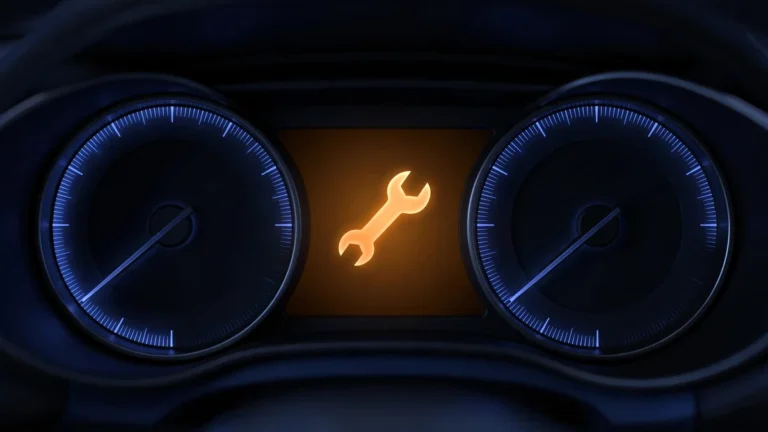
Shuddering engagement from rest is the most misdiagnosed symptom on the list. It can mean worn dual-mass flywheel dampers, heat spots or contamination (a weeping rear main seal oiling the disc), or — very commonly — nothing more than worn engine or transmission mounts letting the drivetrain rock. Do not let a shop quote you a clutch purely on chatter without inspecting the flywheel and mounts when the transmission is out. Severe slip can occasionally trigger a drivetrain malfunction warning, since the electronics notice engine and wheel speed disagreeing.
5. Grinding gears or hard engagement
Difficulty engaging gears — especially reverse or first at a stop — usually means the clutch is not fully releasing. Prime suspects: a failing slave or master cylinder, low or contaminated fluid, or air in the line. A failing throwout bearing can feel similar, with a whirring noise that changes when you press the pedal. Check the hydraulics before pricing a full clutch job; a slave cylinder is a fraction of the cost.
6. Rattle at idle that vanishes when you press the clutch
This one is almost never the clutch disc. A rattle in neutral at idle that disappears when you press the clutch is the signature of a failing dual-mass flywheel — worn internal springs letting the two masses knock together. Budget for a flywheel, not just a clutch kit.
7. Vague, mushy pedal feel
Many owners convince themselves their clutch is dying when it is really BMW’s clutch delay valve (CDV) — a restrictor in the hydraulic line that slows engagement to cushion shifts, making the pedal feel indirect and the bite point hard to find. It is an intentional design quirk, not wear (enthusiasts sometimes remove it for a more direct pedal; it changes feel, not clutch life). A pedal that sinks or an engagement point that wanders is a hydraulic problem, not a CDV problem.
| Symptom | Most likely cause | What to do |
|---|---|---|
| Revs climb in high gears under load | Worn clutch disc | Plan a clutch replacement; ease off hard throttle until then |
| Bite point creeping toward top of travel | Normal disc wear | Monitor; confirms wear when paired with slip |
| Recurring burning smell | Slipping, overheating friction material | Inspect soon; heat damage can spread to the flywheel |
| Shudder engaging from a stop | Dual-mass flywheel wear, oil contamination, or worn mounts | Inspect flywheel and mounts with the transmission out |
| Gears grind / hard to engage | Hydraulics (slave/master), air in line, release bearing | Check hydraulics first — far cheaper than a clutch job |
| Rattle at idle, stops with clutch pressed | Failing dual-mass flywheel | Budget for a flywheel with the clutch |
| Vague, mushy pedal, consistent bite point | Clutch delay valve quirk | Normal BMW behavior; not a repair item |
| Pedal sinks or bite point wanders | Hydraulic failure | Inspect master/slave cylinders and fluid |
The Dual-Mass Flywheel Judgment Call
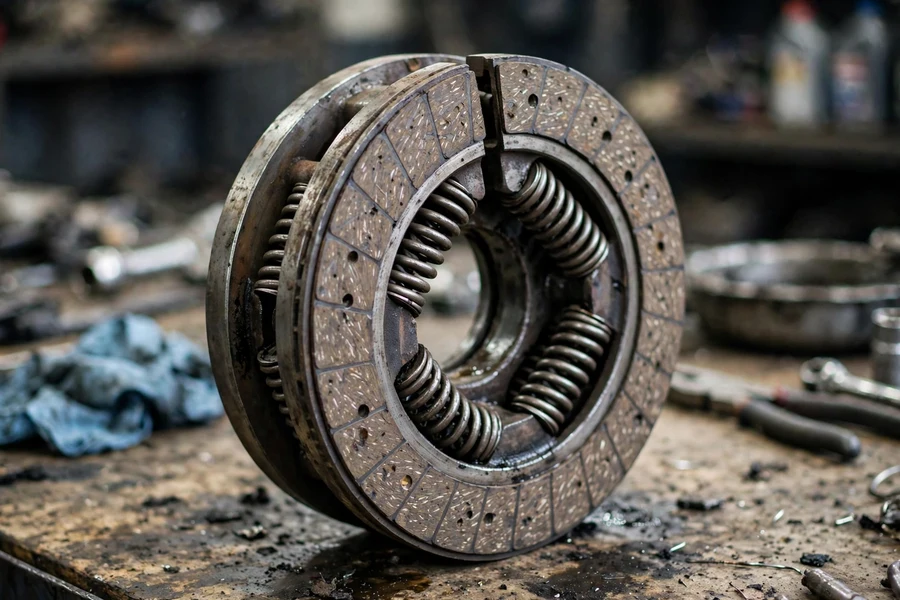
The flywheel is where clutch quotes explode. Every modern 3 Series manual uses a dual-mass flywheel (DMF): two masses joined by springs and dampers that absorb engine vibrations before they reach the transmission — which is why a 3 Series idles smoothly in neutral without the gear rattle older manuals had. It is also a wear item with an internal mechanism that degrades over time, and it cannot simply be machined flat like the solid flywheels of the past.
The strong specialist consensus is that a dual-mass flywheel should not be resurfaced: machining cannot fix the worn springs and dampers inside — the actual failure mode — and it changes the precise mating dimensions the release geometry depends on. ZF (whose Sachs brand builds these units) describes the DMF as an integral part of the driveline design and warns that cheap single-mass substitutes on everyday cars risk damaging transmission components. Their aftermarket guidance on dual-mass flywheels is the authoritative read.
So: replace it with the clutch, or keep it? The honest framework specialists use has three inputs — mileage, symptoms, and what you can see once it is out:
- High mileage (roughly 75,000+ miles) with no flywheel service history: replace it. The internal dampers are consumable; a widely repeated specialist rule of thumb is that a DMF being asked to do a second clutch cycle is living on borrowed time. The labor to get back in there later dwarfs the part cost now.
- Any DMF symptoms (idle rattle, takeoff chatter): replace it. These are the internal mechanism failing, and no cleaning or resurfacing fixes that.
- Low mileage, no symptoms, and it passes inspection once out (no visible heat spots or discoloration between the rivets, no grease leaking from inside, no excessive rotational play, no sticking): many specialists will clean the friction surface with a scuff pad and reuse it. This is the one scenario where keeping the flywheel is defensible.
You cannot fully judge the flywheel until the transmission is out — exactly when the car is immobile on the lift. Smart shops quote the job both ways (with and without the flywheel) so there is no mid-job surprise, and many owners pre-authorize the flywheel if it fails inspection.
When a single-mass conversion makes sense — and its trade-offs
Single-mass flywheel (SMF) conversion kits — the well-known Valeo-style kits being the common example — replace the dual-mass unit with a conventional solid flywheel and a sprung-hub clutch disc (the damping moves from the flywheel into the disc, the way clutches worked for decades). They cost roughly what a new dual-mass flywheel costs, the solid flywheel can be resurfaced at the next clutch change, and there is no internal damper mechanism left to fail.
The trade-off is refinement. A single-mass setup transmits more engine vibration into the transmission — typically some gear rattle at idle in neutral and busier low-speed manners, most noticeable on four-cylinder cars. Weight-matched conversion kits drive far more normally than lightweight racing flywheels, but they will not idle as silkily as the dual-mass setup BMW engineered the car around.
The honest read: a single-mass conversion suits a tuned or track-driven car, or a high-mileage keeper wanting cheaper future clutch changes. For a stock daily driver that values factory smoothness, a fresh dual-mass flywheel is the better choice — it is what BMW designed the transmission around. Do not choose a conversion purely because it looks cheaper on paper.
| Option | Typical part cost | Drivability | Best for |
|---|---|---|---|
| Keep existing DMF (inspect, clean, reuse) | $0 extra | Stock smoothness | Low mileage, no symptoms, passes inspection |
| New dual-mass flywheel | $400–$1,000 (OE-quality) | Stock smoothness | Stock daily drivers; high-mileage cars on clutch #2 |
| Single-mass conversion kit | Roughly the price of a new DMF | Possible idle gear rattle, busier low-speed feel | Tuned/track cars; keepers wanting cheaper future clutch changes |
Clutch or Something Else? Interactive Symptom Checker
Clutch or Something Else?
Pick the symptom that best matches your car to get the most likely cause and the smart next step.
Your result will appear here.
These are owner- and specialist-reported patterns, not a remote diagnosis. If in doubt, a good independent BMW shop will road-test it in minutes — most will tell you honestly whether it is the clutch, the flywheel, or the hydraulics.
What Is Actually Included in a Clutch Job
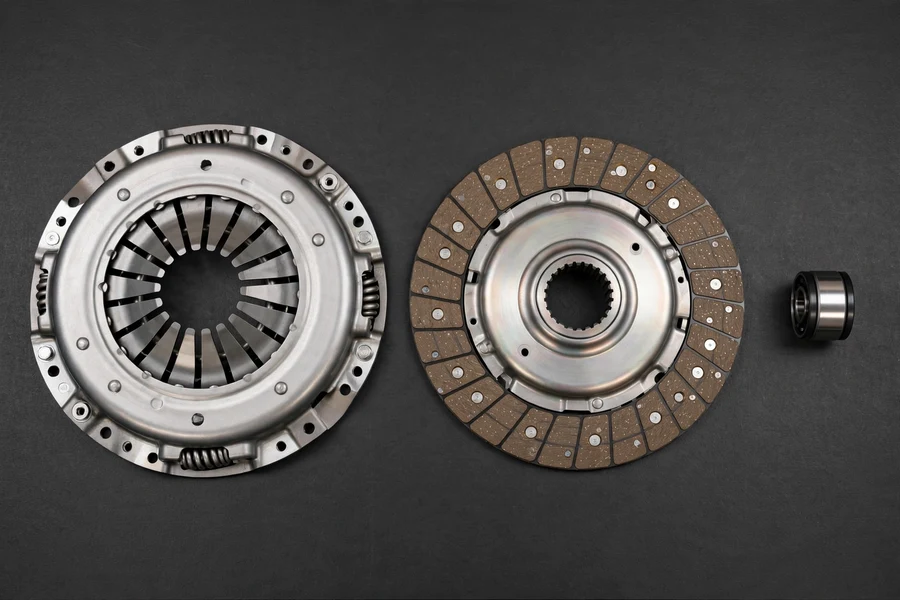
A clutch job is never just a disc. Because the transmission has to come out — the single most expensive part of the operation — the economics favor replacing every wear item you can reach while you are in there:
| Part | What it does | Replace? |
|---|---|---|
| Clutch disc | The friction surface that wears against the flywheel | Always — it is the reason for the job |
| Pressure plate | Clamps the disc to the flywheel; its diaphragm spring fatigues with age | Always (comes in the clutch kit) |
| Throwout (release) bearing | Pushes the pressure plate fingers to disengage the clutch; a common noise source | Always (comes in the clutch kit) |
| Pilot bearing | Supports the transmission input shaft in the crankshaft | Always — a $15 part that requires the whole job to reach later |
| Dual-mass flywheel | Vibration-damping flywheel; internal springs wear out | Conditional — see the judgment call above |
| Rear main seal | Keeps engine oil from leaking onto the clutch | Strongly recommended — cheap part, and a weeping seal oils the new disc |
| Clutch slave cylinder | Hydraulic actuator for the release bearing | Often — especially if pedal feel was ever inconsistent |
| Manual transmission fluid | Lubricates the gearbox; many cars are on original “lifetime” fill | Recommended while the transmission is drained and accessible |
| Guibo (flex disc), shifter bushings | Driveline coupling and shift linkage wear points | Inspect; replace if cracked or sloppy — the labor is already paid for |
The “while you are in there” logic is the whole game: these parts add a few hundred dollars now, but reaching any one of them later costs the full transmission-removal labor again. A suspiciously cheap quote deserves scrutiny — ask whether it includes the pilot bearing, rear main seal, and slave cylinder.
If your other 3 Series is the automatic, its equivalent big service is the ZF 8HP transmission fluid change — no clutch to replace, but fresh fluid on a real interval, not BMW’s “lifetime” claim.
The Labor Reality: A Transmission-Out Job
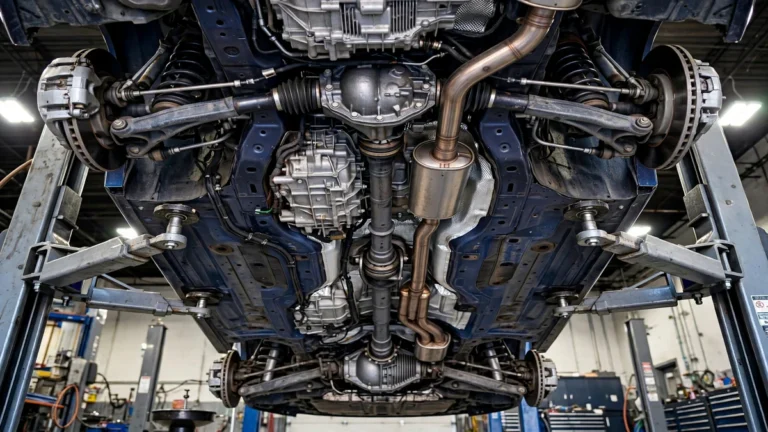
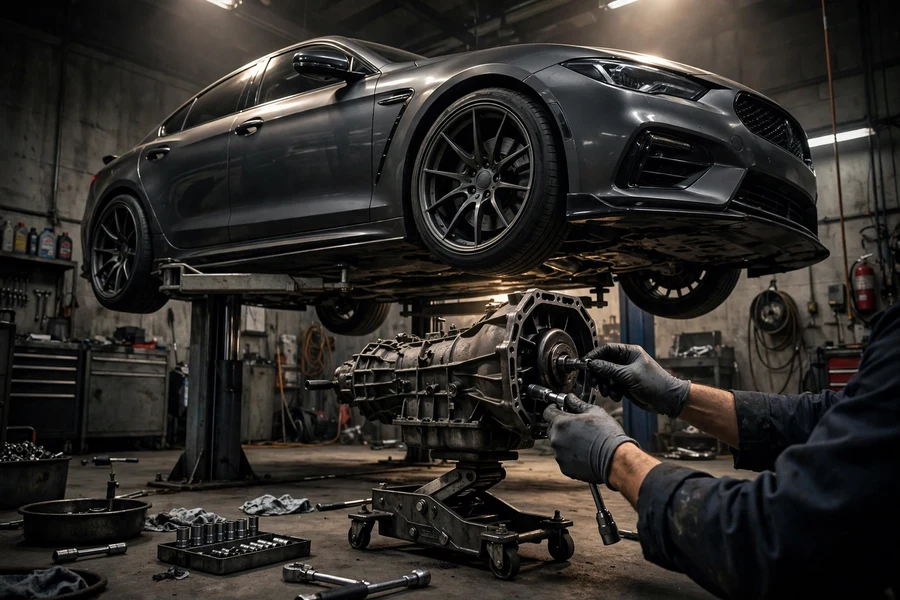
There is no shortcut: the exhaust comes down, the driveshaft comes out, the shifter linkage disconnects, and the gearbox is unbolted from the bellhousing and lowered. Book time is typically 6–10 hours depending on generation and drivetrain — with a lift, a transmission jack, and a tech who has done it before.
The RWD vs xDrive difference is real. On a rear-wheel-drive car the path to the bellhousing is relatively clear once the exhaust and driveshaft are out. On xDrive cars, the transfer case, front driveshaft, and front differential crowd the same space — the transfer case typically comes off with the transmission, adding roughly 1.5–2.5 hours of labor. That is the xDrive adder in the cost table below.
Honest difficulty rating: 8 out of 10. You need tall, stable jack stands or a lift, a transmission jack, a clutch alignment tool, and the discipline to follow torque specs on the pressure plate and flywheel bolts. Classic DIY failures: misaligning the disc so the input shaft will not seat, and nicking the new rear main seal on installation. If you have done suspension and brake work confidently and have the equipment, it is a long-weekend job. If not, pay a specialist — a botched installation means removing the transmission twice.
Honest Cost Bands (Estimates, Not Quotes)
Every number below is an owner- and specialist-reported estimate for a 3 Series (E90/F30 era); local labor rates move them. Use them to sanity-check quotes, not to budget to the dollar. The pattern that matters: the clutch kit is the cheap part — labor and the flywheel decision are the bill.
| Route | Clutch kit only | Clutch kit + new dual-mass flywheel | xDrive adder |
|---|---|---|---|
| DIY (parts only) | $300–$650 | $700–$1,650 | $0 — your Saturday |
| Independent BMW specialist | $1,500–$2,100 | $2,100–$3,000 | +$250–$450 |
| BMW dealer | $2,600–$3,400 | $3,200–$4,300 | +$300–$500 |
The DIY parts bill: an OE-quality clutch kit (LUK or Sachs) at $300–$650, a new dual-mass flywheel at $400–$1,000, plus pilot bearing, rear main seal, slave cylinder, and fluid at $100–$250 combined. The specialist route buys the lift, the transmission jack, the experience, and usually a labor warranty. The dealer route buys genuine BMW parts and the highest labor rate in town — owners report dealer quotes 40–60% above a good independent for this job.
Clutch Cost Estimator
Estimate Your Clutch Job
Three choices, one honest ballpark. All figures are owner/specialist-reported estimates.
Estimates based on owner- and specialist-reported US pricing. Your quote will vary with local labor rates, generation, and parts brand. Always get the quote both ways — with and without the flywheel — before authorizing.
How Driving Style Shapes Clutch Life
A clutch dies from heat, and heat comes from slipping — every launch, shift, and hill hold is a controlled slip event. The 150,000-mile clutches and the 60,000-mile clutches are mostly separated by habits, not luck.
- Stop riding the pedal. Even light pressure keeps the release bearing loaded and the disc kissing the flywheel — the most common habit behind premature wear. Foot off the pedal unless you are shifting.
- Make shifts decisive. A slow engagement slips the disc far longer than a quick, confident one — revs matched, fully engaged, foot off the pedal.
- Do not hold the car on a hill with the clutch. Balancing on the bite point is a friction-material bonfire — hold with the brake or handbrake, then launch normally.
- Respect tuned torque. A Stage 1 tune adds the mid-range torque that finds a clutch’s limit — many tuned owners report slip in high gears well before 100,000 miles. If you tune it, budget for an uprated clutch sooner.
- City traffic and towing are clutch killers. Constant stop-and-go means constant heat cycles; towing multiplies the load on every engagement. Expect the shorter end of the life range.
- Learn to rev-match downshifts. Matching revs before releasing the clutch dramatically cuts the slip and shock the disc absorbs.
None of this requires driving like a saint. A clutch is designed to slip — that is literally its job during every launch. The goal is simply to keep slip events short, complete, and cool, which is also the philosophy behind the 3 Series maintenance schedule: mechanical sympathy on a timetable beats heroic repairs.
Break-In: The 500-Mile Rule
A fresh clutch needs a break-in, and skipping it is the most common way to ruin a new disc. The friction material needs 300–500 miles of normal driving to bed against the flywheel and pressure plate. Until then it cannot handle full heat — a hard launch on a green clutch glazes the surface, and a glazed disc slips and wears prematurely for life.
- First 500 miles: normal street driving, gentle to moderate launches, no full-throttle acceleration — especially not in high gears.
- No launches, no burnouts, no towing. Anything that generates big heat before the disc is bedded risks glazing.
- Engage fully and cleanly. Do not ride or feather the new clutch “to be gentle” — clean engagement beds the surfaces better than prolonged slipping.
- Vary your driving. City stop-and-go is useful during break-in — many gentle engagement cycles. Just keep them gentle.
- After 500 miles: drive it normally. The disc is bedded; there is no second phase.
Frequently Asked Questions
How much does a BMW 3 Series clutch replacement cost?
As owner- and specialist-reported estimates: $1,500–$2,100 at an independent BMW specialist for the clutch kit alone, $2,100–$3,000 with a new dual-mass flywheel, and $2,600–$4,300 at a dealer. DIY parts run $300–$650 for a quality clutch kit or $700–$1,650 including a flywheel. xDrive cars typically add $250–$500 in labor over RWD. Always get quotes both with and without the flywheel.
How long does a BMW 3 Series clutch last?
Owner-reported figures cluster around 80,000–120,000 miles for a first replacement on stock cars. Gentle highway drivers often exceed 150,000 miles; tuned cars, heavy city commuters, and drivers who ride the pedal can need one far earlier. Clutch life is dominated by driving technique and heat cycles, which is why identical cars vary so widely. There is no clutch interval in the maintenance schedule — it is a wear item, replaced on condition.
Do I have to replace the dual-mass flywheel with the clutch?
Not always, but usually at higher mileage. The strong specialist consensus is that dual-mass flywheels should not be resurfaced — machining cannot fix worn internal dampers and changes the release geometry. If your car has roughly 75,000+ miles on the original flywheel, shows idle rattle or takeoff chatter, or the flywheel fails inspection once it is out, replace it. Reusing it is defensible only at low mileage with no symptoms and a clean inspection.
Is a single-mass flywheel conversion a good idea for a daily driver?
For most daily drivers, no — a fresh dual-mass flywheel preserves the factory smoothness BMW engineered the car around. Single-mass conversions make sense for tuned or track-driven cars (where the stock DMF is a weak point under added torque) or high-mileage keepers that want cheaper future clutch changes, since a solid flywheel can be resurfaced. Expect some idle gear rattle and busier low-speed manners in exchange, and note ZF’s own caution that cheap single-mass substitutes on everyday cars risk driveline damage.
Can I replace the clutch myself?
It is doable but firmly an advanced DIY — about an 8 out of 10. You will need tall stable jack stands or a lift, a transmission jack, a clutch alignment tool, and torque-spec discipline. The classic mistakes are misaligning the disc so the input shaft will not seat, and damaging the new rear main seal on installation. If you have not done major driveline work before, pay an independent BMW specialist: the parts savings of DIY evaporate the moment a transmission has to come out twice. For the full picture of 3 Series ownership costs, see the complete 3 Series guide.