How BMW’s CBS System Decides Your Oil Change Timing
Your BMW does not change its oil every 10,000 miles because a calendar told it to. It changes its oil when a sensor in the oil pan, a model of your driving style, and a hard two-year ceiling agree the time has come. That logic — measuring actual wear instead of counting miles — is bmw condition based service, the system behind every wrench icon, oil-can symbol, and “service due” message your car has ever shown you. This guide explains what CBS actually measures, how each of its service items is calculated, how to read the displays, and how to reset each item yourself by generation.
Short answer
bmw condition based service is BMW’s sensor-driven maintenance system: instead of fixed mileage intervals, it computes each service date from live data. Engine oil life comes from an oil-condition sensor (thermal and capacitive measurement) plus driving-style modeling, capped at 2 years. Brake pads are tracked by two-stage wear sensors plus a wear model. Brake fluid, microfilter, and vehicle check are time-based. When a service is performed, reset that CBS item through the cluster or iDrive — and know that BMW locks out resets during roughly the first 20% of a fresh interval to prevent accidental clearing.
In this guide
- What CBS actually is — and what it replaced
- The sensor inputs behind every CBS item
- Every CBS service item, what drives it, and its limits
- Engine oil: how CBS calculates oil life
- Brake pads: the two-stage wear sensor explained
- Time-based items: brake fluid, microfilter, vehicle check
- Reading your CBS display: cluster, iDrive, app
- Reset procedures by generation: E90, F30, G20
- Interactive: CBS interval predictor
- Interactive: CBS myths quiz
- Using CBS to judge a used 3 Series
- Reset mistakes that cause real problems
- Frequently asked questions
What CBS actually is — and what it replaced
Before CBS, BMW used fixed service intervals: an oil service every so many miles, an “Inspection I” and “Inspection II” alternating on a schedule. The problem with fixed intervals is that they are wrong for almost everyone — gentle highway drivers get serviced too early, and hard city drivers too late. Condition Based Service, introduced across the lineup in the early 2000s and standard on every 3 Series from the E90 onward, replaced the fixed schedule with a simple idea: let the car measure the actual condition of its consumables and call for service when the measurements say so.
That is the part most owners misunderstand. CBS is not a fancier reminder calendar. For the items it measures — engine oil and brake pads — it runs a continuous calculation in the background from the day the item is reset, combining physical sensor readings with a mathematical model of how you drive. For the items it cannot measure — brake fluid aging, cabin filter loading, the calendar-driven vehicle check — it counts time, because time is the correct proxy for those wear mechanisms. The result is a service plan that adapts to your driving instead of punishing or rewarding it arbitrarily.
One more thing CBS is not: it is not the whole maintenance schedule. CBS covers the items the car can judge by itself. It does not track coolant, transmission fluid, differential fluid, or any of the “lifetime fill” items BMW quietly leaves off every schedule — which is why this guide pairs with our full 3 Series maintenance schedule and costs breakdown. Think of CBS as the car’s own to-do list, and the full schedule as everything else the car cannot see.
The sensor inputs behind every CBS item
CBS draws on a small set of physical inputs, most of which already existed for other jobs. The oil-condition sensor lives in the oil pan and does triple duty: it measures oil level (thermal principle), oil temperature, and oil quality (capacitive/conductivity measurement that tracks contamination and additive depletion). The brake pad wear sensors — one per axle — are simple two-stage resistor loops embedded in the pads. Everything else comes from data the car already has: mileage, engine starts, fuel consumption, operating temperatures, and elapsed time.
| Input | What it measures | Which CBS items it feeds |
|---|---|---|
| Oil condition sensor (oil pan) | Oil level, temperature, and quality via thermal + capacitive sensing | Engine oil |
| Brake pad wear sensor (one per axle) | Two-stage circuit: intact, first stage worn through, second stage worn through | Front brake pads, rear brake pads |
| Odometer / trip data | Distance driven, trip lengths, cold vs. warm starts | Engine oil, brake pads, spark plugs |
| Fuel consumption model | Total fuel burned — a proxy for engine workload | Engine oil |
| Operating temperature history | How often and how long the engine reaches full temperature | Engine oil |
| Elapsed time (cluster clock) | Calendar time since last reset | Brake fluid, microfilter, vehicle check, oil (2-year cap) |
Notice what is missing: there is no sensor that directly measures brake pad thickness in millimeters, no sensor that sniffs brake fluid moisture, and no sensor that grades cabin filter dirt. CBS is a hybrid system — part measurement, part model, part calendar — and understanding which part drives which item is the key to reading it correctly.
Every CBS service item, what drives it, and its limits
Here is the complete CBS item list for a 3 Series, with the logic behind each one. “Typical range” figures below are what owners actually see; the hard limits are the ones CBS enforces no matter how gently you drive.
| CBS item | Driven by | Typical range owners see | Hard limit |
|---|---|---|---|
| Engine oil | Oil-condition sensor + fuel burned + temperature history + driving style model | ~10,000–15,000 miles | 2 years, always |
| Front brake pads | Two-stage wear sensor + pad-wear model | ~30,000–70,000 miles | Sensor stage 2 triggers service-now warning |
| Rear brake pads | Two-stage wear sensor + pad-wear model | ~30,000–70,000 miles | Sensor stage 2 triggers service-now warning |
| Brake fluid | Time only | Every 2 years | 2 years |
| Microfilter (cabin filter) | Time/mileage (generation-dependent) | ~Every 2 years or ~30,000 miles | Varies by generation |
| Spark plugs | Mileage (engine-dependent) | ~60,000 miles (turbo engines); up to ~100,000 (N52-era NA engines) | Shown by CBS per engine |
| Vehicle check | Time only | ~Every 4 years | Calendar |
A few of these deserve unpacking, because the table hides the interesting engineering. Oil life, brake pad tracking, and the time-based items each work differently — and each has a failure mode owners should understand.

Engine oil: how CBS calculates oil life
Engine oil is the flagship CBS item and the one with the most sophisticated logic. When you reset the oil CBS, the counter starts at 100% and the car begins watching four things. First, the oil-condition sensor in the pan continuously reports oil quality — as contaminants accumulate and additives deplete, the oil’s electrical properties shift, and the sensor sees it. Second, the car totals the fuel you burn, because fuel burned is an excellent proxy for total engine workload: an engine that burned 800 gallons did roughly twice the work of one that burned 400, regardless of the miles covered. Third, it watches temperature history — frequent short trips where the oil never reaches operating temperature are brutal on oil life, because moisture and fuel dilution never boil off. Fourth, elapsed time ticks away toward the two-year cap.
The practical upshot: a highway commuter who drives 15,000 gentle miles a year will see CBS call for oil around 12,000–15,000 miles, while a city driver doing 6,000 miles of short trips will get the call much sooner — sometimes under 10,000 miles — even though the odometer says less. This is CBS working as designed, and it is why comparing your oil interval to someone else’s is meaningless without comparing driving patterns. And no matter what: two years after the last reset, CBS calls for oil. Time oxidizes oil even in a parked car, and BMW draws the line there.
Two caveats worth knowing. The oil-condition sensor measures oil quality, but it cannot detect the wrong oil — if a shop fills your N20 with non-LL-01 oil, CBS will happily count down as if everything is fine, so use the correct specification (our oil change interval guide covers specs and the LL-01/LL-04 question). And low oil level accelerates the countdown: running a quart low raises oil temperature and concentrates contaminants, so CBS will shorten the interval. Check the level; the sensor is already judging you for it.
Brake pads: the two-stage wear sensor explained
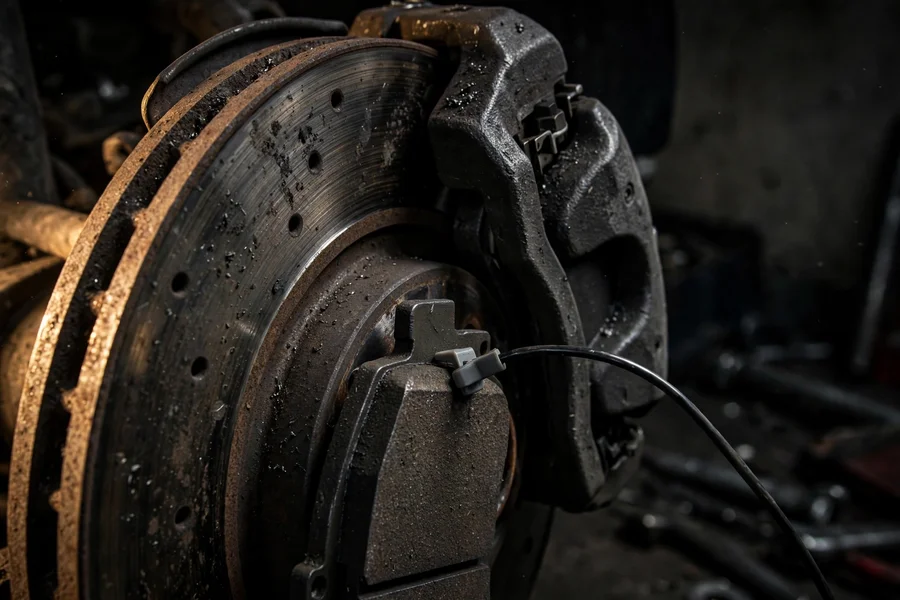
Brake pad CBS is the item owners misunderstand most, because the wear sensor is dumber than people think and the model around it is smarter than people think. The sensor itself is a simple loop of wire embedded in the pad at a fixed depth. It has two stages: when the pad wears to the first depth, the outer loop breaks and the car knows the pad is roughly two-thirds gone; when it wears to the second depth, the inner loop breaks and the car raises an immediate service warning. That is it — the sensor gives two data points, not a continuous thickness reading.
Everything between those two data points is the model. From the day the brake CBS is reset, the car estimates pad wear from your braking behavior — deceleration events, speeds, mileage — and projects when the pad will reach the sensor depths. Once the first sensor stage breaks, the estimate snaps to reality and the remaining-life figure becomes precise. This is why CBS can show “front brakes: 20,000 miles remaining” with confidence: it is extrapolating your measured wear rate forward.
The wear sensor is single-use. Once a stage has worn through, the sensor must be replaced — resetting brake CBS without replacing a triggered sensor fails or immediately re-triggers, which is the number-one cause of “reset unsuccessful” complaints. There is one sensor per axle (front left, rear right on most 3 Series), and BMW’s logic will not let you reset brake CBS if the sensor circuit reports worn. New pads, new sensor, then reset — in that order.
Time-based items: brake fluid, microfilter, vehicle check
Some wear mechanisms have no useful mileage proxy, so CBS simply counts time. Brake fluid is hygroscopic — it absorbs moisture from the air through hoses and seals from the day it is bottled, and moisture lowers the boiling point, which is a genuine safety issue on a hard mountain descent. No sensor measures this in the car, so CBS calls for brake fluid every two years, full stop. The reset procedure for this one is on our brake fluid reset guide if you need the step-by-step.
The microfilter (cabin filter) is similar: it loads with dust and pollen whether you drive or not, and a damp filter grows things you do not want to breathe. CBS typically calls for it every two years or around 30,000 miles depending on generation — check your car’s own display rather than memorizing a number. The vehicle check is a calendar inspection item (roughly every four years on US cars): a dealer or independent shop goes over the car on a lift, checks for leaks, worn bushings, and aging rubber, and resets the item. Spark plugs sit in between — mileage-driven, but the figure depends on the engine: plan on roughly 60,000 miles for turbo engines and up to 100,000 for the naturally aspirated N52 era, and let CBS show you the exact number for your car.
Reading your CBS display: cluster, iDrive, app
CBS shows up in three places, and each shows a different level of detail. At startup, the instrument cluster flashes any overdue or due-soon items — the ones that demand attention, like a brake pad warning or an oil service that has crossed the line. This is the car’s way of making sure you cannot miss a safety-relevant item.
The full picture lives in iDrive under Vehicle Status / Service Required (menu names vary slightly by iDrive generation — see our iDrive generations guide if your menus look different). There you get the complete list: every CBS item with its remaining mileage or its due date. Green means healthy margin, yellow means due soon, red means overdue. This screen is also where you check the exact remaining figure before a long trip or a used-car purchase — a car showing 2,000 miles of front-brake life remaining is telling you about a $300–$600 bill in its near future.
The My BMW app mirrors the CBS list remotely, which is genuinely useful: you can check whether the car you are about to buy, or the car your teenager drives, is due for anything without walking to the garage. The app reads the same CBS data the cluster does.
Reset procedures by generation: E90, F30, G20
Resetting a CBS item is a cluster ritual that changes slightly by generation. The golden rule for all of them: do the work first, reset second, and never reset an item you did not service — the car will happily believe you and schedule the next service from a lie.
| Generation | Entering CBS reset mode | Scrolling / confirming |
|---|---|---|
| E90 (2006–2011) | Key in (or press start without brake), wait for service reminder to clear, press and hold the odometer reset button until the service menu appears | Short-press the odometer button to scroll items; use the BC stalk button to select; press and hold BC to confirm “Reset?” |
| F30 (2012–2019) | Press start once without touching the brake (ignition on, engine off), wait for the reminder to disappear, press and hold the odometer reset button until the CBS menu appears | Short-press odometer button to scroll; press and hold on the item until “Reset?” appears, release, press and hold again to confirm |
| G20 (2019+) | Press the start button three times quickly (foot off the brake) to enter diagnostic mode — the cluster confirms it — then press and hold the BC button on the indicator stalk | Short-press BC to scroll through items; press and hold on the item until “Reset?” appears, release, press and hold again to confirm |
Two details from BMW’s own training documentation are worth knowing. First, a fresh CBS item is protected against premature reset for roughly the first 20% of its interval — if you try to reset oil life at 95% remaining, the car will refuse, showing that reset is not possible. This is deliberate, and it is not a fault. Second, brake pad resets require the wear sensor to report a healthy circuit: if the sensor has worn through and you have not replaced it, the reset fails. Always replace the sensor with the pads.

Interactive: CBS interval predictor
Pick your generation, the service item, and your driving style. The predictor applies the CBS logic from this guide — sensor-driven items scale with driving style, time-based items don’t — to estimate what your car will actually call for.
CBS interval predictor
Estimates only — your car’s own CBS display is the authority. Ranges reflect the typical figures in this guide.
Interactive: CBS myths quiz
Six statements about CBS. True or false? Your score at the end tells you whether you actually understand your car’s brain — or just think you do.
CBS myths quiz
Question 1 of 6
Using CBS to judge a used 3 Series
CBS is one of the most underused tools in a used-car inspection, because it is a tamper-evident window into how the car was actually maintained. Before you buy, sit in the car, open the iDrive service list, and read every item — then interpret what you see like a service advisor would.
First, look at the spread. A car with 80,000 miles showing oil at 60% remaining, front brakes at 40%, and brake fluid due in three months is a car that was serviced on time and driven normally — the CBS items were reset when the work was done, which means the work was done. A car with 80,000 miles showing every item at 95–100% is suspicious, not reassuring: either someone reset everything without doing the work (the classic curbstoner move), or the cluster was replaced and the counters restarted. Ask for receipts; CBS at 100% across the board on a high-mileage car is a story that needs documentation.
Second, convert the remaining figures into money. CBS tells you the near future in plain numbers: front brakes with 3,000 miles remaining means a brake job is due within months — budget accordingly and use it in negotiation. Brake fluid showing overdue by a year means the previous owner deferred maintenance, which makes you wonder what else was deferred. Third, check the dates, not just the miles: brake fluid and vehicle check are calendar items, so an “overdue by 14 months” brake fluid on an otherwise clean car is a small red flag about the seller’s habits, not the car’s health.
Finally, cross-check CBS against the physical car. If CBS says the oil is fresh but the oil on the dipstick (where fitted — many of these engines have no dipstick, so check via iDrive’s electronic level) looks black and smells of fuel, someone reset without servicing. If CBS shows new front brakes but the discs are deeply lipped, same story. CBS is honest; the person holding the reset button sometimes isn’t. Pair this check with our used 3 Series pre-purchase inspection guide for the full walkthrough.
Reset mistakes that cause real problems
CBS is only as honest as the person pressing the buttons. The classic mistake is resetting the oil CBS without changing the oil — usually after a top-up or out of habit at the wrong menu. The car then schedules the next 12,000+ miles from a lie, and the two-year cap becomes your only safety net. The second classic is the brake reset without a new wear sensor: the reset fails, or the warning returns immediately, and owners conclude the system is broken when it is working exactly as designed. The third is resetting everything at once after doing one job — if you changed the oil but not the microfilter, leave the microfilter alone.
One more: aftermarket brake pad wear sensors. Cheap sensors sometimes report the wrong resistance, and CBS reads them as permanently worn — the reset never takes. If a brake CBS reset fails with new pads and a new sensor, the sensor is the prime suspect, not the procedure. And remember the 20% protection window: if a reset refuses on a fresh interval, that is the car protecting you from yourself, not a malfunction.
Typical CBS oil interval by driving style (miles)
Illustrative midpoints from the typical 10,000–15,000 mile range stated in this guide; hard city driving can fall below 10,000. The 2-year cap applies to all three.
Frequently asked questions
An oil-condition sensor in the oil pan measures oil level, temperature, and quality (thermal plus capacitive sensing), while the car models your fuel burn and temperature history to judge driving severity. Gentle highway driving stretches the interval toward 15,000 miles; hard short-trip driving shortens it well below 10,000. A hard two-year cap applies regardless of mileage.
Yes, through the instrument cluster on all three generations: E90 and F30 use the odometer reset button (F30: press start once without the brake first), while G20 requires three quick start-button presses to enter diagnostic mode, then the BC stalk button. Only reset items you actually serviced, and note BMW blocks resets during roughly the first 20% of a fresh interval.
Almost always the wear sensor. It is a single-use part — once a stage wears through, the sensor must be replaced along with the pads, or the reset fails. Foot off the brake and parking brake released during the procedure also matter. Cheap aftermarket sensors that report the wrong resistance will block the reset permanently.
No. CBS covers oil, brake pads, brake fluid, microfilter, spark plugs, and the vehicle check. It does not track coolant, transmission fluid, differential fluid, or transfer-case service — the “lifetime fill” items. Our 3 Series maintenance schedule covers the full picture including everything CBS cannot see.
In iDrive’s service list, green means healthy margin, yellow means a service is due soon or just due, and red means overdue. For brake pads specifically, the second wear-sensor stage triggers an immediate red-level warning — that one means stop planning and book the job, because the pad is at its wear limit.