BMW Brake Fluid Flush in 9 Steps (E90/F30/G20)
Short answer: A BMW 3 Series brake fluid flush takes about 90 minutes in a driveway: siphon the old fluid from the reservoir, refill with fresh DOT 4 LV, then bleed each corner in the order right-rear, left-rear, right-front, left-front (plus the clutch slave on manuals) until the stream runs clear. BMW calls for fresh fluid every 2 years because brake fluid absorbs moisture. You need 1 liter of fluid, a $50–$90 pressure bleeder (or a helper), and a wrench. Approximate costs: $30–$60 DIY, $90–$180 at an independent BMW shop, $150–$250 at a dealer.
Of all the maintenance a BMW 3 Series asks for, a brake fluid flush has the best ratio of safety benefit to effort. Brake fluid is hygroscopic: it pulls moisture out of the air through hoses, seals, and the vented reservoir cap, and that dissolved water lowers the fluid’s boiling point. Fresh DOT 4 boils dry at a minimum of 230°C (446°F); after a couple of years of absorbed moisture, the wet boiling point can sit at just 155°C (311°F). On a long downhill or a hard stop, old fluid can boil at the calipers and leave the pedal sinking toward the floor. BMW’s answer is simple: change it every two years, mileage irrelevant.
One boundary before the steps: this is the flush procedure itself — draining old fluid and replacing it at all four calipers. If your only job is clearing the dashboard reminder after a service, that is covered separately: our BMW 3 Series brake fluid service reset guide walks through the CBS reset for E90, F30, and G20. This guide covers the mechanical work — the fluid specs by generation, the correct bleeding order, the clutch circuit on manual cars, the ABS/DSC caveats, and honest cost bands.
This is documentation-based guidance: manufacturer intervals, published DOT specifications, and widely used shop procedures — not personal anecdote. Independent guides, built from documentation and data.
In this guide
- Why old fluid is a real safety problem
- The right fluid for your generation
- Interactive: which bleeding method fits you
- Tools and supplies
- The 9-step flush procedure
- Manuals: don’t forget the clutch circuit
- ABS and DSC bleeding notes
- Interactive: is your flush due?
- Dealer vs independent vs DIY costs
- Mistakes to avoid
- Frequently asked questions
Why old fluid is a real safety problem
The hydraulic system in a 3 Series is sealed in name only. Brake fluid absorbs moisture continuously — through rubber hoses, caliper seals, and even the vented reservoir cap. Over two years, that absorption measurably degrades performance: U.S. FMVSS 116 defines a wet boiling point (at 3.7% absorbed water) of just 155°C for DOT 4, down from a 230°C minimum dry. Under repeated hard braking, the calipers are the hottest point in the system, and boiling fluid creates compressible vapor bubbles — which is why a car with ancient fluid can develop a soft, sinking pedal on a mountain descent while feeling perfectly normal in daily traffic.
Moisture does more than lower the boiling point. Dissolved water corrodes from the inside: steel brake lines, caliper pistons, master-cylinder bores, and the delicate solenoid valves inside the ABS/DSC hydraulic unit all live in this fluid. Internal corrosion is what turns a $150 fluid service into a seized caliper or a failing DSC unit years later. Darkening — amber turning tea-brown — is the visible signal of contamination, though color alone is a rough gauge: two-year-old fluid can look fine and still test high in moisture.
The chart below shows the FMVSS 116 minimum dry and wet boiling points for the common glycol-based DOT ratings. BMW-spec fluid needs to hold its boiling point high and its viscosity low in cold weather so the DSC can pulse the brakes dozens of times per second — which is why the low-viscosity variant matters on modern cars.
DOT brake fluid boiling points — FMVSS 116 minimums (°C)
Wet = at 3.7% absorbed water, the standard FMVSS test condition. Higher is better.
Minimums per U.S. Federal Motor Vehicle Safety Standard 116; quality fluids test well above these. DOT 5.1 is glycol-based like DOT 4 and compatible — it is not the same as silicone-based DOT 5, which must never go in a BMW.
Note the chart shows minimums, not what your bottle actually tests at — a quality DOT 4 LV product often tests at 265°C dry and 170°C wet when new. The gap between new and wet is what the two-year interval buys you: you flush long before the fluid can drift down to those wet minimums.
The right fluid for your generation
BMW’s brake fluid specification is straightforward, and the generations differ by one letter: LV.
| Generation | Years | BMW fluid spec | What to buy |
|---|---|---|---|
| E90 (3 Series) | 2006–2011 | DOT 4 | Any quality DOT 4 or DOT 4 LV — LV is fully backward-compatible |
| F30 (3 Series) | 2012–2018 | DOT 4 LV | DOT 4 LV (low viscosity); standard DOT 4 works but LV is the specified fluid |
| G20 (3 Series) | 2019–present | DOT 4 LV | DOT 4 LV — specified for the DSC-equipped cars |
DOT 4 LV (low viscosity, ISO 4925 class 6) is the factory fill on F30 and G20 cars and is backward-compatible with every older BMW, including the E90 — using LV on an E90 is fine. What you must never do is use DOT 5: it is a silicone-based fluid, it does not mix with glycol-based DOT 3/4/5.1, and it has no place in a BMW brake system. DOT 5.1, despite the name, is glycol-based and compatible — but BMW specifies DOT 4 LV, so buy that.
Quantity: 1 liter is enough for a complete flush on a 3 Series — the reservoir, lines, and calipers together hold under a liter, and a measured full-liter push leaves margin at each corner. Buy two 1-liter bottles anyway; the second bottle is cheap insurance against running the reservoir dry mid-job, and unopened fluid keeps for a year or so if the seal is intact. Never reuse an opened bottle that has been sitting on a shelf: it has been breathing moisture since you opened it.
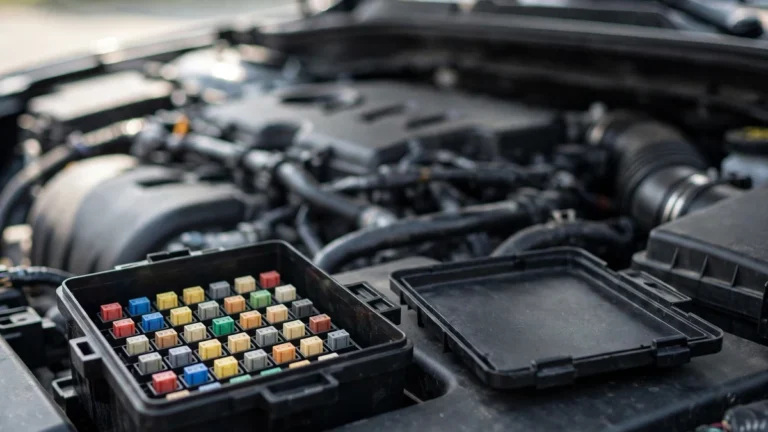
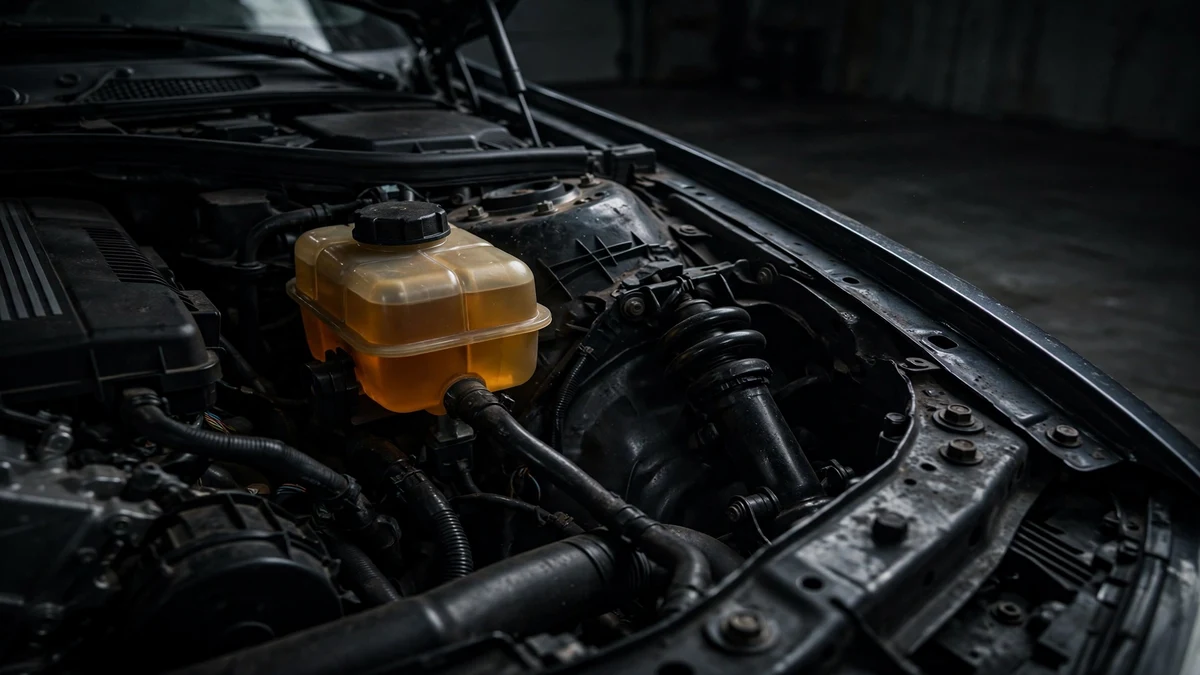
The brake fluid reservoir sits at the back of the engine bay on the driver’s side. Dark, tea-colored fluid is the visible signal that it has been in service too long.
Interactive: which bleeding method fits you
There are three ways to do this job in a driveway: a pressure bleeder, the classic two-person pedal pump, or a vacuum bleeder at each caliper. The picker below weighs your tools, your help, your transmission, and your experience — then tells you the best fit and the watch-outs for your situation.
Bleeding-method picker
Tools and supplies
The shopping list is short. A full flush needs one liter of DOT 4 LV, but buy two — the insurance bottle is the cheapest mistake-prevention you can buy.
| Item | What it does | Approx. cost (US) |
|---|---|---|
| DOT 4 LV brake fluid, 2×1L | Flush fluid + insurance bottle (1L does the job) | $15–$25 per liter |
| Pressure bleeder with BMW adapter | Pressurizes reservoir to ~2.0 bar; best one-person method | $50–$90 one-time |
| Clear vinyl hose + catch bottle | Fits over the bleeder screw; shows color and bubbles | $10 |
| Box-end wrench (typically 11 mm) | Opens bleeder screws without rounding them | On hand |
| Turkey baster or large syringe | Siphons old fluid from the reservoir first | $5 |
| Jack + jack stands (or ramps) | Access to all four calipers — see our safe jacking guide | On hand |
| Nitrile gloves + eye protection | Brake fluid strips paint and irritates skin | $10 |
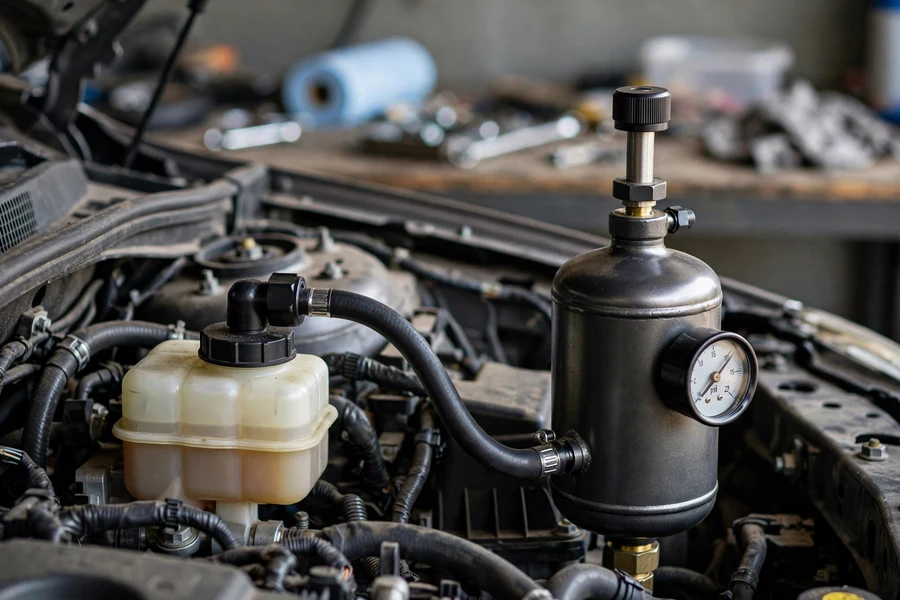
A pressure bleeder feeds fresh fluid into the reservoir under steady pressure — the cleanest way to flush a BMW solo.
The 9-step flush procedure
Difficulty: easy-moderate — no computer, no special BMW tools, just patience and attention to fluid level. Time: about 90 minutes the first time, an hour once you have done it. The bleeding order on all 3 Series generations is the same: farthest from the master cylinder first.
| Bleeding order | Corner | Approx. fluid to push through |
|---|---|---|
| 1 | Right rear | ~250 mL — longest line, most old fluid |
| 2 | Left rear | ~150 mL |
| 3 | Right front | ~150 mL |
| 4 | Left front | ~150 mL |
| 5 (manuals only) | Clutch slave cylinder | Until the stream runs clear |
Step 1 — Prep and protect
Park on level ground, engine off, transmission in Park or first gear, parking brake on. Lay rags or a fender cover around the reservoir — brake fluid eats paint. Pop the hood and open the reservoir cap. Siphon the old fluid out with a turkey baster or large syringe, leaving just enough to keep the master cylinder ports covered, then refill to MAX with fresh DOT 4 LV. Do not let the reservoir drop below MIN at any point during this job — that is the single most important rule of the whole procedure.
Step 2 — Get access
Lift the car and secure it on jack stands so you can work all four corners, or work one corner at a time if that is your setup. You do not strictly have to remove all four wheels — many people flush with the wheels on, reaching the bleeder through the spokes — but removing them gives you a clear view of the bleeder screw and its condition. Bleeder screws corrode; spray each one with penetrating oil a few minutes before you touch it, and reach for a box-end wrench, never an adjustable. Our safe jacking guide for the 3 Series shows the correct lift points if you have not had the car up before.
Step 3 — Set up your bleeding method
Pressure bleeder: fill the tank with fresh fluid, thread the BMW adapter cap onto the reservoir, and pump to about 2.0 bar (BMW’s shop procedure, TIS 34 00 048, specifies this pressure). The tank now feeds the reservoir continuously, so it cannot run dry. Two-person: your helper sits in the driver’s seat while you check that the reservoir is at MAX — you will top it up by hand after every corner. Either way, slip the clear hose over the first bleeder screw and route it into your catch bottle with the hose end submerged in a little fresh fluid.
Step 4 — Bleed the right rear
Crack the bleeder about a quarter turn — with a pressure bleeder, fluid flows on its own; with a helper, have them pump the pedal three or four times, hold it down, then crack the screw and close it again before they release. Watch the hose: old fluid comes out dark, often with fine bubbles. Keep bleeding until the stream runs the clear amber of new fluid with zero bubbles — roughly 250 mL at this corner, the longest run in the car. Close the bleeder snugly (it seats on a tapered shoulder; strong-arming it snaps the screw), then check the reservoir level.
Step 5 — Bleed the left rear
Repeat at the left rear: roughly 150 mL until the stream is clear and bubble-free. The rear corners carry the bulk of the old fluid, so the color change here is usually dramatic — dark tea to clear amber. This visible contrast is your proof the flush is actually replacing fluid rather than just moving it around.
Step 6 — Bleed the right front
Move to the right front caliper and repeat: about 150 mL, clear stream, no bubbles. Front lines are shorter, so the fluid changeover happens faster here. Keep checking the reservoir — if you are on the two-person method, top it up now.
Step 7 — Bleed the left front
Finish the four wheels at the left front. This corner is closest to the master cylinder, so the fluid here is usually the freshest already — a short bleed confirms clean fluid at all four corners. Close the bleeder, and wipe any spilled fluid from the caliper immediately.
Step 8 — Bleed the clutch (manuals only)
If your 3 Series is a manual, the job is not done yet — the clutch hydraulics draw from the same reservoir. See the clutch section below for the details; on automatics, skip to Step 9.
Step 9 — Final checks and test drive
Top the reservoir to MAX, reinstall the cap, and remove the pressure bleeder if you used one. Pump the brake pedal a few times with the engine off — it should feel firm and high, not spongy or sinking. Start the engine and confirm the pedal firms up with boost. Reinstall the wheels, lower the car, and take a careful test drive: several normal stops, then a firmer stop from 40 mph in a safe area. Recheck for leaks at every bleeder and confirm the reservoir is still at MAX. If the CBS reminder was due, reset the brake fluid service indicator — only now, after the fluid is actually new. Pour the old fluid into a sealed container and drop it at a hazardous-waste or auto-parts recycling point; it must not go down a drain or into the trash.
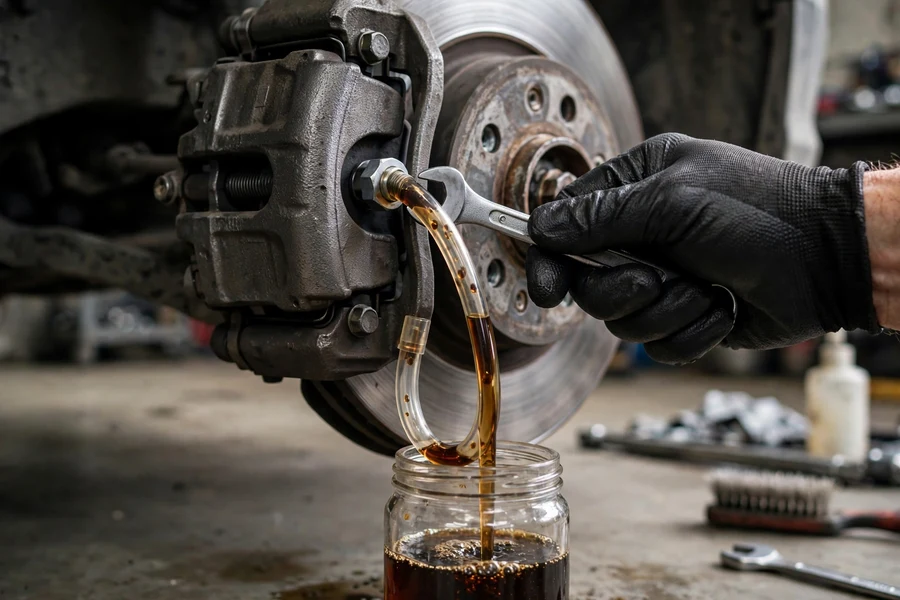
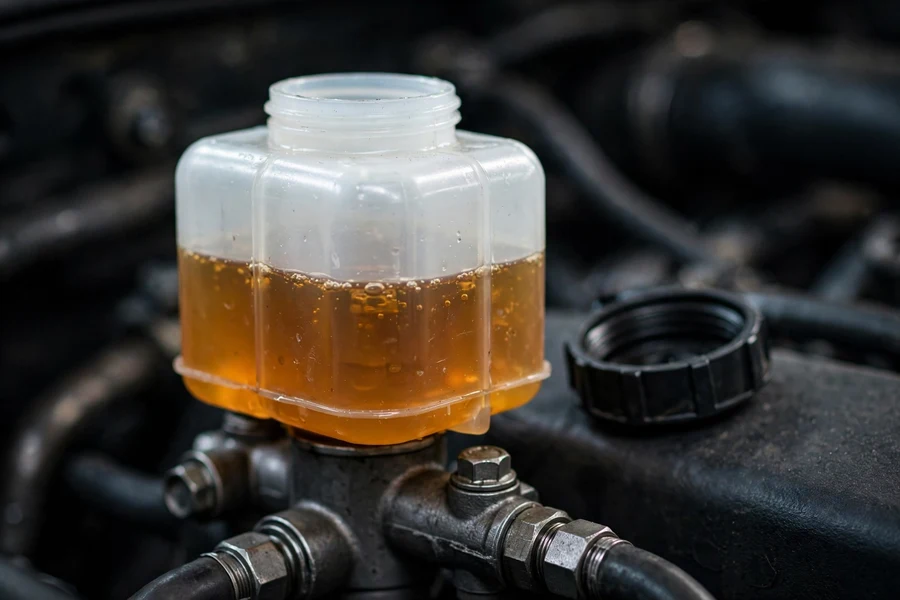
Bleed each corner until the stream runs clear amber with no bubbles — the color change from old to new fluid is unmistakable.
Manuals: don’t forget the clutch circuit
Manual-transmission 3 Series models feed the clutch master and slave cylinders from the same brake fluid reservoir — which means a “full” flush that skips the clutch leaves a slug of old fluid in the slave cylinder and its line. The clutch slave bleeder sits on the transmission bellhousing (usually a small 7 mm screw) and is bled exactly like a caliper: hose on, open the screw, bleed until clear, close it.
One practical note: the clutch circuit responds best to the pedal-pump method. Have your helper slowly pump the clutch pedal while you work the bleeder — the pressure bleeder alone moves less fluid through the slave than through the calipers. And this is another moment to double-check the reservoir level: a gulp of air here travels straight into the clutch hydraulics. Skipping this step will not ruin the job, but doing it is what makes the flush complete.
ABS and DSC bleeding notes
For a routine fluid flush — one where the reservoir never ran dry and no lines were opened upstream — you do not need to do anything special with the ABS/DSC unit. Fresh fluid pushed through in the normal bleeding order replaces the vast majority of the system’s volume, and the car’s self-check cycles the pump on startup anyway.
The exception is air that reaches the DSC hydraulic unit. That happens if the reservoir ran dry mid-job, if you replaced a brake line, caliper, or the master cylinder, or if the system was opened for another repair. Air trapped in the DSC’s internal valves and accumulator will not come out with normal bleeding — it needs the automated bleed routine in BMW’s ISTA diagnostic software, which cycles the pump and valves in sequence while you bleed. If you suspect air in the DSC (a spongy pedal that normal bleeding cannot cure), a BMW specialist can run the routine in under an hour. Do not substitute the driveway trick of triggering ABS on a loose surface and re-bleeding: it is dangerous on public roads and does not replace the sequenced pump cycle.
If you end up with an ABS or DSC warning light after brake work, our ABS/DSC warning light guide walks through diagnosis — but a warning right after a flush almost always traces back to air in the system or a disturbed wheel-speed sensor, not a failed module.
Interactive: is your flush due?
Not sure whether this job is urgent? Answer three questions and get a verdict based on BMW’s two-year interval, your driving, and what the pedal is telling you.
Flush-due checker
Dealer vs independent vs DIY costs
A brake fluid flush is one of the cheapest services a BMW asks for — and one of the cheapest to do yourself. Bands below are approximate US figures; dealers vary by region, and independents by labor rate.
| Option | Typical cost (US) | What you get |
|---|---|---|
| BMW dealer | $150–$250 | OEM DOT 4 LV, pressure-flush per BMW procedure, CBS reset, service record |
| Independent BMW specialist | $90–$180 | Same job, quality aftermarket or OEM fluid, lower labor rate |
| DIY, two-person method | $30–$60 | 2L of DOT 4 LV + hose and bottle; free if fluid is already on the shelf |
| DIY, pressure bleeder | $30–$60 + $50–$90 bleeder (one-time) | Fastest solo method; the bleeder pays for itself against one shop visit |
The dealer premium buys a stamped service history and zero effort. The independent is the sweet spot for most owners — dealer-level work at roughly two-thirds the price. DIY wins on cost and timing: a Saturday morning instead of a service appointment, and you will need the bleeder again in two years anyway.
Mistakes to avoid
- Letting the reservoir run dry. The number-one DIY failure. One gulp of air means starting over — or worse, air in the DSC unit and a trip to a shop with ISTA. Top up after every corner.
- Using the wrong fluid. DOT 5 (silicone) in a BMW is a system-killer. Stick to DOT 4 LV; DOT 4 works on an E90, but LV is specified and backward-compatible everywhere.
- Reusing old or opened fluid. An opened bottle has been absorbing moisture since the seal broke. Fresh bottles only, and dispose of leftovers properly.
- Rounding off bleeder screws. Use a box-end wrench, soak corroded screws in penetrating oil first, and remember they seat on a taper — snug, not gorilla-tight.
- Skipping the clutch on manuals. The slave cylinder’s share of old fluid stays put if you skip it.
- Resetting the CBS reminder before the job. The reminder tracks when the fluid was changed, not when you felt like clearing it. Reset only after fresh fluid is in — our reset guide has the per-generation steps.
- Ignoring a spongy pedal afterward. A firm pedal is the pass/fail test. If it is soft after a correct flush, there is still air in the system or a leak — diagnose before driving normally.
One last planning note: the fluid flush sits inside BMW’s broader 3 Series maintenance schedule, which tracks every interval — oil, filters, spark plugs, coolant — in one place. Two years from now, when the CBS reminder lights up again, you will already own the bleeder.
Frequently asked questions
How often does a BMW 3 Series need a brake fluid flush?
Every 2 years, regardless of mileage — that is BMW’s standing interval, and the car’s CBS system tracks it by time. Heat, humidity, and driving style only move the date earlier; nothing moves it later. Track use calls for an annual flush.
Can I use regular DOT 4 instead of DOT 4 LV?
On an E90, yes — DOT 4 meets the original spec, and DOT 4 LV is fully backward-compatible if you want the newer fluid. On F30 and G20 cars, use DOT 4 LV: it is the specified fluid, and its lower viscosity is what the DSC system’s fast valve cycling was calibrated around. Never use DOT 5 silicone fluid in any of them.
What is the correct bleeding order on a 3 Series?
Right rear, left rear, right front, left front — farthest from the master cylinder first — then the clutch slave cylinder on manual-transmission cars. This is the order BMW’s shop procedure uses and the one every experienced BMW DIYer follows.
Do I need a scan tool to bleed the ABS module?
For a routine flush, no. The DSC pump does not need cycling as long as the reservoir never ran dry and no lines were opened upstream. If air did reach the DSC unit — reservoir ran dry, lines replaced — the automated bleed routine in BMW’s ISTA software is required, which means a shop with the right equipment.
How much brake fluid does a 3 Series hold?
The whole system — reservoir, lines, calipers — holds under a liter, so one liter of fresh DOT 4 LV completes the flush. Buy two bottles anyway: the second is cheap insurance against running the reservoir dry mid-job, and unopened fluid stores fine for about a year.