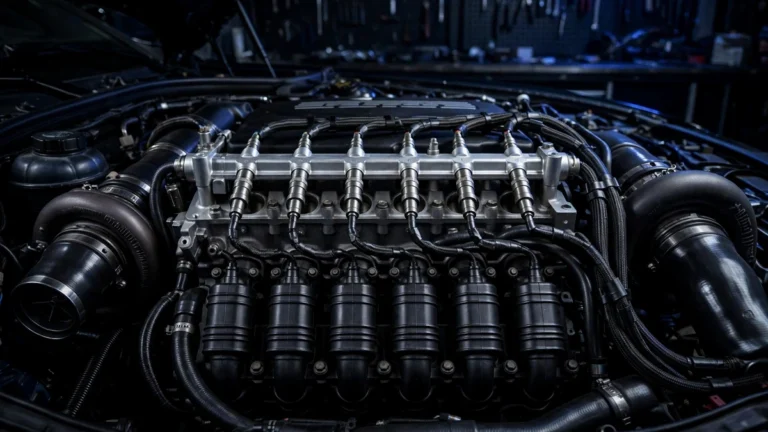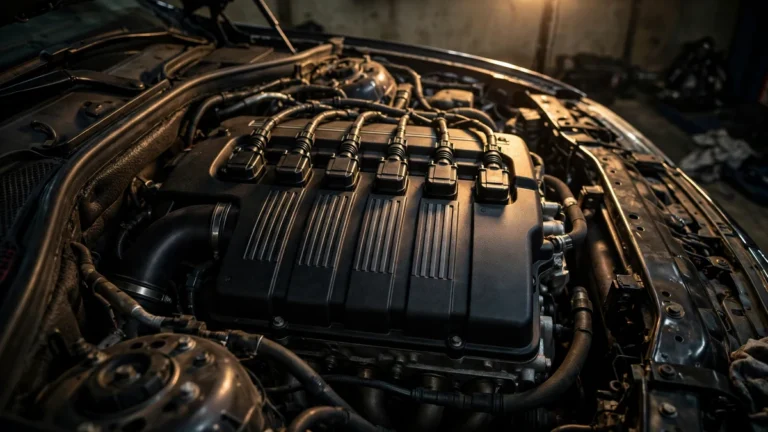
6 BMW EVAP System Problems That Set P0440-P0456
Short answer: BMW EVAP system problems almost always show up as check-engine codes P0440 through P0456 — the fuel-vapor system is leaking, or its purge/vent valves and leak-detection pump have failed. Start with the gas cap (tighten until it clicks, replace if the seal is cracked), because it is the cheapest fix. If the code returns, the prime suspects are a stuck-open purge valve (hard starting right after refueling), a failed DMTL leak-detection pump (P0442/P0456 that keeps returning), or a cracked charcoal-canister hose. A smoke test ($100–$200 at an independent shop) finds leaks in minutes; most EVAP repairs run $200–$700.
Gasoline evaporates constantly, even in a parked car, and on every BMW 3 Series since OBD-II became mandatory, a sealed system called EVAP is responsible for catching those vapors before they escape. The charcoal canister adsorbs fuel vapor from the tank, the purge valve meters it into the engine to be burned, the vent valve seals the system for testing, and BMW’s leak-detection pump (DMTL on most US 3 Series) pressurizes the whole network to hunt for leaks as small as half a millimeter. When anything in that chain fails, the computer sets an EVAP code and the check engine light comes on.
The good news: EVAP faults are among the cheapest check-engine codes a BMW can throw, and they rarely leave you stranded. The bad news: they are also among the most thrown-parts-at codes, because six different codes point at roughly a dozen components, and “replace the gas cap” advice gets applied to failures a cap could never cause. This guide walks the full system — what each component does, what each code actually means, the six failure patterns BMW 3 Series owners hit most, how a smoke test works, and honest cost bands. If you are staring at a generic check engine light and have not pulled codes yet, start there; what follows assumes you know your code.
In this guide
- How the BMW EVAP system works
- Code definitions: P0440–P0456
- The six BMW EVAP failure patterns
- DMTL vs NVLD: how your BMW hunts leaks
- Interactive: EVAP code diagnostic tool
- The smoke test, explained
- Interactive: should you DIY or book a shop?
- Repair cost bands (honest numbers)
- Gas cap basics: the $30 fix that works
- EVAP codes vs O2 sensor and catalytic converter codes
- Frequently asked questions
How the BMW EVAP system works
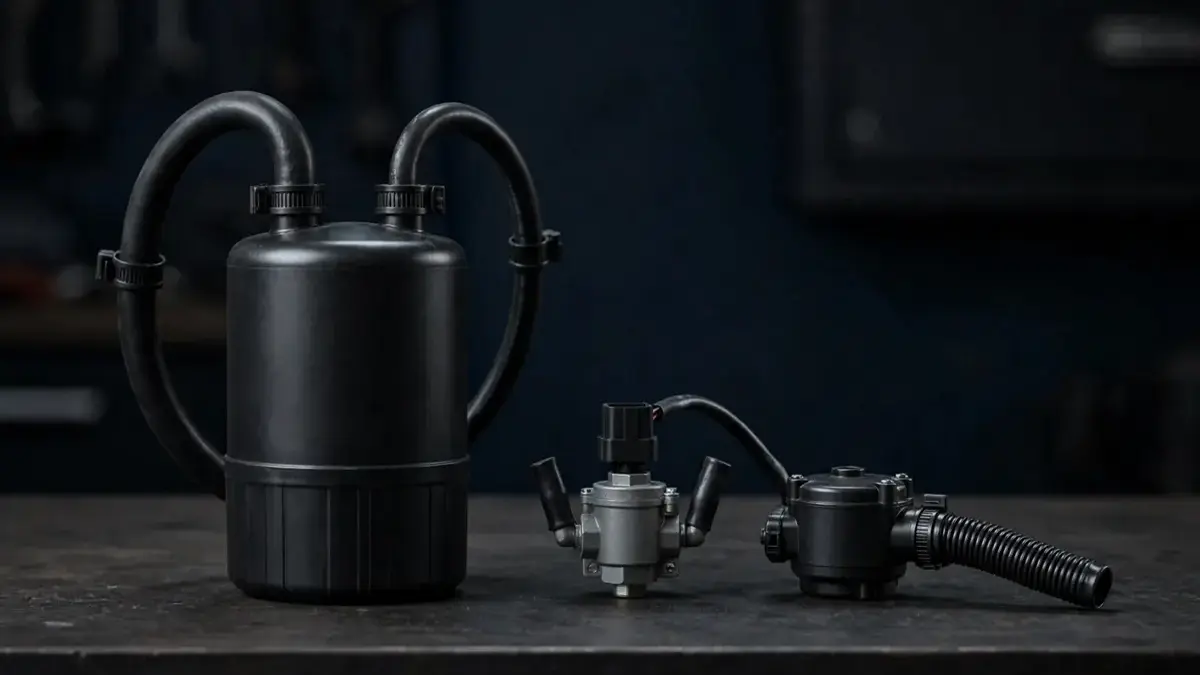
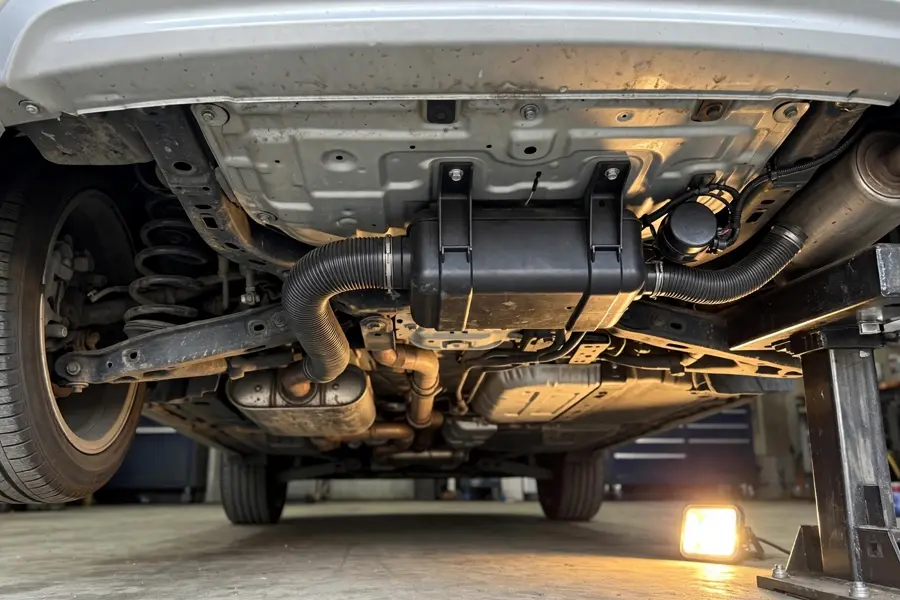
Think of the EVAP system as a sealed breathing circuit for the fuel tank. Fuel vapor rises off the gasoline in the tank constantly — more when it is hot, more when the tank is low. Instead of venting to the atmosphere, that vapor is routed through hoses to the charcoal canister (also called the activated-carbon canister), a black plastic box mounted under the trunk floor or behind the rear wheel well, packed with activated charcoal pellets. The charcoal adsorbs the hydrocarbons like a sponge, holding them until the engine is ready.
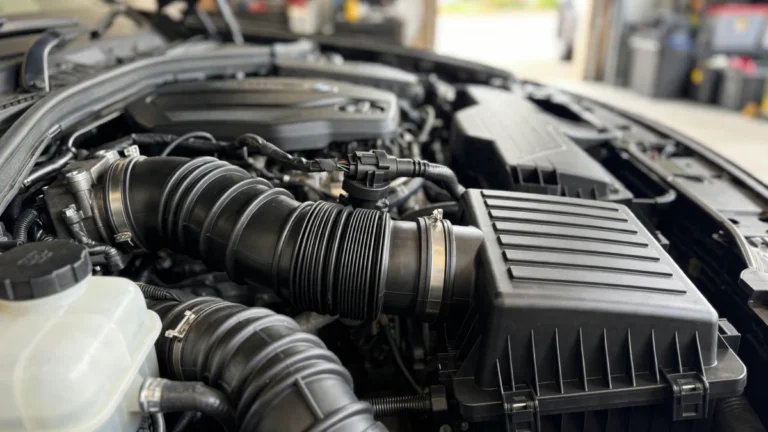
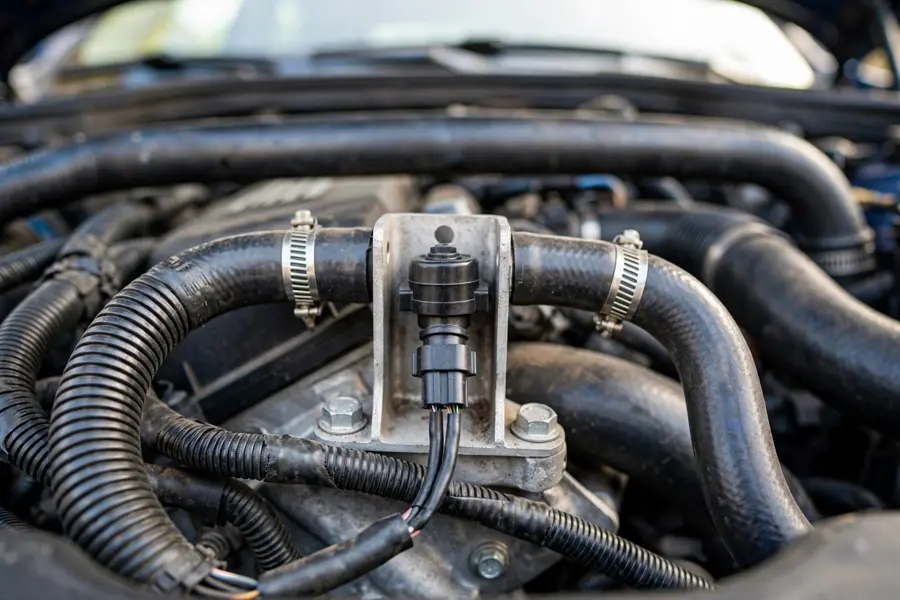
When you are cruising and the engine has spare capacity, the computer opens the purge valve — BMW calls it the fuel tank breather valve — which sits in the engine bay plumbed between the canister and the intake manifold. Engine vacuum (or, on turbo engines, managed pressure) draws the stored vapor out of the charcoal and into the combustion chambers, where it burns as fuel. You can often hear this valve ticking at idle; that rapid clicking is normal purge operation, not a fault.
The vent valve (canister shutoff valve) sits at the canister end and is normally open, letting fresh air flow through the canister during purge. When the computer wants to test the system for leaks, it closes the vent valve and commands the DMTL pump — the Diagnostic Module for Tank Leakage, a small pump mounted beside the canister — to pressurize the sealed tank and line network. It then watches how fast pressure bleeds off. A fast bleed means a large leak (P0455); a slow one means a small leak (P0442); a barely-measurable one means a very small leak (P0456). US-market BMW 3 Series models from the E46 onward use this pump-based DMTL approach, which is why BMW EVAP codes skew toward leak-size descriptions rather than valve faults.
Every connection in this circuit is a potential leak point: the gas cap seal, the filler neck, the fuel pump and level-sender flange seals under the rear seat, the rubber and plastic lines running the length of the car, the canister’s hose nipples (which get brittle and crack with age), and the valves themselves. Because the whole system is designed to hold pressure, even a crack you cannot see can set a code — which is why diagnosis is about testing, not guessing.
Code definitions: P0440–P0456
These definitions follow the SAE J2012 OBD-II standard, which is the same across manufacturers — the BMW-specific part is which component usually causes each one. Read your code, then read the “most likely on a BMW” column with suspicion, not certainty: codes describe a test result, not a part.
| Code | What it means | Most likely on a BMW 3 Series | Typical symptom |
|---|---|---|---|
| P0440 | Evaporative emission control system malfunction (general) | Stuck-open purge valve or loose gas cap; an intermittent version of the codes below | Usually none — light only |
| P0441 | Incorrect purge flow — the computer commanded purge and measured the wrong amount of flow | Purge valve sticking open or closed; collapsed vacuum line between valve and canister | Hard start or rough idle after refueling |
| P0442 | Small leak detected in the EVAP system | Aging gas cap seal, weakening DMTL pump, or a small crack in a vent hose | Usually none; code returns after clearing |
| P0446 | Vent control circuit malfunction — electrical fault in the vent/shutoff valve circuit | Failed vent valve at the canister or corroded connector; this is a circuit code, not a leak | Nozzle may click off during fueling if the valve is stuck closed |
| P0455 | Large leak detected — the system cannot hold pressure at all | Loose or missing gas cap; disconnected or split vent hose; stuck-open purge valve | Possible fuel smell; sometimes none |
| P0456 | Very small leak detected — the hardest code to chase | Gas cap gasket, filler-neck seal, or a DMTL pump whose reference orifice is clogged | None — pure emissions-monitor code |
BMW’s own diagnostic software often logs manufacturer-specific companion codes alongside these — P2401 and P2402 point at the DMTL pump circuit, and P0443/P0444/P0445/P0449 cover the purge and vent valve circuits. A generic OBD-II reader shows the P044x family; a BMW-capable scan tool shows the deeper story. That distinction matters for P0456 in particular: if a P2401 sits behind it, the “very small leak” is the pump failing to test itself, not an actual leak.
The six BMW EVAP failure patterns
Across E46, E90, and F30 generations, EVAP failures cluster into six repeat patterns. If your symptom matches one of these, you are probably looking at that part.
1. The dying gas cap seal. The rubber O-ring on the fuel cap hardens and micro-cracks with age and heat cycles. It is the single most common cause of P0455 and P0456, and the fix is a new cap — ideally OEM, because cheap aftermarket caps are a documented source of repeat codes. Tighten until it clicks, clear the code, and drive two full warm-up cycles before declaring victory; the EVAP monitor only runs under specific conditions.
2. The purge valve stuck open. This is the pattern with a signature symptom: the car starts hard, idles rough, or stalls for a few seconds immediately after refueling. A healthy purge valve is sealed shut with no power applied; when it sticks open, raw fuel vapor floods the intake the moment you add fresh fuel and agitate the tank. Pull the valve and blow through it — if air passes with the valve unpowered, it has failed. On many BMW six-cylinders the valve sits behind the oil filter housing area or under the intake, a 30-minute job once you can reach it.
3. The tired DMTL pump. The leak-detection pump lives beside the canister behind the passenger-side rear wheel liner, exposed to road spray and salt for a decade or more. When it weakens, it reports leaks that do not exist — recurring P0442 or P0456 with no symptoms and no visible leak. Some owners report hearing the pump’s self-test whir after shutdown change pitch or stop entirely. A BMW scan tool can command the pump and read its current draw directly, which is the definitive test.
4. Cracked canister nipples and vent lines. The charcoal canister is plastic, its hose barbs are plastic, and the corrugated vent lines running forward get brittle. A cracked barb on the canister sets large-leak codes (P0455) and is visible once the wheel liner is out — look for white stress lines at the base of each nipple. Vent hoses chafe where they pass over the rear subframe. This is exactly what a smoke test finds in under ten minutes.
5. The stuck vent (shutoff) valve. Less common than the purge valve, but when the vent valve sticks closed the tank cannot breathe during refueling: the nozzle clicks off repeatedly, or fuel backs up the filler neck. When it sticks open, the DMTL pump cannot pressurize the system and every leak test fails. P0446 specifically flags its electrical circuit; a mechanical stick shows up as a leak code instead.
6. The overfilled tank. Topping off past the first nozzle click floods the charcoal canister with liquid fuel instead of vapor. Charcoal saturated with liquid cannot adsorb vapor, purge flow readings go wrong, and P0441 or P0442 follows. Stop at the first click — this is the only EVAP failure caused entirely by habit, and the only one fixed by changing the habit.
DMTL vs NVLD: how your BMW hunts leaks
You will see two acronyms in BMW repair literature. US-market 3 Series cars (E46 onward, including E90 and F30) use DMTL: an electric pump actively pressurizes the sealed EVAP system and measures the bleed-down against a reference orifice. Some other markets and older designs use NVLD (natural vacuum leak detection), which seals the system after shutdown and watches the natural vacuum that forms as the fuel cools — no pump at all. The practical difference for diagnosis:
| DMTL (your US 3 Series) | NVLD | |
|---|---|---|
| How it tests | Electric pump pressurizes the system to a set pressure | Seals the system; cooling fuel creates natural vacuum |
| When it tests | Shortly after engine shutdown, on a timer | After shutdown, as the tank cools |
| What fails | The pump itself, its reference orifice, or its filter | The pressure/vacuum switch or its seal |
| Codes it produces | P0442/P0455/P0456 plus pump codes P2401/P2402 | Leak codes; no pump circuit codes |
| DIY test | Listen for the pump whir after shutdown; scan tool can command it | Almost none — needs a BMW scan tool |
Knowing your car is DMTL matters because the pump is a wear item with a finite life, and because its failure mimics a leak. If you have recurring small-leak codes with no symptoms, test or replace the messenger (the pump) before hunting a leak that may not exist.
Interactive: EVAP code diagnostic tool
Pick your code and the symptom that matches your car. The tool narrows it to the most likely cause, the first test to run, and what that repair typically costs. All 24 combinations are covered — including the dead ends, which tell you what not to replace.
EVAP code diagnostic tool
The smoke test, explained
A smoke test is the correct diagnostic for every leak code — P0442, P0455, and P0456 — and it is the reason EVAP diagnosis does not have to be guesswork. The technician seals the EVAP system (usually at the vent valve, commanded closed with a scan tool), connects a smoke machine to the system’s test port or the tank vent line, and fills the network with a harmless mineral-oil vapor at very low pressure. Then they simply look: smoke curling out of a hose, a canister barb, the filler neck, or a flange seal marks the leak exactly. A test that finds nothing on a car with recurring leak codes points back at the DMTL pump itself — a pump that cannot build test pressure reports phantom leaks.
Two things a smoke test cannot do: it cannot find a stuck-open purge valve (that is a flow problem, found with the blow-through test), and it cannot diagnose P0446 (an electrical circuit fault). Shops that smoke-test first for those codes are billing you for the wrong test. For leak codes, though, the $100–$200 diagnostic fee routinely saves multiples of itself in parts not thrown at the car.
Before any test equipment comes out, three free checks: tighten the cap until it clicks and inspect its seal; look at the filler neck for cracks; and pull the rear seat base to check the fuel pump and sender access covers for dampness or smell. Owner forums are full of P0455s solved at this stage.
Component test procedures
| Component | Test | Pass | Fail means |
|---|---|---|---|
| Purge valve | Remove; blow through it unpowered, then apply 12V and blow again | Sealed shut unpowered; opens with a crisp click on 12V | Air passes unpowered = stuck open (replace); no click on 12V = dead coil (replace) |
| Vent valve | Command open/closed with a BMW-capable scan tool; listen and feel for actuation | Audible click and airflow changes with command | No response = failed valve or wiring; stuck closed also blocks refueling |
| DMTL pump | Listen for the self-test whir after shutdown; command it with a scan tool and read current draw | Runs and draws steady current during the test | Silent, weak, or erratic = replace the pump |
| Gas cap | Visual and flex inspection of the rubber seal; check that it clicks and holds tension | Seal is pliable with no cracks; cap clicks and stays tight | Hard, cracked, or flattened seal = replace (OEM recommended) |
| Hoses & canister | Smoke test; visual check of canister barbs for stress cracks | No smoke escapes; barbs intact | Smoke or visible cracks = replace the hose or canister |
Interactive: should you DIY or book a shop?
Most EVAP repairs are genuinely DIY-friendly — the parts are accessible and no special calibration is needed afterward. The exception is anything requiring a smoke machine or a BMW scan tool. Answer five questions for a straight recommendation.
DIY or shop? — 5-question scorer
1. Do you have a basic tool set and a multimeter?
2. Is the suspect part easy to reach (gas cap, purge valve, DMTL pump behind the wheel liner)?
3. Can the car sit for 2–3 hours if a step gets fiddly?
4. Is an emissions or smog retest due within two weeks?
5. Is it a leak code (P0442/P0455/P0456) with no obvious cause — i.e. you would need a smoke test?
Repair cost bands (honest numbers)
EVAP work is cheap by BMW standards — there is no $3,000 surprise hiding in this system. These are typical US independent-shop ranges (parts plus labor), gathered from owner-reported invoices and shop estimates; dealers run 30–50% higher on labor, and genuine BMW parts cost more than quality aftermarket.
Bars scaled to the $700 maximum. “DIY: easy” means basic hand tools and under an hour; “moderate” means wheel-liner or underbody access. One documented owner invoice: a dealer charged $552 for DMTL pump diagnosis and replacement on an F30 — an independent shop typically does it for less.
Difficulty ratings, honestly: the gas cap is a one-minute DIY. The purge valve is a 2/10 — unplug, unbolt, swap hoses — on engines where it sits in the open bay; budget more time if yours hides under the intake manifold. The DMTL pump is a 2/10 once the rear wheel liner is out (a few Torx screws). The vent valve and canister are 3/10 for access, not complexity. Nothing in the EVAP system requires coding or calibration afterward, which is rare for BMW work and a genuine point in the DIY column.
Gas cap basics: the $30 fix that works
The gas cap is a pressure-tested seal, not a lid. Its rubber O-ring must hold the same pressure as the rest of the EVAP system, and after years of heat cycles that ring hardens, flattens, and micro-cracks. The failure is invisible — the cap looks fine, clicks fine, and still leaks. This is why “just tighten it” fixes some P0455s (the cap was genuinely loose) while others need a new cap: a loose cap and a dead seal produce the same code.
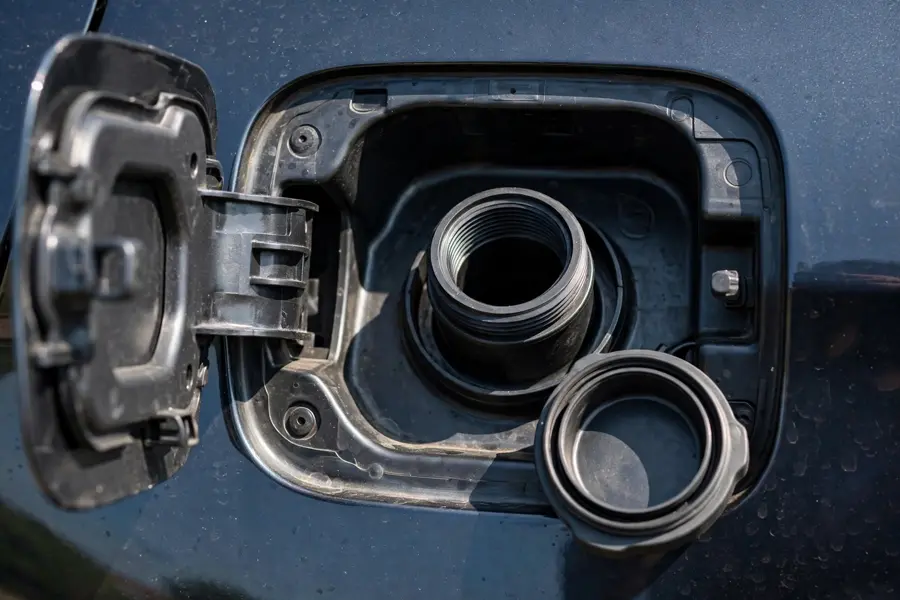
The correct procedure: remove the cap, inspect the seal (flex it — if it is hard or cracked, replace the cap), inspect the filler neck rim for damage, reinstall until it clicks, clear the code with your OBD-II scanner, and drive two full warm-up cycles. The EVAP monitor is picky — it only runs with the fuel level between roughly 15% and 85%, the engine fully warm, and the car parked overnight first — so give it a few days before concluding the fix worked. Buy OEM or a proven OE supplier; ultra-cheap caps are a known source of repeat P0455/P0456 codes.
EVAP codes vs O2 sensor and catalytic converter codes
EVAP codes (P0440–P0456) live on the fuel-vapor side of emissions; oxygen sensor codes (P013x–P016x) and catalyst efficiency codes (P0420/P0430) live on the exhaust side. They are independent systems that happen to share the check engine light, and a car can absolutely have both at once — an aging 3 Series with 150k miles often does. Our guides to BMW O2 sensor diagnosis and catalytic converter failure (P0420) cover the exhaust side in the same depth.
Which to fix first? If an emissions test is due, fix the EVAP code first: the EVAP monitor is the slowest to complete its self-test, so it dictates your timeline. A stuck-open purge valve can also skew fuel trims enough to confuse O2-sensor diagnosis, so clear the EVAP fault before chasing a marginal sensor code. But do not expect fixing one to fix the other — a P0456 will never cure a P0420.
Frequently asked questions
Can I drive with an EVAP code on my BMW?
Yes — EVAP faults do not affect engine lubrication, cooling, or anything that strands you. The car is safe to drive. The real consequences are a failed emissions or smog test (a stored EVAP code or an incomplete EVAP monitor is an automatic fail in most states) and slightly higher evaporative emissions. Fix it at your convenience, but before your registration renewal.
Will a new gas cap fix P0455 or P0456?
Often, yes — the cap seal is the most common cause of both. But “often” is not “always.” The correct sequence is: tighten the cap until it clicks, clear the code, and drive two full warm-up cycles. If the code returns, replace the cap (OEM) and repeat. Only if it still returns should you move to the purge valve, DMTL pump, or a smoke test. Skipping straight to parts is how a $30 fix becomes a $600 guess.
Why does my BMW start hard right after I fill up with gas?
That is the textbook symptom of a purge valve stuck open. With the valve stuck, adding fuel agitates the tank and floods the intake with vapor the moment you restart. Pull the valve and blow through it — a good one is sealed shut with no power applied. Replacement is one of the easiest BMW repairs: unplug, unbolt, swap the hoses. If your car also sets P0441, you have your confirmation.
How much does an EVAP smoke test cost for a BMW?
Typically $100–$200 at an independent BMW shop — roughly an hour of diagnostic labor. Dealers charge more. It is money well spent for any leak code (P0442, P0455, P0456) with no obvious cause, because it pinpoints the exact leak in minutes instead of funding a round of parts-guessing. Note that a smoke test will not diagnose a stuck purge valve or a P0446 circuit fault; those need the blow-through test and a scan tool respectively.
I have an EVAP code and an O2 sensor code. Which do I fix first?
Fix the EVAP code first if an emissions test is coming up, because the EVAP monitor takes the longest to complete its self-test and an incomplete monitor fails you. A stuck-open purge valve can also distort fuel trims and muddy O2-sensor diagnosis. But treat them as independent faults: clearing a P0456 will not fix a P0135 or a P0420, and each needs its own diagnosis.