BMW Secondary Air Pump Failure Sounds Like a Jet Engine
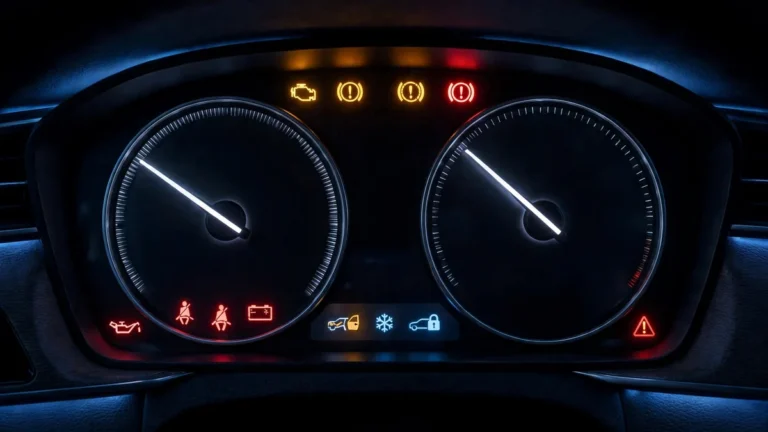
Short answer: BMW secondary air pump failure sounds like a jet-engine howl for 60–120 seconds on a cold start, followed by a Service Engine Soon light with codes P0410, P0411, P0412, P0418, or the BMW-specific P1421/P1423. The pump is almost never the real culprit: a leaking check valve lets exhaust condensate back into the pump, where it freezes or corrodes the motor. Test before you buy — listen on a cold start, check for 12V at the pump connector, and do the paper-towel test inside the hose — and replace the check valve with the pump. A full DIY refresh runs roughly $280–$450 in parts (owner/community-reported pricing).
In this guide
- What the secondary air system actually does
- The components and what each one does
- The classic failure: how exhaust water kills the pump
- Symptoms of secondary air pump failure
- Which 3 Series engines have this system
- The codes, decoded
- Interactive: SAP fault finder
- Test it yourself: the component test matrix
- Interactive: repair cost estimator
- What the repair costs
- The DIY replacement, step by step
- The N51 SULEV warranty check
- Deleting, unplugging, and simulators: the honest version
- Secondary air pump FAQ
What the Secondary Air System Actually Does
A cold engine runs rich and a cold catalytic converter does almost nothing, so the first minute or two after a cold start produces most of a drive’s hydrocarbon and carbon monoxide emissions. The secondary air system shortens that dirty window: an electric pump injects fresh air into the exhaust manifold, where the extra oxygen triggers after-burning that burns off unburned fuel and heats the converter so it lights off faster. Once the converter is working — typically 60–120 seconds after a cold start — the pump shuts off until the next cold start.
That narrow job description explains every symptom on this page: the system runs only on a cold start and cannot cause a no-start, a stall, or warm-engine power loss. If your car has a drivability problem that persists when warm, look elsewhere first — our BMW 3 Series won’t-start guide covers the systems that actually can keep an engine from running.
Follow the air and the signals through a cold start and the whole system makes sense:
| Step | What happens | The part doing it |
|---|---|---|
| 1 | Cold start detected by the DME. | DME (engine computer) |
| 2 | The DME energizes a high-current relay, sending battery voltage to the pump. | Secondary air pump relay (salmon/pink on the E90) |
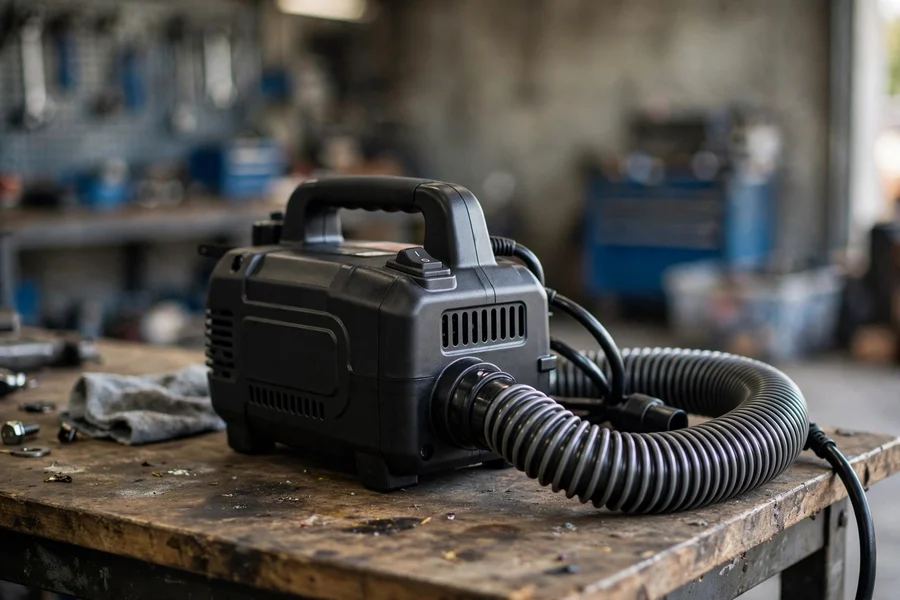
| 3 | The pump spins up, drawing fresh air through its intake snorkel. | Secondary air pump + intake snorkel |
| 4 | The DME energizes a small solenoid valve that routes intake vacuum to the check valve. | Electric changeover (solenoid) valve + vacuum line |
| 5 | Vacuum opens the check valve; pumped air flows into the exhaust manifold. | Secondary air (non-return) check valve |
| 6 | After ~60–120 seconds the DME drops both signals; the relay opens and the check valve springs shut. | Relay + solenoid valve + check valve spring |
| 7 | The DME watches the pre-cat O2 sensors for the lean shift that proves air arrived. | O2 sensors (the system’s only feedback) |
There is no airflow or pressure sensor in this system: the DME’s only proof that air reached the exhaust is the oxygen sensors’ reaction — which is why slow or aging O2 sensors can set secondary-air codes even when the pump, valve, and relay are all fine.
The Components and What Each One Does
Six parts, and failures cascade through them in a predictable order. Learn the chain and you stop replacing the wrong part.
| Component | Job | How it typically fails |
|---|---|---|
| Secondary air pump | Electric blower pushing fresh air toward the exhaust | Seizes after water gets inside; bearings howl first |
| Non-return check valve | One-way gate: pump air in, exhaust blocked from flowing back | Sticks open; exhaust condensate back-flows into the pump |
| Electric changeover (solenoid) valve | Routes vacuum to the check valve on command | Sticks open or closed; its vacuum line rots |
| Pump relay | High-current switch commanded by the DME | Contacts stick — the pump runs until it melts |
| Fuse | Protects the pump circuit (location and rating vary by model) | Blows when a frozen or shorted pump overloads the circuit |
| Hoses + vacuum lines | Carry air (pump to valve) and vacuum (solenoid to valve) | Crack, harden, or disconnect — cheap, and often the whole problem |
The Classic Failure: How Exhaust Water Kills the Pump
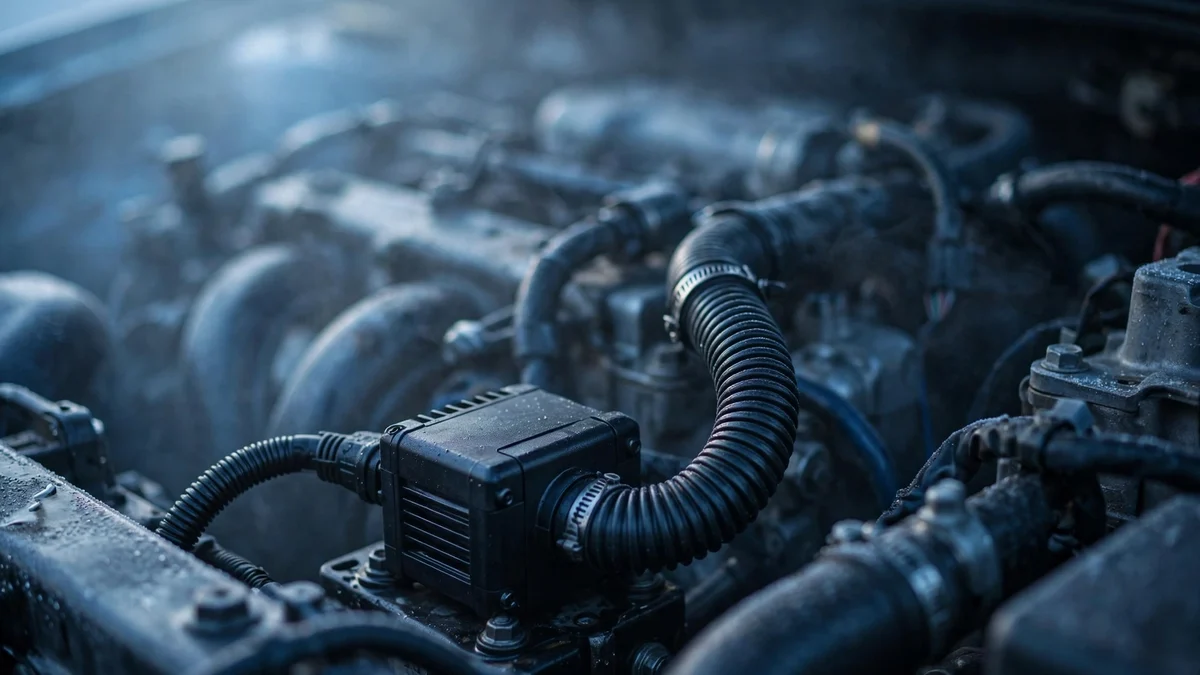
Almost every dead secondary air pump dies the same way, and the pump is the victim, not the cause. Per Pierburg — the company that builds these pumps — in its service information SI 0083: when the non-return check valve stops sealing, exhaust gas pushes back through it whenever the pump is off. Exhaust is full of water vapor, which condenses in a cold manifold and collects at the system’s lowest point — the pump. In cold weather it freezes inside; in any weather it corrodes the motor.
The next cold start, the DME commands the pump on. If the rotor is frozen, the motor draws locked-rotor current and the fuse pops — which is why a blown SAP fuse is a symptom, not a fix; a fresh fuse blows again the next morning. If the rotor turns but the bearings are rusted, you get the famous howl: a jet-engine whine that builds for a minute or two and stops when the DME shuts the pump off. Pierburg’s bulletin is blunt: whenever a pump is replaced, the changeover valve and check valve must be inspected for leaks, because replacing only the pump leaves the actual cause in the car and the new pump fails again. Their quick check takes seconds: pull the hose off the check valve on the pump side and do a finger test for deposits. Deposits on the pump side mean the valve is leaking and must be replaced.
This is also why the failure is seasonal in cold climates. Owners report the light arriving with the first cold snap of autumn and going quiet through a mild spell. The water was always getting in; the cold is just when it freezes the pump solid enough to set a code.
Symptoms of Secondary Air Pump Failure
The noise is nearly diagnostic on its own; the light alone is not, because SAP codes share the dashboard with everything else. For the full landscape of what a Service Engine Soon light can mean, see our check engine light causes guide.
| Symptom | What it usually means | How specific to SAP |
|---|---|---|
| Loud jet-engine / vacuum-cleaner howl for 60–120 s on cold start, then silence | Dying pump bearings or water inside the pump | Signature |
| Soft vacuum-cleaner hum on cold start, then it stops | Healthy pump doing its job | Normal |
| No sound at all on cold start, SES light on with SAP codes | Dead pump, blown fuse, bad relay, or no power | Strong |
| Pump runs but never shuts off | Relay contacts stuck closed (or solenoid stuck) | Act now |
| SES light with P0410/P0411/P1421/P1423 | System fault — pump, valve, or electrical | Strong |
| Slight cold-start rpm fluctuation | Inconsistent air delivery (leaking valve, weak pump) | Weak |
| Failed emissions / OBD readiness monitor never sets | Secondary-air monitor can’t complete | Strong |
| Rough idle or power loss when warm | Not the SAP system — it is off by then | Not SAP |
A soft hum you only notice with the hood open is a working pump — don’t “fix” it. A howl you can hear from inside the house, getting louder over weeks, is a pump on its way out. A sudden loud roar right after engine work is usually a disconnected or split hose — check both hose ends before ordering anything.
Which 3 Series Engines Have This System
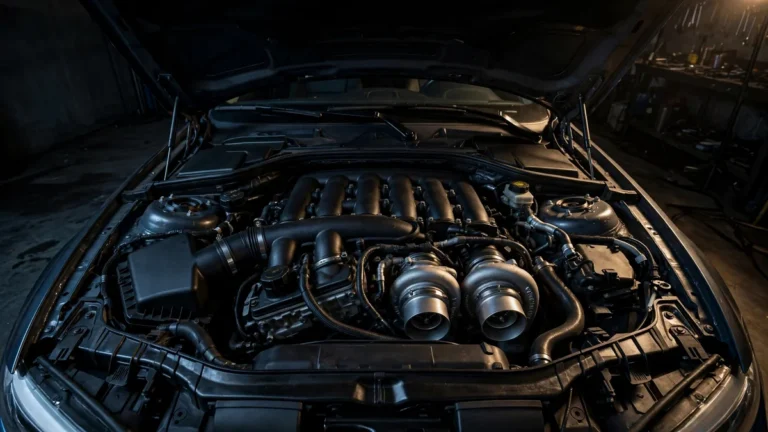
The system is well documented on the six-cylinders: the M52/M54 (E46), the N51 SULEV (E90), and the N54/N55 turbo sixes (335i). The N51 deserves special attention — it generates the most SAP failure reports in the E90 world, and N51 cars carry the SULEV emissions warranty discussed below.
One important split: the standard US-market N52 (ULEV, non-SULEV) in the E90 328i/330i is widely reported as not having the secondary air pump at all — the SAP relay position (K6304) in the junction box sits empty on those cars. The 30-second fitment check: on a stone-cold start, open the hood and listen. If an electric blower hums for a minute or two and then stops, you have the system; if in doubt, look for the SAP relay and fuse in your model’s fuse chart.
Model-year context — including which E90 variants tend to be worth the upkeep — is in our 3 Series reliability by year guide.
The Codes, Decoded
SAP codes fall into two families: generic OBD-II codes any scanner reads, and BMW-specific P1xxx codes that some cheap scanners mislabel or miss entirely. The generic codes point at the system; the BMW codes often point at the component. Neither family tells you whether the pump or the valve is the root cause — that is what the test matrix is for.
| Code | Definition | What it usually means on a BMW |
|---|---|---|
| P0410 | Secondary Air Injection System Malfunction | The classic water-in-pump code |
| P0411 | Secondary Air Injection System Incorrect Flow Detected | Air isn’t reaching the exhaust: stuck valve, blocked hose, weak pump |
| P0412 | Secondary Air Injection Switching Valve A Circuit Malfunction | Electrical fault in the changeover (solenoid) valve circuit |
| P0418 | Secondary Air Injection System Relay A Circuit Malfunction | Relay circuit fault — check the SAP relay and its wiring |
| P0419 | Secondary Air Injection System Relay B Circuit Malfunction | Second relay circuit (some models); same diagnostic path |
| P0491 / P0492 | Secondary Air Injection System Insufficient Flow, Bank 1 / Bank 2 | Valve or hose fault on that bank |
| P1421 | BMW: Secondary Air Injector Valve Circuit Short to Ground | BMW-specific; valve/solenoid circuit fault |
| P1422 | BMW: Secondary Air System Bank 2 | Bank 2 counterpart to P1421 |
| P1423 | BMW: Secondary Air Injection Bank 1 Flow Too Low | BMW-specific; the classic pair with P1421 |
| P1473 / P1475 | BMW: Secondary Air Injection Pump Relay Circuit | Relay control fault detected by the DME |
The P1421/P1423 pair confuses owners: one is electrical (valve circuit), the other is flow. They commonly appear together when a failed check valve has taken the pump with it. Replacing the pump alone clears the flow code for a while, but the valve code returns — the root cause is still in the car.
Interactive: SAP Fault Finder
Answer four questions about the noise, the codes, the pump’s cold-start behavior, and the check valve. All 256 combinations were tested before publication.
BMW secondary air pump fault finder
Test It Yourself: The Component Test Matrix
The finder points at the suspect; this matrix proves it. Work through the matching rows in order — the electrical tests take minutes, the parts cost hundreds. One rule: test on a cold start. The DME only powers this system when the engine is cold, so every check below is meaningless on a warm engine.
| Component | The test | Pass | Fail = |
|---|---|---|---|
| Pump power supply | Cold start: check for 12V at the pump connector | ~12V present for 60–120 s | No power — check fuse, relay, and wiring before buying a pump |
| Pump motor | Unplug and jump the pump directly with 12V | Spins strongly, blows hard | Seized or weak motor — replace |
| Pump airflow | Cold start: disconnect the hose at the valve end, feel the airflow | Strong blast for ~90 s, then stops | Weak/no flow with 12V present = dead pump; never stops = stuck relay |
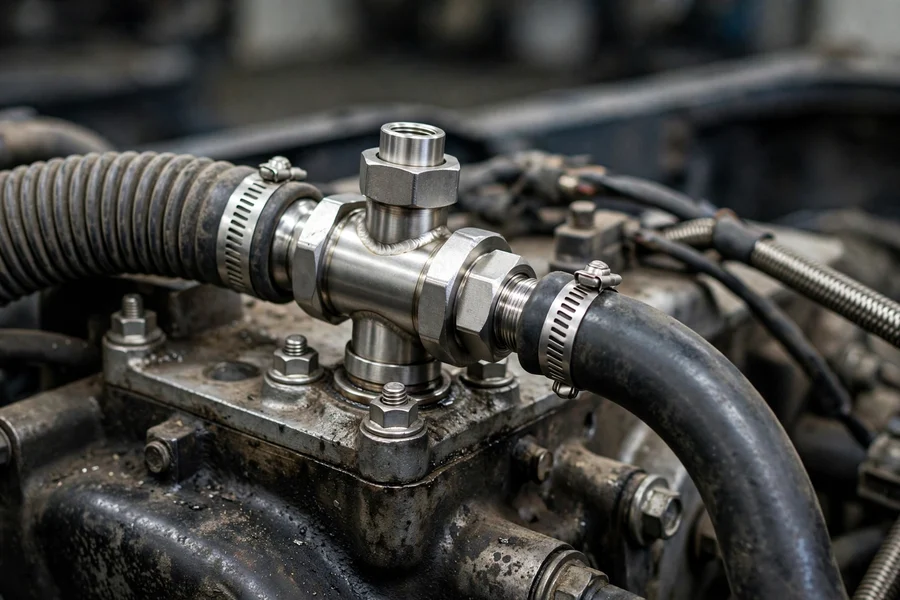
| Check valve | Paper-towel / finger test inside the hose on the pump side | Clean and dry | Residue or wetness = leaking valve — replace with the pump |
| Vacuum line + solenoid | Cold start: vacuum at the valve’s small hose for 1–2 min; inspect lines for cracks | Vacuum present, then released; lines supple | No vacuum = dead solenoid or broken line |
| Relay + fuse | Swap-test the relay (E90: salmon/pink, DME box near firewall); check the fuse | Behavior changes with a known-good relay; fuse intact | Stuck relay (pump never stops) or blown fuse (recheck after a pump lock) |
| O2 sensor response | Cold start: watch pre-cat O2 readings on a BMW-capable scan tool | Clear lean shift while the pump runs | No shift with good airflow = aging O2 sensors |
Two traps catch DIYers. A blown fuse is never the root cause — a healthy circuit doesn’t pop fuses, so a blown SAP fuse means a locked or shorted pump, and the replacement blows on the next cold start unless the pump is fixed. And if the pump spins on a direct 12V jump but won’t run in the car, the problem is the power path (fuse, relay, wiring), not the pump. Buy the $20 relay before the $250 pump.
Interactive: Repair Cost Estimator
Pick the scope, the labor, and your engine — every one of the 36 combinations returns a planning band plus a comparison chart. All 36 were tested before publication.
Secondary air repair cost estimator
What the Repair Costs
Secondary air repair is one of the cheaper jobs on a 3 Series — until you pay a dealer to do it twice. The parts are simple: an OE-quality pump typically runs about $200–$300, the check valve about $80–$110, and the relay, gasket, and vacuum lines are small money. Labor varies with access — on some engines the pump sits right up top, on others it hides behind the wheel liner or under intake plumbing. Treat every number on this page as an owner/community-reported planning estimate, not a quote — VIN, pump/valve combination, wiring repairs, and blocked passages can all move the final number.
The pattern in owner-reported invoices is consistent: a DIY full refresh (pump, valve, lines) lands around $280–$450 in parts and an hour or two of work; an independent BMW shop typically charges $550–$850; a dealer quote lands around $900–$1,400. The two mistakes that inflate the bill are paying for a pump without the valve (and buying the pump again a year later), and paying diagnostic time for a fuse that blows again because nobody asked why it blew.
The DIY Replacement, Step by Step
A beginner-accessible repair on most of these engines: no timing, no fluids, no special tools. Only ever do it on a cold engine — you need the cold start to test, and the check valve lives on the hot exhaust side.
- Confirm the diagnosis cold. Stone-cold engine, hood open, helper starts the car. Listen for the howl, feel for airflow at the hose, check 12V at the pump connector, and do the paper-towel test inside the hose on the pump side of the check valve.
- Disconnect the battery (negative terminal) — you will be working around a high-current circuit.
- Free the pump. Remove the intake snorkel and the electrical connector, loosen the hose clamp at the pump outlet, and unbolt the pump from its bracket. Note the rubber mounts — they isolate vibration and tear with age.
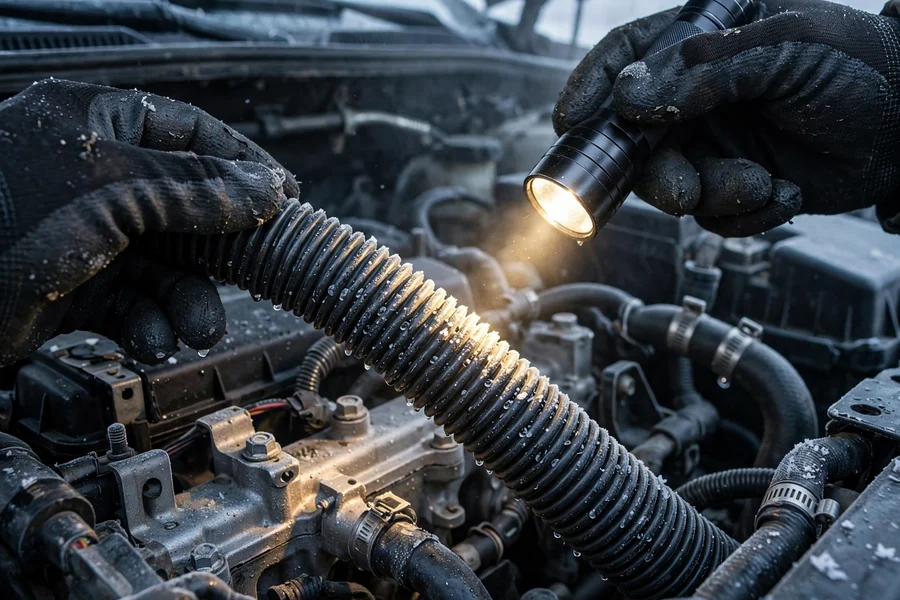
- Inspect the hose. Pull the large corrugated hose off the check valve. If it is wet inside or smells of exhaust, the valve failed and the pump drowned. Replace the hose if it is brittle.
- Replace the check valve and gasket. Unbolt the valve from the exhaust manifold or cylinder head, scrape the mating surface clean, and fit the new gasket — the flange is thin and warps if the bolts are tightened unevenly.
- Replace the vacuum lines. Pull every small vacuum line between the changeover solenoid and the check valve and replace them with proper vacuum hose — the $10 step everyone skips and then chases codes for.
- Install the new pump. Seat it on its mounts, reconnect the hose and clamp, the electrical connector, and the snorkel.
- Check the relay and fuse. Before the first start, inspect the SAP relay for burnt contacts or a melted housing, and confirm the fuse is intact. A stuck relay cooks a new pump within days.
- Cold-start test. Reconnect the battery, start the engine cold, and listen: a soft hum for 60–120 seconds, then silence. Clear the codes and run two full cold-start cycles so the DME completes its secondary-air monitor.
- Verify readiness. With a scan tool, confirm the monitor ran and passed and no SAP codes return. In an inspection state, this is the difference between a repair and a repair that passes.
If the pump is buried behind the wheel liner or under intake components on your engine, the only difference is access time — the test order and the replace-both rule don’t change. Photograph every hose routing before you disconnect anything; the vacuum line path matters and memory is unreliable.
The N51 SULEV Warranty Check
If your car has the N51 SULEV engine, stop before you buy parts. BMW’s California Emission Control System Warranty covers specified emissions components — the secondary air system among them — for 15 years or 150,000 miles, whichever comes first, on cars sold and registered in the participating states. That can turn a $900 dealer repair into a $0 warranty repair. Eligibility depends on model year, in-service date, state of first sale and registration, and your warranty booklet, so call a BMW dealer with your VIN and ask specifically about SULEV emissions coverage before you spend a dollar. This is the one scenario where the dealer is the cheapest option.
Deleting, Unplugging, and Simulators: The Honest Version
Can I just delete it? The honest answer has three parts. The mechanical truth: unplugging the pump silences the noise and changes nothing about how the car drives — the system only runs for a minute on cold starts. The dashboard truth: it sets SAP codes and a permanent Service Engine Soon light, and the readiness monitor never completes — an automatic emissions-test failure in any state with OBD inspection. The legal truth: the secondary air system is federally required emissions equipment, and defeating it on a road car violates federal anti-tampering rules. It also makes the car harder to sell to anyone who has to inspect it.
The aftermarket answers — SAP delete tunes and plug-in simulators — are marketed mainly toward track and off-road builds where emissions rules differ. For a street-driven 3 Series, they trade a $300 repair for a car that can never honestly pass inspection. The repair is cheap, the system is simple, and a working SAP setup keeps the car legal, quiet, and sellable. Fix it properly.
Secondary Air Pump FAQ
Will a bad secondary air pump leave me stranded?
No. The pump only runs for a minute or two on cold starts and has no role in keeping the engine running — it cannot cause a stall, a no-start, or warm-engine power loss. If the car won’t start or runs badly when warm, the cause is elsewhere; start with our won’t-start guide. The one real urgency is a stuck relay: a pump that never shuts off can melt itself — pull the relay the same day you notice it.
Can I just unplug the pump to stop the noise?
Unplugging it stops the noise but trades it for a permanent Service Engine Soon light, stored SAP codes, and a secondary-air readiness monitor that never completes — an automatic failure in states with OBD emissions testing. It is also tampering with federally required emissions equipment on a road car. The legitimate fix costs a few hundred dollars in parts and keeps the car legal and inspectable.
Why did my brand-new pump fail again within months?
Because the check valve wasn’t replaced with it. The valve lets exhaust condensate back into the pump, and Pierburg’s service information (SI 0083) directs technicians to inspect the check valve and changeover valve whenever a pump is replaced — replacing only the pump leaves the actual cause in the car. Always replace the valve and its gasket with the pump.
Is the jet-engine noise on cold start normal or a failure?
A soft hum you only notice with the hood open is normal — that’s a healthy pump. A howl you can hear from inside the house, building over weeks, is failing pump bearings, usually from water that entered through a leaking check valve. A sudden roar right after engine work is usually a disconnected or split hose — check both hose ends before ordering parts.
Is the repair covered on my N51 SULEV under warranty?
It may be. BMW’s California Emission Control System Warranty covers specified emissions components — including the secondary air system — for 15 years or 150,000 miles, whichever comes first, on qualifying cars. Eligibility depends on model year, in-service date, and state of first sale and registration — call a BMW dealer with your VIN before paying for the repair yourself.