BMW IBS Sensor Failure? Battery Drain & BST Fixes
Short answer: A failed BMW IBS sensor (the small module on the battery’s negative terminal) feeds wrong voltage, current, and temperature data to the engine computer, which then mis-manages charging — the classic result is a battery that dies overnight, a “battery discharged” warning, or a car that refuses to start even though the battery tests good. The Battery Safety Terminal (BST) is a separate pyrotechnic device on the positive terminal: it fires in a crash or hard impact and physically severs the cable. It can’t be reset — a fired BST must be replaced, and it usually lights the airbag warning.
In this guide
- What the IBS does on E90, F30 and G20
- IBS failure symptoms
- How much parasitic drain is normal? BMW’s 80 mA rule
- Fault codes: 2E8C, CD8F01, 8040B1, CD8E10, 93B2
- Interactive: battery-drain diagnostician
- How to test the IBS
- The Battery Safety Terminal: when it fires and what to do
- Interactive: repair cost estimator
- IBS and BST repair: difficulty, steps and real cost bands
- FAQ
What the IBS does on E90, F30 and G20
Modern BMW 3 Series cars charge their batteries nothing like a 1990s sedan. The engine computer (DME) actively manages the electrical system: it commands the alternator’s output up and down, sheds loads when the battery is weak, and tracks the battery’s state of charge and aging over its life. None of that works blind — it needs live measurements, and that is the Intelligent Battery Sensor’s job.
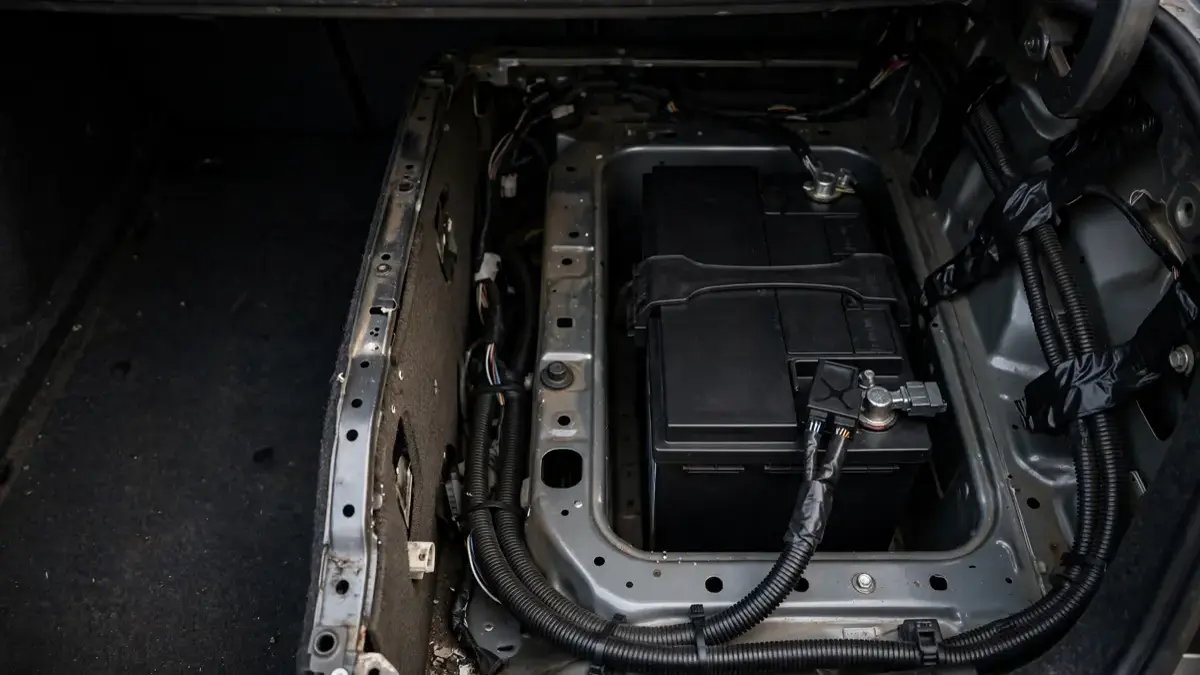
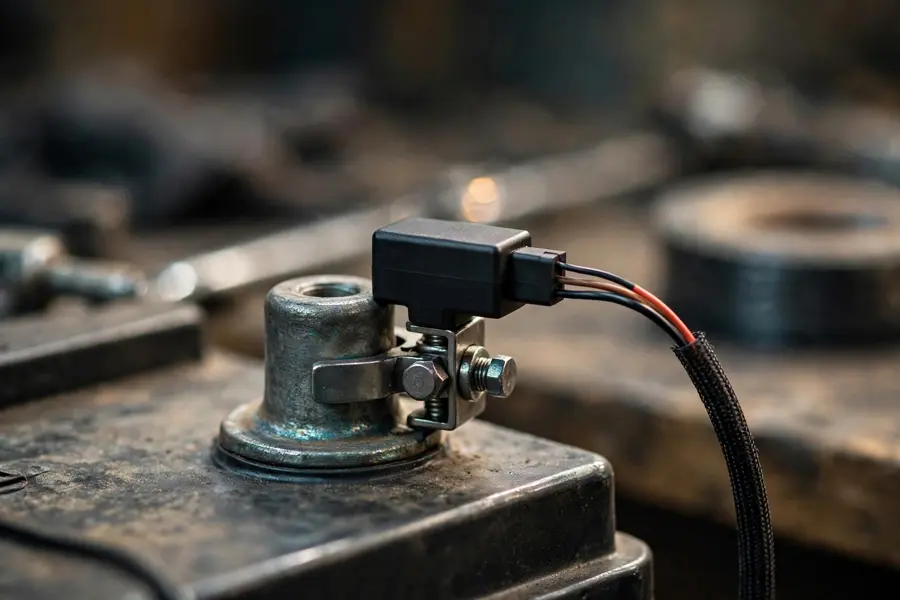
The IBS is a small black module clamped directly onto the battery’s negative terminal post, with a 2- or 3-wire harness plugged into it. It measures three things continuously and reports them to the DME over the LIN data bus:
| What the IBS measures | How the DME uses it |
|---|---|
| Battery terminal voltage | Decides how hard to drive the alternator and when to warn you the battery is low |
| Charge/discharge current (via an internal shunt resistor) | Computes the battery’s true state of charge and how much energy braking recuperation can recover |
| Battery temperature | Adjusts the target charging voltage — cold batteries charge differently from hot ones |
| Wake-up line activity | Reports whether control units are keeping the car awake when it should be asleep |
Because the IBS talks on the LIN bus rather than being a dumb cable, the car notices when it misbehaves. A sensor that reports impossible values, drops off the bus, or has a damaged wake-up line will set faults in the DME — and because the whole energy strategy leans on that data, a bad sensor can produce symptoms far out of proportion to a part that costs under $200.
On E90 cars the IBS is usually part of the negative battery cable assembly — you replace the cable with the sensor. F30 cars follow the same pattern, while on the G20 the battery moved under the hood on most models and the sensor design was updated, but the diagnostic approach is identical: same LIN bus, same connector-check-first rule, same 80 mA sleep threshold. Year and chassis change where your hands go, not how the diagnosis works.
Scope note: the IBS is the negative-terminal sensor. The pyrotechnic Battery Safety Terminal lives on the positive terminal and is a crash-safety device — covered separately below. And if your car is dying but the IBS is healthy, work through the general drain guide first: battery keeps dying.
IBS failure symptoms
IBS failures are masters of disguise. Owners typically replace the battery first — sometimes twice — because every symptom screams “dead battery.” The tell is that the problem persists after the battery is confirmed good or replaced. Community reports and shop receipts consistently point to the same pattern:
| Symptom | What it means | IBS likely? |
|---|---|---|
| Battery dead after sitting overnight or a few days, battery itself tests fine | Energy management is making wrong decisions from bad sensor data | Strong candidate |
| Check Control: “Increased battery discharge when stationary” (CC-ID 415) | Car thinks drain is excessive; sometimes the IBS is the thing misreading | Possible — measure drain first |
| New battery dies within hours of installation | Alternator not being commanded to charge correctly, or car never sleeps | Check IBS codes |
| Clock and trip data reset after parking | Car shut down consumers aggressively to “protect” a battery it misjudged | Possible |
| Charging warning at idle that clears at speed (or vice versa) | DME charging strategy reacting to false current readings | Possible |
| LIN-bus fault codes (CD8F01, CD8E10, 8040B1) after battery work | Connector left unplugged or wake-up line damaged | Very likely — inspect first |
| Everything fine until a battery replacement, then chaos | IBS connector forgotten, or new battery never registered | Check both |
One useful sanity check before spending money: unplugging the IBS connector lets the car fall back to a default charging strategy. It will run — the engine doesn’t need the sensor to start — but energy management is blind. If a persistent drain or charging complaint changes character when the sensor is disconnected, the sensor is strongly implicated. Don’t drive for weeks this way; treat it as a diagnostic step, not a fix.
How much parasitic drain is normal? BMW’s 80 mA rule
Not every overnight death is the IBS. Before condemning it, you need a number — and BMW publishes one. The company’s Power Management training documentation states that the closed-circuit (sleep-mode) current of a BMW must not exceed 80 mA, that a fault code is stored in the DME when battery current exceeds 80 mA during the rest phase, and that readings below 50 mA are preferred for most models. A Check Control message is generated if the car detects over 80 mA while parked.
Source: BMW Power Management training document (BMW vehicle power management PDF), cited as BMW documentation on a forum attachment. What that gives you as a DIY target:
- Under 50 mA after sleep — healthy. This is where you want to be.
- 50–80 mA — borderline. The car tolerates it, but a marginal battery or short-trip pattern will still die.
- Over 80 mA after full sleep — a genuine drain. Time to pull fuses and find the circuit.
The critical phrase is “after full sleep.” A BMW draws several amps for minutes after you lock it — modules shutting down, the fuel pump priming, electronics settling. On E90-era cars the General Module enforces a roughly 16-minute timeout; on F30/G20 allow 30–60 minutes with the car locked and untouched before you trust a reading. Measuring too early is the single most common DIY error in drain diagnosis, and it sends people chasing faults that don’t exist. Full procedure and the fuse-pull method are in the battery drain guide; the multimeter setup is shown below.
Fault codes that point at the IBS (and the BST)
BMW’s dealer-level (ISTA/INPA-style) codes give the most precise IBS diagnoses, but generic scanners often show translated equivalents. Exact wording varies by scan tool — treat these as the codes owners and shops report most often, and match the module and description, not just the number.
| Code | Module / bus | Owner- and shop-reported meaning |
|---|---|---|
| 2E8C | DME | Faulted IBS sensor — the classic “replace the sensor” code on BMW repair receipts |
| CD8F01 | LIN | “Intelligent Battery Sensor missing” — sensor not communicating; often a forgotten connector after battery work |
| 8040B1 | Power management | Wake-up line to the IBS: short to B+ or line disconnected |
| CD8E10 | LIN | LIN bus communication fault involving the IBS circuit |
| P160F | DME (generic) | Battery current plausibility — sometimes logged alongside IBS problems |
| CC-ID 415 | Check Control | “Increased battery discharge when stationary” — the dashboard message, not a sensor code by itself |
| 93B2 | MRS / airbag | Battery Safety Terminal fault — this is the positive-terminal device, not the IBS (see below) |
A word of caution from the trenches: multiple modules can throw codes over one bad sensor, and one module’s failure can cascade warnings across unrelated systems. If your scan shows a wall of low-voltage codes plus one IBS code, fix the IBS fault (or the dead battery causing it) first, clear everything, and re-scan — most of the wall usually disappears.
Interactive: BMW battery-drain diagnostician
Answer a few questions and this tool walks the same decision tree a BMW tech follows — separating IBS suspects from battery, alternator, BST, and plain parasitic-drain cases. Every endpoint gives a concrete next step.
How to test the IBS (before you buy one)
IBS sensors aren’t expensive, but replacing one on a hunch is still a hunch. Work through these in order — cheapest and most conclusive first.
1. Inspect the connector and wake-up line
Pop the trunk trim on the battery’s right side (E90/F30) or the under-hood area (G20 battery location varies by model) and look at the negative terminal. The IBS is the module clamped to the post with a small multi-wire plug. After any battery work, this plug is suspect number one — “CD8F01: Intelligent Battery Sensor missing” almost always means someone forgot it or didn’t seat it fully. Look for green corrosion, a bent pin, or a cracked housing, and confirm the wiring isn’t chafed where it leaves the terminal. Code 8040B1 (wake-up line short to B+ or disconnected) points at wiring damage rather than the sensor.
2. Rule out the battery itself
A load test beats a voltage reading every time. Fully charge the battery, let it rest, and have it load-tested — most auto parts stores do this free. If it’s the original or 4+ years old, it can easily be the whole story, and a dying battery makes the IBS log misleading faults. If the battery passes, keep going.
3. Measure sleep current
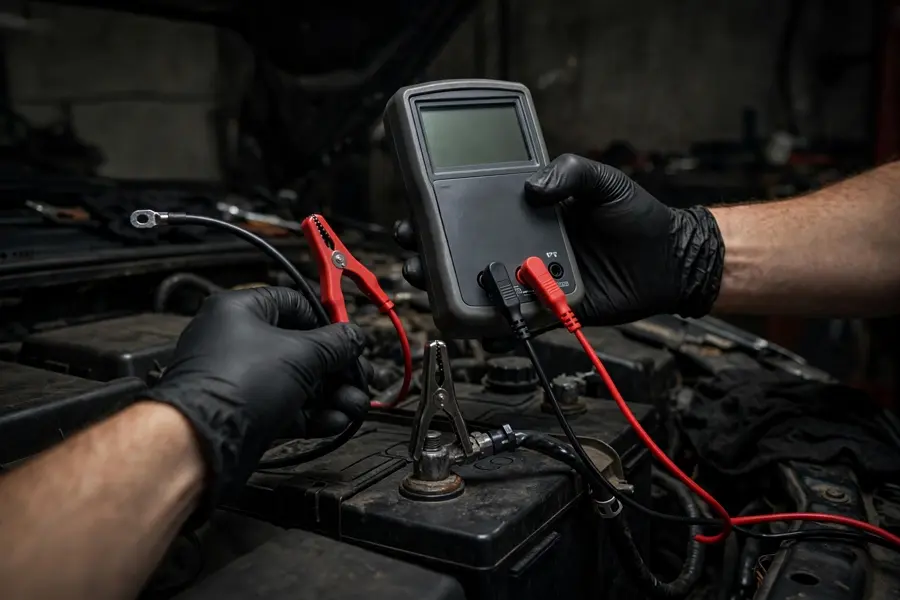
Set a multimeter to the 10 A range and put it in series between the negative cable and the negative post (disconnect the cable, bridge it with the meter). Lock the car, walk away for 30–60 minutes, then read the meter without unlocking anything — use the trunk or keep a door latched shut with a screwdriver so the car thinks it’s closed. Remember BMW’s line in the sand: over 80 mA after full sleep is a drain; under 50 mA is healthy. If the reading is high, pull fuses one at a time to find the circuit. If it’s low and the car still dies, the IBS is lying to the DME — that’s your answer taking shape.
4. Read the sensor’s live data (ISTA if available)
BMW’s ISTA software shows exactly what the IBS is reporting: battery voltage, current, temperature, state of charge, and the sensor’s status on the LIN bus. Compare reported voltage against a handheld meter on the posts — a sensor reading several tenths off, or reporting current flow while the car sits at a confirmed low drain, is a failed sensor. Sanity-check the numbers against physics: at rest with everything asleep, expect roughly 12.4–12.8 V on a healthy charged battery, current within a few dozen milliamps of your meter reading, and a temperature within a few degrees of ambient. An IBS claiming 9 V while your meter shows 12.6 V, or reporting several amps of draw while your ammeter shows 30 mA, has told you everything you need to know.
5. Check battery registration history
If the battery was replaced and never registered, do that first — an unregistered battery produces nearly the full IBS symptom set on its own. Registration details are in the battery registration guide. Only after a registered, tested-good battery still dies should you order a sensor.
The Battery Safety Terminal: what it is, when it fires, and what to do
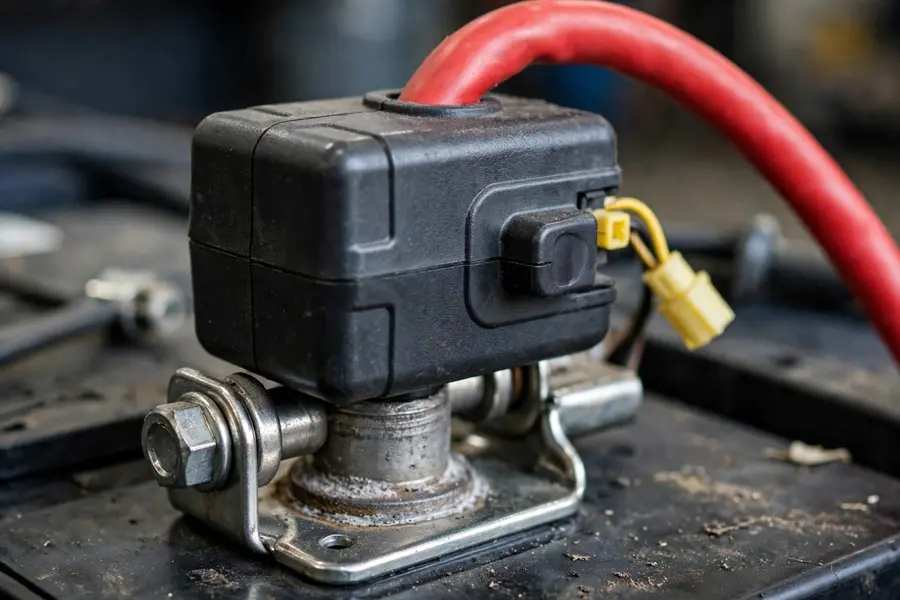
The BST is the IBS’s misunderstood cousin on the other terminal. Where the IBS is a measuring instrument on the negative post, the BST is a pyrotechnic safety device built into the positive battery cable. In a crash — or sometimes a severe enough jolt, like a hard kerb strike — the airbag control unit (MRS/ACSM) fires the BST’s small explosive charge, which physically severs the connection between the battery and the starter/alternator cable. The point is fire prevention: cutting the big positive cable in a wreck removes a major ignition source.
How to tell if it fired
- Totally dead car after an impact. The BST’s signature is a car that was fine, took a hit, and now has zero electrical life — sometimes with the airbag light on.
- Visible separation at the positive terminal. A fired BST shows the cable physically blown apart at the terminal device — it doesn’t look like a loose connection.
- Code 93B2 in the MRS (airbag) module. The airbag unit continuously monitors the pyrotechnic circuit’s resistance; a fired or disconnected BST sets 93B2 and lights the SRS warning.
- A “fired” BST can hide. Community reports note cases where the car was bumped (kerb, pothole) with no airbag deployment and no dash warning, yet the BST fired. If a no-crank appears right after a hard impact, check the positive terminal before the starter.
Wiring faults vs. a fired device
Not every 93B2 means the pyrotechnic fired. The MRS watches the BST circuit’s resistance, so a chafed wire, a corroded pin, or the small yellow connector coming loose reads as a fault too. BMW dealer receipts show techs measuring the BST-to-MRS resistance before replacing anything — follow that example. Unplugging the BST connector and re-scanning is a valid isolation step: if the code changes from “short” to “resistance too high / open circuit,” the wiring is talking and the device itself is suspect. Because 93B2 turns on the airbag light, the full airbag-side diagnosis lives in the airbag light and seat occupancy sensor guide, which contrasts the 93B2 battery-terminal code against seat-mat faults.
Can you reset or repair a fired BST?
No. Once the charge fires, the cable is destroyed by design — there is no reset procedure, and splicing the cable back together defeats a safety system (and keeps the airbag light on). Replacement means a new positive battery cable with the BST device; on some models BMW offered repair kits, but the standard fix is the cable assembly. The job itself is mechanical — disconnect the negative terminal first, swap the positive cable, reconnect — but two things make it a shop-or-confident-DIY job rather than a casual one: it’s a pyrotechnic component, and the MRS fault memory must be cleared with a BMW-capable tool afterward or the airbag light stays on. No coding or registration is required. Specialist airbag-repair companies (MyAirbags is one owners cite by name) offer mail-in BST cable repair for a fraction of new-part cost — worth knowing if a dealer quotes the full cable.
Interactive: IBS / BST repair cost estimator
Pick the repair and where you’d have it done. Bands are estimated from dealer price reports and owner-reported shop invoices — your market and model year move the needle, but the ratios hold.
Repair and DIY: difficulty, steps and real cost bands
Both jobs live at the battery, but they are very different animals. The IBS is a straightforward sensor swap anyone comfortable with a wrench can do. The BST is mechanically simple too — it’s one cable — but it’s a pyrotechnic device tied to the airbag system, so the honest recommendation is a BMW specialist or dealer unless you’re experienced and own a scan tool that can clear MRS faults.
Replacing the IBS
The sensor is part of the negative battery cable. The procedure is the same on E90, F30 and most G20 cars:
- Disconnect the negative terminal first (always negative first on BMWs).
- Unplug the IBS harness connector from the sensor.
- Remove the cable from the battery post and the body ground point.
- Fit the new cable/sensor, reconnect the harness, then the negative terminal last.
- Clear fault memory. If the battery itself was also replaced, register the battery now.
No coding, no programming, no registration is required for the sensor itself — it identifies to the DME over LIN automatically. Plan on 45–60 minutes taking your time. Difficulty: 2/10.
Replacing the BST
- Disconnect the negative terminal first — non-negotiable with a pyrotechnic device in the circuit.
- Unplug the BST’s small connector at the positive terminal.
- Remove the positive cable with the fired BST and fit the new assembly.
- Reconnect positive, then negative.
- Clear the MRS (airbag) fault memory with a BMW-capable tool — the SRS light will not go out on its own.
Mechanically it’s a 3/10 job, but the airbag-system connection and the need for a proper fault clear push it toward a specialist for most owners. One honest parts caveat: cheap aftermarket IBS sensors have a mixed reputation in owner reports — a sensor that misreads from day one puts you right back where you started, so this is one part where an OEM or known-good brand earns its premium. Never probe the BST connector with a multimeter’s continuity beeper — airbag-circuit testing has its own rules, and the dedicated airbag light guide covers what’s safe to check. If your car won’t start and you suspect the BST rather than the battery, the won’t-start guide helps you confirm before spending.
Cost bands at a glance
Estimated bands from dealer price reports and owner-reported invoices (US market, 2026). A used BST cable ($80–$150 owner-reported) is the budget path some owners take, but its history is unknowable — factor that in.
If the bill still stings, remember the alternative diagnosis path: a failing alternator produces overlapping symptoms and costs far more, so confirming the IBS first with the tests above genuinely saves money. The alternator failure guide covers that side, and the increased battery discharge warning guide picks up if that Check Control message is your main complaint.
FAQ
Can I drive with a bad IBS sensor?
The car will run and drive — the engine doesn’t need the sensor to start — but the DME’s energy management is flying blind. That means wrong charging behavior, possible over- or under-charging of the battery, and spurious “battery discharged” warnings. Treat driving with a confirmed bad IBS as a get-home measure, not a lifestyle. Replace the sensor; it’s a sub-$200 part and under an hour of work.
Does the IBS need coding or registration after replacement?
No. The IBS identifies itself to the DME over the LIN bus automatically — there is no coding, programming, or registration step for the sensor itself. The common confusion is with the battery: if you replaced the battery at the same time, the battery must be registered. Skip that and you’ll get nearly the full IBS failure symptom set from a brand-new battery.
Can a fired Battery Safety Terminal be reset or repaired?
No reset exists — the pyrotechnic charge destroys the cable by design. The fix is a replacement positive cable with a new BST, followed by clearing the 93B2 fault in the airbag module with a BMW-capable scan tool. Splicing or bypassing a fired BST defeats a crash-safety system and leaves the airbag light on, and resistor tricks used to silence the light are not a repair. Specialist airbag-repair services offer mail-in BST cable repair at a fraction of new-part cost if the dealer quote hurts.
What is a normal parasitic drain on a BMW 3 Series?
BMW’s own Power Management documentation sets the limit at 80 mA of closed-circuit current after the car has fully gone to sleep, with readings under 50 mA preferred — and the DME stores a fault if the rest-phase current exceeds 80 mA. Measure only after 30–60 minutes locked and untouched; anything measured in the first minutes after locking will read amps, not milliamps, and means nothing.
Is code 93B2 an airbag problem or a battery problem?
Both, in a sense — it’s a battery-terminal device monitored by the airbag system. 93B2 means the airbag control unit sees a fault in the Battery Safety Terminal circuit on the positive cable: either the pyrotechnic fired, or the wiring/connector to it is damaged. It lights the SRS warning because the device belongs to the restraint system. If the BST itself checks out, the fault may be wiring — and the airbag-side diagnosis is covered in the airbag light and seat occupancy sensor guide, which contrasts 93B2 against seat-mat faults.