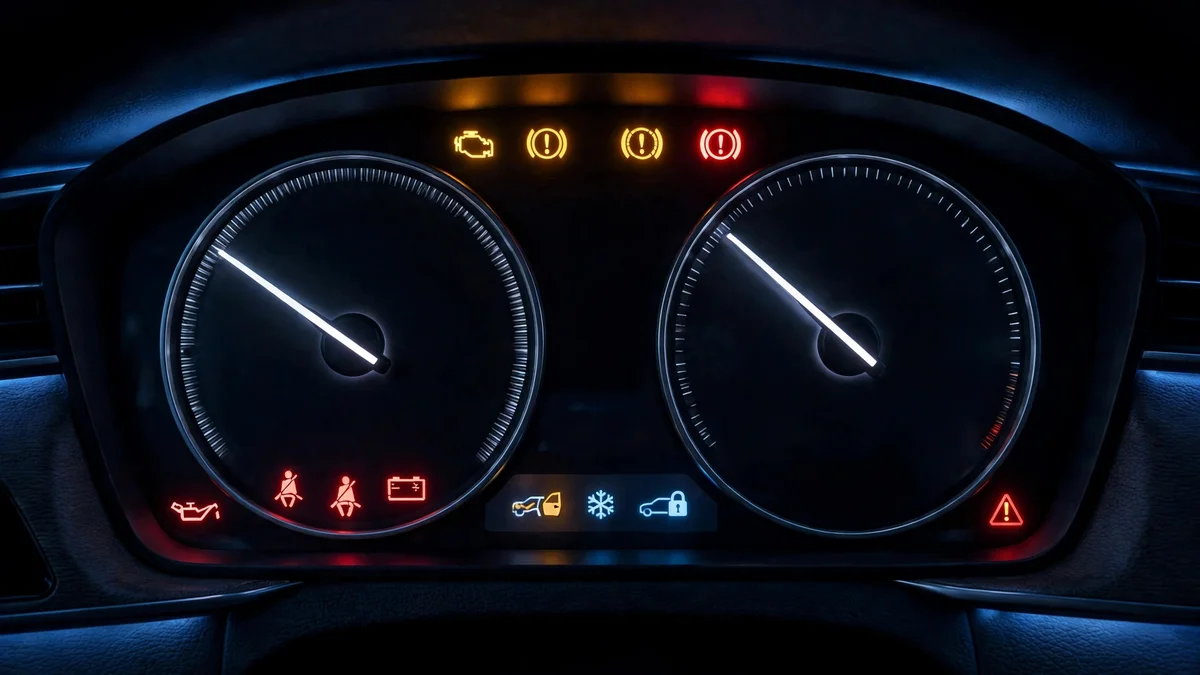
15 BMW Warning Lights Every 3 Series Owner Must Know
Short answer: BMW warning lights speak a two-color language: red means stop or act immediately (oil pressure, coolant overheat, brake system, battery charging, airbag), amber/yellow means the car has logged a fault but is safe to drive to a diagnosis (check engine, drivetrain malfunction, TPMS, the ABS/DSC “trifecta,” brake pads). This guide decodes all 15 warning lights a 3 Series can show, ranks them by severity, tells you exactly what to do in the first 60 seconds, and hands you a link to the full deep-dive fix for each one.
In this guide
- Why BMW warning lights look different from other cars
- Red vs. yellow: the only rule that matters
- The master table: every light ranked by severity
- The 15 lights, decoded one by one (meaning, severity, first action, deep-dive link)
- The first 60 seconds: what to do when a light appears
- Interactive triage tool: tell it your light, get a verdict
- Red-vs-yellow quiz: stop now or drive on?
- Five frequently asked questions
Why BMW warning lights look different
Most cars show you a symbol and leave you to Google it. BMW’s Check Control goes one step further: on the 3 Series it pairs each lamp with a plain-text message in the instrument cluster — “Drivetrain malfunction. Drive moderately.”, “Increased emissions.”, “Chassis stabilization.” On iDrive cars you can open Vehicle info → Vehicle status for a longer explanation and, for some warnings, a recommended maximum speed. The text is helpful, but it is deliberately generic: “drivetrain malfunction” is a category, not a diagnosis. The symbol tells you which system is complaining; the color tells you how fast you need to act; only a fault-code scan tells you what actually failed.
That is the job of this hub. Each section below gives you the tight version — what the light means, its severity color, and your immediate next step — then links to the dedicated deep-dive article where the full diagnosis, fault codes, and repair costs live. If you want the code read before anything else, any BMW-capable scan tool does the job; our OBD2 scanner guide for BMW covers which adapters actually see chassis and restraint codes.
Red vs. yellow: the only rule that matters
BMW follows the same convention as the rest of the industry, and it is the single most useful thing to know when a light appears: red means the car is asking you to stop or act now; amber/yellow means the car has a problem it can live with until your next service visit. Green and blue lamps are just status indicators (headlights, cruise control) — they are never warnings.
| Color | What BMW is telling you | Your move |
|---|---|---|
| Red | Something is wrong right now that can damage the car, the brakes, or you. Oil pressure lost, engine overheating, brake system fault, charging system failed, airbag system down. | Stop safely as soon as you can — or, for charging and airbag faults, drive straight to help without switching the engine off. Red never means “see how it goes.” |
| Amber / yellow | A system has logged a fault and may be running in a degraded mode. Emissions fault, drivetrain malfunction, TPMS, ABS/DSC trifecta, worn brake pads, low oil level, washer fluid, bulb out. | Note the symbol, keep driving normally (gently, if the message says so), and book a diagnosis soon. Amber is the car asking for an appointment, not a tow truck. |
| Flashing (any color) | The fault is happening right now and getting worse — classic example: a flashing check-engine light means an active misfire that can overheat the catalytic converter. | Treat flashing as one severity level worse than steady. A flashing amber behaves like a red: ease off, and stop if it keeps flashing. |
Two traps to avoid. First, three amber lights at once look terrifying but are usually one fault: the ABS/DSC “trifecta” lights ABS, DSC, and amber BRAKE together from a single stability-system failure. Second, lights that clear themselves still count — intermittent faults stay stored in the control modules, and a warning that comes and goes is often the early stage of the permanent version.
The master table: every light, ranked by severity
Stop-now reds first, then the ambers. Skim the row that matches your dashboard, then jump to the section for the full picture — or use the triage tool further down to get a personalized verdict.
| Light | Color | Meaning | Do this now | Deep dive |
|---|---|---|---|---|
| Oil pressure (oil can) | Red | Oil pressure lost — engine damage in progress | Switch off the engine immediately | Oil level guide |
| Coolant overheat (thermometer) | Red | Engine overheating | Stop, let it cool, check coolant cold | Coolant guide |
| Brake system (red BRAKE / !) | Red | Brake fluid low or brake system fault | Check fluid level; stop if pedal feels soft | Brake fluid guide |
| Battery / charging | Red | Alternator not charging; car is running on battery | Drive to help, electrics off, don’t stall it | Alternator guide |
| Airbag / SRS | Red | Restraint system fault; airbags may not deploy | Drive to a shop; get it scanned | Airbag guide |
| Transmission fault | Red | Gearbox fault; usually limp mode (one gear) | Stop safely; restart may clear it temporarily | Transmission guide |
| ABS/DSC trifecta (ABS + DSC + BRAKE) | Amber | Stability system fault; ABS and DSC disabled | Drive gently; regular brakes still work | Trifecta guide |
| Check engine / increased emissions | Amber | Emissions-system fault detected by the DME | Check the gas cap; book a scan | Emissions guide |
| Drivetrain malfunction | Amber | Generic powertrain fault; power reduced | Drive gently; stop if shaking or flashing CEL | Drivetrain guide |
| Chassis stabilization | Amber | DSC can’t trust its sensor data | Drive moderately; check steering-angle/battery | Chassis guide |
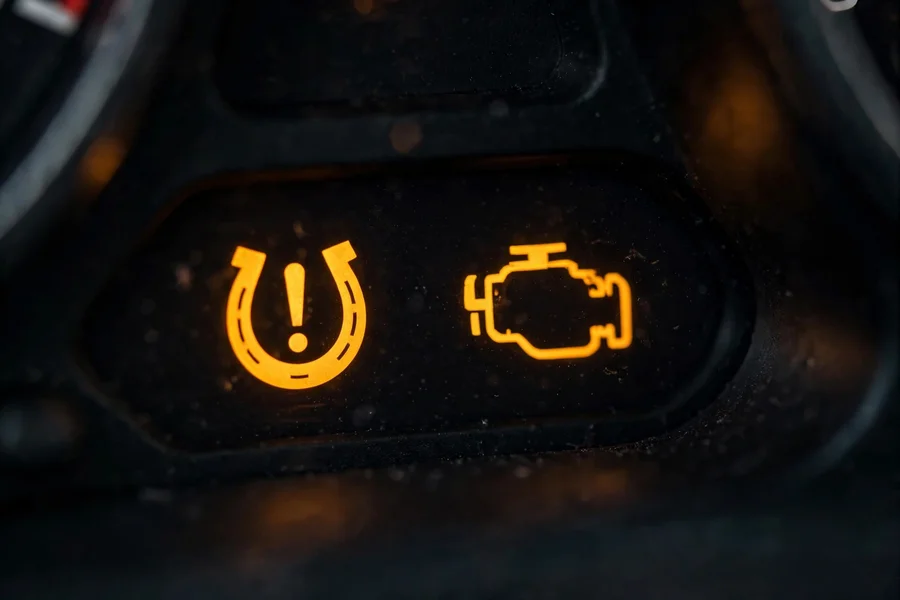
| TPMS (horseshoe + !) | Amber | Tire pressure low on at least one tire | Check all four pressures cold; reset TPMS | TPMS guide |
| Low oil level (oil can) | Amber | Oil level low but pressure still OK | Top up with the correct oil soon | Oil level guide |
| Brake pads worn | Amber | Pads at minimum thickness | Book a brake job; stops fine for now | Brake pad costs |
| Washer fluid low | Amber | Washer reservoir empty | Refill — a two-minute fix | None needed |
| Bulb out (lamp symbol) | Amber | An exterior lamp has failed | Check which lamp; replace the bulb | Bulb guide |
| Service due (car on lift) | Amber | Maintenance interval reached — not a fault | Book the service; reset after it’s done | Reset guide |
Powertrain and emissions
1. Check engine / “increased emissions” (amber)
Meaning: the engine computer (DME) has detected an emissions-related fault. On a BMW this is Check Control’s friendlier phrasing of the ordinary check engine light. First action: tighten the gas cap until it clicks and drive normally for a few days; a loose cap is the cheapest cause and the message often clears on its own. If it returns — or if the light is flashing, which means an active misfire — scan the codes before buying any part. Full guide: BMW increased emissions warning: causes, checks & costs. A steady light with no drivability change is also how a failing oxygen sensor or a worn spark plug first announces itself — both are covered step-by-step in the deep dive.
2. “Drivetrain malfunction. Drive moderately.” (amber)
Meaning: a generic “powertrain fault detected” alert — a category, not a diagnosis. The usual 3 Series suspects are a cracked charge pipe leaking boost, a worn turbo wastegate, VANOS solenoid faults, ignition misfires, or a weak battery confusing the electronics. First action: if the car still drives smoothly, drive gently and book a BMW-specific scan within days; if it is shaking, has lost major power, or the check-engine light is flashing, pull over and stop. Full guide: BMW drivetrain malfunction: causes by engine. Because the message is generic, never let a shop replace parts on the message alone — insist on the stored fault code, which names the exact system that reported the fault.
Brakes and stability
3. The ABS/DSC “trifecta” (three amber lamps)
Meaning: the amber ABS lamp, the DSC triangle, and the amber BRAKE lamp glowing together mean the stability-control unit has logged a fault and switched ABS and traction control off. Most often it is a failed wheel speed sensor; the steering-angle sensor, the DSC module, or a weak battery are the other usual suspects. First action: your regular brakes still work — drive gently in, knowing ABS and stability control are offline. Full guide: BMW ABS/DSC warning lights: trifecta causes & fixes. If cruise control, the speedometer, or hill-start assist quit at the same time, that is normal — they all share the wheel-speed data the DSC unit just rejected.
4. “Chassis stabilization” (amber text message)
Meaning: Dynamic Stability Control no longer trusts its sensor data — a plausibility failure rather than a dead component. Usual fixes: a steering-angle sensor recalibration, a new battery (low voltage corrupts everything at once), or the transfer-case actuator on xDrive cars. It commonly appears after an alignment, a curb strike, a jump start, or the car sitting unused. First action: drive moderately and scan every module with a BMW-capable tool; generic readers miss chassis codes. Full guide: BMW chassis stabilization warning, decoded. A quick tell: if the message appeared the morning after a battery disconnect or jump start, try a full steering lock-to-lock turn with the engine running — that alone can restore the steering-angle calibration.
5. Red BRAKE / brake-system light (red)
Meaning: a red circle with an exclamation mark — or the word BRAKE in red — means low brake fluid or a brake-system fault. This is one of the genuine stop-now reds. First action: check the brake-fluid reservoir level; if the pedal feels soft, spongy, or travels further than usual, do not drive the car — have it towed. If the lamp is amber rather than red, see the trifecta above. Full guide: BMW 3 Series brake fluid reset & service. Also check that the reservoir cap is seated properly — and never top up brake fluid with anything except the DOT specification printed on the cap.
6. Brake pads worn (amber)
Meaning: a circle with dashed pads on either side — the wear sensor says the pads have reached minimum thickness. First action: book a brake job within the next few hundred miles; the car stops perfectly well in the meantime. Typical 3 Series pad replacement runs a few hundred dollars at an independent shop — the full breakdown is in our brake pad replacement cost guide. Most 3 Series wear sensors are one-shot: once the light is on, the sensor itself is consumed and gets replaced along with the pads.
Tires and gearbox
7. TPMS — tire pressure warning (amber)
Meaning: the horseshoe-with-exclamation-mark means at least one tire is significantly under-inflated. Federal rules (FMVSS 138) require the lamp to trigger at 25% or more below the door-placard pressure — see the NHTSA final rule — so by the time it lights, the tire is well past “a little low.” First action: check all four pressures cold against the driver’s door placard, inflate, then perform a TPMS reset (iDrive: Vehicle info → Vehicle status → Reset). Full guide: BMW 3 Series TPMS reset, by generation. Do not trust your eyes here — a tire can be 25% low and still look perfectly fine, which is exactly why the system exists.
8. Transmission fault (red)
Meaning: the transmission control module has detected a gearbox problem and usually engaged limp mode — locking you into one gear to protect itself. First action: pull over safely; switching the car off and on may clear it temporarily, but the underlying fault remains and needs a scan. Common causes range from low transmission fluid and mechatronic sleeve leaks to adaptation issues. Full guide: BMW transmission fault warning: causes & fixes. Repeated limp-mode events point at fluid level, the mechatronic sealing sleeve, or adaptation values — all far cheaper than a replacement gearbox if caught early.
Safety restraints
9. Airbag / SRS light (red)
Meaning: the seated-figure-with-airbag lamp means the restraint system has a fault — in a crash, airbags or tensioners may not deploy. The single most common 3 Series cause is the passenger seat occupancy sensor mat, followed by wiring under the seats disturbed by sliding them. First action: the car is safe to drive to a shop, but get it scanned promptly — this is your crash protection, not a convenience feature. Full guide: BMW airbag light & seat occupancy sensor. Sliding the seats fully forward and back can tug the under-seat wiring — if the light appeared right after someone adjusted the seats, that harness is the first place to look.
Engine fluids
10. Oil pressure (red oil can)
Meaning: the red oil can means oil pressure is lost — not just low level. The engine is being damaged while it runs. First action: switch the engine off immediately and coast to a stop. Check the oil level once stopped; if the level is fine, the problem is the pump or sensor and the car needs a tow, not a top-up. Related: how to check your BMW’s oil level and our oil change interval guide. The 3 Series has no mercy rule here: unlike low oil level, there is no “drive gently” version of lost oil pressure.
11. Low oil level (amber oil can)
Meaning: the amber oil can means the level is low but pressure is still fine — a top-up warning, not an emergency. BMWs with no dipstick check this electronically, so the reading can lag a real leak by a drive cycle. First action: add the correct specification oil (see the oil level guide for the iDrive procedure), then watch for a pattern — repeated top-ups point to a leak or consumption issue worth diagnosing. Check the level the same way every time — engine warm, car level, via iDrive — so you are comparing like with like.
12. Coolant overheat (red thermometer)
Meaning: the red thermometer in waves means the engine is overheating. On the 3 Series the usual culprits are the electric water pump, a stuck thermostat, or low coolant from a leak (expansion tank cracks are a classic). First action: stop, switch off, and let it cool fully before opening anything — then check the level cold and look for leaks. Full guide: BMW low coolant warning: causes & fixes. Never open the expansion tank cap when the engine is hot, and never keep driving with the needle in the red hoping it drops — aluminum heads warp fast.
Electrical and the minor ones
13. Battery / charging system (red battery)
Meaning: the red battery outline means the charging system has failed — usually the alternator. The car is running on battery alone — you have minutes to perhaps half an hour before everything dies. First action: switch off every electrical load (heated seats, blower, lights if safe), drive straight to a shop or a safe stopping point, and do not switch the engine off until you are somewhere you can leave the car — it may not restart. Full guides: alternator failure symptoms and battery keeps dying. If the car dies completely, a jump start gets you moving, but the underlying charging fault is still there — see our won’t-start guide if it then refuses to crank.
14. Washer fluid low (amber windshield)
Meaning: the windshield-with-spray symbol means the washer reservoir is empty. First action: refill it — this is the only warning light on the page that is a two-minute fix with no diagnosis required. (If the reservoir keeps emptying with no visible puddle, the level sensor or pump grommet is the usual suspect.) Use proper washer fluid, not plain water — water freezes in the lines and breeds the exact kind of gunk that clogs the jets.
15. Bulb out / lamp failure (amber)
Meaning: the lightbulb symbol means Check Control has detected a failed exterior lamp — headlight, taillight, brake light, or indicator. First action: walk around the car with the lights on, identify the dead lamp, and replace the bulb; on many 3 Series generations it is a straightforward owner job. Note that cheap LED conversions can trigger false bulb-out warnings because the system expects the resistance of a filament bulb. Full guide: headlight bulb replacement. Replace bulbs in pairs where visibility matters — headlights age together, and the second one usually fails within weeks of the first.

The first 60 seconds: what to do when a light appears
A warning light is at its most useful in the minute it appears — that is when you have the most context. Run this drill before you touch your phone:
- Note the color and the symbol. Those two facts alone place the fault in the master table above — red means stop, amber means appointment.
- Read any text message, and note whether the light is flashing. “Drive moderately” is a real instruction; a flashing lamp is one severity level worse than a steady one.
- Check the gauges and feel the car. Temperature normal? Power normal? Brakes normal? A car that feels fine with an amber light is a car you can drive to a diagnosis.
- Red: pull over safely. Amber: keep driving normally. Do not try to “make it home” on a red oil or coolant light — the repair bill for a seized engine or warped head dwarfs any tow fee.
- Do not disconnect the battery to clear it. That wipes the freeze-frame data the diagnosis needs, and on a BMW it can trigger a cascade of new warnings that bury the original fault.
Which light is on? Get a verdict
Warning-light triage tool
Three questions — then a verdict: what it is, how urgent, and what to do next.
Quiz: stop now or drive on?
Red vs. yellow quiz
Eight scenarios. For each one: stop now, or drive on? Explanations included — no trick questions, one deliberate curveball.

Warning lights: five frequently asked questions
Why does my BMW show a text message instead of just a symbol?
That is BMW’s Check Control system translating raw fault codes into plain language. A generic car shows the engine outline and leaves you guessing; a 3 Series adds “increased emissions” or “drivetrain malfunction — drive moderately” so you know the category immediately. The trade-off is that the message is deliberately broad — only the stored fault code names the actual failed part, which is why every deep-dive guide on this site starts with “scan it first.”
Can I keep driving with the check engine light on?
If it is steady and the car drives normally, yes — drive to your destination, then book a scan soon. If it is flashing, that means an active misfire that can overheat and destroy the catalytic converter: ease off the throttle immediately, and pull over if it keeps flashing. The same logic applies to every amber light on this page: steady means “appointment,” flashing means “stop.”
A warning light disappeared on its own. Is the problem gone?
Probably not — it is probably intermittent. BMW control modules store faults even after the lamp clears, so a warning that comes and goes (classic with wheel speed sensors and the trifecta) is usually the early stage of the permanent version. If a light ever appeared, the code is still there to be read, and reading it now is cheaper than reading it after the tow.
Why did three warning lights come on at the same time?
Because BMW’s DSC unit is the hub that ABS, traction control, cruise control, and the brake warning all report through. One failed input — most often a wheel speed sensor — makes the unit distrust its math, so it flags every system that depends on that math: ABS, the DSC triangle, and the amber BRAKE lamp together. It looks like three problems; it is almost always one. Our ABS/DSC trifecta guide walks through the diagnosis.
Do I need a BMW dealer to diagnose a warning light?
No — you need a BMW-capable scan tool, not a dealer. Generic OBD2 readers only see engine codes; BMW’s chassis, restraint, and transmission modules need a tool that speaks BMW protocols (see our OBD2 scanner guide). Any good independent BMW specialist has one, and charges far less than a dealer for the same diagnosis.