BMW 3 Series Water Pump Died? Full DIY Replacement
Short answer: BMW 3 Series water pump replacement is very DIY-able once you know which pump your engine uses: N-series cars (E90, early F30) have an electric pump paired with an electronic thermostat, while B-series cars (late F30, G20) went back to a belt-driven mechanical pump with a heat management module. Budget 1–2 hours on an F30 328i, a full afternoon on an E90, new single-use bolts, the correct blue or HT-12 coolant — and never skip the post-repair bleed.
Replacing the water pump on a BMW 3 Series looks intimidating from above the engine bay and turns out to be straightforward once you’re underneath the car. The pump hangs low on the front of the engine, the fasteners are few, and there is no timing work involved. What decides whether your Saturday goes well is preparation: ordering the right pump for your engine code, having the single-use bolts on hand, and knowing the coolant and bleeding requirements before you drain a drop.
One important boundary for this guide: if you are still figuring out whether your pump has actually failed, start with our BMW water pump failure symptoms guide — it covers the failure sequence, the 2E81–2E84 fault codes, and the full cost breakdown. This article assumes the diagnosis is done and walks through the replacement itself: parts and tools, the procedure per engine family, torque notes, coolant specs, and the mandatory bleed afterward.
In this guide
- Which water pump your 3 Series has (it depends on the engine)
- Parts and tools checklist
- Interactive: which pump and what else to replace
- Step-by-step: electric pump replacement (N52, N54, N20, N26, N55)
- B-series cars: mechanical pump and heat management module
- The thermostat question: replace it while you’re in there?
- Coolant spec: blue G48 vs. green HT-12
- The mandatory post-repair bleed
- DIY vs. independent shop vs. dealer: cost estimator
- Water pump replacement FAQ
Which water pump your 3 Series has (it depends on the engine)
BMW used two fundamentally different cooling architectures across the 3 Series generations, and ordering the wrong one is the single most common parts mistake. N-series engines (E90 and early F30) use an electric water pump controlled by the engine computer, paired with an electronically mapped thermostat. The modular B-series engines (late F30 and all G20) went back to a belt-driven mechanical pump, with a computer-controlled heat management module doing the thermostat’s job. Confirm your engine code under the hood or via your VIN before ordering anything.
| Model | Engine | Pump type | Companion part | Key install note |
|---|---|---|---|---|
| E90 325i / 328i / 330i (2006–2013) | N52 | Electric | Electronic thermostat (separate, bolted to pump) | 3 single-use aluminum bolts; access from below |
| E90 335i (2007–2010) | N54 | Electric | Electronic thermostat (separate, bolted to pump) | Intercooler and cooling fan removal for access |
| F30 328i (2012–2016) | N20 / N26 | Electric | Thermostat in one bolted pump assembly | Easiest DIY of the group; 1–2 hours |
| F30 335i (2012–2015) | N55 | Electric | Electronic thermostat (layout revised vs. E90) | Fan removal; upper bolt is the awkward one |
| F30 330i (2017–2018) | B46 | Mechanical (belt-driven) | Heat management module (no conventional thermostat) | No electric-pump self-bleed routine |
| F30 340i (2016–2018) | B58 | Mechanical (belt-driven) | Heat management module | Module needs ISTA end-stop teach-in |
| G20 330i (2019+) | B46 / B48 | Mechanical (belt-driven) | Heat management module | Separate electric aux pumps for turbo/intercooler — different parts |
| G20 M340i (2020+) | B58 | Mechanical (belt-driven) | Heat management module | Module needs ISTA end-stop teach-in |
The B-series distinction trips up a lot of owners because the electric-pump reputation is so strong. Parts catalogs for G20 330i cars list small electric auxiliary pumps for the turbocharger and intercooler circuits — those are real failure points, but they are not the main engine water pump. The main pump on B46/B48/B58 engines is the belt-driven mechanical unit (BMW part family 11-51-8-638-026 on the four-cylinders).
Parts and tools checklist
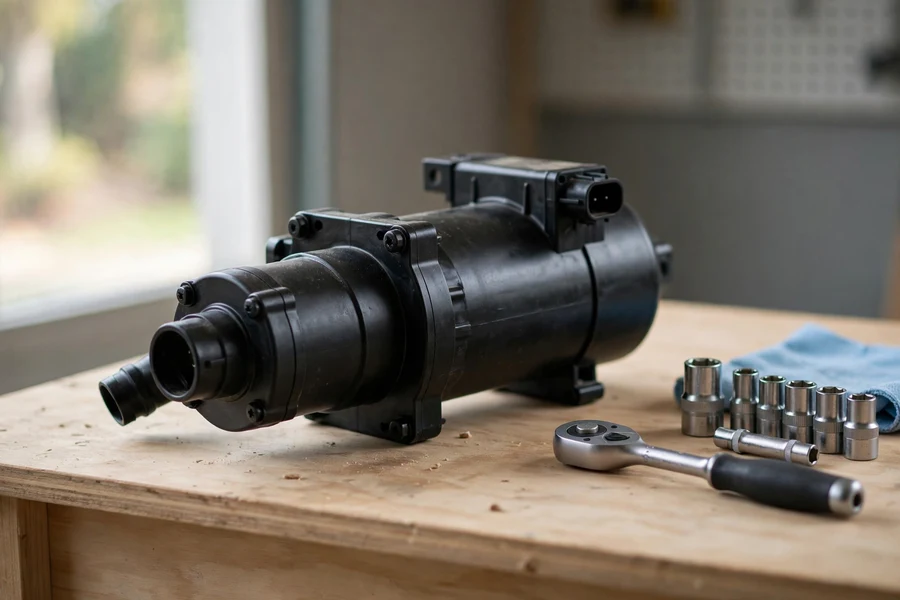
Gather everything before the car goes in the air. The job stalls most often on missing bolts — the aluminum pump bolts are single-use — or on the wrong coolant. Buy the pump, thermostat or module, bolts, and coolant as one order.
| Part | Notes |
|---|---|
| Water pump (correct for your engine code) | Electric unit for N-series; mechanical for B-series. Genuine BMW or OE-supplier (Pierburg) quality — this is not the part to cheap out on |
| Thermostat (N-series) or heat management module (B-series) | See the thermostat judgment section below — N-series: replace together; B-series: inspect and decide |
| Water pump mounting bolts | Single-use aluminum on N-series (3 bolts); always new, never reused |
| Thermostat-to-pump hose and hose clamps | The short U-hose between pump and thermostat hardens with age; replace it while the system is open |
| Engine coolant (correct spec) | Blue G48 or green HT-12 per the coolant table — concentrate mixed 50/50 with distilled water, never tap water |
| O-ring assembly lubricant | Silicone-based; helps hoses and seals seat without tearing |
| Distilled water | For mixing concentrate and for final top-ups |
| Tool | Why you need it |
|---|---|
| E-Torx socket set (E12 for pump bolts) | BMW uses external Torx fasteners on the pump — standard hex sockets will round them |
| 3/8-inch ratchet, extensions, universal joint | The upper pump bolt is reached blind; extensions and a wobble joint are mandatory |
| 8–13 mm sockets | Undertray, thermostat bolts, and ancillary fasteners |
| Flex-shaft hose clamp driver | Reaches the clamps buried behind the pump where a screwdriver won’t fit |
| Torque wrench (low range) | Aluminum bolts and plastic housings crack if overtightened — see torque notes |
| Floor jack and jack stands (or ramps) | The entire job happens from below; follow our safe jacking points guide |
| Large drain pan (at least 3 gallons) | The system holds roughly 2–2.5 gallons; coolant is toxic to pets — catch it all |
| Spill-free coolant funnel | Keeps air out during refill and makes the bleed far less messy |
| 10-amp battery charger | The electric-pump bleed routine runs ~12 minutes on ignition power; a weak battery aborts it |
| Flathead and Phillips screwdrivers | Undertray clips, hose clip persuasion, connector locks |
| BMW-capable scan tool | To confirm no pump fault codes remain and to activate the bleed routine on some models |
A note on the scan tool: it is not required to turn the wrenches, but it closes the loop. After the repair you want to verify that no 2E81–2E84 pump codes return and that the new pump responds to commands. Our OBD2 scanner guide for BMW covers which tools can talk to the cooling system properly.
Interactive: which pump — and what else to replace
Pick your engine below and the picker returns the pump type, the companion part to order with it, the correct coolant, and the install gotchas for your car.
Which pump & what else? Select your engine to get the parts list and install notes.
Your parts list and install notes will appear here.
Step-by-step: electric pump replacement (N52, N54, N20, N26, N55)
This is the procedure for the electric-pump cars — the E90 325i/328i/330i/335i and the F30 328i/335i, which cover the large majority of water pump DIYs on 3 Series cars. Work on a cold engine, on level ground, with the car properly supported. Coolant is sweet-tasting and toxic to animals, so keep pets away and catch every drop.
Preparation
- Raise the front of the car on jack stands or drive-on ramps and remove the forward underbody splash shield.
- Disconnect the battery negative terminal. You will be unplugging the pump’s electrical connector, and the bleed routine runs on ignition power later.
- Place the drain pan under the pump area. On the N52, free up room by unbolting the power-steering cooler hose mount on the passenger side and lowering the front sway bar (two nuts per mount) — tie both out of the way.
- On the N54/N55 335i, remove the cooling fan assembly (and the intercooler on the E90) for access; on the F30 N55 the fan must come out and a second person makes refitting it far easier.
- Have your 10-amp battery charger ready for the bleed step — the pump runs about 12 minutes on ignition power, and a sagging battery aborts the routine.
Removal
- Unplug the electrical connectors from the water pump and the thermostat. Check the pump connector seal — oil contamination can swell it and prevent the new connector from locking; the seal is replaceable separately.
- Loosen the hose clamp on the thermostat-to-pump hose (the nipple facing the rear of the car) and pull the hose off the pump inlet. Most of the coolant in the pump, thermostat, and local hoses drains here — let it finish.
- Loosen the pump outlet (supply) hose clamp. On some cars this hose is solidly mounted to the chassis and cannot be removed; you will pull the pump out of the hose instead.
- Disconnect the radiator-to-thermostat hose at the large quick-disconnect elbow on the front of the thermostat: pull the locking wire, then pull the fitting straight off. Expect the rest of the system’s coolant.
- Remove the two thermostat mounting bolts, then the three water pump mounting bolts with an E12 Torx socket. Two are easy to see; the third hides above the pump — look for the blue-headed aluminum bolt about an inch forward of where you expect it.
- Discard the three aluminum pump bolts. They are single-use torque-to-yield fasteners and must not go back in.
- Wiggle the pump free. If a hose has bonded to a nipple, break the seal gently with a small screwdriver or plastic trim tool around the hose’s edge — never pry against the plastic nipples, which snap.
Installation
- Transfer any wiring-harness clips to the new pump and compare old and new units side by side — nipple positions, connector type, and mounting ears should match.
- Lightly lubricate O-rings and hose nipples with silicone O-ring lubricant. Dry rubber on dry plastic is how hoses tear and seals roll.
- Seat the new pump and thermostat, then install the NEW aluminum bolts. BMW’s published tightening data for the N52K electric pump specifies a 10 Nm jointing torque plus 90° of rotation, with the screws replaced every time — follow the torque-plus-angle sequence evenly across the bolts rather than fully tightening one at a time.
- Reconnect all hoses, confirming each quick-disconnect’s locking wire is fully seated and each clamped hose sits past its bead. Reconnect both electrical connectors and tug-test the pump connector — it must audibly lock.
- Refit the sway bar, power-steering cooler mount, fan, intercooler (as applicable), and the splash shield. Torque the sway-bar mount nuts to spec.
- Refill with the correct 50/50 coolant mix through the expansion tank, then run the bleed procedure (next section but one — it is not optional).
- Start the engine, bring it to operating temperature, and check every connection for leaks with the system pressurized. Recheck the coolant level after the first full heat cycle.
Bolt and torque notes — read this before touching a wrench
The N-series electric pump bolts deserve their own warning because they are the most commonly ruined fasteners in this job. BMW uses single-use aluminum bolts (identifiable by their blue heads) to mount the pump to the crankcase. Aluminum bolts are torque-to-yield: they stretch permanently as they are tightened, which is exactly why BMW’s tightening data pairs a torque figure with an angle of rotation. Published BMW TIS/ISTA data for the N52K electric pump gives 10 Nm jointing torque plus 90° rotation, and explicitly calls for the screws to be replaced. Reusing a stretched aluminum bolt risks snapping it in the block or losing clamp load — either outcome turns a Saturday job into a machine-shop visit.
Two honest caveats. First, that 10 Nm + 90° figure is documented for the N52K application; tightening data varies across engine codes and chassis, so verify the figure for your exact car in BMW’s TIS/ISTA documentation rather than assuming it transfers. Second, published torque figures for the thermostat housing bolts and hose clamps are not consistently documented — snug them evenly by hand, then verify with a pressurized leak check rather than guessing at a number.
B-series cars: mechanical pump and heat management module
The F30 330i (B46), F30 340i (B58), G20 330i (B46/B48), and G20 M340i (B58) play by different rules. BMW returned these engines to a conventional belt-driven mechanical water pump and replaced the thermostat with a computer-controlled heat management module — a rotary valve assembly that meters coolant to the block, head, turbocharger, and heater circuits independently for faster warm-up and lower fuel consumption.
The pump half of the job will feel familiar to anyone who has done a water pump on any other car: drain the system, release the serpentine belt, unbolt the pump from the front of the engine, clean the mating surface, fit the new pump with its gasket, and refill. It is a simpler, cheaper part than the electric unit — which is why the DIY parts bill on these cars runs lower.
The heat management module is the part that changes the difficulty rating. On the B58 its replacement typically requires removing the intake manifold (plus the DME and power distribution box above it) just to reach the module — a long, careful job with many connectors to track. After a module replacement, BMW’s ISTA diagnostic system must run a service function that teaches the module’s position-sensor end stops back in; skip that step and the module cannot calibrate its rotary valve. Without ISTA access (or a tool that runs BMW service functions), the module half of this job belongs at an independent BMW specialist, even if you do the pump yourself.
One more B-series trap: the small electric auxiliary pumps. Parts catalogs list electric coolant pumps for the turbocharger and charge-air cooler circuits on these cars, and they are genuine failure points — but they are not the engine’s main water pump. Diagnose which circuit is actually at fault before ordering.
The thermostat question: replace it while you’re in there?
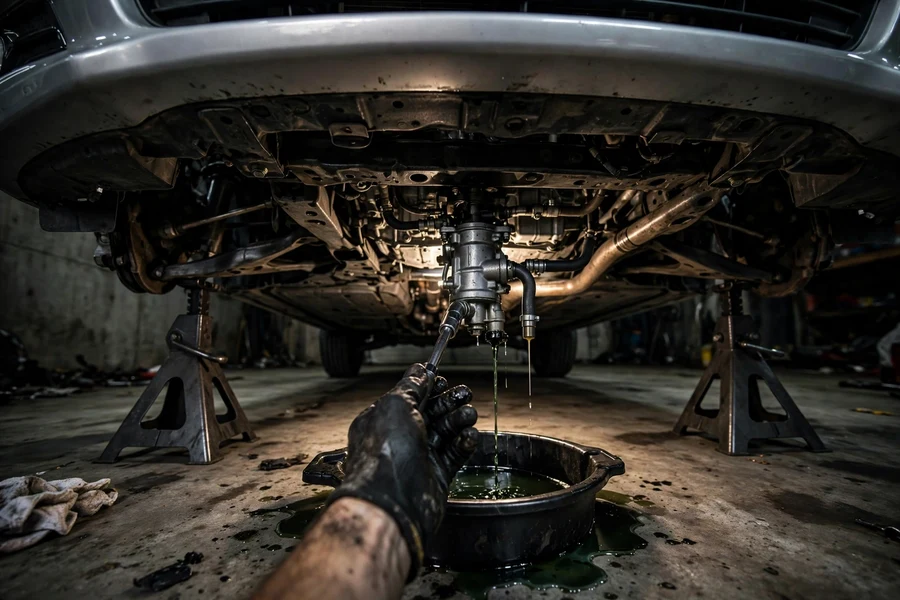
On the N-series electric-pump cars, the answer is an unambiguous yes. The thermostat is an electronically controlled unit with essentially the same service life as the pump — both typically fail in the 60,000–100,000 mile window — and it is already unbolted in your hands during the pump job. Doing the pump now and the thermostat six months later means draining the system and fighting the same hose clamps twice. Every major DIY guide treats pump and thermostat as a pair, and the incremental parts cost is small next to the repeated labor.
On the B-series cars the calculus flips. The heat management module is a separate, expensive part buried behind hours of additional labor, and it does not share the pump’s failure pattern. Replace the module when there is a reason: a stored module fault code, a visible coolant leak at the module housing, or degraded plastic on a high-mileage keeper. “While you’re in there” is not a reason by itself when “in there” means removing the intake manifold.
Coolant spec: blue G48 vs. green HT-12
BMW switched coolant chemistry mid-F30-production, and using the wrong one is an avoidable mistake. The rule is by build date, not model year: F30 cars built through July 31, 2018 left the factory with blue G48; cars built from August 1, 2018 onward got green HT-12. All G20 cars use HT-12. Check your build date on the driver’s door-jamb sticker and confirm with the color in the expansion tank — then stick with whatever is already in the system, because a flush never removes 100% of the old coolant.
| Car | Coolant | BMW part family | Mix |
|---|---|---|---|
| E90 all (N52, N54) | Blue G48 | 82-14-1-467-704 | 50/50 with distilled water |
| F30 built through 7/31/2018 (N20, N26, N55, early B46/B58) | Blue G48 | 82-14-1-467-704 | 50/50 with distilled water |
| F30 built from 8/1/2018 (late B46/B58) | Green HT-12 | 83-19-2-468-442 | 50/50 with distilled water |
| G20 all (B46, B48, B58) | Green HT-12 | 83-19-2-468-442 | 50/50 with distilled water |
Three rules with no exceptions: never mix blue and green (the additive packages are incompatible), never use tap water (minerals plate out inside the electric pump and the heat management module), and never run the engine on plain water beyond getting the car onto a trailer. Buy concentrate and distilled water separately — pre-mixed jugs cost more per gallon and you lose control of the ratio.
The mandatory post-repair bleed
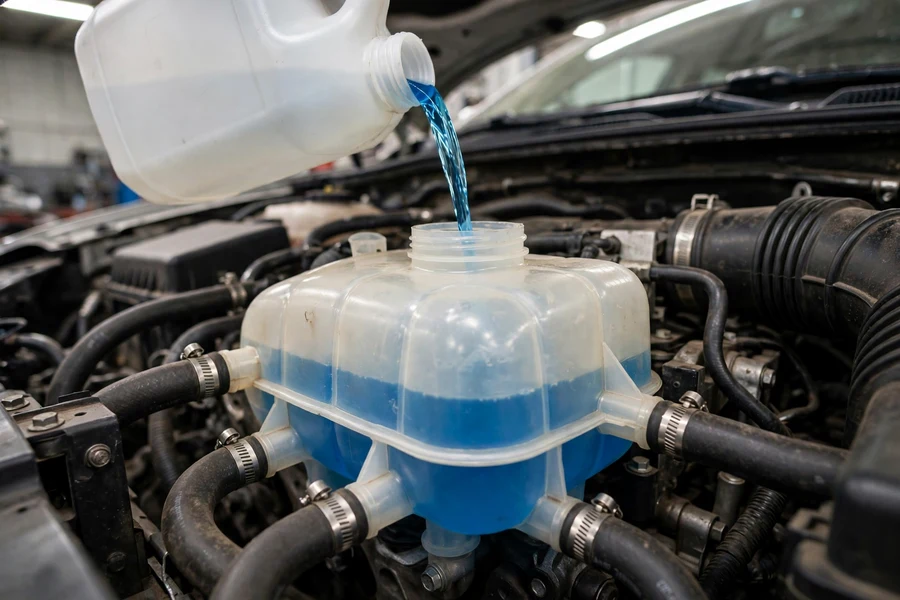
Refilling the system is only half the refill. Air trapped in the cooling circuit creates hot spots that can overheat the engine with a full expansion tank staring back at you — and on the electric-pump cars, trapped air is the number one cause of “the new pump must be defective” comebacks that are really bleeding failures. The bleed is part of the repair, not an optional extra.
On the N-series electric-pump cars, BMW built the bleed into the car: ignition ON with the engine OFF, cabin heat to maximum, blower to low, then press the accelerator to the floor for ten seconds. The electric pump runs on its own for about 12 minutes, cycling on and off to push air out to the expansion tank. Keep the battery charger connected — if voltage sags, the routine aborts silently. Expect the coolant level to drop as air escapes; top up and repeat until the level holds.
The full routine — including the B-series mechanical-pump procedure, the exact button sequence, and what to do when the level won’t stabilize — lives in our BMW 3 Series coolant bleeding procedure guide. Read it before you start the job, not after the refill: pump, thermostat, coolant, bleed, leak check, done.
DIY vs. independent shop vs. dealer: cost estimator
Water pump replacement has one of the widest dealer-to-DIY price spreads on a 3 Series. The bands below match the owner-reported figures in our water pump failure guide — treat them as typical ranges, not quotes, since labor rates vary sharply by region.
Cost & difficulty estimator. Typical ranges assembled from owner-reported invoices and specialist parts pricing.
Your estimate and difficulty rating will appear here.
A word on the F30 335i, 340i, and 330i (N55, B58, B46): published owner invoice data is thinner for these cars, so they don’t get their own estimator band. Expect them to land between the F30 328i and E90 bands depending on parts choice and shop rate — with one exception: if a B58 heat management module is replaced with the pump, budget extra diagnostic time for the ISTA end-stop teach-in.
Water pump replacement FAQ
Can I drive to the shop with a failing water pump?
No — have it towed. The N-series electric pump fails suddenly rather than gradually, and driving on a dead pump overheats the engine within minutes, risking a warped head or blown gasket that dwarfs the pump bill. The full failure sequence is covered in our water pump failure symptoms guide.
Do I really need to replace the thermostat with the water pump?
On N-series cars (E90, F30 328i/335i), yes — the electronic thermostat shares the pump’s service life and is already unbolted in your hands, so replacing only the pump schedules the same labor twice. On B-series cars, the heat management module is a much bigger separate job — replace it on evidence (codes, leaks, age), not automatically.
Can I reuse the water pump bolts?
No. The N-series electric pump uses single-use aluminum torque-to-yield bolts (blue heads). BMW’s tightening data for the N52K specifies 10 Nm jointing torque plus 90° of rotation with new screws every time — a reused bolt has already stretched and can snap in the block or lose clamp load. New bolts cost very little; a snapped bolt costs a great deal.
Which coolant does my 3 Series take — blue or green?
Go by build date: blue G48 for the E90 and for F30 cars built through July 31, 2018; green HT-12 for F30 cars built from August 1, 2018 and for all G20 cars. Check the driver’s door-jamb sticker and the expansion tank color, match what’s already in the system, mix 50/50 with distilled water only, and never mix blue and green.
Do I need a scan tool or ISTA after replacing the pump?
A BMW-capable scan tool is strongly recommended: it confirms no 2E81–2E84 pump codes return and verifies the new pump responds. Full ISTA is only mandatory in one case — after replacing a B58 heat management module, whose position-sensor end stops must be taught in through ISTA’s service function. The electric-pump bleed routine itself runs from the ignition and accelerator pedal with no tools required.
With the pump replaced, the system bled, and no codes returning, the cooling system is good for the next service interval — many owners pair this job with a fresh look at the rest of the system via our 3 Series overheating guide. For the bigger picture, the complete BMW 3 Series guide is the hub this article hangs off.