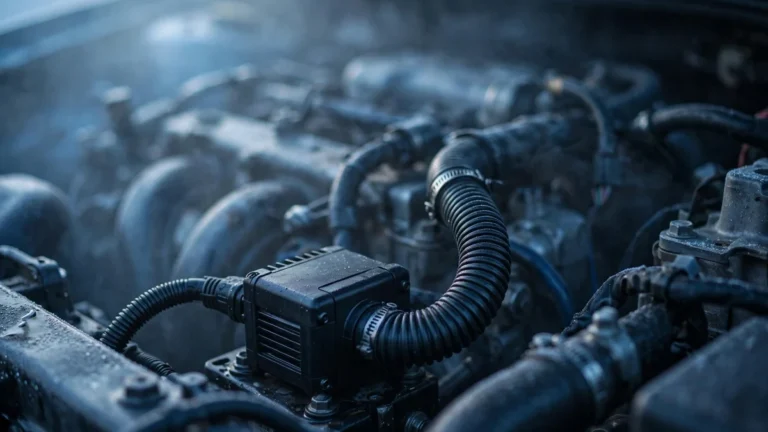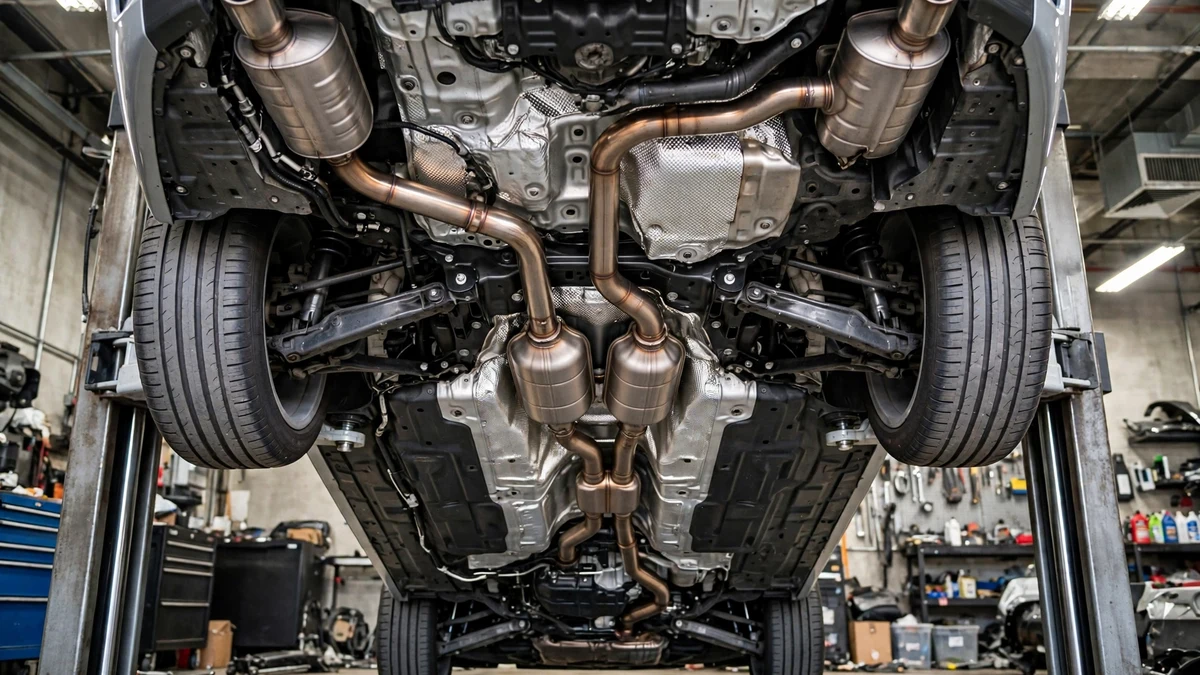
7 Signs of BMW Catalytic Converter Failure Before P0420
Short answer: BMW catalytic converter failure usually announces itself as P0420 (bank 1) or P0430 (bank 2) — catalyst efficiency below threshold. The code means the converter’s oxygen-storage capacity has degraded, but it does not automatically mean the cat is dead: lazy O2 sensors, exhaust leaks, misfires, and rich fueling can set the same code. Confirm with a live-data O2 waveform comparison before spending money — replacement typically runs $900–$3,500+ at a shop depending on OEM vs aftermarket, and the root cause (misfire, oil burning, coolant) must be fixed first or the new cat dies too.
A P0420 or P0430 code on a BMW 3 Series sends a lot of owners straight to a quote for a new catalytic converter — and sometimes that is exactly what the car needs. But these two codes are among the most misdiagnosed in OBD-II. The converter is the priciest part in the emissions system, the job is labor-heavy on BMW’s close-coupled exhaust layout, and nothing about the code tells you why the catalyst failed. This guide covers what the codes mean, how to separate a dead converter from a lazy sensor or an engine problem, honest repair costs, and the root causes you must fix first.
The sensor measures, the cat converts: what P0420 really means
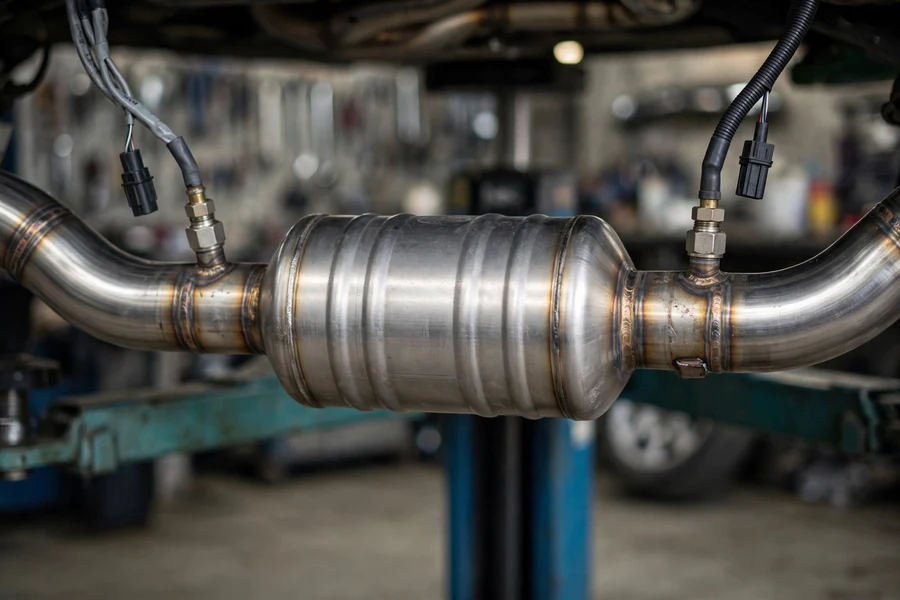
Here is the distinction that saves people thousands. Oxygen sensors and catalytic converters do different jobs, and confusing them is the most common P0420 mistake. The oxygen sensors measure oxygen in the exhaust — upstream drives fuel trim, downstream watches the converter. The catalytic converter converts — its platinum, palladium, and rhodium washcoat on a ceramic honeycomb turns carbon monoxide, hydrocarbons, and nitrogen oxides into carbon dioxide, water vapor, and nitrogen. Sensors never convert; converters never measure.
P0420 (bank 1) and P0430 (bank 2) are catalyst efficiency codes. The computer compares the upstream and downstream O2 signals and asks whether the converter still buffers oxygen like a healthy washcoat. Behind a good cat the downstream signal goes nearly flat; when the washcoat degrades, the downstream trace starts mirroring the upstream switching, and the code sets. But a skewed downstream reading is not always a dead converter: a lazy upstream sensor, an exhaust leak ahead of the downstream sensor, misfires, or rich fueling can all fail the monitor while the converter itself survives. Our BMW 3 Series oxygen sensor replacement guide covers the sensor side — test procedures, which sensor each code names, and the swap itself. Read it first if your scan shows O2 codes; this article picks up where it leaves off, for cases where the converter itself is the suspect.
Symptoms of BMW catalytic converter failure
A converter fails two ways, and symptoms split along that line. A chemically dead cat — poisoned or aged washcoat — often changes nothing about how the car drives; only the light tells the story. A mechanically failed cat — cracked, broken, or melted substrate — announces itself with noise, smell, and lost power.
| Symptom | What it usually indicates | Urgency |
|---|---|---|
| Check engine light, car drives normally | Washcoat efficiency degraded (classic P0420/P0430) | Moderate — diagnose, plan the repair |
| Rotten-egg (sulfur) smell from the exhaust | Converter overloaded by rich running, or its chemistry spent | Moderate — find whether fueling or the cat is at fault |
| Metallic rattling on cold start or over bumps | Substrate brick cracked or broken loose inside the housing | High — debris can migrate and block the exhaust |
| Power loss, especially at higher RPM | Melted or collapsed substrate restricting exhaust flow | High — backpressure stresses the engine |
| Engine will not rev past a certain point | Severe restriction — exhaust cannot escape fast enough | High — stop driving and diagnose |
| Excess heat under the car, hot floor | Converter running extremely hot from unburned fuel | High — overheating cat damages nearby parts |
| Failed emissions / smog test | Any catalyst code is an automatic failure | Moderate — repair before retest |
| Worse fuel economy, no other symptom | Weak signal on its own — many possible causes | Low — never condemn a cat on this alone |
Two symptoms deserve attention. The rattle means the ceramic brick has cracked and pieces are shifting — a rattling converter is done, and loose substrate can lodge downstream and choke the exhaust. The sulfur smell is widely misunderstood: hydrogen sulfide passing through unconverted means the cat is overwhelmed by rich exhaust or its chemistry is spent. Smell alone does not condemn the cat — check rich-running causes first, because a new converter behind a rich-running engine will soon smell the same.
What actually kills a catalytic converter
Converters are built to last the vehicle’s life, and most do — unless something upstream kills them. Death comes by contamination (something coating the washcoat), thermal damage (temperatures melting the substrate), or physical damage. On the 3 Series, the killers map onto this site’s most-documented engine problems:
| Killer | How it destroys the cat | The 3 Series connection |
|---|---|---|
| Misfires dumping raw fuel | Unburned fuel ignites inside the converter; temperatures spike past design limits and melt the substrate | Worn ignition coils and overdue spark plugs — the classic N52/N54 misfire pair |
| Engine oil consumption | Burned oil leaves phosphorus and zinc ash that coats the washcoat, gradually smothering it | High-mileage N52/N54/N55 and N20 engines — see our oil consumption guide |
| Coolant entering combustion | Silicates from antifreeze glaze the washcoat permanently, plus misfires that add thermal damage | Head gasket failures and unexplained coolant loss |
| Chronic rich running | Constant excess fuel overheats the converter and overwhelms its chemistry | Leaking injectors (notorious on the N54), failed fuel pressure regulation, bad upstream O2 readings |
| Leaks dripping onto the cat | Oil or coolant baking onto the housing can crack the substrate through thermal shock | Valve cover gasket leaks dripping onto hot exhaust parts |
| Thermal fatigue and age | Thousands of heat cycles gradually sinter the precious metals, shrinking active surface area | Typically a 150,000+ mile story on a maintained engine |
| Physical impact / broken mounts | Cracked housing or fractured substrate from bottoming out or failed hangers | More common on lowered cars and collapsed engine mounts |
Misfires are the fastest killer on the list. Normal converter temperature is already several hundred degrees; when a cylinder misfires, unburned fuel reaches the hot brick and combusts inside it, and a single extended misfire event can melt the ceramic. That is why the first rule of P0420 is check for misfire codes: P0300–P0306 alongside P0420 means the converter may be the victim, not the disease. Fix the misfire, verify it stays clear, then evaluate the cat — a new converter behind a misfiring engine can die within months.
Oil is the slow killer, and the reason BMW’s documented oil appetite matters beyond the dipstick. The N52, N54, N55, and N20 families all develop oil consumption with age, and every quart burned sends phosphorus and zinc ash through the exhaust. The washcoat cannot burn it off; it accumulates until the catalyst is sealed away from the exhaust stream. A quart every 1,000–1,500 miles plus P0420 are very likely related — and a new converter without an oil-consumption fix starts dying on day one.
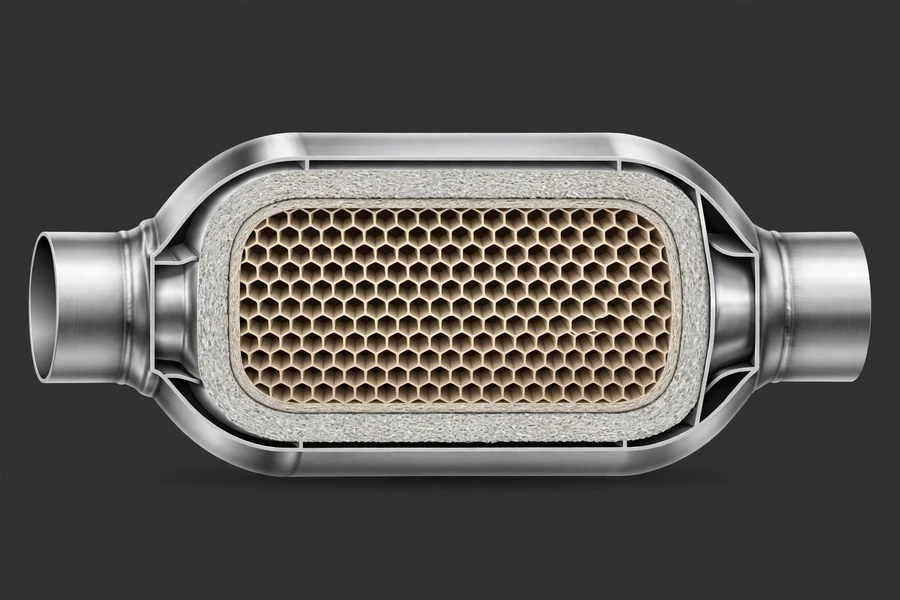
Above is the business end: a ceramic honeycomb monolith — thousands of tiny channels — coated with the precious-metal washcoat. Contamination seals the channel walls, melting collapses the channels, cracking shatters the brick. Every failure mode ends the same way: exhaust stops meeting active catalyst, the downstream O2 signal mirrors the upstream one, and the monitor sets P0420 or P0430.
Dead cat or something cheaper? Use the checker
Pick your fault code or main symptom. The checker separates true catalyst failures from the codes and symptoms that point at sensors, misfires, leaks, or fueling — and tells you what to test next instead of guessing.
Cat failure or something else? — pick a code or a symptom.
Your result will appear here.
Diagnosing P0420/P0430 the right way
A proper P0420 diagnosis has an order, and the order matters because each step is cheaper than the next part you might buy. Work top to bottom; stop and fix whatever you find. You need a BMW-capable OBD2 scanner with live data — a basic code reader cannot do tests two and three.
1. Read every code, not just the cat code
Pull all stored, pending, and permanent codes before clearing anything. P0420 with misfire codes is a misfire problem in disguise. With P0171/P0174, suspect unmetered air — intake leaks, a failed crankcase vent valve. With P0172/P0175, suspect fueling. With O2 heater or signal codes on the same bank, the referee is compromised — test the sensor circuit first. A lone P0420 with healthy fuel trims is the cleanest case for genuine converter degradation, but it still needs the waveform test.
2. The O2 waveform comparison — the decisive test
With the engine fully warm and idling, graph the upstream (sensor 1) and downstream (sensor 2) voltages for the affected bank. The upstream signal should switch rapidly between roughly 0.1 and 0.9 volts — normal fuel-trim cycling. Behind a healthy converter the downstream trace goes nearly flat in the mid-range, because the washcoat buffers the swings. Behind a dead converter it switches in sync with the upstream — the buffering is gone, and you are looking at raw exhaust on both sides. Hold 2,500 RPM for a steadier picture, and on a six-cylinder compare banks: the good bank is your reference trace. One honest limit: cheap scanners graph slowly or not at all. If yours cannot graph, use the temperature test below — or consider that a better scan tool pays for itself the first time it stops you buying a part you did not need.
3. The infrared temperature test — the quick screening
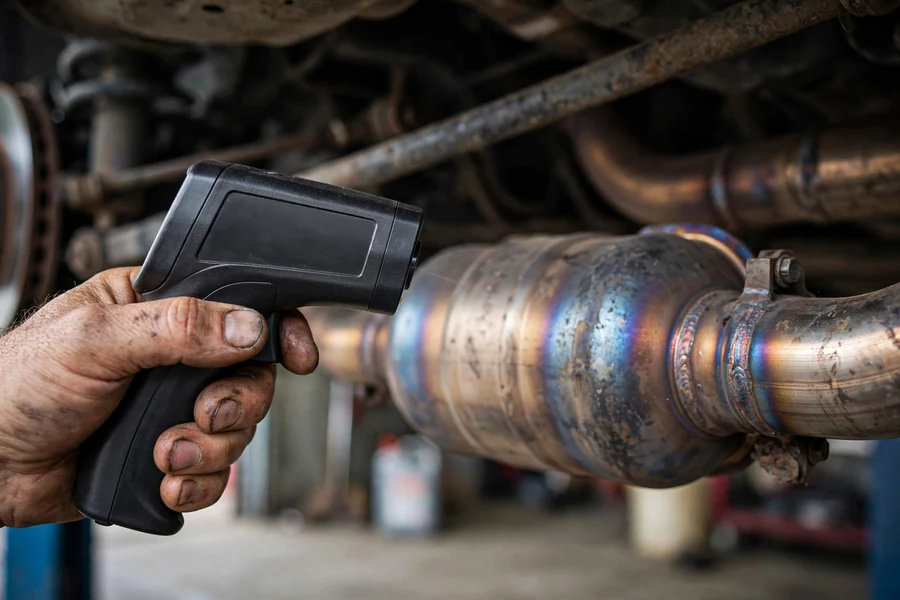
A working converter is exothermic — its chemistry generates heat. With the engine fully warm, aim an infrared thermometer at the inlet pipe just before the converter and the outlet pipe just after it. A healthy cat’s outlet reads noticeably hotter than its inlet — typically on the order of 50–100°F hotter — because the conversion reactions release energy. Outlet the same or cooler than inlet means no chemistry is happening. Treat this as screening, not verdict: heat shields and aim add noise, and a partly degraded cat can still show a small rise. But a flat reading alongside P0420 is strong corroboration, and it takes two minutes with a $25 tool.
4. Backpressure and vacuum — testing for a clogged cat
Power loss means testing for restriction, not efficiency. Thread a backpressure gauge into the upstream O2 sensor bung: typical service guidance treats under about 1.5 psi at idle and under about 3 psi at 2,500 RPM as normal, with readings well above that indicating a restricted exhaust. The shade-tree alternative is a vacuum gauge on the intake manifold — steady vacuum at idle that drops sharply and stays low under load suggests the engine cannot exhale. A restricted converter is the one failure mode where continued driving risks real engine damage from heat and backpressure.
5. The physical inspection
With the car safely lifted, look before you conclude. Check manifold gaskets and flanges ahead of the downstream sensor for leaks — even small ones dilute the exhaust with outside air and skew the efficiency monitor. Look for impact damage, heat discoloration (blued steel), and loose heat shields. Tap the housing gently with a rubber mallet: a healthy brick is silent, loose substrate rattles. Check the downstream O2 sensor’s wiring for melting or chafing near hot exhaust parts. If the evidence still conflicts after all five steps, an hour of specialist diagnostic labor is cheaper than a converter you did not need.
Repair options and honest cost bands
Once the converter is confirmed dead, three decisions remain: OEM or aftermarket, which emissions standard the part must meet, and who does the labor. Get the standard wrong and the car can pass the OBD-II monitor yet fail a visual inspection — so it comes first.
Emissions legality: federal vs CARB, stated plainly
Replacement converters come in two regulatory flavors. Federal/EPA-compliant direct-fit converters are legal in most states. CARB-compliant converters carry a California Air Resources Board executive order (EO) number stamped on the housing and are required in California and the states that adopted its standards — a federal-only converter fails the visual inspection there even with no codes stored. The EPA has allowed CARB-approved aftermarket converters to be sold and installed in federal-emissions areas, so a CARB-stamped unit is the safe universal choice if you are unsure or might move states; the reverse is not true. Buy for the state on the registration, and verify the EO number is stamped on the part before it goes on the car.
Two legal facts worth knowing without preaching: federal rules prohibit shops from replacing a converter unless a legitimate need is established (a failed efficiency monitor qualifies), and defeating emissions equipment — “test pipes,” O2 sensor spacers used to fake the monitor, hollowed-out converters — violates the Clean Air Act regardless of whether your state currently tests. The spacer trick deserves naming because forums recommend it constantly: it does not fix anything, it only blinds the monitor, while the underlying rich-running or contamination problem keeps damaging the engine. The honest version: if the cat is dead, replace it with a compliant part.
Check the federal emissions warranty before you pay anything
Federal law requires the catalytic converter — a “specified major emission control component” — to be covered for 8 years or 80,000 miles, whichever comes first. The warranty follows the car, not the owner, so a used 3 Series under those limits qualifies. Check the warranty booklet or call a dealer with the VIN before authorizing any paid repair. Owners miss this constantly and pay four figures for a repair the manufacturer owed them; California-registered cars get additional state-level coverage on top.
OEM vs aftermarket: the real trade-offs
| Option | Typical part cost (per bank) | Honest assessment |
|---|---|---|
| BMW OEM converter assembly | $1,200–$2,500+ | Exact fit, factory durability. On many BMW sixes the primary cats are integrated into the exhaust manifolds/downpipes, which is why the assembly costs what it does. |
| Direct-fit aftermarket (EPA or CARB) | $300–$800 | Bolts in like stock; quality varies by maker. Established brands’ direct-fit units are the value sweet spot for most owners. |
| Universal weld-in converter | $100–$300 + fabrication | Cheapest part, but needs cutting and welding and some fail to keep BMW’s monitor happy. False economy unless the exhaust is already custom. |
Those are owner- and specialist-reported parts bands, not quotes — BMW’s integrated manifold-cat assemblies and rusted exhaust fasteners move real invoices around. Labor is the other half: figure 2–4 hours at an independent BMW specialist for a bolt-in replacement, more if manifold studs snap or the failed unit is a close-coupled manifold cat rather than an underfloor secondary — very different jobs, so get the quote itemized per bank. All-in, independent shops commonly land $900–$2,000 for a quality aftermarket direct-fit job and $2,000–$3,500+ for OEM, per bank. On quality tiers, the honest answer is tiered: the cheapest universal cans have the thinnest washcoat loading and the shortest reported service life, while mid-tier direct-fit units from established exhaust brands carry real converter warranties (typically 5 years/50,000 miles) and keep BMW monitors satisfied when the engine is healthy. What kills aftermarket converters early is almost never the brand — it is the same root causes that killed the original.
DIY difficulty: honest assessment
This is a moderate-to-hard DIY depending on which converter failed. An underfloor secondary cat on a lift with clean fasteners is a straightforward unbolt-and-swap afternoon. A close-coupled manifold cat on a 150,000-mile car is a different animal: rust-welded studs, tight working room around the subframe, O2 sensors seized in their bungs — snap a manifold stud and Saturday becomes a tow-truck Monday. If the fasteners look like rust sculptures, a specialist’s labor is the cheaper risk. After any repair, the catalyst monitor needs a proper warm-up drive to run and set “ready,” which an emissions retest requires.
Can you drive with P0420?
It depends on the failure mode. A chemically degraded converter with no other symptoms — the classic lone P0420, car drives fine — is not an emergency. The car runs normally; the costs of waiting are a guaranteed emissions-test failure and the chance that an unfixed root cause keeps degrading things. Many owners drive for months while they diagnose properly and budget the repair.
A mechanically failed converter is a different story. Rattling substrate can lodge sideways and suddenly choke the exhaust — drive gently and fix it soon. Power loss that worsens with RPM means restriction is already happening: backpressure climbs and trapped heat cooks valves, gaskets, and turbochargers. If the car struggles to rev, loses power on hills, or the exhaust note goes flat and quiet, stop driving and diagnose the restriction. That is not a next-month condition.
Fix the root cause or the new cat dies too
A new converter inherits the exact exhaust stream that killed the old one. Before it goes on, verify the following are healthy — not “probably fine,” verified:
- No misfires, current or pending. Worn ignition coils and overdue spark plugs are the number-one converter killers on these cars — cheap insurance next to a converter.
- Fuel trims near zero. Persistent rich trim means unburned fuel is still reaching the new cat. Find the cause — leaking injector, pressure regulation, skewed upstream sensor — and confirm trims settle first.
- Oil consumption addressed. A burning engine ashes the new washcoat from mile one. Our oil consumption guide covers how much is too much on each engine family.
- No coolant loss. Silicate glazing from coolant is permanent and quick. Unexplained coolant loss with white exhaust smoke means settling the head gasket question first.
- No exhaust leaks ahead of the downstream sensor. Fix manifold and flange leaks so the new converter’s monitor reads accurately — otherwise a brand-new cat can throw a false efficiency code.
Ask the shop directly: “What killed the old cat, and what are we fixing so it doesn’t happen again?” If the answer is a shrug, get a second opinion before authorizing the work. And one myth to retire: catalytic converter cleaner additives. No pour-in product restores sintered precious metals, un-melts a substrate, or removes baked-on ash — the chemistry of a dead converter is not reversible from a bottle. At best they do nothing; at worst they delay the real repair while the root cause keeps working.
BMW catalytic converter failure FAQ
Does P0420 always mean the catalytic converter is bad?
No — P0420 means the efficiency monitor failed, not that the converter is confirmed dead. Exhaust leaks ahead of the downstream sensor, a lazy upstream O2 sensor, misfires, and rich or lean fueling can all set it with a sound converter. Confirm with the waveform comparison: a downstream signal mirroring the upstream switching means the converter’s oxygen buffering is genuinely gone; a flat downstream trace means looking at sensors, leaks, and fueling first.
How long does a BMW 3 Series catalytic converter last?
On a well-maintained engine with no misfires, oil burning, or coolant loss, owners commonly report original converters lasting well past 150,000 miles — they are designed for vehicle lifetime. Premature failure almost always has a cause: chronic misfires, oil consumption, coolant intrusion, or rich running. If yours died young, the mileage is a clue the root cause is still active and will kill the replacement too.
Should I replace the O2 sensors with the catalytic converter?
Replace sensors that test bad, not ones that are merely nearby. If the downstream sensor is original with 150,000+ miles, many specialists recommend doing it with the converter since its response feeds the efficiency monitor and the labor overlaps — but that is preventive logic, not a requirement. A new sensor will not fix a dead converter, and a new converter will not fix a code caused by a skewed sensor. Test each part on its own evidence; our oxygen sensor guide has the full procedure.
Will an aftermarket catalytic converter keep the check engine light off?
A quality direct-fit converter — EPA-compliant for federal states, CARB EO-stamped for CARB states — keeps BMW’s catalyst monitor satisfied if the engine is healthy. Reported failures trace to three things: universal weld-in cans with marginal washcoat, the wrong emissions flavor for the registration state, or an unresolved root cause killing the new converter the way it killed the old one. Correct flavor, established manufacturer, healthy engine — the monitor stays happy.
Is the catalytic converter covered under warranty on a used BMW?
Quite possibly: federal law mandates 8 years/80,000 miles of catalytic converter coverage and the warranty follows the car, so a used 3 Series under those limits qualifies. Check the warranty booklet or call a dealer with the VIN before paying — owners regularly miss this and pay out of pocket for a manufacturer-covered part. Accident damage and tampering are excluded; a converter that simply lost efficiency through normal use is exactly what the warranty exists for.