How to Calibrate Your BMW’s Steering Angle Sensor
BMW steering angle sensor calibration teaches the DSC (Dynamic Stability Control) module where “straight ahead” is. The sensor stores its zero position in memory that is kept alive by the battery, so anything that interrupts power or moves the steering geometry — a wheel alignment, battery replacement, suspension or steering work, or a sensor swap — can leave the DSC working from a wrong zero point. The fix is a calibration: either the no-tools lock-to-lock relearn (turn the wheel full lock right, full lock left, back to center with the ignition on) or a scan-tool service function that saves the centered position as zero. DIY is free and takes about 15 minutes; a shop charges roughly $75–$150 at an independent BMW specialist and $100–$250 at a dealer (owner/community-reported bands). If warning lights are the problem rather than the calibration itself, see our guide to the BMW “Chassis Stabilization” warning, decoded — this article is the calibration procedure, not the warning diagnosis.
What the steering angle sensor actually does
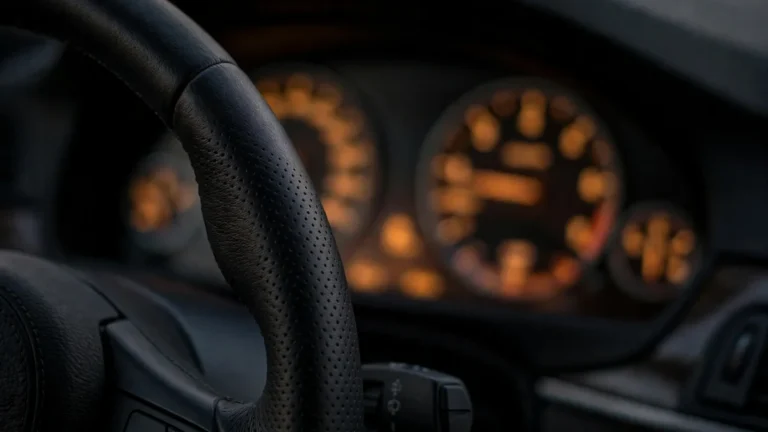
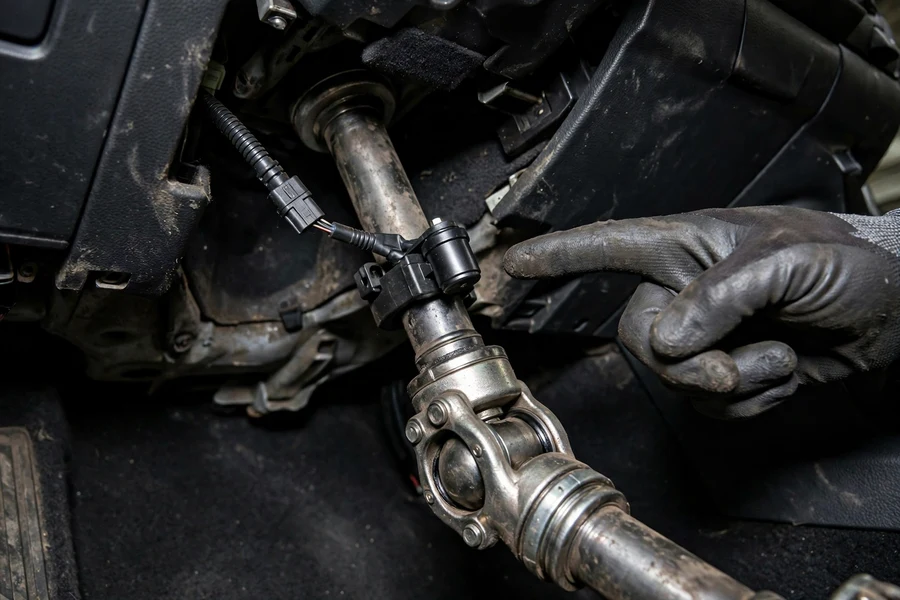
The steering angle sensor — BMW calls it the LWS, Lenkwinkelsensor — is mounted low on the steering column, ahead of the flexible coupling. On E46-era cars it is a standalone module on the column; on E90-era cars and later it is integrated into the SZL (steering column switch cluster), the same unit that houses the turn-signal and wiper stalks. It measures how far and how fast the steering wheel turns and broadcasts that over the CAN bus to the DSC module.
The DSC module uses the steering angle as the “driver intent” input. It compares it against three independent reality checks: the four wheel-speed sensors, the yaw-rate sensor, and the lateral-acceleration sensor. When those inputs agree, the DSC knows the car is doing what the driver asked; when they disagree, it intervenes with selective braking and engine torque reduction to keep the car stable. That cross-check is the whole reason calibration matters. If the sensor’s stored zero point is wrong — say it thinks straight-ahead is 6 degrees left — the DSC sees a permanent mismatch between the wheel position and where the car is actually going. Depending on the magnitude, the module either throws a plausibility fault code and disables itself (lighting the DSC/ABS warning), or worse, works from subtly wrong data.
Here is the detail that catches people out: the sensor’s zero position is stored in memory that needs continuous battery power. Disconnect the battery — or let it die — and the stored initial position is cleared. The DSC then has to re-learn where center is, either from the next lock-to-lock initialization or from a scan-tool calibration. This is documented BMW DSC behavior, and it is why “my DSC light came on after a battery swap” is one of the most common steering-angle complaints on every 3 Series generation.
Two more design facts are worth knowing before you calibrate. First, calibration only sets the zero reference — it cannot fix a bad alignment. If the steering wheel sits off-center when the car tracks straight, no amount of recalibrating will center it; the tie rods have to be adjusted first (see our BMW wheel alignment and tire-wear guide). Second, when a new sensor is installed, the DSC service documentation describes it as mating the sensor to the module: the calibration routine generates a new identification number and the module and sensor are paired from that point on. Replacement without coding and calibration leaves an identification mismatch and the diagnosis system will refuse to proceed.
When calibration is needed (and which method to use)
Calibration is a “re-teach zero” operation. It is required whenever the relationship between the steering wheel and the front wheels changes, or whenever the stored zero is wiped. The table below covers every common trigger and the right method for it.
| What happened | Why calibration is needed | Recommended method |
|---|---|---|
| Wheel alignment (any kind) | Toe adjustments change the steering-wheel position at which the car tracks straight; the old zero no longer matches reality. BMW alignment instructions call for sensor adjustment after the alignment. | Lock-to-lock first; scan-tool service function if the DSC light persists |
| Battery disconnected or replaced | The stored zero position lives in battery-backed memory; power interruption clears it. | Lock-to-lock relearn |
| Suspension or steering work (control arms, bushings, tie rods, struts, wheel bearings) | Anything that changes steering geometry or requires the alignment to be reset shifts the zero point. | Lock-to-lock after a verified alignment; scan tool for persistent faults |
| Steering angle sensor replaced | The new sensor must be coded to the car and then calibrated so the DSC module pairs with it. | Scan-tool service function (ISTA or equivalent) — coding first, calibration second |
| Clock spring / SZL work | On E90 and later cars the sensor lives in the SZL; disturbing it loses the stored position. | Scan-tool service function |
| DSC/ABS warning lights with no recent work | Possible miscalibration, plausibility fault, or a failing sensor — diagnosis comes before calibration. | Read DSC fault codes first; calibrate only if the data supports it |
| New tires of a different size or uneven tire wear | Changed rolling diameter skews the wheel-speed inputs the DSC cross-checks against the steering angle. | Fix the tire issue first; lock-to-lock relearn as a follow-up |
One nuance worth flagging: on F30 and G20 cars the DSC software is more forgiving than on E46/E90 cars. Several owners report the system re-learning the zero point on its own after a few miles of straight driving following an alignment or battery swap, with no warning lights ever appearing. The older generations are less tolerant — they tend to light the DSC warning and hold a fault code until you calibrate. The decision tree further down accounts for this generation gap.
Symptoms of a miscalibrated steering angle sensor
A miscalibrated sensor and a failing sensor look similar from the driver’s seat — both light the DSC/ABS warning — but they diverge in the scan data, which is why diagnosis matters before you throw calibration at the problem. Keep this article’s scope in mind: it covers calibration only. For decoding what each stability warning actually means, the deep dive is our “Chassis Stabilization” warning guide, and for the ABS/DSC warning cluster generally, see BMW ABS and DSC warning lights.
| Symptom | More likely calibration… | More likely failing sensor… |
|---|---|---|
| DSC warning light after alignment, battery swap, or suspension work | ✓ — classic trigger events | — |
| Warning appears immediately at startup, every time | ✓ — zero point is lost | Possible — persistent internal fault |
| Warning comes and goes; light off on some starts | Borderline — plausibility fault at a threshold | ✓ — intermittent electrical faults behave this way |
| Live data: sensor reads 0° with wheel centered, ±symmetric at locks | — (already calibrated) | — (sensor is fine; look elsewhere) |
| Live data: reads a large offset at center, or jumps erratically | ✓ if offset is steady — needs recalibration | ✓ if erratic — sensor readings jumping around indicate hardware failure |
| Steering wheel off-center when car tracks straight | Alignment issue first — calibration cannot fix this | — |
Three DSC-module fault codes are the usual signatures, and they are worth quoting because owners encounter them constantly in forum and shop diagnoses: 5E40 (steering angle sensor consistency — the module’s plausibility check failed), 5EBE (steering angle sensor implausible), and 5EF4 (steering angle sensor, fault, internal). A 5E40 or 5EBE after recent work is a calibration candidate; a persistent 5EF4 after successful calibration points at hardware. Note that generic OBD-II readers often cannot see DSC-module codes at all — you need a BMW-capable scanner, covered in our best OBD2 scanners for BMW guide.
Interactive: which calibration method does your car need?
Answer three questions — your chassis, what triggered this, and what tools you have — and the tool builds your exact calibration plan: method, difficulty, time, and cost band. Every branch is grounded in the procedures in this article.
Calibration method picker
Interactive: steering angle calibration true-or-false quiz
Five statements, five chances to avoid the mistakes that waste owners the most time. Pick true or false for each and get instant feedback.
Calibration quiz — true or false?
Method 1: the lock-to-lock relearn (no tools needed)
This is the initialization procedure documented in BMW DSC service material and widely confirmed by owners: turning the wheel from lock to lock teaches the sensor its full travel and re-establishes the center position. It is the right first move after a battery disconnect or a fresh alignment, and it costs nothing.
| Step | What to do | Why it matters |
|---|---|---|
| 1 | Park on level ground with the front wheels pointing straight ahead. Check tire pressures and confirm the steering wheel is installed straight. | Calibration sets zero from the current geometry — garbage in, garbage out. |
| 2 | Start the engine (or switch the ignition on). Confirm the DSC warning light is on — this is the state that needs initializing. | The light confirms the module is in the uninitialized state this procedure resolves. |
| 3 | Turn the steering wheel to full lock right. Hold it there for about 2 seconds. | The sensor registers the end of its travel on one side. |
| 4 | Turn the steering wheel to full lock left. Hold it there for about 2 seconds. | The sensor registers the opposite end of travel. |
| 5 | Return the wheel to the centered position. Watch the DSC OFF/warning light — it should go out. | The light extinguishing is the module’s confirmation that initialization succeeded. |
| 6 | Switch the ignition off, then restart the car. Confirm the DSC indicator stays off. | Confirms the learned zero survived a power cycle. |
| 7 | Drive normally for about 10 minutes and re-check that no DSC/ABS lights are on. | Confirms the calibration holds under real driving and the plausibility check passes. |
If the light does not go out at step 5, switch off, wait a moment, and repeat the sequence once more from step 2 — some modules need a second pass. If two clean attempts fail, stop guessing: you need the DSC fault codes read. A generic code reader that only talks to the engine module will not see them; a BMW-capable scanner will, and the live steering-angle data will show whether the sensor is holding a steady offset (calibration problem) or jumping erratically (hardware problem). On E90 cars with active steering, note the community-documented caution that a raw sensor reset without proper initialization can leave active steering disabled — use the scan-tool service function instead of shortcuts.
Method 2: scan-tool service function (the precise route)
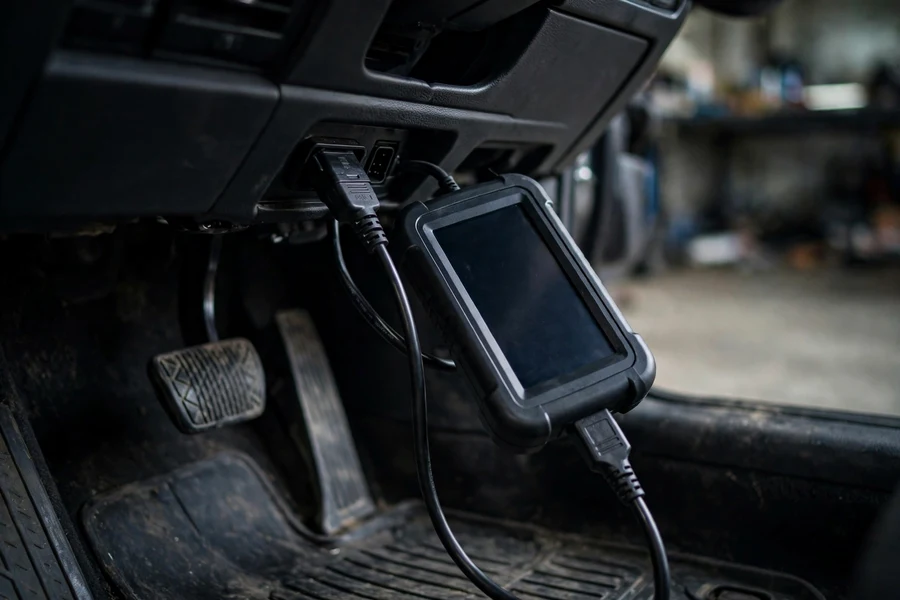
The scan-tool route runs BMW’s own service function — called “steering angle sensor calibration,” “steering angle learning,” or “initialization” depending on the tool — which saves the centered steering position as the zero reference and, on a new sensor, pairs it with the DSC module. This is the method BMW specifies after steering or suspension repairs, and it is mandatory after a sensor replacement. Community-documented implementations include ISTA’s DSC service function and, on older cars, the INPA/Tool32 workflow (loading the DSC group file and running the steering-angle matching job — documented by owners as taking only seconds once the software is set up).
| Step | What to do | Detail |
|---|---|---|
| 1 | Verify the alignment and geometry first. | Centered steering wheel with the car tracking straight; correct tire pressures; matched tire sizes. Calibration follows geometry, never precedes it. |
| 2 | Center the steering wheel with the front wheels straight ahead. | The routine saves the current position as zero — park straight, wheels straight. |
| 3 | Connect the scan tool to the OBD-II port and open the DSC/ABS module. | You need a tool that reads chassis-module codes, not just engine codes. |
| 4 | Read and record the DSC fault codes before touching anything. | 5E40/5EBE suggest calibration; 5EF4 (internal fault) suggests hardware. Record them for your records. |
| 5 | Run the steering-angle calibration / learning service function and follow the prompts. | Typical prompt flow: confirm the wheel is centered → start → wait for the success confirmation. |
| 6 | Clear the DSC fault codes. | The memory fault usually clears automatically on success, but clear manually to be certain. |
| 7 | Verify live data: steering angle should read approximately 0° with the wheel centered and swing symmetrically both ways. | This is your proof the calibration took — do not skip it. |
| 8 | Road-test and re-scan. | Confirm no codes return and the DSC light stays off under normal driving. |
After a sensor replacement, add the coding step before step 5: the new sensor must be coded to the vehicle (VIN-matched) so the DSC module accepts it. On E90-era cars this is commonly done with NCS Expert or Tool32 against the SZL/LWS module; ISTA folds coding and calibration into one workflow on supported cars. Skipping coding and going straight to calibration is the most common reason a new sensor still shows a fault — the diagnosis system reports an identification mismatch and refuses to proceed until the sensor is coded.
Difficulty and cost: all four routes compared
Honest difficulty ratings first — this job ranges from trivial to shop-only depending on the trigger:
| Route | Difficulty | Time | Typical cost |
|---|---|---|---|
| DIY lock-to-lock relearn | 1/5 — anyone | 15 minutes | $0 |
| DIY scan-tool calibration | 2/5 — easy if you own the tool | 30–45 minutes | $0 (tool $150–$400 to buy) |
| Independent BMW specialist | N/A — they do it | 30–60 minutes in the shop | $75–$150 (owner/community-reported) |
| BMW dealer | N/A — they do it | About 1 hour billed | $100–$250 (owner/community-reported) |
| Sensor replacement + coding + calibration (E90 SZL unit) | 4/5 DIY / shop job | 1–3 hours | $500+ at a dealer; sensor alone ~$250–$600 (owner/community-reported) |
Calibration cost comparison (USD)
Midpoints of owner/community-reported bands. Bars show typical cost per route — not quotes.
The takeaway is blunt: the calibration itself is almost never expensive. What costs money is a replacement — on the E90 the sensor is part of the SZL/clock-spring assembly, which owners report as a roughly $600 part before coding and calibration labor, pushing dealer totals past $500–$1,000 in many reported cases. That is why the diagnosis step matters so much: paying for a sensor you did not need is the expensive mistake, while the calibration you did need is the cheap one. And because BMW-capable scan tools have become affordable, buying one (see our BMW scan tool guide) pays for itself the first time a DSC light appears.
Common mistakes that waste time and money
- Calibrating before the alignment is right. If the steering wheel is off-center when the car tracks straight, fix the tie rods first (tie rod replacement or a proper alignment). Calibration stores zero from current geometry — it cannot straighten a crooked wheel.
- Calibrating a new sensor without coding it. Replacement sensors need coding/VIN-matching before the calibration routine, or the DSC module rejects them with an identification mismatch.
- Using a generic OBD-II reader for diagnosis. Engine-code readers usually cannot see DSC-module codes (5E40, 5EBE, 5EF4). You will conclude “no codes” while the DSC module is full of them.
- Ignoring the basics. Uneven tire pressures, mismatched tire sizes, and a weak battery all produce steering-angle plausibility faults. Check tire pressures (TPMS reset guide), match your tires, and rule out a dying battery (battery keeps dying guide) before touching calibration.
- Replacing the sensor when only calibration was needed. A steady offset in live data after alignment or battery work is a calibration job, not a parts job. Erratic, jumping readings are the hardware signal.
- Shortcuts on active-steering cars. On E60/E90-era cars with active steering, owner-documented experience warns that a raw sensor reset without proper initialization can disable active steering and stack DSC faults — use the full service function.

When calibration keeps failing
If you have done everything above — geometry verified, lock-to-lock attempted, scan-tool service function run — and the DSC fault returns, the sensor itself is now the prime suspect. The distinguishing test is live data: a sensor that reads a steady but wrong offset at center is a calibration problem, while a sensor whose reading jumps erratically as you turn the wheel, drops out, or flatlines is a hardware problem. Owners who have chased this report that the analog readings “jumping all around” during a slow lock-to-lock sweep is the classic dying-sensor signature, whereas a clean, smooth sweep that simply does not sit at zero is the classic lost-zero signature.
Before ordering parts, rule out the two impostors. First, the clock spring and SZL wiring on E90-era cars: the sensor shares its housing with the column switch cluster, and disturbed connectors or a failing clock spring produce faults that look exactly like a bad sensor. Second, low system voltage: a weak battery or poor connections cause intermittent DSC faults that vanish with a healthy battery and return when voltage sags, mimicking an erratic sensor. Both are cheaper than the sensor and both are confirmed by pattern — wiring faults tend to be position-dependent (fault appears at a certain steering angle), voltage faults tend to be startup-dependent (fault appears on cold starts and clears after driving).
If the evidence does point at the sensor, the replacement path is: new sensor coded to the car, then the calibration service function, then verification. On the E46 the sensor is a separate module on the column; on the E90 it comes as part of the SZL assembly, which is why the part cost is higher and why coding is unavoidable. Budget for the shop route if you lack coding tools — this is the one steering-angle job that genuinely needs equipment, and the owner-reported dealer totals reflect that. And if your reading has led you back to warning-light territory rather than procedure territory, the “Chassis Stabilization” warning guide is where the diagnostic side of this story lives.
Frequently asked questions
Can I calibrate the steering angle sensor just by driving?
Sometimes, on newer cars. F30 and G20 3 Series models often re-learn the zero point on their own after a few miles of straight driving following an alignment or battery swap — if the DSC light clears by itself, the job is done. E46 and E90 cars are much less forgiving and usually need the lock-to-lock relearn or a scan-tool service function. If the warning is still on after a normal drive, drive-learning is not going to save you; calibrate explicitly.
Will disconnecting the battery calibrate the sensor?
No — it does the opposite. The sensor’s stored zero position lives in battery-backed memory, so disconnecting the battery wipes it and creates the need for calibration. This is why a DSC warning after a battery swap is expected behavior, not a new fault. Do the lock-to-lock relearn after reconnecting, and remember that a fresh battery should also be registered to the car (see our BMW 3 Series battery replacement guide).
How do I know the calibration actually worked?
Three checks, in order: the DSC warning light stays off after a restart, the live steering-angle data reads approximately 0° with the wheel centered and swings symmetrically at both locks, and a ~10-minute test drive produces no returning warning or fault codes. The live-data check is the proof — a light that simply went out without verification can come back. If you do not have a scan tool for live data, the light-plus-test-drive combination is the practical alternative.
Do I need calibration after replacing the battery?
Very often, yes. The power interruption clears the stored zero position, so a DSC warning after a battery replacement is one of the most common steering-angle complaints across all 3 Series generations. The fix is the free lock-to-lock relearn: full lock right, full lock left, back to center, then a short drive to confirm. If the light persists, have the DSC codes read before assuming the worst.
I replaced the sensor — why is the DSC light still on?
Almost certainly because the new sensor was not coded to the car before calibration. The DSC module pairs with the sensor via an identification number generated during the service function, and it refuses an uncoded sensor with an identification mismatch. The order is fixed: code the sensor to the vehicle first (on E90 cars this is commonly done against the SZL module), then run the steering-angle calibration service function, then clear codes and verify live data. Calibration without coding cannot succeed.